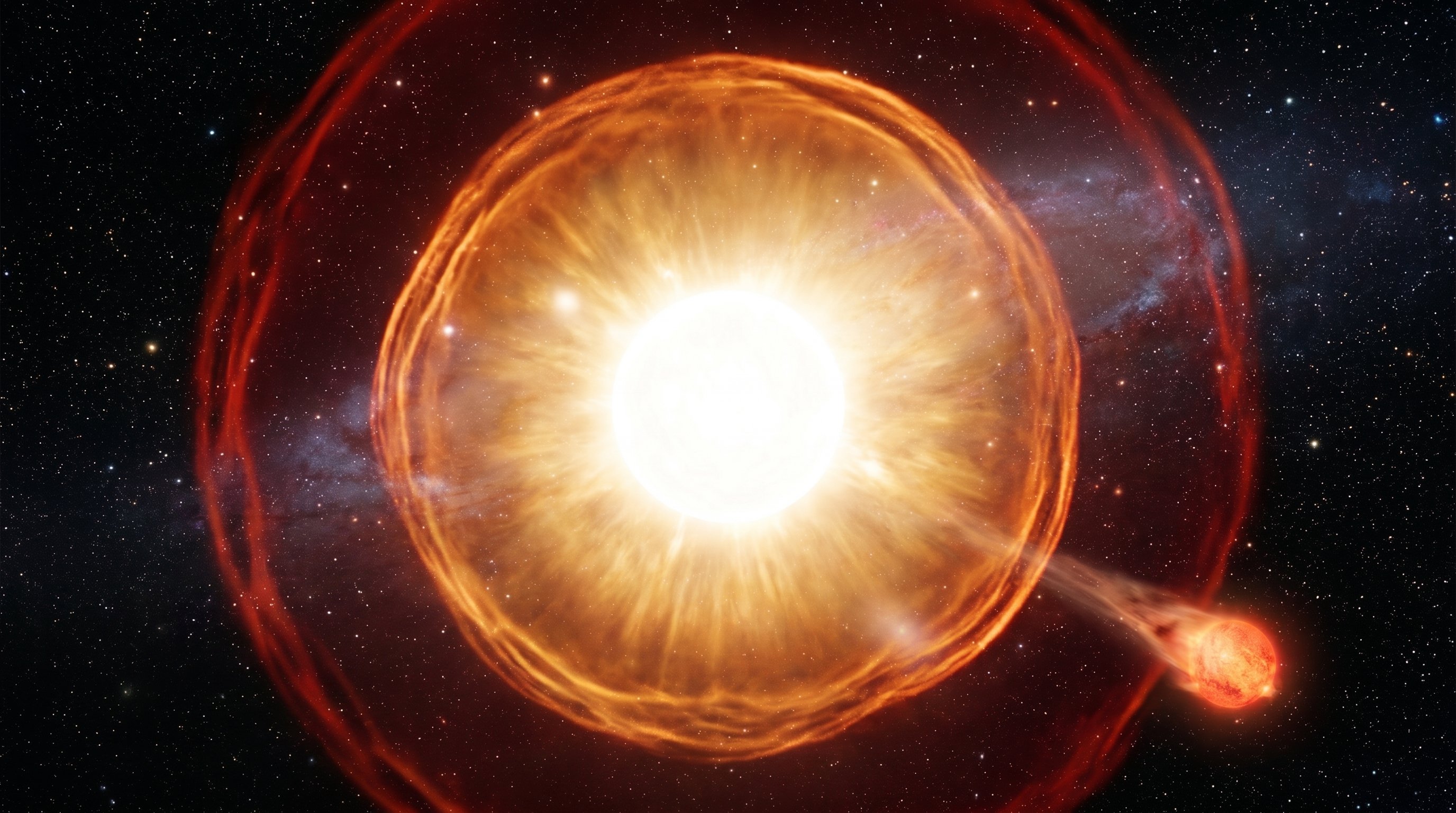
Why White Dwarfs Are Not Actually Dead
The Sun has been burning for four and a half billion years. It will burn for roughly five billion more. When it finally exhausts its fuel, expands into a red giant, and sheds its outer layers into space, what remains will be a white dwarf: a sphere roughly the size of Earth, containing most of the Sun's current mass, producing no energy through fusion, and sitting quietly in the dark. Most descriptions stop there. They call it a dead star and move on. That description is wrong in almost every way that matters.
What a White Dwarf Actually Is
A white dwarf is the exposed core of a former star. When a Sun-like star exhausts its hydrogen, the core contracts while the outer layers expand into a red giant. The helium in the core eventually ignites in a process called the helium flash, fusing into carbon and oxygen. For most stars, the fusion stops there. The star lacks the mass to push further into heavier element synthesis. The outer layers are eventually shed as a planetary nebula, leaving the carbon-oxygen core exposed. That core is the white dwarf.
The numbers involved resist easy intuition. A typical white dwarf contains roughly the mass of the Sun compressed into a sphere with the radius of Earth. The resulting density is approximately one million times the density of water. A teaspoon of the material would weigh between five and fifteen tonnes on Earth depending on which white dwarf you sampled. [1] Surface gravity runs at approximately 350,000 times Earth's. A 70-kilogram person standing on the surface would weigh roughly 7,000 tonnes.
No fusion is occurring. No new energy is being generated. The white dwarf radiates stored thermal energy from its formation into space, cooling over billions of years with no mechanism to replenish what is lost. By any conventional definition, this is a dead object. The conventional definition is inadequate.
The Quantum Wall Holding It Together
What keeps a white dwarf from collapsing under its own gravity is not heat and not fusion. It is a quantum mechanical rule called the Pauli exclusion principle: no two electrons can occupy the same quantum state simultaneously. Pack matter tightly enough and the electrons run out of available states. Further compression is not merely resisted -- it is forbidden by the structure of quantum mechanics itself.
The pressure this generates is called electron degeneracy pressure. Its defining property is that it has nothing to do with temperature. The degeneracy pressure of a white dwarf exists at any temperature, including absolute zero. This makes white dwarfs structurally unlike anything in ordinary experience: the force holding the star together is not a thermodynamic property but a quantum one, baked into the identity of electrons rather than their energy.
The equation governing this pressure in the non-relativistic regime is:
$$P_{\text{deg}} = K \cdot \rho^{5/3}$$where $P_{\text{deg}}$ is the degeneracy pressure, $\rho$ is the density, and $K$ is a constant depending on the electron mass and composition. The pressure scales with density to the 5/3 power, which is a steeper relationship than thermal pressure in most contexts and is what allows a star's worth of mass to be supported by quantum mechanics alone.
At relativistic electron velocities -- which occur in the most massive white dwarfs -- the exponent changes:
$$P_{\text{deg, rel}} = K_r \cdot \rho^{4/3}$$This softer scaling is what produces the Chandrasekhar limit. When electrons are moving near the speed of light, degeneracy pressure can no longer keep pace with gravitational demand as mass increases. The wall still exists. It is simply no longer strong enough.
The Chandrasekhar Limit: A Hard Ceiling the Universe Enforces
In 1930, a nineteen-year-old named Subrahmanyan Chandrasekhar worked out during a ship voyage from India to England that relativistic electron degeneracy pressure has a maximum mass it can support. Above approximately 1.4 solar masses, no stable white dwarf solution exists. The predicted radius shrinks to zero and density to infinity -- which is the mathematics communicating that the physical description has broken down and something else must happen instead.
The critical mass is given by:
$$M_{\text{Ch}} \approx \frac{5.87}{\mu_e^2} \, M_{\odot}$$where $\mu_e$ is the mean molecular weight per electron. For a carbon-oxygen white dwarf, $\mu_e = 2$, giving $M_{\text{Ch}} \approx 1.44 \, M_{\odot}$. This number is a universal constant of stellar physics. Every white dwarf everywhere in the universe is subject to it. [2]
Arthur Eddington publicly dismissed Chandrasekhar's result at a 1935 meeting of the Royal Astronomical Society, calling it a reductio ad absurdum. He was wrong. Chandrasekhar received the Nobel Prize in Physics in 1983. The limit is real, and the universe enforces it without exception.
A white dwarf approaching 1.4 solar masses becomes physically smaller as its mass increases, a direct consequence of the inverse mass-radius relationship: more mass means stronger gravity, stronger gravity compresses the degenerate electron gas further, and the star shrinks rather than expands. At the limit, the radius the equations predict is zero. In practice, something intervenes before that point.
Binary Systems and the Accretion Trap
An isolated white dwarf is genuinely passive. The danger appears when it has a companion star. A significant fraction of stars form in binary systems, and when the more massive star completes its evolution and becomes a white dwarf, the companion often continues its stellar life for billions of years afterward. As the companion ages and expands into a red giant, it may fill its Roche lobe: the gravitational boundary within which material is bound to the companion rather than to the white dwarf. When the companion overfills this boundary, material flows across it.
The transferred material, carrying angular momentum from the companion's orbit, does not fall directly onto the white dwarf. It spreads into an accretion disk and spirals inward over time, arriving at the white dwarf surface as a steady accumulation of hydrogen. Under surface gravity 350,000 times Earth's, each new layer compresses against the last. The white dwarf has no mechanism to return this mass. Electron degeneracy pressure does not respond to temperature changes, so the star does not expand to relieve the increasing load. It simply accepts the mass, compresses further, and grows incrementally heavier. [3]
This is the accretion trap. Mass arriving from the companion is permanent. It walks the white dwarf, increment by increment, toward 1.4 solar masses.
Nova: The Explosion That Changes Nothing
As hydrogen accumulates on the white dwarf surface, the base of the layer heats under compression. Unlike a normal stellar environment, there is no thermostat. Rising temperature increases the fusion rate, which increases temperature, which increases the fusion rate further. When the base of the hydrogen layer reaches approximately 10 million degrees Celsius, a thermonuclear runaway ignites across the entire surface in seconds.
The explosion ejects material at velocities ranging from several hundred to several thousand kilometers per second and brightens the system by up to 19 magnitudes, a factor of roughly 40 million in apparent brightness. Systems invisible to the naked eye become among the brightest objects in the night sky. This is a nova.
The white dwarf survives intact. The detonating layer was the accreted hydrogen envelope. The white dwarf beneath it was never structurally threatened. The accretion disk, indifferent to what just occurred, resumes feeding the surface immediately. The hydrogen layer begins building again. The countdown restarts.
The total energy released in a nova is approximately:
$$E_{\text{nova}} \approx 10^{45} \text{ ergs} \approx 10^{38} \text{ joules}$$This is more energy than the Sun emits in roughly 10,000 years. The white dwarf absorbs none of it structurally. It is a surface event.
Recurrent Novae and the Long Walk
Some systems cycle through this process on timescales short enough for humans to observe multiple eruptions. T Coronae Borealis, a white dwarf of approximately 1.35 solar masses orbiting a red giant companion, erupts roughly every 80 years. It did so in 1866 and 1946. In 2023, it dimmed in a pattern matching the behavior observed before the 1946 eruption. Astronomers have been monitoring it closely since. [4]
T CrB sits 0.05 solar masses below the Chandrasekhar limit. If each nova cycle deposits a small net gain in mass -- which current evidence suggests is likely for high-mass, high-accretion systems -- the white dwarf may be accumulating toward a threshold from which there is no reset. Not a surface explosion that clears the clock. Something that goes all the way through.
Type Ia Supernovae: The Total Destruction
When carbon ignition occurs not at the surface but at the white dwarf's core, what follows is categorically different from a nova. A deflagration front propagates subsonically from the center outward, heating the carbon and oxygen interior ahead of it. Under the right conditions, this front transitions to a supersonic detonation. The detonation wave consumes the entire star in approximately ten seconds.
The total nuclear energy released is:
$$E_{\text{SN Ia}} \approx 1\text{--}2 \times 10^{44} \text{ joules}$$This equals the total energy output of the Sun across its entire ten-billion-year main sequence lifetime. Released in ten seconds. The expanding ejecta reaches velocities of 10,000 to 20,000 kilometers per second, several percent of the speed of light.
Nothing survives. No neutron star. No black hole. No remnant of any kind. The white dwarf that existed for billions of years is simply gone, replaced by an expanding shell of iron and nickel seeding the interstellar medium with heavy elements that will eventually be incorporated into new stars, new planets, and new living things. [5]
The Double Detonation and Merger Pathways
A companion star is not required. In the double detonation mechanism, a helium shell accreted onto a white dwarf detonates first, driving a shockwave inward that triggers carbon ignition in the core before the total mass reaches the Chandrasekhar limit. In the merger pathway, two white dwarfs in a close binary lose orbital energy to gravitational wave emission and spiral together until one disrupts the other. If their combined mass exceeds 1.4 solar masses, the result is detonation.
In April 2025, a paper in Nature Astronomy announced the discovery of WDJ181058.67+311940.94: a double white dwarf binary 49 parsecs (roughly 160 light-years) from Earth, with a combined mass of 1.555 solar masses and an orbital period of 14.24 hours. Gravitational wave emission is already draining the orbit. The predicted merger time is $22.6 \pm 1.0$ billion years. When it detonates, it will reach an apparent magnitude of approximately $-16$, outshining every star in Earth's sky simultaneously. [6]
It exists right now. Orbiting every 14 hours. 160 light-years away.
How Dead Stars Revealed Dark Energy
Because Type Ia supernovae occur when white dwarfs approach the same mass threshold, their peak brightnesses are similar enough -- after a correction based on light-curve shape called the Phillips relation -- to serve as standardized distance markers across cosmological scales. Comparing the apparent brightness of distant Type Ia supernovae to their standardized intrinsic luminosity measures how far away they are and, by extension, how fast the universe was expanding when their light was emitted.
In 1998, two independent teams using this method found that distant supernovae were systematically fainter than a decelerating universe predicts. The universe was not slowing down under its own gravity. It was accelerating. Something was driving the expansion faster over time, a component of the universe's energy budget with no name and no satisfactory physical explanation.
Dark energy. The dominant component of the universe. Constituting approximately 68 percent of the total energy content of the observable universe. Discovered by measuring the brightness of exploding white dwarfs. The 2011 Nobel Prize in Physics went to Saul Perlmutter, Brian Schmidt, and Adam Riess for the discovery.
White Dwarfs Still Consuming Their Planetary Systems
Between 25 and 50 percent of all observed white dwarfs show heavy elements -- calcium, magnesium, iron, silicon -- in their atmospheres. [7] These elements should not be there. Under surface gravity 350,000 times Earth's, gravitational settling removes heavy elements from the observable atmosphere in timescales ranging from hours, for the hottest white dwarfs, to millions of years for the coolest. Against the multi-billion-year ages of these objects, even millions of years is effectively immediate. Something is actively putting the metals there.
The source is tidally disrupted planetary material. Rocky bodies perturbed into the white dwarf's Roche radius -- approximately one solar radius -- are shredded by tidal forces into debris disks that spiral onto the surface. The elemental ratios in the atmosphere reflect the composition of whatever was destroyed, whether it had a metallic core, silicate mantle, or chondritic bulk composition. Polluted white dwarfs are currently the most direct method available for measuring the bulk elemental composition of exoplanetary bodies.
In October 2025, astronomers confirmed that LSPM J0207+3331, a white dwarf 145 light-years from Earth and approximately three billion years old, is still actively accreting from a debris disk containing 13 distinct chemical elements. The accreted material originated from a differentiated rocky body at least 200 kilometers in diameter. The debris disk around this white dwarf is the oldest and most metal-rich ever observed around a hydrogen-rich white dwarf. Three billion years of cooling, and the star is still consuming the remnants of worlds that formed when the solar system was young. [8]
Crystallization, Dynamos, and Magnetic Fields From Freezing
As a white dwarf cools, its carbon-oxygen interior undergoes a phase transition from a dense quantum liquid to a solid crystal lattice. The transition releases latent heat, delaying the cooling timeline by approximately one billion years. The Gaia space telescope confirmed this observationally in 2019 by detecting a pile-up of white dwarfs at a specific temperature and luminosity in the color-magnitude diagram -- a feature called the Q-branch -- where white dwarfs caught mid-crystallization linger longer than standard cooling models predict.
The crystallization also has an electromagnetic consequence. As the solid lattice grows outward from the core, oxygen preferentially joins the crystal structure while carbon remains in the surrounding liquid. The carbon-enriched liquid is buoyant and rises; denser material sinks. This drives convection in an electrically conducting, rotating fluid: precisely the conditions required to generate a magnetic dynamo. The same principle operates in Earth's outer core, where convecting liquid iron generates the geomagnetic field.
This explains a longstanding puzzle: why most magnetic white dwarfs appear only late in their cooling lives, after billions of years of apparent non-magnetism. The field is being generated -- or in some cases, a fossil field from the progenitor star is diffusing outward through the interior -- on timescales that only become observable when the star is old. A white dwarf that showed no detectable magnetic field for billions of years can develop field strengths of up to several megagauss from the physics of its own solidification.
What We Actually Know About White Dwarfs
White dwarfs are the most common endpoint of stellar evolution. More than 97 percent of all stars, including the Sun, will end their lives as white dwarfs. The Milky Way contains an estimated 10 billion of them. [9] Before the Gaia space telescope, fewer than 40,000 had been confirmed. Gaia identified approximately 359,000 high-confidence white dwarf candidates. In July 2026, four additional white dwarfs were confirmed within 65 light-years of Earth, hidden behind brighter red dwarf companions and detectable only in ultraviolet light, raising the estimated local white dwarf density by 16 percent.
The theoretical endpoint of white dwarf cooling is a black dwarf: a cold, dark, crystalline object radiating nothing, supported by electron degeneracy pressure, invisible against the background of space. The cooling timescale required is approximately $10^{15}$ years. The current age of the universe is approximately $1.38 \times 10^{10}$ years. The ratio is roughly 100,000. No black dwarf exists anywhere in the observable universe. Every white dwarf ever formed is still somewhere on the cooling curve.
White dwarfs carry loaded thermonuclear triggers. They consume the remnants of their own planetary systems. They generate megagauss magnetic fields from the thermodynamics of their own freezing interiors. They ring in oscillation frequencies that map interiors no telescope can see. Some are walking toward the largest explosions in the observable universe. One sits 160 light-years away with a future detonation written into its orbital mechanics.
Dead is the wrong word. Quiet, maybe. Patient. Loaded with physics that does not announce itself and does not require an audience.
Notes
[1] The teaspoon weight varies because white dwarf density depends on mass. A 0.6 solar mass white dwarf has a central density of roughly $10^6$ g/cm3; a 1.2 solar mass white dwarf approaches $10^{10}$ g/cm3 at the core.
[2] Chandrasekhar, S. (1931). "The Maximum Mass of Ideal White Dwarfs." Astrophysical Journal, 74, 81.
[3] The accretion rate required to grow a white dwarf to the Chandrasekhar limit without triggering continuous nova ejection is approximately $10^{-7}$ solar masses per year, a narrow window that makes single-degenerate Type Ia progenitors relatively rare.
[4] Starrfield, S. et al. (2025). "Hydrodynamic Predictions for the Next Outburst of T Coronae Borealis." arXiv:2502.10925.
[5] A typical Type Ia supernova produces approximately 0.5 solar masses of nickel-56, which decays to cobalt-56 and then to iron-56 over weeks, powering the optical light curve after the initial explosion fades.
[6] Munday, J. et al. (2025). "A super-Chandrasekhar mass type Ia supernova progenitor at 49 pc set to detonate in 23 Gyr." Nature Astronomy. doi:10.1038/s41550-025-02528-4.
[7] Koester, D., Gansicke, B. T., and Farihi, J. (2014). "The frequency of planetary debris around young white dwarfs." Astronomy and Astrophysics, 566, A34.
[8] Le Bourdais, E. et al. (2025). "Tracing Planetary Accretion in a 3 Gyr old Hydrogen-rich White Dwarf: The Extremely Polluted Atmosphere of LSPM J0207+3331." Astrophysical Journal. doi:10.3847/1538-4357/ae0ace.
[9] Althaus, L. G. et al. (2010). "Evolutionary and pulsational properties of white dwarf stars." Astronomy and Astrophysics Review, 18, 471.

Comments (0)
Leave a Comment