How Massive Is Sagittarius A* and How Does It Affect Us
Most people, when they think about the center of the Milky Way, picture something distant. Something irrelevant to daily life on a small planet in the galactic suburbs. That picture is not wrong exactly, but it is incomplete in ways that turn out to matter. At the center of this galaxy sits a supermassive black hole containing the equivalent mass of 4.297 million suns. It is not doing anything dramatic right now. It does not need to. The mass alone is enough to organize the orbital architecture of hundreds of billions of stars, to have reshaped the atmosphere of this planet during its active past, and to be quietly preparing, across a timeline too long for urgency but too real for dismissal, for something considerably larger than its current stillness suggests.
The Number That Does Not Land
Four million solar masses. The brain reads it, acknowledges it, files it under large number, and moves on. This is a failure of intuition rather than intelligence. The human mind was not built for quantities at this scale, and no amount of effort will produce the sensation of actually holding the number. What can be done instead is to place it in relation to things that are themselves already difficult to hold.
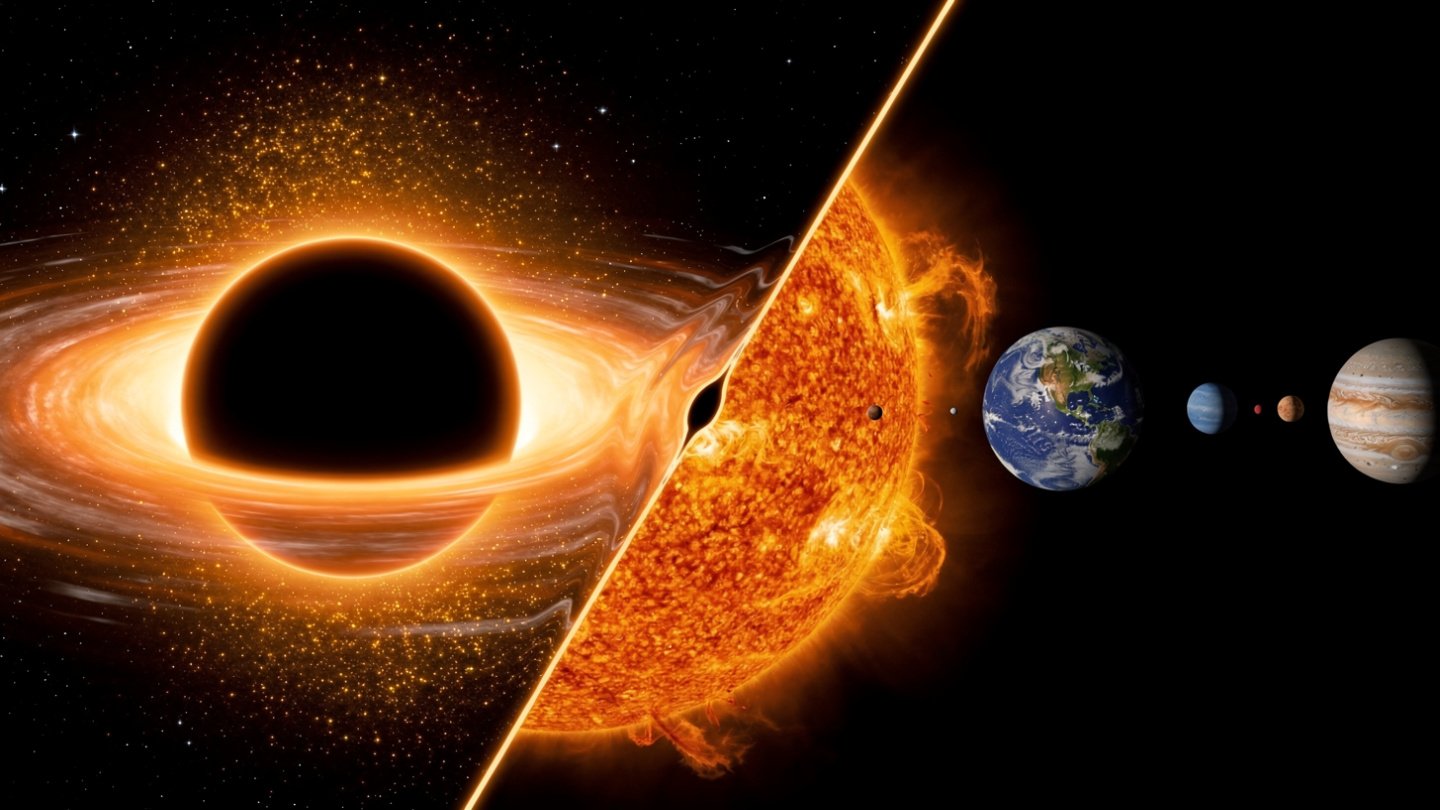
The Sun is not a modest object. It spans 1.4 million kilometers across. It contains 99.86 percent of all the mass in the solar system. Every planet, every moon, every asteroid and comet and scattered piece of ice beyond Neptune together accounts for the remaining 0.14 percent. The Sun has been fusing hydrogen for 4.6 billion years and has enough fuel for another five billion or so. By any ordinary standard, the Sun is enormous.
Sagittarius A* contains four million of them. The notation required to write its mass in kilograms is $8 \times 10^{36}$ kg. The event horizon, the boundary of no return, has a radius given by the Schwarzschild formula:
$$R_s = \frac{2GM}{c^2}$$For Sgr A*, this yields approximately 12.7 million kilometers. The diameter of the event horizon is therefore roughly 25.4 million kilometers, which fits inside Mercury's orbital radius of 57.9 million kilometers with room to spare. Four million solar masses, inside a sphere smaller than the inner solar system. The density implied is not a number that maps onto any ordinary conception of matter.
What makes the number more useful than notation is context. The mass measurement did not come from theory. It came from watching stars move.[1]
The Stars That Confirmed It
Within the innermost fraction of a light-year around Sagittarius A* sits a cluster of young, massive stars called the S-stars. They orbit the black hole the way planets orbit stars, except their orbital periods are measured in years rather than centuries, and their velocities require relativistic corrections that Newton alone cannot account for.
S2 is the most studied. A blue main-sequence star roughly fifteen times the mass of the Sun, it completes one full orbit around Sgr A* every 16.05 years. At its closest approach, called periapsis, it passes within 120 astronomical units of the event horizon and reaches a velocity of approximately 7,650 kilometers per second. That is 2.5 percent of the speed of light. At those velocities and that proximity, the orbit precesses: the ellipse itself slowly rotates over successive laps in a way that Newtonian gravity predicts incorrectly and general relativity predicts exactly.
Two independent research groups monitored S2 and its neighbors across three decades. Reinhard Genzel at the Max Planck Institute for Extraterrestrial Physics and Andrea Ghez at UCLA worked in parallel, sometimes in competition, tracking stellar positions in the near-infrared where galactic dust is less opaque. In 2018, the GRAVITY collaboration measured the gravitational redshift of S2's light during periapsis passage, confirming general relativity's prediction with high precision. In 2020, they measured the Schwarzschild precession of S2's orbit. The same year, Genzel and Ghez shared the Nobel Prize in Physics for their work establishing Sgr A* as a supermassive compact object.[2]
The mass extracted from these observations is 4.297 million solar masses, with an uncertainty of approximately 12,000 solar masses. The error bar itself represents twelve thousand times the mass of the Sun. In the context of the total, it is a rounding detail.
A Quiet Machine Running Below Capacity
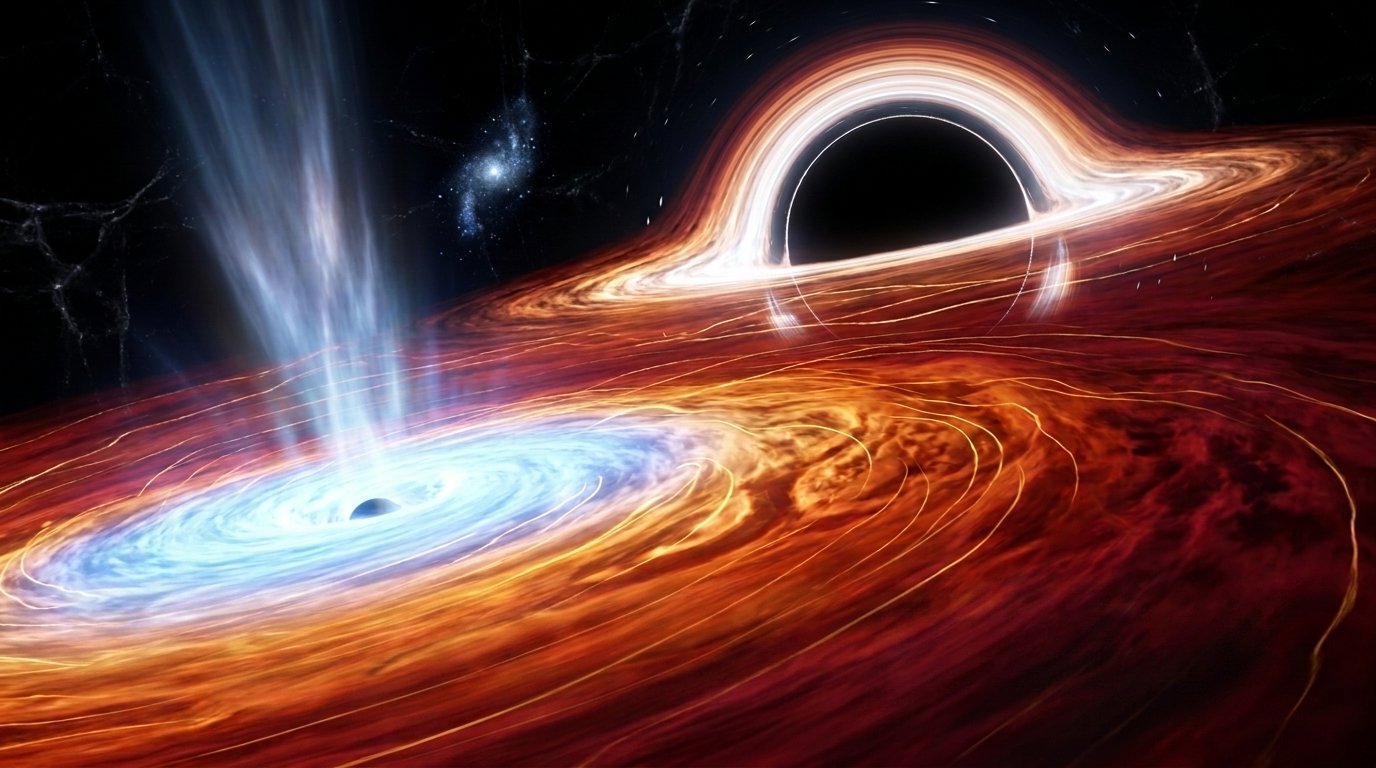
Sagittarius A* is, by the standards of its own potential, doing almost nothing right now. It accretes material at a rate of a few hundredths of an Earth-mass per year, drawing in gas shed by the massive young stars that orbit nearby. The luminosity this produces is roughly $10^{11}$ times less than what a comparably massive actively feeding black hole would generate. Astrophysicists classify it as a Low-Luminosity Active Galactic Nucleus, or LLAGN, running in what is called a radiatively inefficient accretion flow regime.
The physical reason for this inefficiency is not fully resolved. The leading explanation involves the structure of the accretion flow itself: Chandra X-ray Observatory observations established that while material is captured at the Bondi radius, approximately 99 percent of it is expelled in outflows before reaching the event horizon. Only a thin trickle gets through. The energy that should be released as radiation is instead advected inward with the flow or blown outward in winds, leaving the central object dim by AGN standards.
This quietness is not absence. The event horizon has not retracted. The gravitational field extends outward in every direction with the same character it has always had. The S-stars continue their orbits. Flares occur in the infrared and X-ray several times daily, each one monitored by telescopes pointed through 26,000 light-years of dust and gas. The machine is running. It is running far below its rated capacity, for reasons that remain an active research question, and it has been doing so for at least several million years.
What It Left Behind
Sagittarius A* was not always this quiet. The evidence is written in structures that are still visible above and below the galactic plane, still expanding, still warm with the energy that produced them.
In 2010, physicists analyzing data from the Fermi Gamma-ray Space Telescope discovered two enormous lobes of gamma-ray emission rising symmetrically above and below the Milky Way's disk. Each lobe extends roughly 25,000 light-years from the galactic plane. Together, the Fermi Bubbles span half the diameter of the Milky Way's stellar disk. They cover approximately ten percent of the entire sky as seen from Earth, invisible to the naked eye because they emit in gamma rays rather than visible light.
In 2020, the eROSITA space telescope revealed something larger: a second pair of nested bubble structures extending 45,000 to 50,000 light-years above and below the disk in X-ray emission, enclosing the Fermi Bubbles like a larger shell around a smaller one. The total energy stored in these structures is estimated at approximately $10^{55}$ to $10^{56}$ ergs. For comparison, a standard core-collapse supernova releases approximately $10^{51}$ ergs. The bubbles represent an energy output equivalent to tens of thousands of supernovae, sustained over approximately 100,000 years.[3]
Current best estimates place the onset of this activity at approximately 2.6 million years ago, when Sgr A*'s accretion rate was three to four orders of magnitude higher than today. The jets that formed during this period pushed material outward perpendicular to the galactic plane, and the resulting bubble structures have been expanding ever since. They are not slowing in any currently measurable way. They are still moving outward right now.
The Atmosphere That Felt It
The Fermi Bubble event was not the only consequence of Sgr A*'s active past. During the peak of its AGN phase, the X-ray and extreme ultraviolet luminosity of the galactic center was high enough that radiation reached the upper atmosphere of Earth at a distance of 26,000 light-years.
The inverse square law governs how radiation intensity falls with distance: $F = L / (4\pi d^2)$. At 26,000 light-years, even AGN-level luminosity is reduced to a fraction of what it was at the source. The fraction is small. But small is not zero.
A 2017 study by Balbi and Tombesi, published in Scientific Reports, modeled the X-ray and extreme UV flux reaching Earth during Sgr A*'s peak active phase and estimated the atmospheric response. The upper ionosphere would have experienced significantly elevated ionization rates. High-energy photons ionizing nitrogen and oxygen molecules in the stratosphere produce nitrogen oxides that participate in catalytic cycles consuming ozone. The estimated increase in surface UV flux at Earth's distance ranges, depending on model assumptions about peak luminosity and duration, from a few percent to several tens of percent above baseline.[4]
This was happening 2.6 million years ago. The genus Homo was beginning. Homo habilis appears in the fossil record at approximately 2.4 to 2.8 million years ago. The earliest Oldowan stone tools date to roughly 2.6 million years before present. Early human ancestors were on the surface of a planet whose upper atmosphere was being measurably altered by radiation from the galactic center. The events are not causally connected. The timeline simply overlaps, and the overlap is real.
Gravity at Galactic Scales
The direct gravitational force of Sgr A* on the solar system is unmeasurable. At 26,000 light-years, the inverse square law has reduced the direct pull to something lost entirely in the dominant local influences of the Sun and the distributed mass of the galaxy. In that narrow sense, Sgr A* does not pull on Earth.
But the Sun orbits the galactic center. The galactic orbit of the solar system has a period of approximately 225 million years and a velocity of roughly 220 kilometers per second at a galactocentric radius of 8.18 kiloparsecs. The orbital period follows from:
$$T = \frac{2\pi r}{v}$$The mass enclosed within the solar orbit, including Sgr A*, determines the character of that orbit. Remove Sgr A* from the mass budget and the orbit changes. The change is small, proportionally: four million solar masses in a galaxy of hundreds of billions is a fractional contribution. But the contribution is real, and it has been real for the entire 4.6-billion-year existence of the solar system.
Far does not mean disconnected. The galaxy is one physical system, and Sagittarius A* has been at the center of it for longer than the Sun has existed.
What Is Coming
The Large Magellanic Cloud is approaching. Currently 160,000 light-years from the Milky Way, it is on an inward trajectory that will produce a direct collision in approximately 2.4 billion years. The disruption will send large quantities of gas toward the galactic center, raising the accretion rate of Sgr A* and triggering a new period of AGN-level activity. Current simulations suggest Sgr A* could grow by a factor of roughly eight in mass during the merger event.[5]
The LMC's gravitational influence is already measurable today. Its mass has created a gravitational wake in the Milky Way's dark matter halo, and the stellar disk is measurably offset from the true center of the halo as a consequence. The future collision has begun, in the only sense in which gravitational events begin: gradually, at the outermost scales, through the slow accumulation of influence.
In approximately 4 to 4.5 billion years, Andromeda will merge with the Milky Way. The two central black holes will eventually spiral together and merge in a burst of gravitational wave energy. The resulting object will be far more massive than either current one. What is now Sagittarius A* will be part of something larger.
What We Actually Know
Sagittarius A* contains 4.297 million solar masses, measured with an uncertainty of roughly 12,000 solar masses through three decades of stellar orbit monitoring confirmed by gravitational redshift and orbital precession observations consistent with general relativity. Its event horizon has a radius of approximately 12.7 million kilometers. It is currently accreting at a rate far below its theoretical capacity, in a radiatively inefficient flow regime that remains an active research area.
It produced, approximately 2.6 million years ago, an energetic outburst that inflated structures still visible and still expanding in the galactic halo. That outburst delivered elevated radiation to Earth's upper atmosphere, producing measurable ozone chemistry effects at the surface UV level. The S-stars confirm the mass. The Fermi and eROSITA Bubbles confirm the history. The approaching LMC confirms the future.
What is less settled: the precise accretion history of Sgr A* over its full lifetime, the exact mechanism by which so much captured material fails to reach the event horizon, the peak luminosity of the AGN phase and therefore the precise degree of atmospheric perturbation delivered to early Earth, and the long-term dynamical consequences of the LMC and Andromeda mergers on the central black hole's growth trajectory.
The number is four million solar masses. The number has not changed since the first time it was written here. What has changed is everything around it: the orbiting stars, the expanding bubbles, the altered atmosphere, the approaching satellite galaxy, the future merger. The number is the same. The context is no longer empty.
[1] The stellar orbit method for measuring Sgr A*'s mass uses Kepler's third law in its generalized form: $M = 4\pi^2 a^3 / (G T^2)$, where $a$ is the semi-major axis and $T$ is the orbital period. For S2 with $a \approx 1000$ AU and $T = 16.05$ years, this yields approximately 4.3 million solar masses. See: Genzel, R., Eisenhauer, F., Gillessen, S. (2010). Reviews of Modern Physics, 82, 3121.
[2] The Nobel Prize in Physics 2020 was awarded one half jointly to Reinhard Genzel and Andrea Ghez "for the discovery of a supermassive compact object at the centre of our galaxy." Roger Penrose received the other half for black hole formation theory. See: nobelprize.org/prizes/physics/2020.
[3] Predehl, P. et al. (2020). Detection of large-scale X-ray bubbles in the Milky Way halo. Nature, 588, 227-231. The eROSITA bubbles discovery paper establishing the nested structure and X-ray emission profile.
[4] Balbi, A. and Tombesi, F. (2017). The habitability of the Milky Way during the active phase of its central supermassive black hole. Scientific Reports, 7, 16626. Modeling study of atmospheric effects at various galactic distances during the Sgr A* AGN phase.
[5] Cautun, M. et al. (2019). The aftermath of the Great Collision between our Galaxy and the Large Magellanic Cloud. Monthly Notices of the Royal Astronomical Society, 483, 2185-2196. N-body simulations of the LMC-Milky Way merger and predicted consequences for Sgr A* mass and activity.
Comments (0)
Leave a Comment