Why We Cannot Reach Alpha Centauri
There is a star system you can see without a telescope. It sits in the southern sky, third brightest after Sirius and Canopus, steady and unhurried, close enough to have been named by human beings centuries ago. Alpha Centauri. The nearest stellar neighbourhood to our Sun. And by every physical, biological, and mathematical measure we currently possess, it is as unreachable as if it sat on the other side of the observable universe.
This is not a technology problem waiting for a better rocket. It is a confrontation with fundamental physics, with the limits of the human body in deep space, and with the uncomfortable arithmetic of distance and time. What follows is the full accounting.
A Triple System, Not a Single Star
Alpha Centauri is the name given to what appears, to the naked eye, as a single point of light. Point a small telescope at it and it resolves into two. Add a sensitive wide-field detector and a third appears, far out in the dark, too faint to see without help.
The two bright components are Rigil Kentaurus (Alpha Centauri A, spectral class G2) and Toliman (Alpha Centauri B, spectral class K1). They form a binary pair orbiting their shared centre of mass every 79.9 years on an elliptical path. Their separation varies between 11.2 astronomical units at closest approach and 35.6 astronomical units at maximum separation.[1] Both are Sun-like. Both are slightly older than our Sun, with the system's age estimated between 5 and 6.5 billion years compared to the Sun's 4.6 billion.
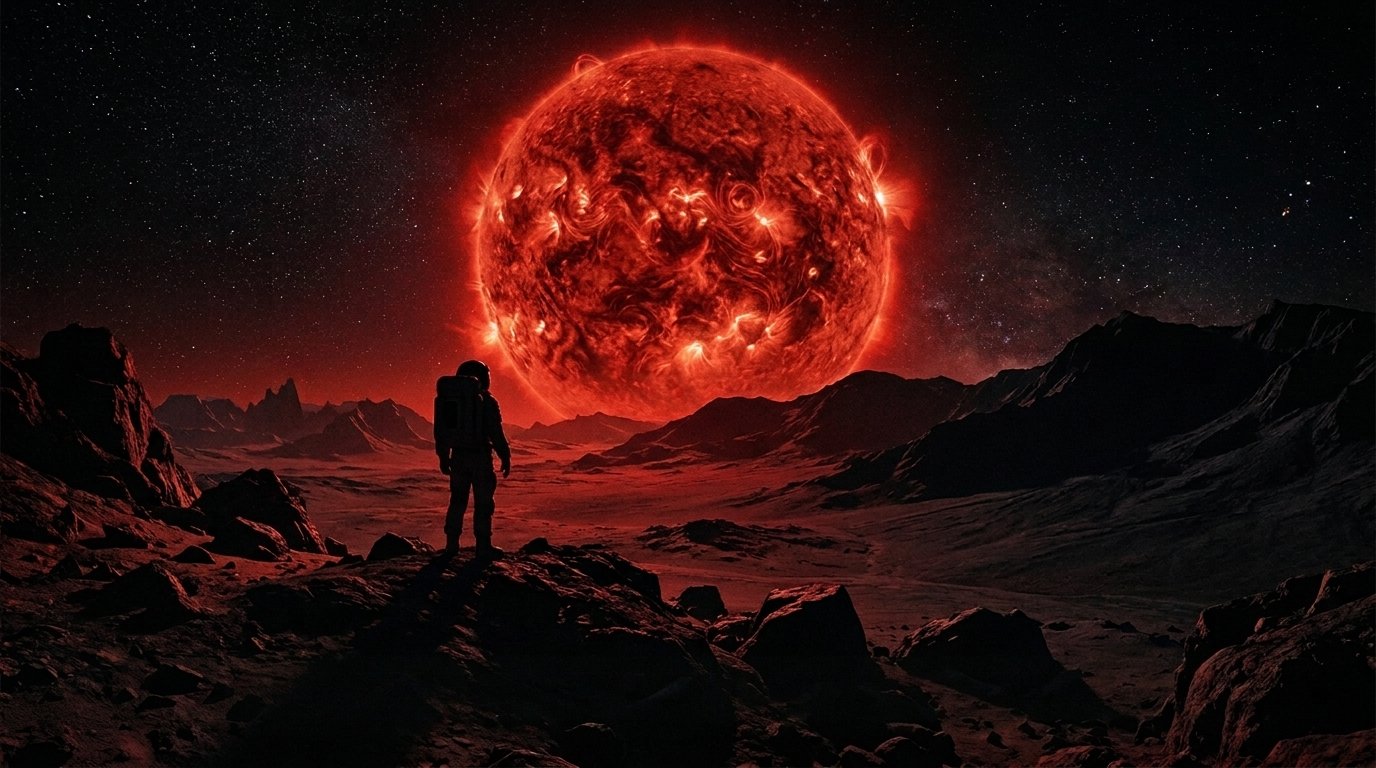
The third member, Proxima Centauri, sits approximately 13,000 astronomical units from the central pair. It orbits them once every 550,000 years. It is a red dwarf of spectral class M5.5, with a mass of roughly 12.5 percent of the Sun's and a radius of approximately 15 percent. It is, fractionally, the closest of the three to Earth at 4.2465 light-years. Despite being our nearest stellar neighbour, it is invisible to the naked eye, with an apparent magnitude of approximately 11.
Proxima will outlive every Sun-like star currently burning in the galaxy. Its main-sequence lifespan is approximately 4 trillion years. The universe is currently 13.8 billion years old. Whatever planetary processes are underway around Proxima have had more time to develop than Earth has existed, and will continue for a period roughly 300 times the current age of the universe.
What 4.24 Light-Years Actually Means
A light-year is a unit of distance equal to the distance light travels in one Julian year: approximately $9.461 \times 10^{12}$ kilometres. Alpha Centauri is 4.2465 of them away, placing it at roughly $4.014 \times 10^{13}$ kilometres from Earth. In astronomical units, that is 268,770 AU.
These numbers do not land. The human brain evolved to navigate distances measured in metres and kilometres, and applies that intuition to interstellar scales without adequate rescaling. So consider Voyager 1 instead.
Launched in September 1977, Voyager 1 is the most distant human-made object ever built. In November 2026, nearly 50 years after launch, it will reach a distance of one light-day from Earth. One light-day. That is approximately $2.59 \times 10^{10}$ kilometres, or roughly $1/1500$ of a light-year. Alpha Centauri is 4.24 light-years away.
Voyager 1 has covered less than 0.1 percent of the distance to the nearest star in 50 years. At its current speed of approximately 17 kilometres per second, it would reach Alpha Centauri in roughly 73,000 years. Agriculture is 12,000 years old. Written language is 5,000 years old. The probe launched before personal computers existed and will arrive, if it arrives, long after anything recognisable as human civilisation would have risen and fallen many times over.
The Rocket Equation and Its Hard Ceiling
The fundamental constraint on chemical rocketry is the Tsiolkovsky rocket equation, derived in 1903:
$$\Delta v = v_e \ln\left(\frac{m_0}{m_f}\right)$$Where $\Delta v$ is the change in velocity, $v_e$ is the exhaust velocity, and $m_0 / m_f$ is the ratio of initial mass (with fuel) to final mass (without). The logarithm is the problem. To double velocity, you must square the mass ratio. To triple it, you must cube the ratio. The growth is exponential, and it rapidly produces mass ratios that are not merely impractical but geometrically impossible.
Chemical rockets are limited to exhaust velocities of roughly 4 to 4.5 kilometres per second. This is not a limit waiting to be overcome by better engineering. It is a thermodynamic ceiling set by the bond energies of molecules. The speed of light is $2.998 \times 10^5$ kilometres per second. Ten percent of that, the floor of any serious interstellar proposal, is approximately 30,000 kilometres per second. The ratio between the best chemical exhaust speed and the minimum target speed is approximately 7,000 to one.
The energy required to accelerate a single tonne of payload to 10 percent of light speed is approximately 450 petajoules. One petajoule is $10^{15}$ joules. Global human energy consumption in a year is approximately 580 petajoules. Launching one tonne at a tenth of light speed would consume energy comparable to nearly a year of all human energy production on Earth. A crewed spacecraft would weigh many thousands of tonnes and would require additional fuel for deceleration and return.[2]
The Serious Proposals and Their Walls
Three propulsion concepts have been studied rigorously enough to merit examination.
Nuclear Pulse Propulsion
Project Orion, studied at General Atomics in the late 1950s and early 1960s with physicist Freeman Dyson among the contributors, proposed propelling a spacecraft via sequential nuclear detonations absorbed by a large pusher plate mounted on shock absorbers. The physics is sound. Theoretical top speeds of 3 to 10 percent of light speed were calculated. The 1963 Partial Nuclear Test Ban Treaty, prohibiting nuclear detonations in space, ended the programme. The design exists. The hardware does not. The legal barrier has not moved.
Project Daedalus
Between 1973 and 1978, the British Interplanetary Society conducted a detailed engineering study for a fusion-pulse spacecraft. The design targeted approximately 12 percent of light speed, sufficient to reach a nearby star in roughly 45 years. It required inertial confinement fusion at 250 pellet detonations per second, and large quantities of helium-3 to be harvested from Jupiter's atmosphere by robotic factories. Neither working fusion ignition at that rate nor robotic atmospheric mining of a gas giant exists. The report remains the most complete interstellar spacecraft design ever published. The spacecraft has not been built.
Breakthrough Starshot
Announced in 2016 with $100 million in seed funding, Breakthrough Starshot proposes accelerating gram-scale nanocrafts on thin reflective lightsails to 20 percent of light speed using a ground-based laser array generating approximately 100 gigawatts. At that velocity, the journey to Alpha Centauri takes roughly 21 years. The physics of radiation pressure is real and demonstrated. The obstacles are material: no substance currently known can survive the laser intensity without being destroyed during acceleration, the array's power requirement exceeds the entire generating capacity of the United Kingdom, and interstellar dust impacts at 20 percent light speed could shred the sail before it reaches the target.[3]
Even if Starshot succeeds on its most optimistic timeline, it sends no human anywhere. It delivers a 24-hour flyby at 60,000 kilometres per second by a gram-scale probe that cannot decelerate, orbit, land, or return. The signal from that flyby takes 4.24 years to reach Earth.
The Interstellar Medium as a Weapon
Interstellar space is not empty. The interstellar medium between the stars contains approximately one hydrogen atom per cubic centimetre on average, along with microscopic dust grains typically 0.1 to 1 micron in diameter. At low speeds, this is irrelevant. At relativistic speeds, it is catastrophic.
At 20 percent of light speed, hydrogen atoms arrive at the spacecraft's frame of reference with the energy of particles in a high-energy accelerator. They bombard the forward surface continuously, depositing energy, degrading materials, eroding the leading face across decades of travel. Dust grains are worse. A grain 0.1 microns across, struck at 20 percent light speed, releases energy equivalent to a cluster of cosmic rays concentrated at a single impact point. It punches a hole. It vaporises material in a flash of heat and secondary particles.
The kinetic energy of a relativistic impactor is given by:
$$KE = (\gamma - 1)mc^2, \quad \gamma = \frac{1}{\sqrt{1 - v^2/c^2}}$$At 50 percent of light speed, $\gamma \approx 1.155$. A single milligram particle at that velocity carries kinetic energy equivalent to a 45-kilogram object moving at approximately 21 kilometres per second. Interstellar space contains milligram particles. At those velocities, no current shielding solution prevents the secondary particle shower generated by impact from penetrating the hull.
What Radiation Does to a Human Body
Beyond Earth's magnetosphere, galactic cosmic rays arrive continuously. These are high-energy atomic nuclei, primarily protons but including heavier ions such as iron-56 and silicon- 28, accelerated to near-light speeds by supernovae and other violent astrophysical events. They carry millions to billions of electron-volts each. They penetrate spacecraft hulls. They interact with everything inside.
The biological damage is described using linear energy transfer:
$$LET = -\frac{dE}{dx}$$Where $dE/dx$ is the energy deposited per unit path length in tissue (typically expressed in keV per micron). High-LET particles like iron-56 nuclei deposit energy in dense clusters that overwhelm the cell's repair systems, unlike the more diffuse ionisation of low-LET X-rays. A high-LET particle passing through a DNA strand can produce a double-strand break, where both sides of the helix are severed simultaneously. The cell has repair mechanisms for this. At the rates galactic cosmic rays arrive in deep space, those mechanisms are overwhelmed.
Studies exposing mice to simulated galactic cosmic ray environments found persistent alteration of hippocampal structure, impaired memory formation, and reduced capacity for spatial reasoning. Apollo astronauts, exposed for at most 13 days beyond Earth's magnetosphere, showed elevated cardiovascular disease rates in later life compared to astronauts who remained in low Earth orbit.[4]
For a crew spending decades in interstellar space, beyond any planetary magnetic shield, the cumulative radiation dose would far exceed current regulatory limits. Statistically near-certain cancer development, cardiovascular damage, and measurable cognitive decline would be the expected outcome. The ship might survive the journey. The people inside it might not arrive as the people who left.
Time Dilation Will Not Solve This
Time dilation is real. It is experimentally confirmed by atomic clocks on aircraft, by the corrections built into GPS satellite systems, and by the NASA Twin Study comparing Scott Kelly after 340 days on the International Space Station with his twin Mark on Earth. The physics is not in question.
The question is practical value at realistically achievable speeds. Time dilation follows the Lorentz factor:
$$\tau = \frac{t}{\gamma} = t\sqrt{1 - \frac{v^2}{c^2}}$$Where $\tau$ is proper time for the traveler and $t$ is coordinate time for the stationary observer. At $v = 0.1c$, $\gamma = 1.005$. A 45-year journey is experienced by the traveler as approximately 44 years and 10 months. The effect saves a few months. At $v = 0.2c$, $\gamma \approx 1.02$. Still negligible for any practical purpose.
Meaningful time compression requires velocities above roughly 70 to 90 percent of light speed. At $v = 0.9c$, $\gamma \approx 2.3$: a 21-year journey is experienced as roughly 9 years. At $v = 0.99c$, $\gamma \approx 7.1$. These are the velocities at which the twin paradox becomes practically significant. They are also velocities that no currently proposed or theoretically near-term propulsion system can approach for any crewed vehicle. The energy requirements at 90 percent of light speed for a crewed spacecraft are not merely large. They are disconnected from any foreseeable physical reality.
The Planet That Sits in the Habitable Zone and Is Probably Hostile
On 24 August 2016, a team led by Guillem Anglada-Escude announced the detection of an exoplanet orbiting Proxima Centauri. The discovery used the radial velocity method: the planet's gravitational pull induces a periodic Doppler shift in the star's spectral lines. The amplitude of that shift was 1.2 metres per second, among the smallest signals ever confirmed. The planet, designated Proxima b, has a minimum mass of approximately 1.07 Earth masses and an orbital period of 11.2 days at a semi-major axis of 0.05 astronomical units. It sits within Proxima's habitable zone.
The habitable zone is defined as the orbital region where a star's energy output is consistent with liquid water existing on a planetary surface, given certain atmospheric assumptions. It is a one-variable concept. It describes orbital distance and energy flux. It says nothing about magnetic fields, atmospheric retention, stellar behaviour, or rotation state.
Proxima b almost certainly fails the conditions the phrase implies at every other level. At 0.05 astronomical units, tidal forces acting over billions of years have almost certainly synchronised the planet's rotation with its orbital period, producing tidal locking. One hemisphere faces the star permanently. The other is in eternal darkness. A tidally locked planet rotating once every 11.2 days likely cannot sustain the internal dynamo required to generate a strong magnetosphere. Without a magnetosphere, stellar wind arrives unimpeded.
At Proxima b's orbital distance, stellar wind pressure is approximately 10,000 times greater than the solar wind pressure Earth receives. This is not a short-term problem. Over geological timescales, it strips planetary atmospheres. The cumulative X-ray and UV flux from Proxima's quiescent emission alone, operating across billions of years, is sufficient to erode even a substantial atmosphere.[5]
The Superflares
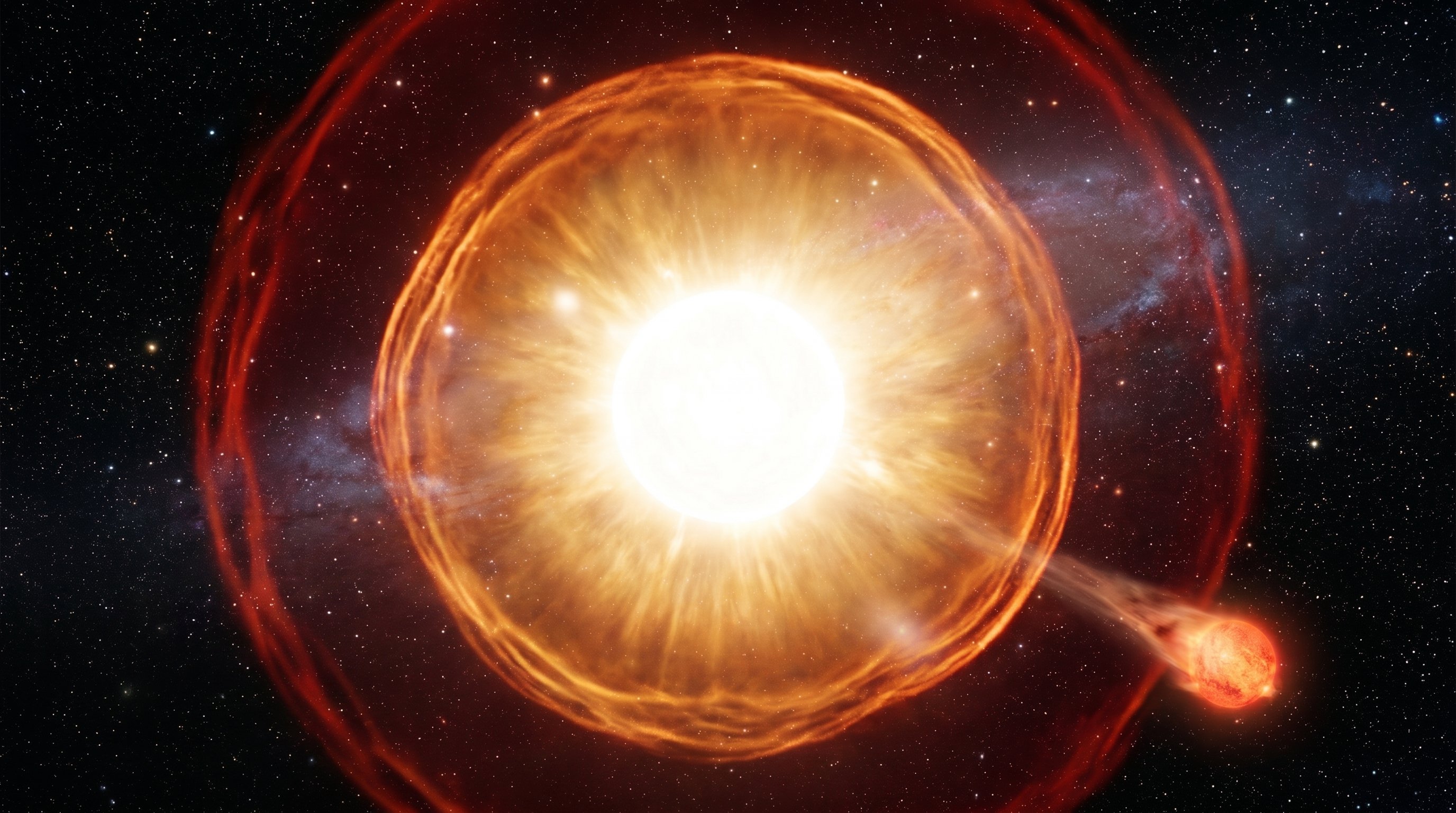
Proxima Centauri's magnetic field is approximately 600 times stronger than the Sun's relative to its size. That energy releases in superflares: sudden eruptions across the electromagnetic spectrum occurring in seconds. In March 2016, Proxima briefly became visible to the naked eye as its optical brightness surged to 70 times above normal. In May 2019, observed simultaneously by nine telescopes in a coordinated campaign, its ultraviolet output spiked to 14,000 times its normal brightness. The 2019 event was one of the most powerful stellar flares ever recorded anywhere in the Milky Way.[6]
Ozone recovery after a single superflare takes several years. Proxima produces at least five superflares per year by conservative statistical estimate. An ozone layer cannot form faster than it is destroyed at that rate. Whatever surface Proxima b has sits under a sky that provides no meaningful ultraviolet shield, exposed continuously to radiation levels that exceed the tolerance of all known Earth organisms.
The Generation Ship and a Problem Without a Solution
If no human lifetime can span the journey, the conceptual response is to stop treating a human lifetime as the relevant unit. A generation ship carries a society across interstellar distance, with the passengers who arrive being the distant descendants of those who departed.
The practical requirements are severe. A closed ecological life support system must cycle every nutrient, calorie, and molecule for centuries without resupply. Population genetics studies suggest a minimum founding population of 10,000 to 40,000 individuals to maintain viable genetic and cultural diversity across a multi-century voyage.[7] Autonomous systems must function without meaningful failure for timescales exceeding all of recorded human history. At one percent of light speed, the journey to Alpha Centauri takes approximately 420 years.
The engineering problems are, in principle, solvable with sufficient technological advancement. The ethical problem is not.
The first generation chooses to go. Every person born on that ship after departure does not. They inherit a mission, a trajectory, and a sealed environment they cannot exit. Their preferences, their identities, their own ideas about what constitutes a good life are irrelevant to the trajectory. The ship continues regardless. Descendants several generations in may have no meaningful connection to the mission that bound their great-grandparents and equally no mechanism to leave it.
No utilitarian calculation resolves this cleanly without assumptions about the mission's success and the destination's worth that cannot be guaranteed in advance. No deontological framework comfortably absorbs the structural removal of agency from people who did not yet exist when the decision was made. The generation ship is not an engineering challenge with ethical footnotes. The ethics is the primary problem.
The Ghost Planet and What Arrival Actually Means
In August 2024, James Webb Space Telescope observations of Alpha Centauri A revealed a faint point of light in mid-infrared data, consistent in brightness and position with a Saturn-mass gas giant orbiting at one to two astronomical units from the star, inside its habitable zone. A 2019 VLT detection of the same region, never fully confirmed, supported the candidate. Follow-up JWST observations in February and April 2025 detected nothing. Orbital modelling of stable trajectories within the Alpha Centauri AB system, accounting for the gravitational influence of the binary companion, showed that approximately 50 percent of consistent orbital configurations would place the planet behind its star during the 2025 observation windows.
As of mid-2025 the object remains a candidate: present in the data once, consistent with the non-detections, and unconfirmed. If confirmed, it would be the nearest directly imaged exoplanet ever detected, orbiting a Sun-like star 4.3 light-years from Earth.
Assume, for a moment, that Breakthrough Starshot succeeds on its most optimistic timeline and a probe reaches the Alpha Centauri system. The probe arrives at 20 percent of light speed. It has approximately 24 hours in the vicinity of the system before passing through and continuing outward. It cannot decelerate. It cannot orbit. It cannot linger. It captures what its gram-scale instruments capture during that single pass and begins transmitting. That transmission travels home at the speed of light. It arrives 4.24 years later.
The researchers who designed the mission receive the first data more than 25 years after launch, assuming the probe survives the journey. Some of them will not be there to see it. No human travels. The nearest star system remains as physically unreachable as it was before the launch. What the mission delivers is a photograph from the other side of a barrier that remains fully intact.
What We Actually Know
Alpha Centauri is a triple star system between 5 and 6.5 billion years old, containing two Sun-like stars in an 80-year binary orbit and one red dwarf sitting 13,000 astronomical units from its companions. The red dwarf is our nearest stellar neighbour at 4.2465 light-years. It hosts at least one confirmed planet, Proxima b, which is Earth-mass, in the habitable zone, almost certainly tidally locked, probably without a strong magnetic field, and orbiting a star that erupts in superflares at a rate incompatible with stable surface ozone chemistry. A candidate Saturn-mass planet around Alpha Centauri A was detected by JWST in 2024 and has not been confirmed.
No current technology can send a human to this system. No technology on a clear near-term horizon changes this. The rocket equation places chemical propulsion in the wrong category entirely. Nuclear propulsion exists as engineering studies and legal barriers. Fusion propulsion requires working fusion. Breakthrough Starshot, the most credible active proposal, sends a gram of instrumentation on a flyby that delivers photographs after a 25-year round-trip delay. Time dilation offers nothing meaningful at achievable speeds. Interstellar dust and galactic cosmic rays represent genuine physical hazards with no clean solutions. Generation ships present engineering challenges and an ethical problem that has no schematic.
Thomas Henderson measured the distance to Alpha Centauri in 1832. Robert Innes identified Proxima Centauri by its shared motion through space in 1915. Guillem Anglada-Escude and the Pale Red Dot team confirmed Proxima b from a Doppler wobble of 1.2 metres per second in 2016. JWST observed a candidate planet around Alpha Centauri A in 2024 from 4.3 light-years away.
None of these people could cross the distance. All of them added a true layer of knowledge about what sits on the other side of it. The drive to continue doing that, against a distance that has not shrunk and will not shrink, is not optimism or denial. It is something more specific: the refusal to let the current limit of reach become the permanent limit of understanding.
The light from Alpha Centauri is still arriving. It left four years ago. It does not know we are watching.
[1] Pourbaix, D. et al. (2016). Parallax and orbital parameters of the Alpha Centauri system from Hipparcos and Gaia astrometry. Astronomy and Astrophysics.
[2] Interstellar travel energy requirements calculated from standard relativistic kinetic energy formula. See also: Wikipedia, "Interstellar travel," physics section, citing world energy consumption data from IEA 2023.
[3] Hoang, T. et al. (2017). The Interaction of Relativistic Spacecrafts with the Interstellar Medium. Astrophysical Journal, 837, 5. DOI: 10.3847/1538-4357/aa5da6
[4] Cucinotta, F.A. et al. (2016). Space radiation risks to the central nervous system. Life Sciences in Space Research, 12. See also: PMC 11336052, NASA Twin Study cardiovascular findings.
[5] Garraffo, C. et al. (2016). The space weather of Proxima Centauri b. Astrophysical Journal Letters, 833, L4.
[6] MacGregor, M.A. et al. (2021). Detection of a Millimeter Flare from Proxima Centauri. Astrophysical Journal Letters, 911, L33. DOI: 10.3847/2041-8213/abf14c
[7] Smith, C.M. (2014). Estimation of a Genetically Viable Population for Multigenerational Interstellar Voyaging. Acta Astronautica, 97, 16-20.
Comments (0)
Leave a Comment