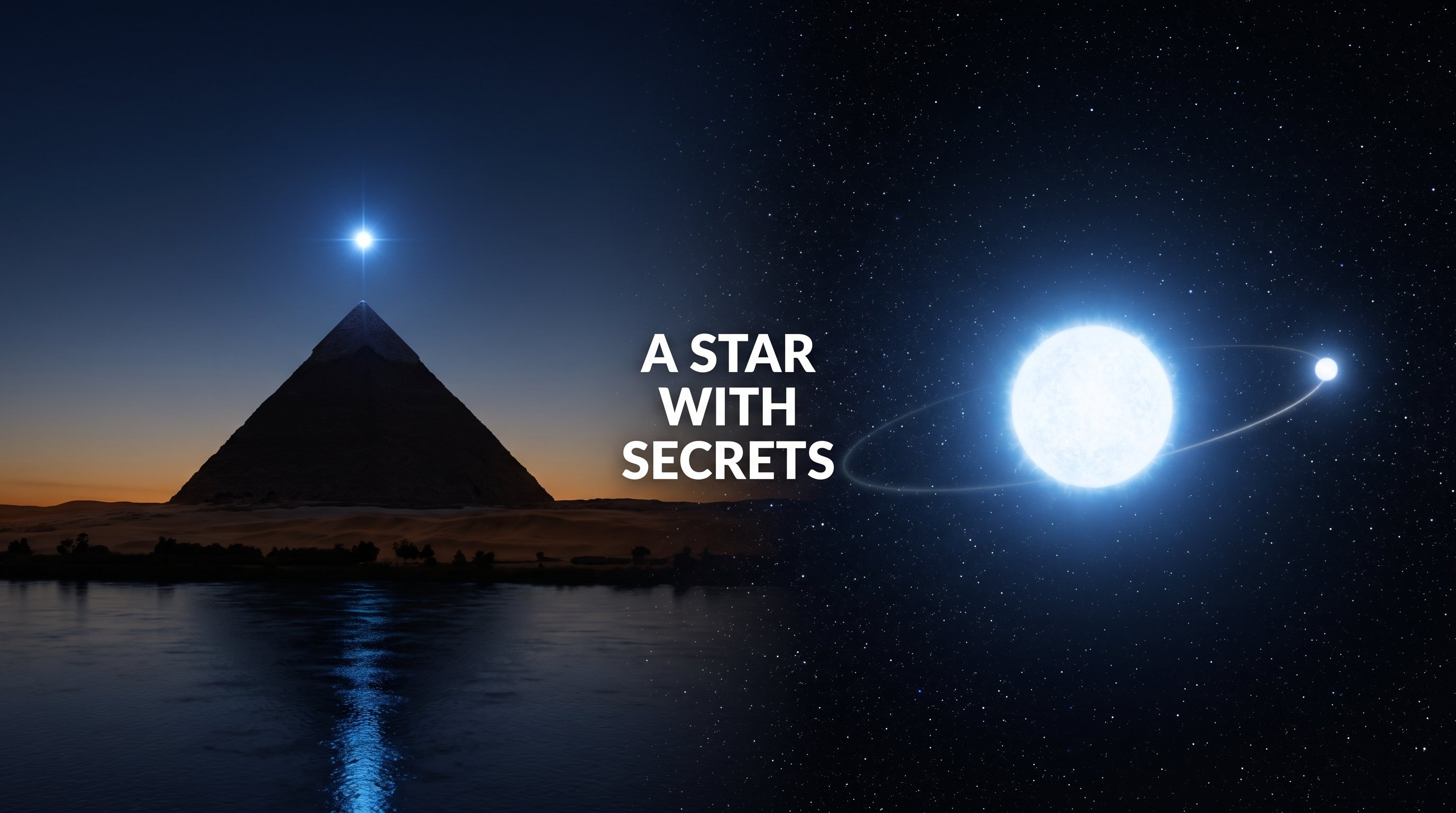
The Dead Star Orbiting Sirius and What It Means
Most people who know the name Sirius think of it as a single object — the brightest star in the night sky, a blue-white blaze in Canis Major, a fixture of winter evenings that has been there as long as anyone can remember. That picture is incomplete. Sirius is a binary system. Orbiting it, invisible to the naked eye, is a white dwarf called Sirius B: a dead star the size of Earth, holding nearly the mass of the Sun, sitting 8.6 light-years from our planet. It predicted nothing when it formed. It chose nothing. It simply exists at the right density, in the right orbit, close enough to have shaped the history of physics and uncertain enough in its future to make the next billion years worth paying attention to.
A Wobble in the Data
In 1844, Friedrich Bessel was reviewing decades of precise positional measurements of Sirius when he noticed the path was wrong. Stars move across the sky over centuries — a property astronomers call proper motion — and that motion should follow a straight line relative to the background. Sirius did not follow a straight line. It curved. Subtly, periodically, in a way that a single star moving freely through space simply does not do.
Bessel concluded that an unseen companion was pulling Sirius off course. He estimated the orbital period at roughly fifty years and announced the companion's existence in 1844 — eighteen years before anyone saw it. There was no image, no light, no direct evidence most observers would recognize as proof. Just the path of Sirius itself, bending repeatedly, implying a mass that had not yet been looked at directly.
On January 31, 1862, telescope maker Alvan Clark was testing a new 18.5-inch refractor by pointing it at Sirius. He was checking the optics, not searching for companions. Just beside Sirius, almost swamped by its glare, a faint point of light appeared. His first instinct was probably that it was an artifact of the glass. It held steady. It was real. Sirius B had been there the whole time.
The detection method Bessel used is not merely historical. Astrometric wobble — the technique of inferring unseen companions from deviations in a star's proper motion — is now one of the primary methods used to detect exoplanets. The logic is identical. The scale is different. The origin of the method is a cold January night in 1844 and a German astronomer who trusted his numbers over the absence of a visible object.
What a White Dwarf Actually Is
Sirius B is a carbon-oxygen white dwarf. Its radius is approximately 5,900 kilometers, slightly smaller than Earth's radius of 6,371 kilometers. Its mass is $1.018 \pm 0.011 \, M_{\odot}$.[1] The density that results from those two numbers — solar mass compressed into roughly Earth's volume — is approximately $10^6$ grams per cubic centimeter, or about one million times the density of the Sun.
The pressure required to hold that structure together against its own gravity is not thermal. There is no fusion happening inside Sirius B. The reactions that sustained it across its main sequence lifetime have stopped. What remains is electron degeneracy pressure — a quantum mechanical resistance arising from the Pauli exclusion principle, which prohibits any two electrons from occupying the same quantum state simultaneously. Under extreme compression, electrons are forced into higher and higher energy states to maintain their individuality, and the resistance this generates supports the white dwarf against gravitational collapse.
The equation of state for a fully degenerate non-relativistic electron gas gives a pressure:
$$P = \frac{\hbar^2}{5m_e}\left(\frac{3\pi^2}{1}\right)^{2/3} \left(\frac{\rho}{m_p \mu_e}\right)^{5/3}$$where $\rho$ is the mass density, $m_e$ is the electron mass, $m_p$ is the proton mass, and $\mu_e$ is the mean molecular weight per electron. Critically, this pressure depends on density but not on temperature. A white dwarf does not need to be hot to hold itself up. It simply needs to exist. This is why white dwarfs are stable across timescales that dwarf any thermal cooling process: the support mechanism is structural rather than energetic.
Sirius B's surface temperature is currently approximately 25,369 K — hotter than its companion Sirius A, which runs at around 9,940 K. This is not a contradiction. The heat is residual, stored in the ionic lattice of the white dwarf since its violent formation and bleeding outward slowly through the surface. Dense objects cool slowly. Sirius B became a white dwarf roughly 124 million years ago and is still working through the thermal energy of its own creation. [2]
The Progenitor That No Longer Exists
Sirius B did not begin as a white dwarf. Its progenitor — the star that underwent the evolution that produced this remnant — had an estimated initial mass of $5.056^{+0.374}_{-0.276} \, M_{\odot}$, based on stellar evolution modelling of the system's age and the white dwarf's cooling track.[3] That star was a B-type main sequence star, burning somewhere between 600 and 1,200 times brighter than the Sun, with a main sequence lifetime of roughly 100 million years.
The relationship between initial and final mass in stellar evolution is called the initial-final mass relation (IFMR). For the Sirius system, this relation is anchored by one of the most precisely measured data points available at high initial masses: a progenitor of approximately 5 solar masses producing a remnant of approximately 1 solar mass. The four or five solar masses that did not survive the transition were shed during the asymptotic giant branch (AGB) phase as slow, dense stellar winds, dispersing into the interstellar medium over millions of years.
During the AGB phase, the progenitor swelled to a radius of approximately $750 \, R_{\odot}$. At the system's then-current orbital eccentricity, the periastron distance was estimated at roughly 1.5 to 1.6 AU — smaller than the progenitor's own radius at peak expansion. The two stars were, at closest approach, in physical proximity that should have produced measurable consequences for both the orbit and the chemical composition of Sirius A.
Neither consequence is clearly visible. Sirius A's spectrum shows no significant enrichment in s-process elements. The orbit has not circularized. This is the central unresolved puzzle of the Sirius system, and no accepted mechanism explains both anomalies simultaneously.[4]
General Relativity and a Shifted Spectral Line
One of the three original tests of Einstein's general theory of relativity, published in 1916, was the gravitational redshift of light. The theory predicted that photons climbing out of a gravitational field lose energy, arriving at a distant observer shifted toward longer wavelengths. On the Sun, this effect is tiny — a Doppler-equivalent shift of roughly 0.64 km/s, difficult to isolate from other sources of line broadening. A white dwarf, with its much stronger surface gravity, produces an effect large enough to measure with the instruments available in the 1920s.
The gravitational redshift expected from a white dwarf of mass $M$ and radius $R$ is:
$$v_{\text{grav}} = \frac{GM}{Rc} \approx \frac{GM}{Rc}$$For Sirius B, with $M \approx 1.02 \, M_{\odot}$ and $R \approx 0.0084 \, R_{\odot}$, this gives a predicted equivalent velocity shift of approximately 80 km/s. In 1924, Arthur Eddington wrote to Walter Adams at Mount Wilson Observatory asking whether this shift could be measured for Sirius B. Adams published a result of approximately 21 km/s in 1925, which was close enough to Eddington's theoretical estimate of 28.5 km/s to be accepted as confirmation of general relativity.
Both values were later found to be in error by nearly a factor of four. The actual gravitational redshift of Sirius B, measured with the Hubble Space Telescope and published by Barstow et al. in 2005, is $80.42 \pm 4.83$ km/s — consistent with the theoretical prediction from modern mass and radius measurements, and inconsistent with both the Adams and Eddington early estimates.[5] The early measurements agreed with each other through a fortunate cancellation of errors on both sides.
Every photon received from Sirius B has climbed out of a gravitational field approximately 350,000 times stronger than Earth's surface gravity. The spectral lines arrive displaced from their laboratory positions by an amount that encodes the mass and radius of the object they escaped from. The light carries a record of the field it climbed through, and that record, read carefully enough, tells you something true about the geometry of spacetime near a very dense object.
Sirius in Human History
The heliacal rising of Sirius — the morning when it first appears on the eastern horizon just before sunrise after approximately 70 days of absence — coincided in early Egyptian civilization with the beginning of the Nile flood. The flood deposited the silt that made agriculture possible along an otherwise desert river valley. Knowing its timing mattered in ways that were directly economic and social.
The Egyptians called the star Sopdet. Temples were oriented so that the first light of Sirius on the morning of the heliacal rising traveled directly down the main axis of the sanctuary. The 70-day absence of Sirius from the sky was mapped onto the 70-day mummification period. The goddess Sopdet was later merged with Isis, her astronomical function absorbed into the theology of death and resurrection that structured Egyptian religious thought for millennia.
The same star organized navigation across the Pacific Ocean, structured Sanskrit astronomical texts as the Chieftain's Star, gave the Greek language the phrase "dog days of summer" (still in use in English today by speakers who have no idea it refers to a star), and appeared in Norse traditions as a marker of winter intensity. No other star in the sky has been integrated into more independent human knowledge systems across more continuous centuries of observation.
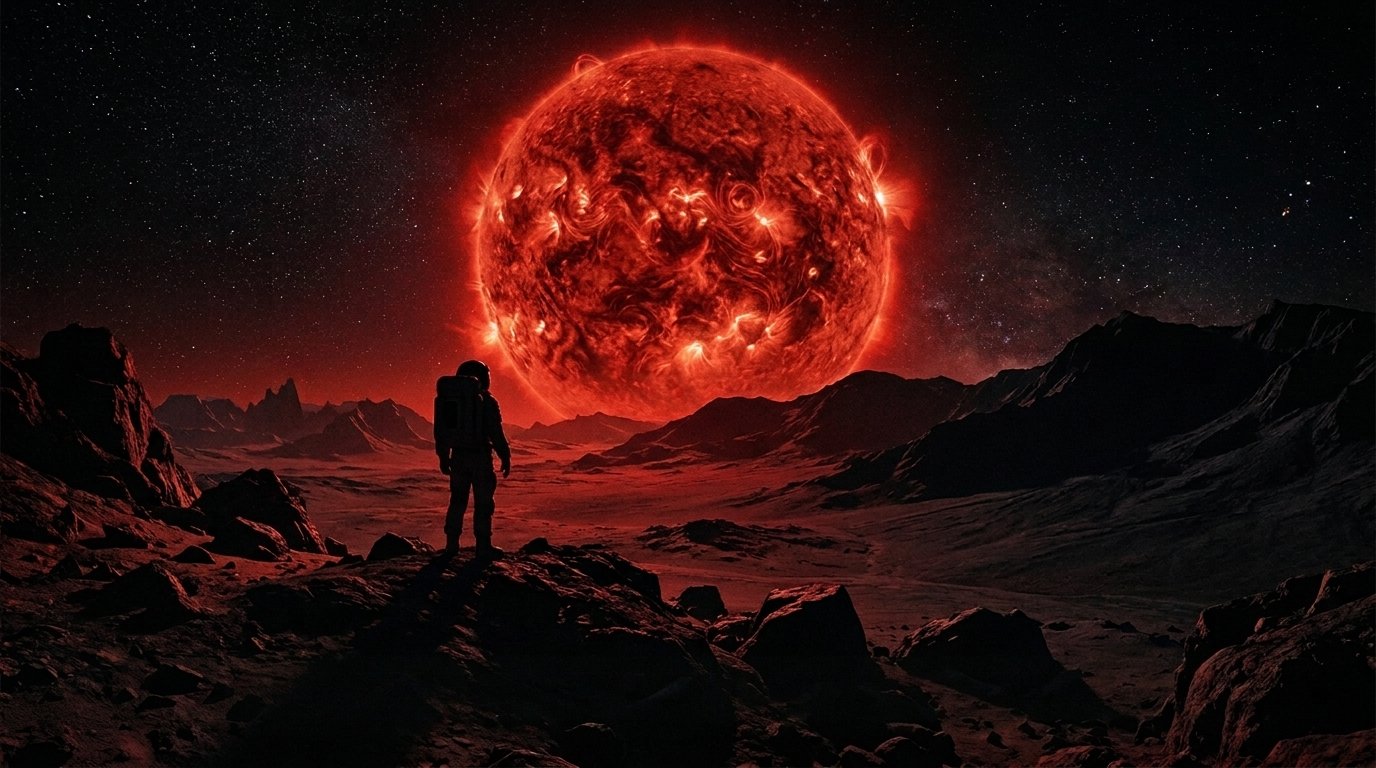
There is also the Red Sirius paradox: Greek, Roman, and Babylonian sources describe Sirius as red, while Chinese astronomical records from the same period consistently describe it as white. The mainstream explanation is that the Mediterranean descriptions reflect literary and cultural tradition — associating the star's heat and danger with redness — rather than literal observation. The minority view, that Sirius B was still completing its giant phase two thousand years ago, is ruled out by the physics: stellar evolution at this stage does not operate on timescales of centuries. The paradox remains unresolved to the satisfaction of everyone involved. [6]
The Orbital Architecture and Its Anomalies
Sirius A and Sirius B orbit their common center of mass with a period of $50.1284 \pm 0.0043$ years and an orbital eccentricity of $e = 0.59$. The separation varies between 8.2 AU at periastron and 31.5 AU at apastron. The average separation of approximately 20 AU is comparable to the Sun-Uranus distance. [7]
The eccentricity is the anomaly. Standard tidal circularization theory predicts that a binary at this separation, with this mass ratio, and at this system age should have an orbit close to circular. The timescale for circularization under standard tidal dissipation models is shorter than the system's 250 million year age. The eccentricity that exists is not marginally inconsistent with these predictions. It is substantially inconsistent.
The tidal circularization timescale scales approximately as:
$$\tau_{\text{circ}} \propto \frac{a^8 M_{\text{comp}}}{M_{\star}^2 R_{\star}^5 Q}$$where $a$ is the orbital separation, $M_{\text{comp}}$ is the companion mass, $M_{\star}$ and $R_{\star}$ are the primary's mass and radius, and $Q$ is the tidal quality factor. For the Sirius system parameters during the AGB phase — when the progenitor's radius was large, making the $R_{\star}^5$ term enormous and the circularization timescale very short — the models consistently predict circularization that did not occur.
No mechanism proposed to date reproduces both the surviving eccentricity and the absence of chemical contamination in Sirius A's spectrum simultaneously. The system is telling two stories that do not fit together, and the gap between them has not been closed.
The Chandrasekhar Limit and the Path to Explosion
Sirius A has approximately 1.4 billion years remaining on the main sequence. When its hydrogen core is exhausted, shell burning begins, the outer layers expand, and the star enters its red giant phase — shedding roughly 70% of its mass over millions of years. Some fraction of that outflowing material will be gravitationally captured by Sirius B.
The Chandrasekhar limit — the maximum mass supportable by electron degeneracy pressure before the relativistic correction causes the pressure to rise too slowly to balance gravity — is approximately:
$$M_{\text{Ch}} = \frac{5.87}{\mu_e^2} \, M_{\odot} \approx 1.4 \, M_{\odot}$$where $\mu_e$ is the mean molecular weight per electron, equal to 2 for a fully ionized carbon-oxygen composition. Sirius B currently holds $1.018 \, M_{\odot}$. The gap to cross is approximately $0.38 \, M_{\odot}$.
At 20 AU average separation, wind accretion efficiency through the Bondi-Hoyle mechanism is estimated at a few percent of the total outflow. Most of the 1.4 solar masses shed by Sirius A will escape the system entirely. The fraction that does reach Sirius B's surface faces a secondary obstacle: the nova cycle. Accreted hydrogen builds up on the white dwarf's surface until the base of the layer reaches ignition conditions, triggering a thermonuclear flash that may eject as much material as was deposited. At the low accretion rates consistent with wide binary separation, nova ejections can be net neutral or net negative for the white dwarf's mass. [8]
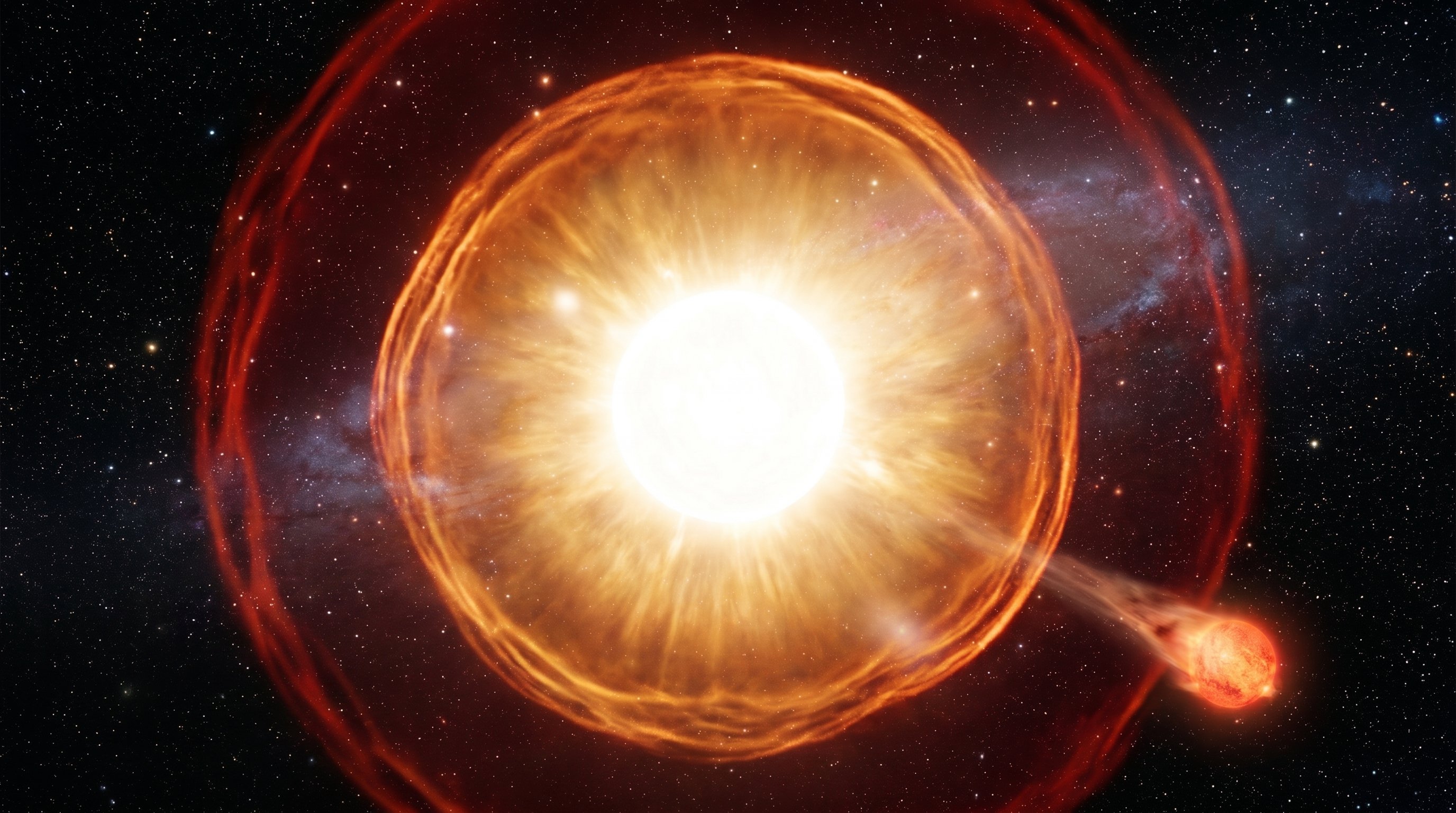
The expert consensus, as of current literature, is that a Type Ia supernova is possible but unlikely. The most probable outcome is repeated nova cycles without net mass gain, followed by Sirius A completing its own evolution into a second white dwarf. A possible alternative is engulfment of Sirius B inside Sirius A's expanding envelope during the giant phase, producing a merged remnant of uncertain character. The explosion scenario requires conditions that the geometry of the system does not favor.
If the Explosion Occurs: Earth Effects
A Type Ia supernova at 8.6 light-years would reach a peak apparent magnitude of approximately $-16.5$. The distance modulus gives:
$$m - M = 5 \log_{10}\left(\frac{d}{10 \, \text{pc}}\right) = 5 \log_{10}\left(\frac{2.64}{10}\right) \approx -2.88$$With an absolute magnitude of approximately $-19.4$ for a standard Type Ia, the apparent magnitude at peak is approximately $-19.4 + (-2.88) \approx -16.5$. The full moon has an apparent magnitude of $-12.7$. The difference of 3.8 magnitudes corresponds to a brightness ratio of $10^{3.8/2.5} \approx 200$. The supernova would appear approximately 200 times brighter than the full moon at peak.
This is the visual event. The longer-term concern is atmospheric.
Cosmic rays accelerated by the expanding supernova remnant arrive at Earth diffusely over centuries to millennia, scattered by galactic magnetic fields. Upon entering the upper atmosphere, high-energy particles trigger cascades that produce nitrogen oxides (NO and $\text{NO}_2$), which participate catalytically in ozone destruction:
$$\text{NO} + \text{O}_3 \rightarrow \text{NO}_2 + \text{O}_2$$ $$\text{NO}_2 + \text{O} \rightarrow \text{NO} + \text{O}_2$$Net reaction: $\text{O}_3 + \text{O} \rightarrow 2\text{O}_2$, with NO regenerated. Each nitrogen oxide molecule can cycle through this reaction thousands of times before being removed from the stratosphere.
Gehrels et al. (2003) calculated that a supernova within 8 parsecs doubles the biologically active UV flux at Earth's surface. Thomas and Yelland (2023) extended this estimate to 20 parsecs. Sirius is at 2.64 parsecs — substantially inside both figures.[9] The UV increase at Earth's surface from a Sirius supernova would not be a doubling. It would be considerably larger, scaling with the inverse square of the ratio of actual to threshold distance.
The biological consequences propagate through scale. UV-B radiation (280 to 315 nm) causes thymine dimer formation in DNA — adjacent thymine bases bonding to each other rather than to their complementary partners, distorting the double helix and introducing mutations if not repaired before replication. Repair mechanisms have finite capacity. When damage rate exceeds repair rate, lesions accumulate.
Phytoplankton, the photosynthetic organisms at the base of nearly every marine food chain, live in the sunlit upper layers of the ocean with no ability to retreat to deeper water without losing the light they require. Sustained UV-B increase suppresses their productivity. Suppressed phytoplankton productivity reduces food availability for zooplankton, then for small fish, then upward through the marine food web. The effect is not instantaneous extinction but sustained, compounding pressure across the decades and centuries of elevated cosmic ray flux.
The Scientific Legacy of a Cooling Remnant
Sirius B is the most scientifically productive stellar remnant within observational range. The sequence of what it enabled runs from 1844 to the present without interruption.
Bessel's detection of its gravitational signature demonstrated that unseen mass could be inferred from orbital dynamics, predating by over a century the astrometric techniques now used to detect exoplanets. The 1862 visual confirmation by Alvan Clark established that white dwarfs physically exist as observable objects rather than theoretical constructs. Walter Adams's 1915 spectrum of Sirius B, revealing extraordinary temperature in a faint object, forced the conclusion of extraordinary density and made white dwarfs scientifically unavoidable. The gravitational redshift measurement of 1925, however inaccurate in its early form, confirmed the principle of relativistic light-shifting from compact objects and was accepted as a test of general relativity for decades before the error was identified.
The precisely measured mass of Sirius B — $1.018 \pm 0.011 \, M_{\odot}$ from HST astrometry[7] — combined with its known progenitor mass, provides one of the most accurately determined data points on the initial-final mass relation at high initial masses. That relation is used in stellar population synthesis models, white dwarf mass function calculations, and the chemical evolution history of the galaxy.
Sirius B did none of this intentionally. It formed, collapsed, orbited, and cooled. Its usefulness to physics was a function of proximity and density — the right object at the right distance at the right moment in the development of astrophysics.
What We Actually Know
Sirius B is a carbon-oxygen white dwarf with a precisely measured mass of $1.018 \, M_{\odot}$ and a radius slightly smaller than Earth's, located 8.6 light-years from Earth in a binary orbit with Sirius A.
It confirmed white dwarf theory through its density measurement in 1915. It provided one of the first real-world tests of gravitational redshift from general relativity in 1925, with an accurate measurement confirmed by HST in 2005. Its initial and final masses anchor the IFMR at high progenitor mass. Its orbital eccentricity and the chemical cleanliness of Sirius A's spectrum remain simultaneously unexplained by current binary evolution models.
Sirius A has approximately 1.4 billion years remaining on the main sequence. When it enters its giant phase, Sirius B will accrete some fraction of the outflowing mass through wind accretion at low efficiency. The most likely outcome is a series of nova eruptions without net mass growth, ending with two white dwarfs cooling in an expanded binary orbit. Engulfment is possible. A Type Ia supernova is physically possible but considered unlikely by current understanding.
If a Type Ia supernova does occur, it would reach approximately magnitude $-16.5$ from Earth — roughly 200 times brighter than the full moon — and produce ozone depletion through cosmic ray bombardment sustained over centuries, with Sirius sitting well inside every proposed kill radius in the literature.
Sirius A will remain the brightest star in Earth's night sky for approximately 210,000 years regardless of what happens to its companion. The system has been there for 250 million years. It will be there, in some form, for considerably longer.
The dead star orbiting the night sky's brightest star has already changed what we know about the universe. Whether it changes the sky itself depends on physics playing out over a timescale that makes the entire history of human civilization look like a rounding error.
Footnotes
[1] Bond, H. E. et al. (2017). "The Sirius System and Its Astrophysical Puzzles: Hubble Space Telescope and Ground-based Astrometry." The Astrophysical Journal, 840(2), 70. Dynamical mass from 150 years of astrometric observations including 20 years of HST data.
[2] Liebert, J. et al. (2005). "The Age and Progenitor Mass of Sirius B." The Astrophysical Journal Letters, 630(1), L69. Cooling age of $124 \pm 10$ Myr derived from Fontaine et al. and Wood cooling tracks.
[3] Liebert et al. (2005), ibid. Progenitor mass $5.056^{+0.374}_{-0.276} \, M_{\odot}$ from TYCHO stellar evolution code applied to system age of 225 to 250 Myr.
[4] El-Badry, K. et al. (2023). "Dynamical Masses and Ages of Sirius-like Systems." Monthly Notices of the Royal Astronomical Society, 524(1), 695. Notes explicitly that the Sirius system's eccentricity and spectral cleanliness are not reproduced by standard binary evolution models.
[5] Barstow, M. A. et al. (2005). "Hubble Space Telescope spectroscopy of the Balmer lines in Sirius B." Monthly Notices of the Royal Astronomical Society, 362(4), 1134. Gravitational redshift $80.42 \pm 4.83$ km/s confirming mass of $0.978 \pm 0.005 \, M_{\odot}$.
[6] Schlosser, W. and Bergmann, W. (1985). "An early-medieval account on the red colour of Sirius and its astrophysical implications." Nature, 318, 45. Chinese records reviewed in Jiang Xiao-yuan (2000), Shanghai Observatory, finding consistent white descriptions throughout the period covered by Western red descriptions.
[7] Bond et al. (2017), ibid. Orbital parameters: period $50.1284 \pm 0.0043$ years, eccentricity $0.5926 \pm 0.0024$, separation range 8.2 to 31.5 AU.
[8] Astronomy.com expert Q&A on Sirius B nova/supernova probability (2023). ResearchGate discussion thread: "Could The Star Sirius B Undergo A Nova?" (2021). Expert consensus that net mass gain at wide binary separation accretion rates is uncertain at best.
[9] Gehrels, N. et al. (2003). "Ozone Depletion from Nearby Supernovae." The Astrophysical Journal, 585, 1169. Thomas, B. C. and Yelland, A. (2023), extending kill radius to approximately 20 parsecs using full cosmic ray effects.
Comments (0)
Leave a Comment