Why JWST's Ice Cloud Find Breaks Exoplanet Models
Astronomers have spent decades building models to predict what alien atmospheres look like. Those models are now quietly being revised. A single observation of a cold, distant gas giant has exposed a gap in our understanding that no one was fully prepared for, and the implications stretch far beyond one planet.
The Planet Nobody Could See Clearly Before
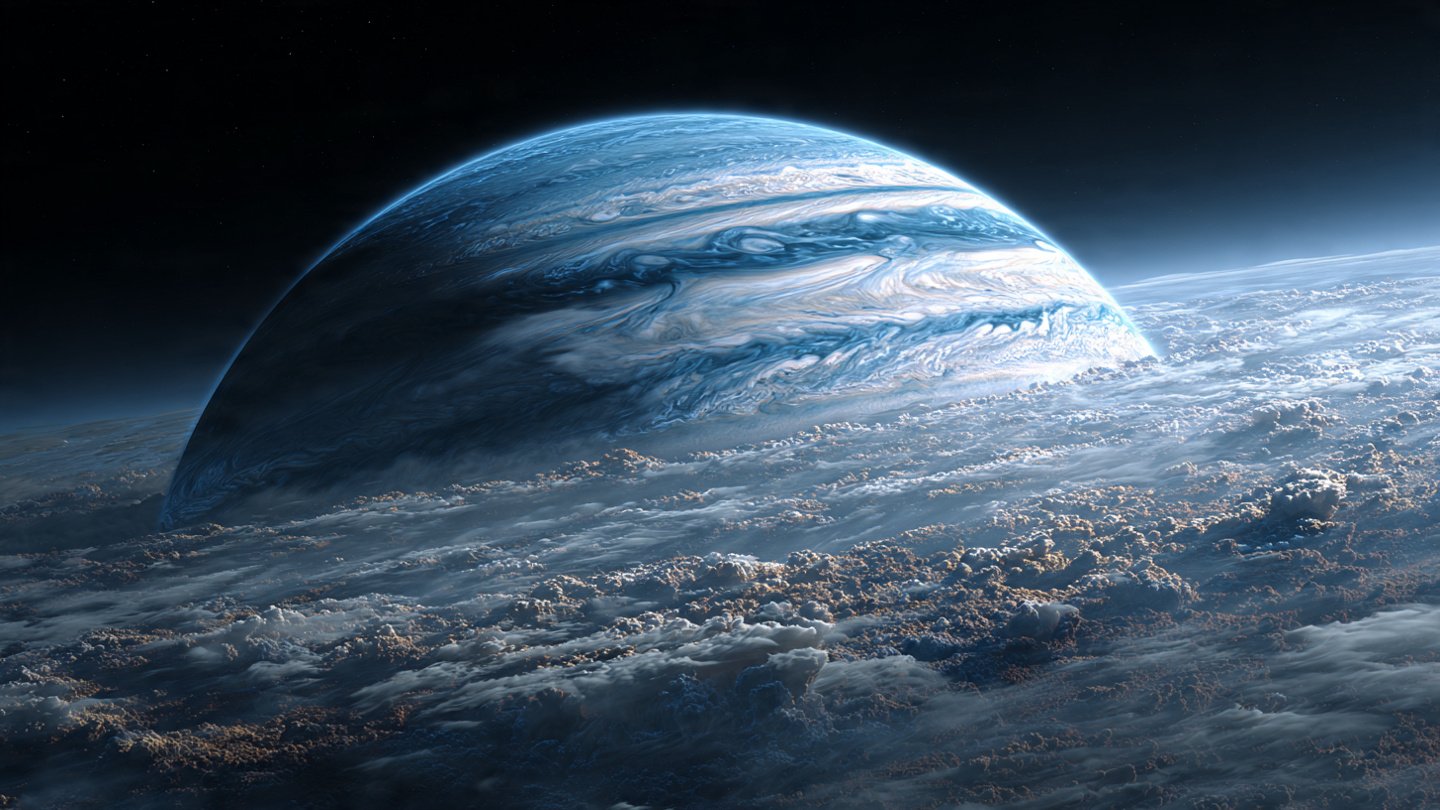
Epsilon Indi Ab sits roughly 12 light-years from Earth, orbiting a star in the southern constellation Indus. For a long time, it existed mostly as an orbital signature, a gravitational suggestion of something large and cold moving through space. Direct imaging of exoplanets is extraordinarily difficult. Most planets caught in direct images are young, hot, and bright, glowing from the residual heat of their formation. Cold planets are nearly invisible against the darkness of space.
What makes Epsilon Indi Ab unusual is its temperature. Its surface hovers somewhere between 200 and 300 Kelvin, which translates to roughly minus 73 to plus 27 degrees Celsius. For context, Jupiter's cloud tops sit around 165 Kelvin. This makes Epsilon Indi Ab warmer than Jupiter but still astonishingly cold by the standards of the exoplanets researchers have managed to study in detail. Most directly imaged gas giants clock in at over 1,000 Kelvin.[1]
The planet also carries significant mass: 7.6 times that of Jupiter, which technically makes it a super-Jupiter sitting just below the theoretical threshold for brown dwarf classification. Yet its diameter is comparable to Jupiter's, compressed by gravity into a dense, opaque sphere. When the James Webb Space Telescope turned toward it for a second time in 2026, using the MIRI coronagraphic instrument at 11.3 micrometres, what came back surprised the entire team.
What the Data Actually Showed
The first thing JWST confirmed was ammonia. The planet appeared significantly brighter at 11.3 micrometres than at 10.6 micrometres, a brightness difference of 0.88 magnitudes, which is a strong ammonia signal. At the cold temperatures of Epsilon Indi Ab, ammonia gas is expected to be abundant and should produce a pronounced spectral feature. That part fit existing predictions reasonably well.
But the ammonia signal was shallower than every model said it should be. The feature was there, just muted, as though something was muffling it. The team, led by Elisabeth Matthews at the Max Planck Institute for Astronomy, considered two possibilities. First, the atmosphere could be low in nitrogen or metallic elements, reducing the total ammonia available. Second, and far more interesting, thick clouds could be physically blocking the signal from below, preventing the full depth of the ammonia absorption from reaching the telescope.
The researchers favoured the cloud explanation. Specifically, water-ice clouds. At 200 to 300 Kelvin, water vapour in a gas giant atmosphere can condense and freeze into clouds of ice crystals, similar in principle to cirrus clouds on Earth but made of water ice rather than supercooled liquid droplets. These clouds would sit at pressure levels where they intercept and scatter light before it can probe deeper atmospheric layers, making certain molecular features appear weaker than they actually are.
The photometry across multiple wavelengths was consistently dimmer than cloud-free atmosphere models predicted. Cold giant exoplanets, as a growing sample, appear to be systematically fainter in the near-infrared than models expect. Epsilon Indi Ab is not an outlier. It is a pattern.
Why This Breaks the Standard Models
Atmospheric models for giant exoplanets have largely been built on observations of hot Jupiters, planets orbiting so close to their stars that their atmospheres are superheated to temperatures above 1,000 Kelvin. At those temperatures, clouds either evaporate or consist of exotic silicate and iron droplets. Water remains a vapour. Ammonia stays in gas form. The chemistry is extreme but, in some ways, simpler to model because fewer condensation processes are active.
At 200 to 300 Kelvin, the chemistry becomes significantly more complex. Multiple molecules begin to condense simultaneously. Water ice can form. Ammonia ice can form at even lower temperatures. These condensates clump into clouds at various pressure levels, creating a layered, patchy structure. In our own solar system, Jupiter's famous banded appearance is driven by exactly this kind of layered cloud chemistry, with ammonia ice in the upper deck and water ice deeper down.
The problem is that translating what we know about Jupiter to an exoplanet 12 light-years away involves enormous assumptions. Gravity, rotation rate, internal heat flux, composition, and the ratio of heavy elements to hydrogen all affect where clouds form and how thick they grow. The models used prior to this observation assumed atmospheres that were largely clear, or at most modestly cloudy, at solar metallicity. Epsilon Indi Ab does not cooperate with that assumption.
In mathematical terms, the radiative transfer equation used to model planetary spectra integrates over all atmospheric layers:
$$F_\nu = \int_0^\infty B_\nu(T(\tau)) \, e^{-\tau/\mu} \, \frac{d\tau}{\mu}$$Here, $F_\nu$ is the emergent flux, $B_\nu$ is the Planck function at temperature $T$, $\tau$ is the optical depth, and $\mu$ is the cosine of the viewing angle. When thick clouds are introduced, they create an effective opacity floor, a layer at which $\tau$ becomes very large and below which the atmosphere becomes opaque. Molecular features that form below that layer are smeared or erased in the observed spectrum. The models that failed to predict this were essentially assuming $\tau$ remained low across much of the infrared spectrum. That assumption is now demonstrably wrong for at least some cold giant exoplanets.[2]
The Broader Implications for Exoplanet Science
One planet with unexpected clouds could be a curiosity. A pattern of cold giant exoplanets that are all consistently fainter than predicted is a structural problem in the field. If the models cannot reliably reproduce the spectra of objects as relatively well-studied as super-Jupiters, then every atmospheric retrieval performed on less-studied worlds carries an unquantified uncertainty.
Atmospheric retrieval is the process of working backwards from an observed spectrum to infer the composition, temperature profile, and cloud structure of a planetary atmosphere. It is the primary tool astronomers use to ask whether a planet has water, carbon dioxide, methane, or any other molecule of interest. If clouds are routinely hiding or distorting these signals in ways models do not account for, then retrieved abundances could be systematically off.
This matters enormously for the long-term goal of biosignature detection. When future telescopes attempt to measure the atmospheric composition of potentially habitable rocky planets, the retrieval tools they use will be trained and validated on objects like Epsilon Indi Ab. Getting cold giant atmospheres right is not an abstract exercise. It is calibration work for the search for life.
The team also notes that the observational method used here, direct coronagraphic imaging combined with multi-wavelength photometry, represents an important technical step. It demonstrates that JWST can extract meaningful atmospheric information from cold, solar-age giant planets for the first time. Previous directly imaged planets were young enough to still be glowing from formation heat. Epsilon Indi Ab is old, cold, and faint, and JWST found it anyway.[3]
What We Actually Know
Epsilon Indi Ab has a mass of 7.6 Jupiter masses, a temperature between 200 and 300 Kelvin, and an orbital eccentricity of approximately 0.24. JWST confirmed ammonia in its atmosphere via a brightness difference between two mid-infrared wavelengths. That ammonia signal is weaker than models predicted, and the most likely explanation is thick water-ice clouds sitting high in the atmosphere and suppressing emission from lower layers. The planet is also fainter in the near-infrared than cloud-free solar-metallicity models predict, consistent with a growing pattern seen in other cold giant exoplanets.
What we do not yet know is the full vertical structure of those clouds, their grain size, their patchiness, or how representative Epsilon Indi Ab is of cold giant planets more broadly. The team is applying for additional JWST time to observe more cold Jupiter-analogs. NASA's Nancy Grace Roman Space Telescope, expected to launch in 2026 to 2027, may be able to directly detect the reflective signature of water-ice clouds in visible light, which would provide an independent confirmation of what JWST inferred from the infrared.
The models will be updated. The retrieval tools will be revised. And the next time a cold exoplanet comes into view, astronomers will go in expecting clouds where they once expected clarity. That shift in expectation, small as it sounds, is how science actually moves forward.
[1] Hot Jupiters, the most commonly studied class of giant exoplanets via direct imaging, typically have effective temperatures well above 800 Kelvin due to proximity to their host stars and residual formation heat in younger systems.
[2] The radiative transfer formulation here is a simplified single-stream version. Full retrieval codes use multi-stream methods (e.g., discrete ordinate) and include scattering terms for cloud particles. The core principle of the opacity floor introduced by condensate clouds holds across these more detailed treatments.
[3] The study is formally titled "A second visit to Eps Ind Ab with JWST: new photometry confirms ammonia and suggests thick clouds in the exoplanet atmosphere of the closest super-Jupiter," published in The Astrophysical Journal Letters, 2026, by Elisabeth C. Matthews et al., doi: 10.3847/2041-8213/ae5823.
Comments (0)
Leave a Comment