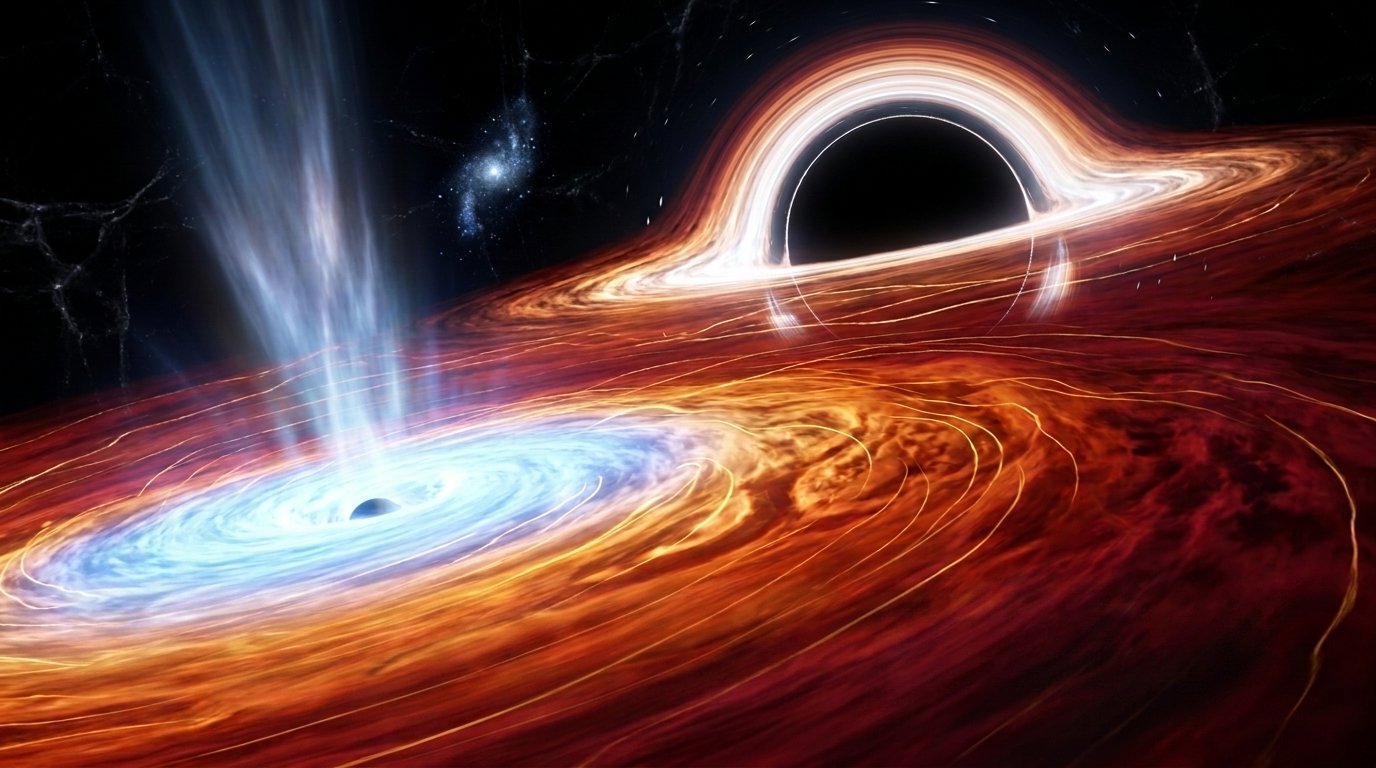
Why GN-z11's Black Hole Should Not Exist
The light arrived after 13.4 billion years of travel, landed on an instrument floating 1.5 million kilometers from Earth, and inside the data it carried was something that, by our best physics, should not have been there. A black hole. Ancient. Actively feeding. Sitting in a galaxy that existed when the universe was three percent of its current age — and consuming matter at a rate that the standard model of black hole growth says is physically impossible to sustain.
This is not a matter of incomplete data or instrument error. The signal was checked, rechecked, and published in Nature in 2024 by a team led by Roberto Maiolino at the University of Cambridge.[1] The object is designated GN-z11. It is the most distant confirmed active black hole ever found. And it is currently eating its own galaxy from the inside.
What GN-z11 Actually Is
GN-z11 was first identified in 2016 using Hubble's Wide Field Camera 3 as part of the CANDELS and GOODS-North survey programs. The name is a catalog label rather than a poetic one: GN for GOODS-North, z11 for its redshift. What the name does not convey is the strangeness of the object.
At a redshift of $z = 10.6034$, GN-z11 is observed as it existed approximately 430 million years after the Big Bang.[2] The light-travel distance is 13.4 billion light-years. The present proper distance, accounting for the expansion of space during the photons' journey, is approximately 32 billion light-years. Both figures describe the same object answering different questions: one tells you how old the message is, the other tells you how far the sender has traveled since writing it.
Physically, the galaxy is small. Its diameter spans roughly 4,000 light-years, approximately one hundred times smaller than the Milky Way. Its stellar mass is around one billion solar masses, approximately one percent of our own galaxy's stellar content. It is irregular in shape, compact, and in 2016 was already producing ultraviolet light at three times the rate of any galaxy of comparable age and distance in the observational record.
That brightness anomaly was the first problem. GN-z11 was forming stars at roughly twenty times the current rate of the Milky Way, from a galaxy with a tiny fraction of our resources. The models could not comfortably account for it using star formation alone. Something else was contributing energy. Finding out what required a different telescope operating at wavelengths Hubble could not reach.
How JWST Read the Signal Inside the Light
The James Webb Space Telescope observed GN-z11 in 2022 and 2023 as part of the JADES program, the JWST Advanced Deep Extragalactic Survey, using its Near-Infrared Spectrograph, NIRSpec. The instrument splits incoming light into its component wavelengths, producing a spectrum that carries chemical and physical information about the source environment. At a redshift of 10.6, ultraviolet emission lines that astronomers use to identify physical processes in nearby galaxies are stretched by cosmic expansion into the infrared range that NIRSpec was specifically engineered to access.
What the spectrum revealed was the emission line designated [Ne IV] $\lambda$2423. This line arises from neon ionized to its fourth state, meaning neon atoms that have had four electrons stripped away. Producing this level of ionization requires photons carrying more than 63.5 electron volts of energy.[3] Ordinary stars, including the most massive and hottest stars found in starburst galaxies, do not routinely produce photons at this energy. The only known astrophysical environment that generates photons energetic enough to strip neon to this degree, consistently and in the quantities GN-z11's spectrum showed, is the accretion disk around an actively feeding supermassive black hole.
[Ne IV] is described in the spectroscopic literature as an unambiguous AGN tracer. The word unambiguous carries genuine weight in this context. The Maiolino team also found semi-forbidden UV emission lines consistent with gas densities above $10^5$ cm$^{-3}$, matching the broad-line regions immediately surrounding accreting black holes, and emission line broadening consistent with gas moving at hundreds of kilometers per second in a strong gravitational environment. Each signature alone would invite interpretation. Together, they converged on a single explanation.
The black hole mass was estimated from the emission line widths using virial relations, calibrated relationships between line width and black hole mass validated across lower-redshift systems. The result: $\log(M_\text{BH} / M_\odot) = 6.2 \pm 0.3$, corresponding to approximately 1.6 million solar masses. At the center of our own galaxy, Sagittarius A* is four million solar masses. GN-z11's black hole is, by modern standards, not particularly large.
The crisis is not the mass. The crisis is the age.
The Eddington Limit and Why GN-z11 Violates It
When a black hole accretes gas, the infalling material forms a rotating disk and heats to millions of degrees, emitting intense radiation. That radiation exerts outward pressure on the infalling gas. At the Eddington luminosity, radiation pressure exactly balances gravitational attraction, and the accretion self-regulates. Exceeding this luminosity would, in the standard picture, blow the infalling gas away and shut off the feeding.
The Eddington luminosity is given by:
$$L_\text{Edd} = \frac{4 \pi G M m_p c}{\sigma_T}$$where $G$ is Newton's gravitational constant, $M$ is the black hole mass, $m_p$ is the proton mass, $c$ is the speed of light, and $\sigma_T$ is the Thomson scattering cross-section of electrons. Numerically this evaluates to approximately $1.26 \times 10^{38}$ erg/s per solar mass. For GN-z11's black hole of 1.6 million solar masses, the Eddington luminosity is approximately $2 \times 10^{44}$ erg/s.
The Eddington ratio, $\lambda_\text{Edd}$, measures the actual accretion rate as a fraction of this limit:
$$\lambda_\text{Edd} = \frac{L_\text{bol}}{L_\text{Edd}} = \frac{\dot{M}}{\dot{M}_\text{Edd}}$$For GN-z11, this ratio is approximately 5.5. The black hole is accreting at five and a half times the Eddington limit. Cosmological simulations, including state-of-the-art zoom-in models, calculate the probability of finding a black hole with this combination of mass and Eddington ratio at $z \sim 10$--11 in the volume surveyed by JWST at less than 0.2%.[4] The simulations cannot reproduce this object. Not rarely. Essentially never.
It is important to note what this means precisely. The Eddington limit is not a fundamental conservation law. It is an approximation derived from an idealized spherically symmetric accretion model. The real constraint is on how the physics behaves beyond the standard operating regime, which is where the slim disk enters the picture.
The Slim Disk: What Happens When Accretion Exceeds the Limit
In the standard thin accretion disk model developed by Shakura and Sunyaev in 1973, the disk is geometrically flat relative to its radius. The scale height $H$ satisfies $H/R \ll 1$. The disk radiates efficiently, cooling as it heats, and maintains thermal equilibrium. In this regime the Eddington limit holds as a natural ceiling because the outward radiation pressure is free to oppose infalling material.
At accretion rates significantly above the Eddington limit, the gas falls inward faster than the disk can radiate away the energy being generated. Photons are produced by friction and compression inside the disk but cannot diffuse outward through the dense, optically thick material before the bulk gas flow carries them inward. This process, called radiation trapping or advection, was first described theoretically by Abramowicz and colleagues in 1988.[5] The disk inflates geometrically as the trapped energy builds internal pressure. The scale height grows until $H/R \sim 1$, producing what is called a slim disk.
In this regime, a significant fraction of the generated energy is advected into the black hole along with the gas rather than escaping as radiation. The outward photon flux is reduced relative to the actual accretion rate, weakening the radiation pressure that would otherwise enforce the Eddington ceiling. The black hole can eat faster because the light it generates is being buried rather than broadcast.
The slim disk also generates large internal pressure gradients that drive powerful outflowing winds from its swollen surface layers. This is the physical origin of the wind detected in GN-z11's spectrum.
The Wind at 1,000 Kilometers Per Second
GN-z11's spectrum contains a deep, blueshifted absorption trough in the carbon emission line C IV. Blueshifted absorption means gas moving toward the observer, which in this geometry means gas being expelled outward from the galaxy's center. The blueshift corresponds to a velocity of 800 to 1,000 km/s, derived from the Doppler relation:
$$\frac{\Delta \lambda}{\lambda_0} = \frac{v}{c}$$At 1,000 km/s, this wind is moving at approximately 0.33% of the speed of light. For GN-z11, a galaxy of roughly one billion solar masses enclosed within 4,000 light-years, this velocity exceeds the gravitational escape velocity. Gas entrained in this outflow does not return. It enters the surrounding intergalactic medium and continues outward permanently.[6]
Gas is the precondition for star formation. When it is removed from the galaxy, the star-forming regions that depended on it exhaust their local reserves without replenishment. New nurseries fail to ignite. The star formation rate that made GN-z11 three times more UV-luminous than its contemporaries begins to fall. The process is not explosive. It is mechanical, slow, and complete.
The same gas being expelled is also the gas that would continue feeding the accretion disk. The wind that the black hole drives outward is simultaneously cutting off the black hole's own future supply. The most extreme accretion phase is therefore self-terminating: feeding generates the wind, the wind removes the gas, the gas was the food, the accretion fades. A loop that requires no external intervention and violates no physical law. An emergent inevitability.
The Nitrogen That Shouldn't Be There
The accretion anomaly is not the only mystery in GN-z11's spectrum. The galaxy also shows a nitrogen-to-oxygen ratio expressed as $\log(\text{N/O}) > -0.25$, significantly above solar values, in a galaxy that has had tens of millions of years of dominant stellar activity.[7]
Nitrogen is produced primarily through intermediate stages of stellar evolution, through the CNO cycle operating at high temperatures. Its abundance relative to oxygen in a galaxy's gas reflects the accumulated history of stellar processing across that galaxy's lifetime. Standard chemical evolution models reproduce nitrogen-to-oxygen ratios in local galaxies with considerable accuracy. Applied to GN-z11, they fail. No standard prescription reaches the observed value on the available timescale without invoking conditions that would be considered unusual in any other context.
What makes this notable beyond being a modeling failure is where the anomalous value points. The nitrogen excess in GN-z11 matches the chemical fingerprint of globular cluster stars in the Milky Way today, produced by high-temperature proton-capture reactions in the CNO cycle operating in dense stellar environments.[8] GN-z11 may be forming, in its dense central regions, the stellar populations that will eventually become globular clusters. The oldest structures in our own galaxy, with their anomalous chemical signatures intact after 12 billion years, may carry the chemical memory of environments like the one GN-z11 represents.
Hebe: Pristine Gas From the First Minutes of the Universe
Three kiloparsecs from GN-z11's center, NIRSpec detected something unexpected in the surrounding halo: a gas clump emitting at the wavelength of ionized helium and nothing else. No oxygen emission. No carbon. No nitrogen. No signature of any element that any star anywhere has ever produced and returned to the surrounding medium. Only hydrogen and helium, the products of Big Bang nucleosynthesis, sitting untouched in the halo of one of the most chemically active objects in the early universe.
The team named this clump Hebe, partly for the Greek goddess of youth, partly for the technical designation of the helium emission line that revealed it. Follow-up observations in 2025 and 2026 using high-resolution JWST spectroscopy resolved Hebe into two spatial components, C1 and C2, both showing He II $\lambda$1640 emission at $z = 10.6$ with no detectable metal lines to deep upper limits.[9]
The interpretation that best fits the data: a cluster or two clusters of Population III stars, the universe's first generation, forming from gas that has been sitting uncontaminated since the first minutes after the Big Bang. Population III stars form from purely primordial gas. They have never been directly confirmed anywhere. Hebe is currently the strongest candidate for such a detection ever found.
How pristine gas survives in the halo of a galaxy that has been forming stars and driving AGN winds at extreme rates is explained, tentatively, by geometry and timing. The enriched outflows travel outward along specific paths through the halo. Filaments of pristine gas from the surrounding intergalactic medium arrive along different channels that the enrichment front has not yet reached. At the specific epoch we observe GN-z11, those channels were apparently still intact.
What the Models Cannot Explain
Standard cosmological simulations, including EAGLE, Illustris, IllustrisTNG, and the more recent SEEDZ suite, cannot produce GN-z11 at the mass and accretion rate observed. The probability analysis places the object at less than 0.2% in the surveyed volume. This failure has several candidate explanations, none of them confirmed.
Resolution is one candidate. Large cosmological simulations cover sufficient volume to be statistically meaningful, but they resolve the physics near a black hole only approximately through sub-grid prescriptions. The microphysics of slim disk accretion, seed formation, and early super-Eddington growth happen on scales below the simulation resolution limit. A prescription calibrated to average behavior may simply miss the extreme tail of the distribution where GN-z11 lives.
Seeding is another. Most simulations place black hole seeds in dark matter halos above a mass threshold, with a fixed initial mass chosen for numerical convenience, typically around $10^4 \, M_\odot$. This approximation does not model the actual physical formation of seeds from Population III stellar remnants or direct collapse events. If real seed masses, timing, or early gas conditions differ from what the prescription assumes, the simulated high-redshift black hole population will not match what JWST finds.
A third possibility is that something in the physics of early black hole growth is genuinely not accounted for in any current theoretical framework. The honest answer from the community is that this cannot be ruled out, and that ruling it out requires better simulations, more data, and more objects like GN-z11 to constrain the models.
What GN-z11 Tells Us About Every Galaxy
Machine learning classification applied to three major cosmological simulations finds that the single strongest predictor of whether a galaxy is forming stars or has stopped is not its stellar mass, its halo mass, its size, or the current luminosity of its AGN. It is the mass of the central black hole.[10]
Not what the black hole is doing right now. What it has accumulated over its entire history. The mass is the fossil record of all past accretion, all past feedback, all past winds driven into the surrounding gas. A galaxy with a more massive central black hole is more likely to be quenched, regardless of whether that black hole is currently active. The cumulative effect is what matters, not the present-tense state.
GN-z11 is catching this process at maximum intensity. The black hole is building the mass that will, long after the accretion fades, continue to influence the galaxy's fate through the legacy of cleared gas and the gravitational presence of a dormant engine at the center of a relic stellar population.
Our own galaxy has a black hole. Sagittarius A* is four million solar masses and currently dormant. The Fermi Bubbles, giant lobes of gamma-ray emission extending 25,000 light-years above and below the Milky Way, are thought to be remnants of a major accretion event a few million years ago. The same physics governs both systems. The same feedback loop. The same relationship between black hole mass and galactic fate. At a lower intensity, for now.
What We Actually Know
GN-z11 exists. The spectrum is real. The [Ne IV] emission, the CIV absorption wind, the elevated nitrogen abundance, the pristine helium clump in the halo, the black hole mass of 1.6 million solar masses, the Eddington ratio of approximately 5.5 -- all of it is in the data, checked carefully by a team that was methodical rather than eager.
What we do not know: whether the black hole seed was heavy or light. Whether Hebe contains Population III stars or something else. Whether the models fail because of resolution and seeding prescriptions or because of genuinely new physics. Whether the nine neighboring galaxies at matching redshifts constitute a proto-cluster that contributed to GN-z11's extreme properties. Whether the trajectory the simulations project -- a quenched relic galaxy with a dormant black hole at its center -- is what GN-z11 has actually become in the 13.4 billion years since this light left it.
What we do know is that the universe produced something like this, once, in a volume of sky JWST pointed at early in its mission, at a time when the universe was barely getting started. That it carried inside its light a complete account of accretion physics at the extreme, chemical nucleosynthesis connecting to our own galaxy's oldest structures, and possibly the first generation of stars the universe ever made.
The light crossed 13.4 billion years to reach the mirror. The mirror read it. We are still working out what it said.
[1] Maiolino, R. et al. (2024). A small and vigorous black hole in the early Universe. Nature, 627, 59--63.
[2] Bunker, A. J. et al. (2023). JADES NIRSpec Spectroscopy of GN-z11. Astronomy & Astrophysics, 677, A88.
[3] The ionization energy of Ne3+ to Ne4+ is 97.11 eV, but the [Ne IV] emission requires the preceding ionization state to be present in the gas. The effective photon energy threshold required to sustain the Ne IV emitting population is above 63.5 eV, well beyond the range of normal stellar photospheres.
[4] Trinca, A. et al. (2024). Is GN-z11 powered by a super-Eddington massive black hole? Astronomy & Astrophysics, A&A 2024 paper on super-Eddington probability in JADES survey volume.
[5] Abramowicz, M. A. et al. (1988). Slim Accretion Disks. The Astrophysical Journal, 332, 646--658.
[6] The escape velocity of GN-z11 is estimated from its total mass and size. For a galaxy of approximately $10^9 \, M_\odot$ within a radius of roughly 600 pc, the escape velocity at that radius is well below 1,000 km/s, confirming that the wind velocity is sufficient for permanent gas removal.
[7] Cameron, A. J. et al. (2023). Initial data release from the JWST observation of GN-z11 confirming $\log(\text{N/O}) > -0.25$. See also Bunker et al. 2023 for the primary spectral data.
[8] Senchyna, P. et al. (2024). GN-z11 in Context: Possible Signatures of Globular Cluster Precursors at Redshift 10. The Astrophysical Journal, 966, 92.
[9] Maiolino, R. et al. (2024). JADES. Possible Population III signatures at $z = 10.6$ in the halo of GN-z11. Astronomy & Astrophysics, 687, A67. Confirmed in companion papers: Maiolino et al. 2026; Ubler et al. 2026.
[10] Bluck, A. F. L. et al. (2023). The Fundamental Signature of Star Formation Quenching from AGN Feedback. The Astrophysical Journal, 944, 108.
Comments (0)
Leave a Comment