Why the Moon Is Slowly Leaving Earth
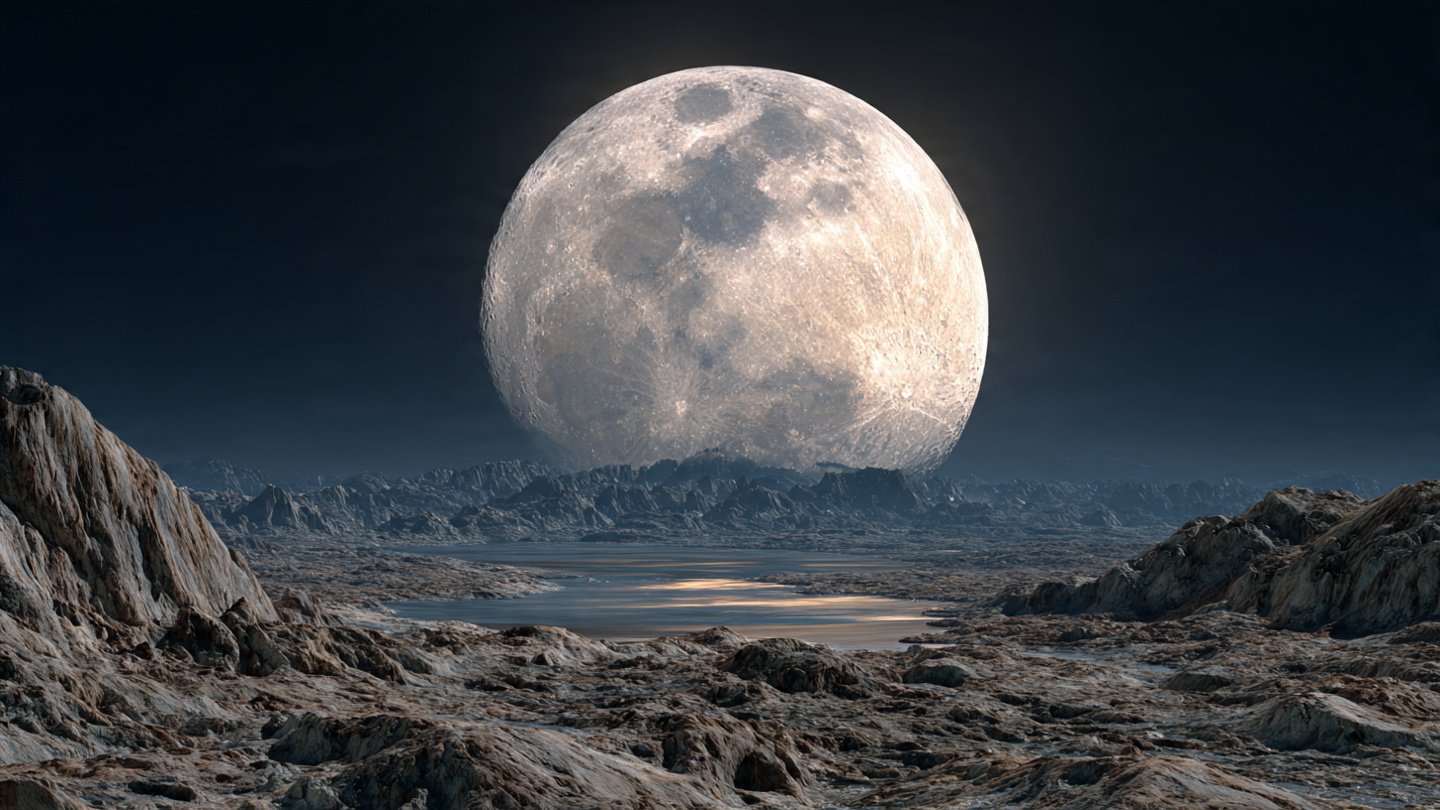
Most people assume the Moon has always been where it is tonight. Fixed at a comfortable distance, rising and setting on schedule, the same object that every human civilization has looked up at and named and built calendars around. That assumption is wrong. The Moon is leaving. It has been leaving since it formed roughly 4.5 billion years ago, and the mechanism driving it away is not some distant cosmic force. It is the ocean beneath your feet, responding to the same pull that moves tides every single day.
The Number That Does Not Feel Real
The Moon recedes from Earth at approximately 3.8 centimeters per year. That is the width of two fingers pressed together. Measured across a distance of 384,000 kilometers, the ratio is so extreme that it resists intuition entirely. The measurement itself became precise only after 1969, when Apollo astronauts placed retroreflector panels on the lunar surface. Since then, observatories including the McDonald Observatory in Texas and the Apache Point Observatory in New Mexico have been firing laser pulses at those panels and timing the return to the nearest picosecond, one trillionth of a second, to derive the exact distance each year compared to the last.
The result is not a model or an inference. It is a timed measurement. Light leaves Earth, strikes the panel, returns. The round trip takes approximately 2.5 seconds. The elapsed time, measured with atomic clocks, translates directly into distance. Year after year, the number increases by 3.8 centimeters.
What makes this figure remarkable is not its size but its consequence. That same recession rate, running continuously for four billion years, has moved the Moon from an original distance of perhaps 24,000 kilometers out to its current 384,000. The Moon was once roughly three times closer than it is tonight. The sky looked different. The tides were different. The length of the day was different. Everything downstream of the Moon's distance was different, and all of it changed because of 3.8 centimeters per year compounding across deep time.
Why the Ocean Is Responsible
The mechanism behind the recession is tidal in origin, but not in the simple sense of tides rising and falling. It involves the geometry of how Earth's rotation interacts with the gravitational bulge the Moon creates in the ocean.
The Moon's gravity pulls on Earth's oceans, creating a bulge of elevated water on the side of Earth facing the Moon, and a corresponding bulge on the opposite side. If Earth were not rotating, these bulges would sit directly beneath and directly opposite the Moon, perfectly aligned, producing no net effect on the Moon's orbit. But Earth rotates faster than the Moon orbits. One full Earth rotation takes 24 hours. One full lunar orbit takes 27.3 days. The Earth is spinning considerably faster than the Moon is going around it.
Because of this speed difference, the tidal bulges get dragged forward by the Earth's rotation, displaced slightly ahead of the Moon's position by a few degrees. These displaced bulges are not just water. They represent real mass distributed across the ocean, and mass exerts gravitational pull. The forward-displaced bulge pulls the Moon in the direction it is already traveling, adding energy to its orbit. In orbital mechanics, adding energy to an orbit does not speed the object up in the intuitive sense. It pushes the object to a higher, wider orbit. The Moon drifts outward.
The energy for this has to come from somewhere. It comes from Earth's rotation. The displaced bulge, by pulling the Moon forward, also drags back on the Earth, applying a continuous braking force to the planet's spin. The Earth slows down. The day gets longer. The Moon moves farther away. These are not two separate phenomena. They are one transaction described from two positions.
The total tidal dissipation across Earth's oceans runs to approximately 3.75 terawatts, a significant fraction of total global human energy consumption, continuously converting rotational energy into the Moon's orbital energy. All of it. Every tide that has ever moved across a continental shelf, every bay where water piles and retreats, every estuary across the entire history of Earth's oceans, has contributed to the Moon's recession.
$$E_{tidal} \approx 3.75 \times 10^{12} \text{ W}$$What the Early Sky Actually Looked Like
Four billion years ago, the Moon's angular size in the sky was not double what we see tonight. Because tidal force scales with the cube of distance, the relationship between proximity and effect is not linear. A Moon three times closer produces tidal forces roughly 27 times stronger than the current Moon. The angular size would have been approximately 10 to 15 times larger in the sky, occupying a visible, undeniable portion of the overhead.
The geological record supports this. Stromatolites, fossilized microbial mats found in ancient formations including the Pilbara region of Western Australia, preserve layered records of biological activity that function as clocks. Analysis of these layers indicates that days in the Archean period ran approximately 14 hours. Earth was spinning nearly twice as fast as it does today.[1]
Tidal surges under a Moon that close were not tides in the modern sense. Sedimentary evidence from the Archean suggests periodic inundations of continental margins on the order of tens of meters, repeating on a cycle of six to seven hours rather than the current twelve. The tidal cycle was faster because both the day and the lunar orbit were shorter. The ocean was in near-constant heavy motion across a planet that was itself more tectonically active and less biologically complex than the one that exists now.
The angular size calculation follows directly from the geometry of apparent diameter:
$$\theta = 2 \arctan\left(\frac{r_{moon}}{d}\right)$$Where $r_{moon}$ is the Moon's physical radius and $d$ is the distance. At 24,000 kilometers, $\theta$ produces an angular diameter roughly 12 times the current value of approximately 0.5 degrees. The Moon would have subtended roughly 6 degrees of sky. For comparison, your closed fist held at arm's length covers approximately 10 degrees. The early Moon would have been more than half that width, visible in unmistakable detail with no optical aid.
The Eclipse Window and Why It Is Closing
The Sun is 400 times wider than the Moon. The Sun is also, at present, almost exactly 400 times farther away. These two ratios cancel, producing an apparent angular size for both objects that is nearly identical as seen from Earth's surface. This is why total solar eclipses are possible. The Moon fits over the Sun precisely enough to block the photosphere completely while leaving the corona visible.
This geometric arrangement is temporary. As the Moon recedes, its apparent angular size shrinks. The window during which the Moon is close enough to cover the Sun completely has been open for some time and will remain open for approximately another 600 million years. After that, the Moon will be too small to produce totality. What remains will be annular eclipses only, the Moon centered on the Sun but surrounded by a visible ring of solar disk that the smaller lunar silhouette can no longer hide.[2]
No other planet in the solar system currently experiences total solar eclipses in this precise sense. The geometry requires a moon of the right size at the right distance, and that combination is, for Earth, a phase rather than a permanent condition.
Tidal Locking and the Destination
The recession has a direction and that direction has an endpoint, at least in principle. The same tidal mechanism that drives the Moon outward also slows Earth's rotation. The Earth's day is currently lengthening at approximately 1.4 milliseconds per century, confirmed by the historical record of solar eclipses whose timing only resolves correctly when the gradual deceleration is accounted for.[3]
The endpoint of this process is mutual tidal locking. The Moon is already locked to Earth, keeping one face permanently toward the planet, a process that completed billions of years ago. Earth's locking to the Moon is still in progress. When complete, the Earth's rotation period would match the Moon's orbital period at approximately 47 current days. The Moon would sit fixed above one hemisphere, never rising or setting. The opposite hemisphere would never see the Moon at all.
The Pluto-Charon system has already reached this state. Charon hangs motionless above one Plutonian hemisphere, going through phases as the Sun's angle changes across their shared 6.4-day orbital period, invisible from the other side entirely. This is the described destination of the Earth-Moon system.
Whether it is reached is a separate question. Current estimates for the full locking timescale range from 50 billion years upward, depending on assumptions about future tidal dissipation rates, which depend on future continental configurations that plate tectonics models cannot reliably project on those timescales. The Sun will exhaust its hydrogen fuel and expand into a red giant in approximately five billion years, almost certainly before the locking completes. The recession may never reach its mathematical conclusion. It will simply be interrupted by a larger sequence of events operating on its own schedule.
$$T_{lock} \sim \frac{\omega a^6 I Q}{3 G m_{moon}^2 R^5}$$Where $\omega$ is the current rotation rate, $a$ is the semi-major axis, $I$ is the moment of inertia, $Q$ is the tidal dissipation factor, $G$ is the gravitational constant, $m_{moon}$ is the lunar mass, and $R$ is Earth's radius. The result is sensitive to $Q$, which varies with ocean geometry and is not constant across geological time.
What We Actually Know
The Moon is receding at 3.8 centimeters per year. This is not a model prediction. It is a direct measurement, repeated annually for over fifty years using laser ranging to retroreflector panels placed on the lunar surface in 1969. The mechanism is tidal friction: Earth's rotation drags the oceanic tidal bulge ahead of the Moon's position, the displaced bulge pulls the Moon forward into a wider orbit, and the energy for this transfer comes from Earth's spin, which slows measurably as a result.
Four billion years of this process have moved the Moon from roughly 24,000 kilometers to 384,000 kilometers. The early Moon was approximately three times closer, subtended 10 to 15 times the current angular size, and produced tidal forces tens of times stronger, resulting in a 14-hour day, massive periodic inundations of continental margins, and a sky that no living thing today would recognize.
The recession will continue. The day will continue lengthening. The eclipse window will continue narrowing. The endpoint of full mutual tidal locking exists in the mathematics but will likely not be reached before the Sun's evolution intervenes. Two timelines are running simultaneously, and the shorter one belongs to the star.
Tonight the Moon is 3.8 centimeters farther than it was last year. It looks identical to the Moon of last year, and the year before, and every year in recorded human history. The recession is invisible at any timescale a human life can navigate. But it is running, continuously, in the dark, whether anyone is watching or not.
[1] Williams, G.E. (2000). Geological constraints on the Precambrian history of Earth's rotation and the Moon's orbit. Reviews of Geophysics, 38(1), 37-59. Stromatolite layer analysis from the Pilbara Craton provides one of the most direct geological records of Archean day length.
[2] Sigismondi, C. (2005). Lunar secular acceleration and the eclipse series. The total eclipse window calculation depends on the current recession rate and the angular size differential between Sun and Moon, which narrows at approximately 0.5 arcseconds per century.
[3] Stephenson, F.R., Morrison, L.V., and Hohenkerk, C.Y. (2016). Measurement of the Earth's rotation: 720 BC to AD 2015. Proceedings of the Royal Society A. Historical eclipse records provide a 2,700-year baseline confirming the deceleration of Earth's rotation at a rate consistent with tidal braking models.
Comments (0)
Leave a Comment