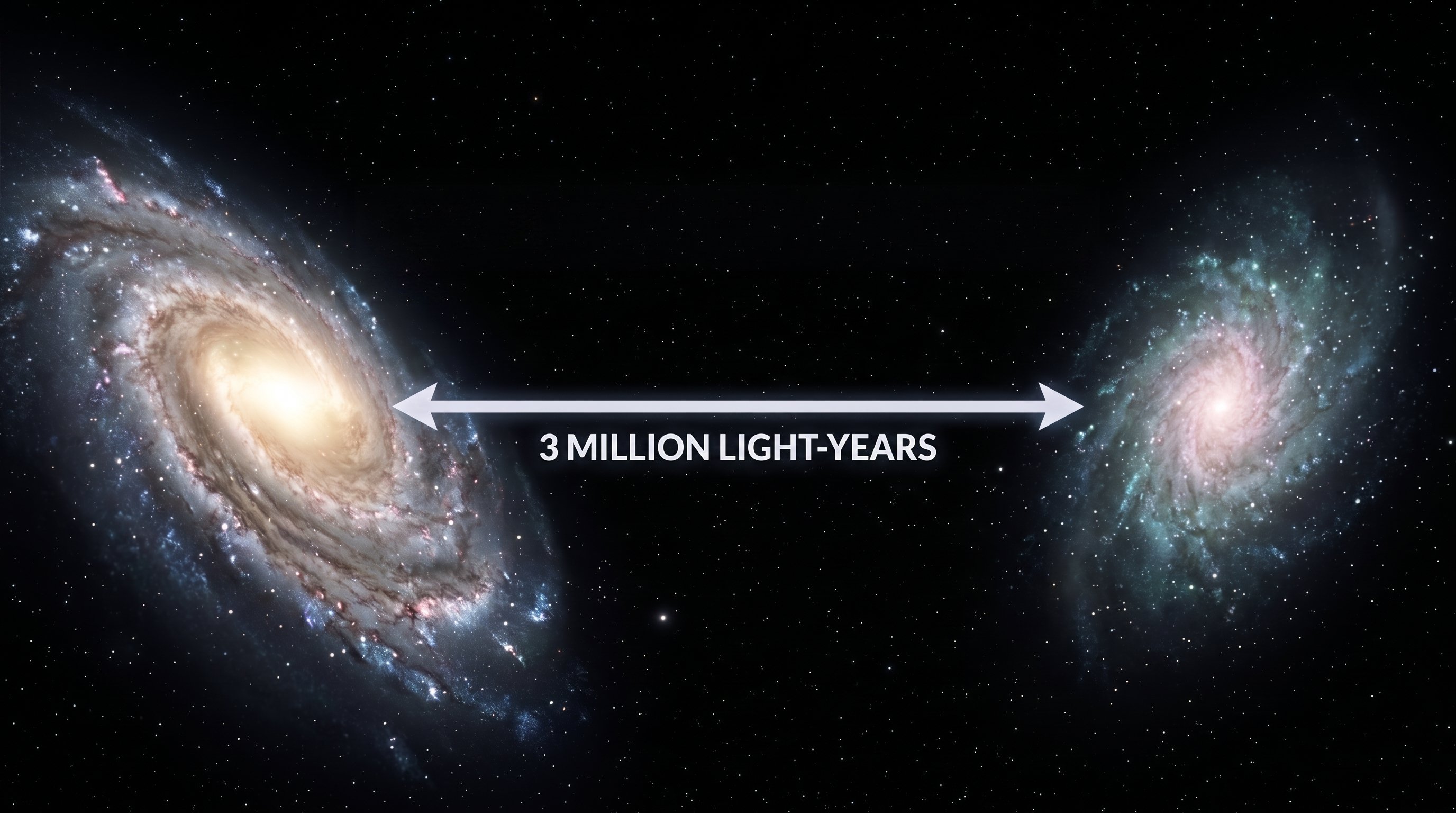
Why the Triangulum Galaxy Cannot Be Stopped
The light arriving from the Triangulum Galaxy tonight left that galaxy nearly three million years ago, before anatomically modern humans drew a first breath. The galaxy has been moving since then. Its stars have aged, its arms have rotated, its interstellar gas has condensed into new stars and been scattered again by supernovae. We have no idea what it looks like right now. The now of M33 is permanently inaccessible to us. What we do know is that it is approaching, that it cannot stop, and that the gravitational system it belongs to has been arranging a collision for longer than the Earth has existed.
The Third Galaxy Nobody Talks About
The Triangulum Galaxy, catalogued as Messier 33, is the third-largest member of the Local Group -- the gravitationally bound collection of roughly 54 galaxies within a radius of about one megaparsec centered between the Milky Way and Andromeda. It is not a dwarf galaxy. It is a full spiral, 60,000 light-years in diameter, containing approximately 40 billion stars, with a star formation rate per unit mass roughly ten times higher than Andromeda's. By mass, the three dominant Local Group members relate to each other at approximately 10:10:1. Andromeda and the Milky Way hold most of the gravitational authority. M33 is the smallest voice in the room. But in a three-body gravitational system, the smallest voice still changes the answer.
Giovanni Battista Hodierna recorded it before 1654 without knowing what it was. Charles Messier catalogued it on the night of August 25, 1764, and described it as a whitish light of almost even density containing no star. Which is accurate, as far as it goes. It is just that a whitish light of almost even density is perhaps the least alarming description possible for something that is a gravitational participant in the future transformation of the Milky Way.
M33 is a pure disk galaxy: no classical bulge, no central thickening, flat all the way to the nucleus. This structural fact turns out to matter enormously for what lives, or does not live, at its center.
The Nucleus With Nothing in It
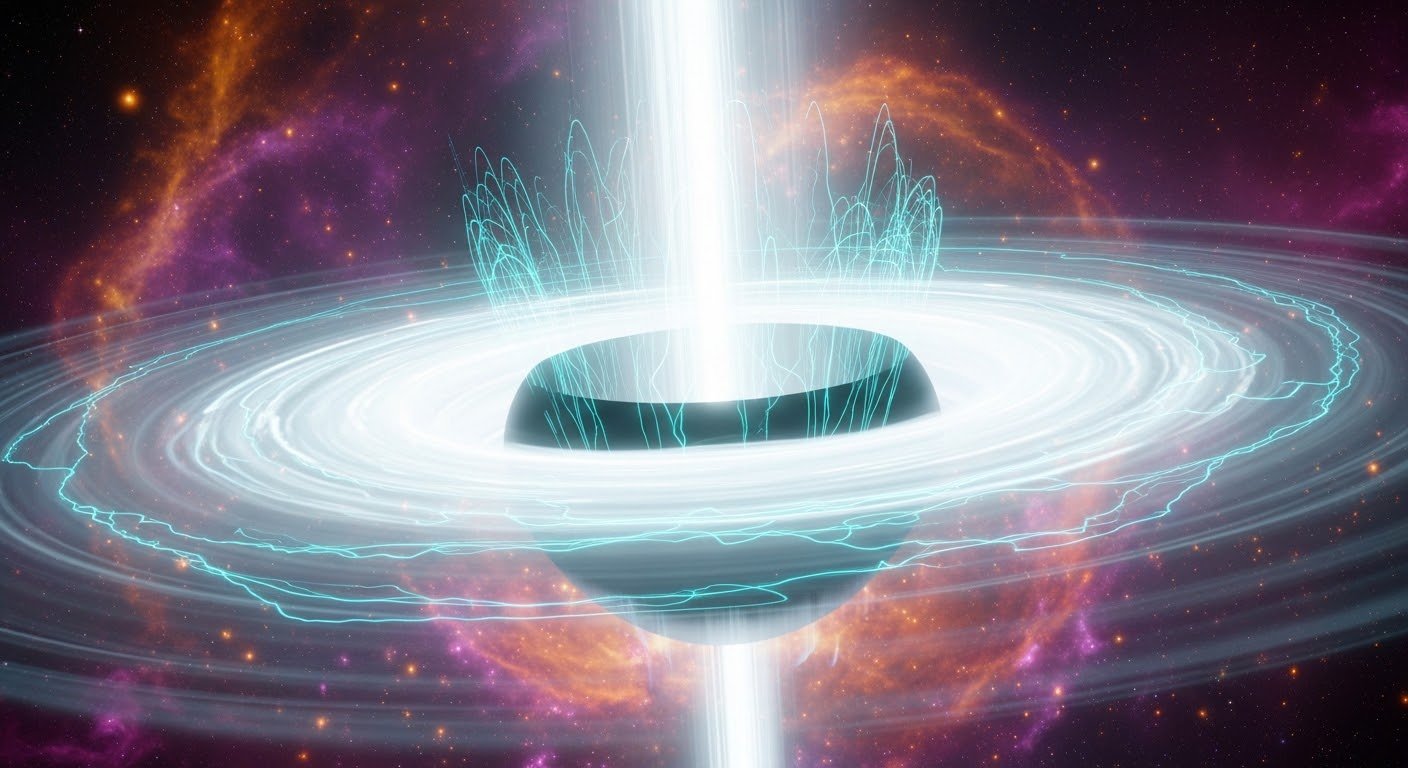
Most large spiral galaxies host a supermassive black hole at their center. The Milky Way's central black hole, Sagittarius A*, weighs approximately four million solar masses. Andromeda's weighs roughly a hundred million. The correlation between a galaxy's central bulge mass and its supermassive black hole mass is one of the tightest relationships in extragalactic astronomy, holding across several orders of magnitude and hundreds of observed galaxies. [1]
M33 has no bulge. The consequence follows directly: the Hubble Space Telescope's Space Telescope Imaging Spectrograph measured stellar velocities at M33's nucleus at a resolution approximately ten times finer than any previous observation. What it found was not the characteristic velocity rise that a massive central object would produce. The best-fit dynamical model returned a central black hole mass of zero. The upper limit, at the boundary of what the data permit, is 3,000 solar masses -- three orders of magnitude below the smallest confirmed supermassive black hole in any other galaxy. [2]
What occupies M33's nucleus instead is an HII region: ionized hydrogen, glowing gas, the same material found in star-forming nebulae scattered across the disk. The center of M33 is not a gravitational well of extraordinary depth. It is, functionally, a star-forming cloud.
Despite this, M33's nucleus is not quiet. It hosts M33 X-8, the nearest ultraluminous X-ray source to the Milky Way. An ultraluminous X-ray source is a compact object -- a stellar-mass black hole or neutron star -- radiating above the Eddington luminosity limit: the maximum brightness achievable through spherical accretion before radiation pressure overcomes gravity. The Eddington luminosity for a body of mass $M$ is:
$$L_{\text{Edd}} = \frac{4 \pi G M m_p c}{\sigma_T}$$where $G$ is the gravitational constant, $m_p$ is the proton mass, $c$ is the speed of light, and $\sigma_T$ is the Thomson scattering cross section. Objects like M33 X-8 exceed this limit through super-Eddington accretion, in which the geometry of the accretion disk changes to allow more collimated radiation escape. The compact object at M33 X-8's center has not been identified as either a black hole or a neutron star. Its X-ray output is modulated by approximately 20% over a period of 106 days, adding behavior that fits neither category cleanly. [3]
The Violent Interior of a Quiet-Looking Galaxy
NGC 604 sits in M33's northeastern spiral arm. It is 1,500 light-years across, powered by more than 200 O-type stars with surface temperatures exceeding 30,000 Kelvin, and it is the second most luminous HII region in the entire Local Group, behind only 30 Doradus in the Large Magellanic Cloud. The visible portion of the Orion Nebula spans roughly 24 light-years. NGC 604 is approximately 40 times larger in extent. [4]
NGC 604 has not undergone one episode of star formation. Observations across multiple wavelengths show evidence of sequential triggered episodes: shockwaves from earlier generations of massive stars compressed surrounding gas, which collapsed into new stellar clusters, which drove their own shockwaves outward. A self-sustaining chain of pressure and collapse, propagating through the molecular cloud over millions of years.
M33's overall star formation rate is approximately 0.7 solar masses per year. Per unit of available mass, this is roughly ten times the rate sustained by Andromeda. One supernova occurs in M33 on average every 147 years -- a direct consequence of the high rate of massive star formation across the disk. The galaxy carries a large population of supernova remnants, expanding shells of debris still glowing, still pushing outward through the interstellar medium.
The galaxy that barely registers in a backyard telescope is, internally, one of the most productively energetic systems in the Local Group.
The Scar From Six Billion Years Ago
Approximately 6.5 billion years ago, M33 and Andromeda passed within roughly 50 kiloparsecs of each other. Not a merger. A flyby. The gravitational gradient across M33 during the encounter -- stronger on the side facing Andromeda, weaker on the far side -- exerted a tidal force that distorted the galaxy's structure. Six and a half billion years later, the distortion persists.
M33's outer neutral hydrogen disk shows a characteristic S-shaped warp, twisted in the direction of Andromeda. First detected in 1976, it has been confirmed repeatedly across HI surveys at multiple resolutions. A fossil hydrogen filament stretches between M33 and Andromeda across the intergalactic medium -- ancient gas displaced during the flyby, insufficient in density to collapse into stars, drifting in the space between two galaxies that have not been this close since. [5]
M33's spiral arms are asymmetric. The southwestern arm is roughly 50% denser than the northeastern arm and offset in rotational phase by approximately 15 degrees. N-body simulations of the M31-M33 tidal interaction reproduce this asymmetry: the arm on the side that faced Andromeda during the flyby was amplified; the one on the far side was suppressed.
A 2025 study in the Monthly Notices of the Royal Astronomical Society complicated this picture further by identifying a subpopulation of star clusters in M33's outer halo following retrograde orbits -- moving opposite to the galaxy's overall rotation. Retrograde orbits are the signature of accreted external material. M33 appears to have swallowed one or more dwarf galaxies at some point in its past, contributing roughly 10% of its halo virial mass from outside its own disk. The same ancient warp attributed to the Andromeda flyby may carry a secondary contribution from this internal accretion event. [6]
The 2019 Gaia Data Release 2 proper motion measurements added one more layer: M33's velocity is inconsistent with a long recurring orbit around Andromeda. The data suggest M33 is on its first infall -- approaching Andromeda for the first time, on a trajectory with no previous history of being this trajectory. The ancient flyby was not part of a repeating loop. It was a single event. One pass. And M33 has been carrying the physical record of it for longer than the Sun has existed.
The Gravitational System These Three Galaxies Share
The Milky Way and Andromeda are each surrounded by dark matter halos extending roughly 300 kiloparsecs -- approximately one million light-years -- from their galactic centers. Each halo contains approximately one trillion solar masses of material that neither emits nor reflects light. At the current center-to-center separation of 2.5 million light-years, these halos already overlap significantly.
The merger at the level of the dominant mass component has already begun. The visible disks remain far apart. The underlying structure does not.
In January 2026, a paper in Nature Astronomy by Wempe, Helmi, and colleagues revealed the larger context. The Local Group is embedded inside a vast, flattened dark matter sheet extending tens of millions of light-years, flanked above and below by two large cosmic voids. This structure was inferred from the positions and velocities of 31 surrounding galaxies. It resolves a century-old puzzle: why galaxies just beyond the Local Group drift away smoothly despite the enormous gravitational mass of the Milky Way and Andromeda. In a flat sheet, the outward gravitational pull of distant mass within the plane counteracts the inward pull of the Local Group. The surrounding galaxies drift freely. The galaxies inside the sheet fall toward each other. [7]
The three-body gravitational problem governing the futures of the Milky Way, Andromeda, and M33 has no general closed-form mathematical solution. Henri Poincare proved this in the 1890s. Two mutually attracting bodies have an exact analytical solution:
$$E_{\text{total}} = \frac{1}{2}\mu v^2 - \frac{G M_1 M_2}{r} < 0$$When the total energy is negative, the system is gravitationally bound and merger is inevitable given sufficient time. Three bodies introduce chaotic sensitivity to initial conditions: trajectories that begin nearly identically diverge exponentially over time at a rate characterized by the Lyapunov exponent $\lambda$, such that:
$$\delta(t) = \delta_0 \, e^{\lambda t}$$Small errors in measured velocities today become, after billions of years of integration, completely different galactic futures. The probabilities quoted throughout this article are outputs of N-body simulation, not exact calculations. They are real and physically meaningful. They are not the same as certainty.
Five Possible Futures for One Galaxy
N-body simulations of the MW-M31-M33 system produce a branching set of outcomes for M33. These are not equally likely, but all are physically supported:
- Absorbed by Andromeda before the main collision. Approximately 86% of simulations place M33 merging with M31 before the Milky Way arrives. M33 ceases to exist as a distinct system before the larger event begins.
- Active participant in the three-way encounter. M33 survives its first pericenter pass with Andromeda and joins a simultaneous interaction involving all three galaxies.
- Strikes the Milky Way first. In 9.3% of simulated trajectories, M33's path at first pericenter carries it toward the Milky Way rather than deep into Andromeda's orbit, arriving approximately 3.7 billion years from now -- before Andromeda. [8]
- Ejected from the Local Group. In 7.2% of trajectories, a gravitational slingshot during the merger chaos gives M33 enough energy to escape the system entirely.
- Orbits Milkomeda before final merger. M33 survives the main collision period and slowly spirals into the elliptical remnant billions of years later.
The 9.3% scenario deserves attention it rarely receives. One in eleven simulated futures produces a Milky Way-M33 collision before Andromeda arrives. A galaxy half our diameter, running at full star-forming capacity, with 40 billion stars and no supermassive black hole, striking us directly. The gas compression would trigger a starburst across both disks. The Milky Way's spiral structure would begin to degrade. Andromeda would arrive later to find something already altered.
What Galaxy Collisions Actually Do
The nearest star to the Sun is approximately 4 light-years away. This distance is roughly representative of average stellar spacing in the Milky Way's disk. When two galaxies merge, stars from one galaxy pass through the spaces between stars in the other. The probability of any two stars directly colliding is negligibly small. Galaxy mergers do not destroy stars.
What gravity does is change orbits. The combined, constantly shifting gravitational field of two merging galaxies redirects stellar trajectories, erases the organized disk rotation, and dissolves spiral arms into tidal tails. When the interstellar gas clouds collide -- and gas, unlike stars, interacts directly through pressure -- the compression triggers a starburst: a rapid, intense episode of new star formation that exhausts the cold gas supply and then shuts itself off.
The result, after the starburst fades and the orbits settle over billions of years, is an elliptical galaxy. Stars from three spirals on randomized orbits around a merged gravitational center. No rotation plane. No spiral arms. No remaining cold gas for new star formation. The identity of each original galaxy dissolved at the structural level, preserved only in the subtle chemical compositions of individual stars that a careful spectroscopic survey might still trace to their origins.
This is Milkomeda. The term was coined by T.J. Cox and Avi Loeb in a 2008 MNRAS paper that provided the first detailed simulation of the merger remnant. It will contain the stars of three galaxies. It will not be making any more.
Where the Sun Goes
The solar system will survive the merger intact. Stellar encounter probabilities during the merger are negligible. The planets will not be disrupted. What changes is the Sun's orbital position within the merged system.
Simulations from van der Marel et al. (2012) find the following probabilities for the Sun's fate inside the merger:
- 85% probability of ending up at a larger orbital radius than today -- farther from the new galactic center.
- 10% probability of being displaced more than 50 kiloparsecs (roughly 160,000 light-years) from the new center -- deep into the extended outer halo of Milkomeda.
- 20% probability of passing through what remains of M33 at some point while still gravitationally bound to the merger remnant.
That last figure is the strangest. M33, tonight a faint smear three million light-years away, has a one-in-five chance of being something the Sun's orbital path passes through during the next ten billion years. Not captured by it. Not destroyed. Simply passing through -- briefly surrounded by stars from a galaxy that is currently beyond the reach of the naked eye.
The Timing Problem
The full Milky Way-Andromeda merger completes in roughly five to six billion years. The Sun exhausts its core hydrogen and begins expanding toward a red giant in approximately the same window. Neither process causes the other. They converge at the same moment in deep time through coincidence of timescale alone.
The Sun will not survive long enough to find a settled home in the galaxy this collision creates. By the time Milkomeda's stellar orbits have stabilized, the Sun will be in its death stages: expanding, cooling, shedding its outer layers into a planetary nebula, collapsing into a white dwarf. An ember of carbon and oxygen, roughly the mass of the Sun compressed into a sphere the size of Earth, orbiting a galactic center it never fully reached.
What We Actually Know
The Triangulum Galaxy is gravitationally bound to Andromeda. Andromeda is gravitationally bound to the Milky Way. The dark matter halos of the two larger galaxies are already overlapping at the current separation of 2.5 million light-years. M33 is on its first infall into the Andromeda system, approaching on a trajectory the Gaia satellite's proper motion measurements show has no history of prior repetition. The Local Group is embedded in a flattened dark matter sheet that simultaneously explains Andromeda's approach and the smooth recession of every galaxy beyond the group.
The merger probability, based on the most current corrected Gaia astrometry, sits at approximately 90%. It is not 100%. The three-body problem guarantees that the remaining uncertainty is irreducible at any finite measurement precision. But the direction every measurement has moved across a century of increasingly precise observation -- from Slipher's 1913 blueshift to the 2026 Gaia revision -- is toward the same answer.
Closer.
The collision is not approaching from outside. It is already underway at the level of structure we cannot see, operating patiently at speeds that make geological processes seem hurried, in a place -- a flat dark matter sheet flanked by two voids -- we did not know we occupied until last year. M33 is three million light-years away. It is also, by the mathematics of the system it belongs to, already part of what happens next.
[1] Kormendy, J. and Ho, L.C. (2013). Coevolution (Or Not) of Supermassive Black Holes and Host Galaxies. Annual Review of Astronomy and Astrophysics, 51, 511-653.
[2] Gebhardt, K. et al. (2001). M33: A Galaxy with No Supermassive Black Hole. The Astronomical Journal, 122, 2469-2476.
[3] Long, K.S. et al. (2002). A Chandra Observation of the Nearby Spiral Galaxy M33. The Astrophysical Journal, 578, L27-L31.
[4] Bosch, G. et al. (2002). VLT spectroscopy of NGC 604: ionization structure and abundance pattern. Astronomy and Astrophysics, 380, 137-148.
[5] Tepper-Garcia, T. et al. (2020). M31/M33 tidal interaction: a hydrodynamic simulation. Monthly Notices of the Royal Astronomical Society, 493, 5636-5648.
[6] Collins, M.L.M. et al. (2025). Unveiling M33's hidden merger history. Monthly Notices of the Royal Astronomical Society, 543, 1.
[7] Wempe, E., Helmi, A. et al. (2026). The mass distribution in and around the Local Group. Nature Astronomy, 10, 548-553.
[8] van der Marel, R.P. et al. (2012). The M31 Velocity Vector. III. Future Milky Way-M31-M33 Orbital Evolution, Merging, and Fate of the Sun. The Astrophysical Journal, 753, 9.
Comments (0)
Leave a Comment