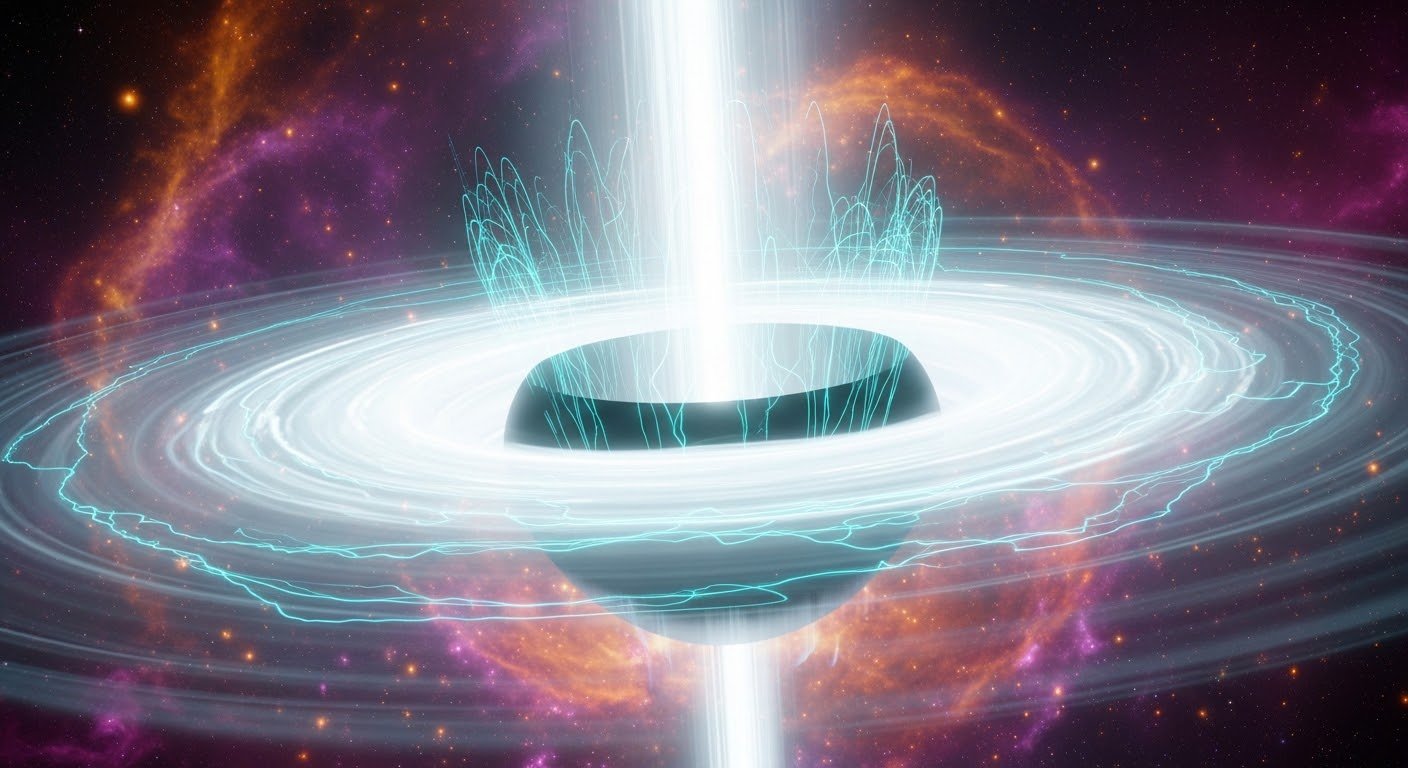
Black Holes Born Before the First Atom
Every black hole you have ever heard about formed from a dying star. A massive sun exhausts its fuel, collapses under its own gravity, and leaves behind a singularity wrapped in an event horizon. The black hole is the end of something. That story is so deeply embedded in how we talk about these objects that it can feel like the only story. It is not. There is a class of black hole that never passed through a stellar phase, never inherited its properties from a progenitor, and formed before a single proton had finished binding together. These objects condensed directly from the quantum chaos of the Big Bang's first millisecond, and three independent lines of modern evidence are now pointing toward their existence simultaneously.
What the Universe Looked Like Before Atoms
In the first millisecond after the Big Bang, the universe was not a place in any conventional sense. Temperature exceeded 1012 Kelvin. Space was expanding so rapidly that two points which had been touching could become causally disconnected before light could travel between them. The material filling all of space was a quark-gluon plasma: quarks and gluons moving freely, too energetic to bind into protons or neutrons, colliding continuously in every direction. Light could not propagate through it. There was no across, no through. Just an unbroken presence of energy at every point.[1]
Embedded in that plasma was something subtle and unavoidable: quantum noise. The Heisenberg uncertainty principle does not merely constrain what we can measure. It places a structural prohibition on quantum fields being perfectly smooth. A field cannot sit at a fixed value everywhere, all the time. It must fluctuate around its average. In the early universe, these fluctuations were not incidental background noise. They were the seeds of all large-scale structure that would eventually follow. Every galaxy cluster, every cosmic filament, every supervoid in the present-day universe traces back to a quantum jitter that quantum mechanics made inevitable and that inflation preserved before it could vanish.
Most of those fluctuations dispersed harmlessly. A small fraction did something permanent.
How Inflation Froze Quantum Jitter Into the Fabric of Space
Cosmic inflation, the period of exponential expansion occurring at roughly 10-36 to 10-32 seconds after the Big Bang, stretched the universe by at least 60 e-folds in a duration shorter than any physical process can meaningfully be said to have a duration. During this expansion, quantum fluctuations were pulled to macroscopic scales faster than they could collapse back on themselves. Normally a quantum fluctuation appears and vanishes on timescales governed by the energy-time uncertainty relation. Inflation interrupted that cycle. It stretched each fluctuation outward before the fluctuation had time to respond, freezing it in place as a classical density perturbation.[2]
The universe emerged from inflation with a specific texture: not smooth, not randomly uniform, but carrying a structured distribution of density deviations across a wide range of scales. This is what the cosmic microwave background records. The small temperature variations visible in CMB maps, at the level of one part in 100,000, are the fossil imprint of inflation's output at the large scales we can observe directly.
For primordial black holes to form in meaningful numbers, the power spectrum of these fluctuations must be dramatically enhanced at small scales, far below what the CMB probes. Specifically, the amplitude of fluctuations at the relevant small scales must exceed the CMB baseline by approximately:
$$P_R(k_{\text{PBH}}) \sim 10^7 \times P_R(k_{\text{CMB}})$$Standard slow-roll inflation produces a nearly flat power spectrum across all scales and does not achieve this. Producing the enhancement requires a departure from standard inflation: an ultra-slow-roll phase, a feature in the inflaton potential, or a two-stage inflationary process. The specific mechanism is not yet identified. The existence of primordial black holes would itself be indirect evidence that such a departure occurred.[3]
The Trap: Horizon Re-entry and the Collapse Threshold
A density fluctuation produced during inflation begins its post-inflationary life parked beyond the Hubble horizon, causally frozen, unable to participate in any dynamic process because no signal can cross it. After inflation ends, the universe's expansion rate slows dramatically and the horizon grows outward, eventually catching up with each frozen fluctuation and pulling it back inside causal contact. This moment of horizon re-entry is the only window in which gravitational collapse is possible.
Inside the horizon, two forces immediately compete. Gravity pulls the overdense region inward. Radiation pressure, with an equation of state:
$$P = \frac{1}{3}\rho c^2$$pushes outward. For most fluctuations, radiation pressure wins. The region compresses to a peak, then rebounds outward as an acoustic wave propagating through the plasma at roughly $c_s \approx c/\sqrt{3}$, or about 58 percent of the speed of light. These acoustic waves are not failures. They are the dominant outcome, and their fossil imprint constitutes the baryon acoustic oscillation signal visible in galaxy surveys today.[4]
Collapse requires the density contrast at horizon re-entry to exceed a critical threshold $\delta_c$. Analytically estimated at 1/3 by Carr in 1975, full numerical general relativistic simulations later refined this value:
$$\delta_c \approx 0.4 \text{ to } 0.7$$with the range reflecting genuine dependence on the perturbation's radial profile. Above this threshold, gravity can pull the region inward faster than the pressure response can propagate across it. The infall accelerates, the density rises, the rising density strengthens gravity, the strengthened gravity accelerates the infall further. There is no rebound. Within a fraction of a second, an event horizon forms.[5]
Mass Is a Timestamp
Primordial black holes have no biography in the sense that stellar black holes do. Their mass is determined almost entirely by when they formed. A PBH forms from the energy enclosed within the Hubble horizon at the moment of collapse. The horizon mass in a radiation-dominated universe scales as:
$$M_{\text{PBH}} \approx \frac{c^3}{G} \cdot t$$where $t$ is the formation time. At $t = 10^{-23}$ seconds, the horizon encloses roughly 1012 grams, about the mass of a small mountain compressed into a volume smaller than an atomic nucleus. At $t = 1$ second, the horizon encloses approximately 105 solar masses. Between those endpoints, the entire PBH mass spectrum is available, set entirely by the clock reading at the moment of collapse.
This mass is not a label. It is a complete specification of the object's future. Mass determines Hawking temperature, which determines evaporation rate, which determines lifespan. A PBH of 5 x 10¹⁴ grams has a Hawking evaporation lifetime:
$$\tau = \frac{5120 \pi G^2 M^3}{\hbar c^4} \approx 13.8 \text{ billion years}$$Objects lighter than this critical mass have already evaporated completely. Objects heavier remain, essentially unchanged, as the universe continues evolving around them.
Two Phase Transitions That Opened the Formation Windows
PBH formation was not uniform across the first second. Two phase transitions temporarily softened the equation of state of the cosmic plasma, lowering the collapse threshold and producing dramatically enhanced formation at specific mass scales.
The QCD Transition at 10 Microseconds
At approximately 10 microseconds after the Big Bang, the universe cooled through the QCD confinement scale at roughly 200 MeV (approximately 2 x 10¹² Kelvin). Free quarks and gluons bound into hadrons for the first time: protons, neutrons, pions. This quark-hadron phase transition temporarily softened the equation of state parameter $w$, reducing radiation pressure and lowering $\delta_c$ by roughly 10 percent.[6]
Because the distribution of fluctuation amplitudes is approximately Gaussian, the PBH formation rate is exponentially sensitive to the threshold value. A 10 percent reduction in $\delta_c$ unlocked exponentially more qualifying fluctuations, producing a thousandfold increase in PBH formation at the corresponding horizon mass of 1 to 2 solar masses. The QCD transition is why solar-mass PBHs are theoretically favoured over most other mass scales, and why their expected mass coincides precisely with the range probed by LIGO and Virgo.
The Electron-Positron Epoch at 1 Second
At approximately 1 second, the universe cooled below the threshold needed to produce new electron-positron pairs. Positrons began annihilating with electrons without replacement, thinning out of existence. Their disappearance reduced the number of relativistic species contributing to the plasma's pressure and energy density, producing a second, smaller softening of the equation of state and a second enhancement of PBH formation at solar-mass scales. The black holes that LIGO may be detecting today could have formed in the moment antimatter vanished from the universe.
What Hawking Found While Studying These Objects
Thinking carefully about small primordial black holes led Stephen Hawking to the most consequential theoretical result in black hole physics since general relativity itself. He was asking a specific question: what happens to a very small PBH over time? General relativity gives a clean but unsatisfying answer. A black hole maintains its properties indefinitely unless it accretes matter or merges with something.
Hawking suspected quantum mechanics had something to say. Near an event horizon, virtual particle-antiparticle pairs form continuously in the quantum vacuum. When these pairs nucleate close enough to the horizon, the gravitational field can separate them before they annihilate: one partner falls inward, the other escapes outward as real radiation carrying real energy. The black hole loses the energy required to promote the virtual particle to a real one, and its mass decreases. The temperature of this Hawking radiation is:
$$T_H = \frac{\hbar c^3}{8\pi G M k_B}$$Smaller mass means higher temperature. Higher temperature means more intense radiation. More intense radiation means faster mass loss. The evaporation accelerates as the black hole shrinks, ending in a burst of high-energy gamma rays. This result, published in 1974, emerged from a question about primordial objects that had never been observed. Without PBHs as the motivating problem, the discovery might have come much later.[7]
The Dark Matter Question Is Still Open
Primordial black holes have been a dark matter candidate since Chapline proposed it in 1975. Five decades of observations have compressed the available parameter space significantly. Most mass ranges are now constrained or ruled out:
- Below 5 x 10¹⁴ grams: already evaporated via Hawking radiation
- 1014 to 1017 grams: gamma-ray and cosmic ray background constraints
- 1023 to 1028 grams: microlensing surveys (EROS, HSC, OGLE)
- Solar mass to 100 solar masses: LIGO merger rate constraints limit the dark matter fraction to a few percent
- Above 1,000 solar masses: CMB distortion constraints
The surviving region is the asteroid mass window: roughly 1017 to 1023 grams. In this range, microlensing timescales are too short for most surveys, Hawking evaporation is negligible, and gravitational wave and CMB constraints do not reach. Every test brought to this window has left it open.[8]
A 2024 theoretical result may extend the available parameter space further. The memory burden effect, developed by Dvali and collaborators, proposes that as a black hole evaporates and its mass falls, the information stored in its internal quantum states becomes comparable to the remaining mass-energy and creates a back-pressure that slows or halts further evaporation. If correct, PBHs below the standard evaporation threshold may not have evaporated completely, opening dark matter windows at lower masses than previously considered.[9]
Three Lines of Evidence Arriving Simultaneously
S251112cm: A Sub-Solar Gravitational Wave Candidate
On 12 November 2025, the LIGO-Virgo-KAGRA network detected a gravitational wave signal designated S251112cm, with a chirp mass between 0.1 and 0.87 solar masses and a greater than 99 percent probability that at least one component is sub-solar in mass. No stellar evolution pathway produces a black hole lighter than the Sun. The minimum mass for a stellar-origin black hole is set by the Tolman-Oppenheimer-Volkoff limit at approximately 3 solar masses. There was no electromagnetic counterpart: no kilonova, no gamma-ray burst, no optical transient detected across the sky localisation region.[10]
Two independent research groups analysed the signal and reached similar conclusions. If the event represents a primordial black hole merger, the predicted detection rate using the current network is approximately 0.8 events per year, consistent with the extreme rarity observed. Among 390 confirmed gravitational wave events in the GWTC-5.0 catalog released in May 2026, not one involves a sub-solar mass component. S251112cm stands alone.
JWST and the Overmassive Black Hole Problem
JWST has been finding galaxies at redshifts above 7 hosting central black holes with black-hole-to-stellar mass ratios far exceeding the local relation. In nearby galaxies, the central black hole mass is roughly one-thousandth of the stellar bulge mass. The JWST little red dot population shows ratios approaching unity in some cases: the black hole nearly as massive as the entire stellar component of the galaxy.
Growing a black hole this massive this quickly through Eddington-limited accretion from a stellar remnant seed requires near-continuous accretion at the maximum rate for hundreds of millions of years, with no margin for the reduced accretion periods that real galactic nuclei routinely experience. A massive primordial black hole seed already present before the first star formed resolves this without any exotic physics. It had a head start of hundreds of millions of years of sub-Eddington accretion, growing at unremarkable rates, producing the disproportionately massive systems JWST is imaging at $z > 7$.[11]
Simulations targeting Abell 2744-QSO1, a compact, metal-poor, black-hole-dominated galaxy at redshift $z \approx 7$, show that a massive PBH seed reproduces the object's observed black-hole mass, stellar mass, morphology, and unusually low metallicity within current measurement uncertainties. The low metallicity is particularly informative: it indicates that the black hole was growing before significant stellar generations had enriched the surrounding gas, consistent with a seed that predated star formation entirely.
The NANOGrav Nanohertz Background
In 2023, NANOGrav and three independent pulsar timing array collaborations confirmed the detection of a stochastic gravitational wave background at nanohertz frequencies. The most developed explanation involves supermassive black hole binaries distributed across the observable universe, whose mergers produce a continuous gravitational wave hum. The spectral shape of the detected signal, however, shows features the binary explanation does not fully account for.
A strongly first-order phase transition near the QCD confinement scale would produce bubble dynamics that generate a stochastic gravitational wave background peaking at precisely the nanohertz frequencies the arrays are sensitive to. And a strongly first-order QCD transition is the same mechanism that produces the thousandfold enhancement in solar-mass PBH formation discussed earlier. The gravitational wave background and the PBH population would be two consequences of the same underlying physics. The arrays are still running. The dataset grows every year.[12]
What We Actually Know
Primordial black holes have not been confirmed. S251112cm remains a candidate event that has not completed the full parameter estimation and peer review process required for catalog inclusion. Hawking radiation has never been directly detected. The dark matter fraction of PBHs is bounded from above but not measured. The NANOGrav signal has not resolved to a definitive source identification.
None of these open questions represent failures of the theory. They represent the natural condition of a field confronting the limits of what instruments built on Earth can reach back to see. The Hubble horizon at the moment of PBH formation enclosed volumes smaller than a proton. The events that produced these objects occurred in the first millisecond of existence, in conditions that no laboratory has replicated and no telescope can image directly.
What the field possesses is a physically coherent formation mechanism anchored in mainstream quantum field theory and general relativity. A gravitational wave candidate with the one mass signature that no stellar process produces. A space telescope finding black holes whose masses cannot be explained by any formation pathway that requires stars to form first. A pulsar timing signal compatible with the gravitational echoes of the same phase transition that the formation models require. Simulations of a specific galaxy at redshift 7 that fit the observations without invoking exotic physics.
No single thread in this tapestry constitutes proof. Together, they constitute a case. Multiple independent lines of evidence, each motivated by different physics, each pointing in the same direction.
The objects that may have shaped the large-scale structure of the observable universe, that may constitute a fraction of its dark matter, that may sit at the centres of the earliest massive galaxies as seeds that predated the galaxies themselves, formed before the universe had cooled enough to make a single atom. They have been here, if they exist at all, since the beginning of everything else.
The detectors are listening. What they find next will determine whether the beginning left permanent marks, or whether it kept no record of what it made.
[1] The quark-gluon plasma state has been experimentally recreated at CERN and RHIC through relativistic heavy-ion collisions, providing laboratory constraints on its equation of state directly relevant to PBH formation rates during the QCD transition.
[2] Carr, B. and Green, A.M. (2024). "Primordial Black Holes as Dark Matter Candidates." arXiv:2406.05736. Comprehensive review of inflation models and their PBH formation implications.
[3] The specific inflationary mechanism required for PBH formation at observable mass scales remains an open theoretical question. Models include ultra-slow-roll inflation, inflaton potential features, and multi-field scenarios. See arXiv:2307.00510 and arXiv:2209.14183.
[4] Baryon acoustic oscillations, first detected in galaxy surveys in 2005, are the large-scale fossil record of acoustic waves that propagated through the pre-recombination plasma. They represent the same physical process that prevents most fluctuations from collapsing into primordial black holes.
[5] Niemeyer, J.C. and Jedamzik, K. (1999). "Near-Critical Gravitational Collapse and the Initial Mass Function of Primordial Black Holes." arXiv:astro-ph/9901292. The foundational numerical study refining the collapse threshold beyond the analytic estimate.
[6] Musco, I. (2023). Phys. Rev. D 109, 083506. Detailed analysis of the QCD phase transition's effect on the PBH mass function, including the thousandfold formation enhancement at solar-mass scales.
[7] Hawking, S.W. (1974). "Black Hole Explosions?" Nature 248, 30. The original announcement of black hole radiation, motivated directly by questions about the fate of small primordial black holes.
[8] Thoss, V., Burkert, A. and Kohri, K. (2024). MNRAS 532, 451. Comprehensive constraint survey with asteroid window analysis and memory burden implications.
[9] Dvali, G. et al. Memory burden framework developed 2018-2024. Applied specifically to PBH evaporation in arXiv:2402.17823 and arXiv:2409.04518.
[10] Magaraggia, A. and Cappelluti, N. (2026). ApJ 1000, 262. University of Miami analysis of S251112cm, predicting 0.8 sub-solar PBH merger events per year with the current LIGO-Virgo-KAGRA network. Independent confirmation: Haque, Iocco and Visinelli, arXiv:2603.25795 (2026).
[11] Zhang, H., Liu, B. and Bromm, V. (2025/2026). arXiv:2512.14066. Hydrodynamic simulations showing that a massive PBH seed reproduces the observed properties of Abell 2744-QSO1 within current measurement uncertainties.
[12] NANOGrav Collaboration (2023). ApJL 951. The 15-year dataset paper announcing the confirmed nanohertz stochastic gravitational wave background. Phase transition interpretation: Gouttenoire, arXiv:2307.04239.
Comments (0)
Leave a Comment