Why the Giant Arc Should Not Exist
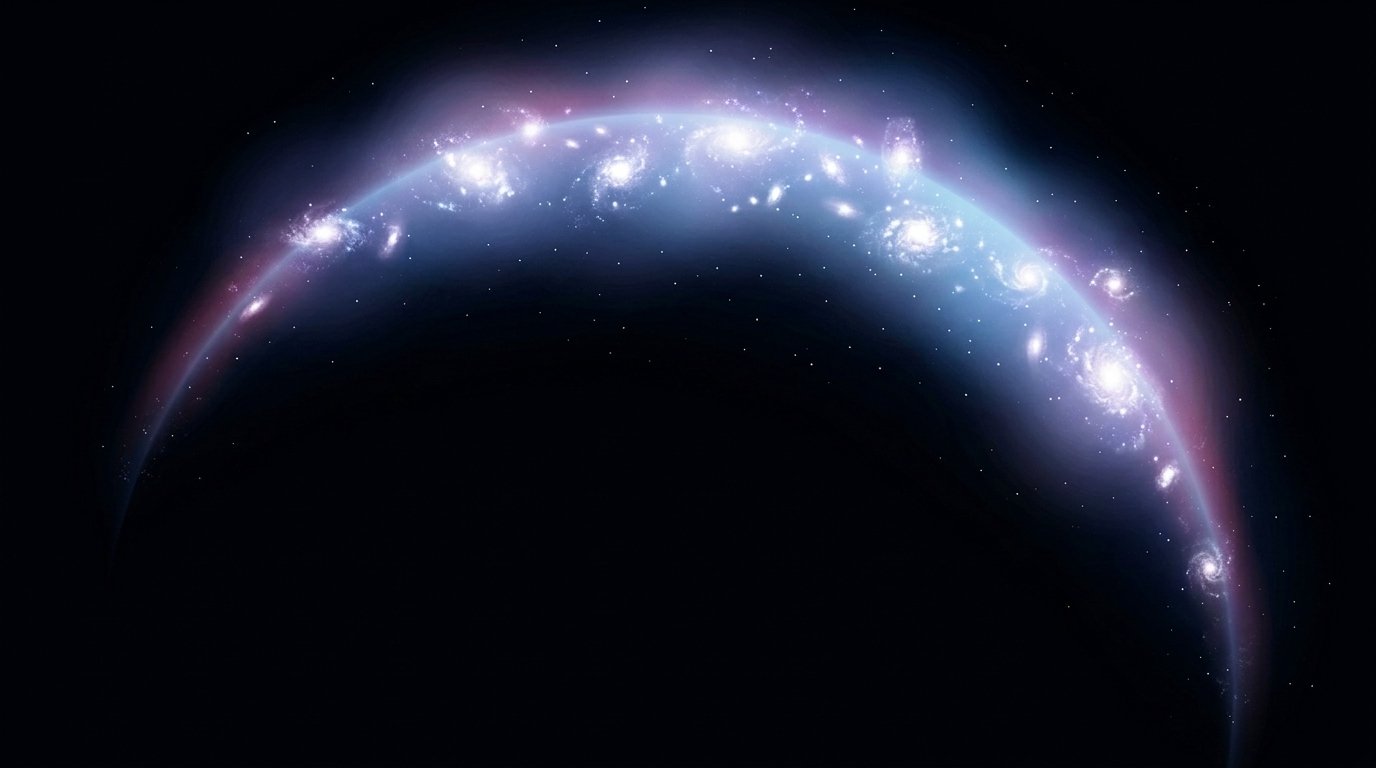
In 2021, a PhD student at the University of Central Lancashire was stepping through slices of astronomical data late at night. She was not looking for anything in particular. The dots in one particular slice curved. What she had found, or what had found her, was a crescent-shaped arrangement of galaxies stretching 3.3 billion light-years from end to end. The standard model of cosmology says nothing that large should exist. The argument about whether it does is one of the most consequential open debates in modern physics.
The Rule the Universe Runs On
Modern cosmology is built on a foundational working assumption called the cosmological principle. It states that the universe, viewed at sufficiently large scales, is homogeneous (the same average density everywhere) and isotropic (the same in every direction). Edward Arthur Milne formalized it in the 1930s, though the intuition behind it extends back to Copernicus: no location in the universe is special, and therefore no region should look dramatically different from any other at large enough scales.[1]
The cosmological principle is not a law in the sense that conservation of energy is a law. It is a premise. But it is a premise that the Lambda-CDM model -- the standard model of cosmology -- is built upon mathematically. The Friedmann equations describing cosmic expansion assume it. The interpretation of the cosmic microwave background assumes it. The entire framework of distance measurement in observational cosmology assumes it. Remove it, and the equations do not automatically collapse. They require rewriting from different starting assumptions.
From this principle, the standard model derives a hard ceiling on the size of any coherent structure the universe can produce. The calculation accounts for how inflation smoothed the initial density field, how gravity has been amplifying structure over cosmic time, and how dark energy has been accelerating expansion for approximately the last five billion years, pulling regions of space apart faster than gravity can bridge them at large scales. The result is a theoretical maximum of approximately 1.2 billion light-years. Not a rough estimate. A derived consequence of the model.
The Giant Arc is 3.3 billion light-years long. That is a factor of nearly three beyond the ceiling. In physics, a discrepancy of that magnitude between a model's prediction and an observation is not a rounding error. It is a signal that something is either wrong with the framework or wrong with the measurement.
How Matter Builds the Universe -- Up to a Point
The universe began in near-perfect uniformity. Density variations of roughly one part in 100,000 -- quantum fluctuations stretched to cosmic scale by inflation -- provided the seeds from which all structure grew. Gravity amplified these variations slowly over cosmic time. The growth of a density perturbation is described by the linear growth equation:
$$\delta(\mathbf{x}, t) = D(t) \cdot \delta_0(\mathbf{x})$$where $\delta$ is the density contrast at position $\mathbf{x}$ and time $t$, $D(t)$ is the growth factor, and $\delta_0$ is the initial density perturbation. In the matter-dominated era, structure grows proportionally to the cosmic scale factor. In the dark-energy-dominated era -- the last five billion years -- expansion accelerates and growth is suppressed.
This suppression is critical. It means there is a window during which structure formation is possible, and a maximum scale at which gravitational assembly can produce coherent structures before expansion outpaces it. The homogeneity scale -- the scale above which the universe is statistically uniform -- sits at approximately 370 megaparsecs, or about 1.2 billion light-years.[2]
Below that threshold: expected structures. The cosmic web of filaments, voids, walls, and nodes. The Sloan Great Wall at 1.37 billion light-years. The South Pole Wall at a comparable scale. Every known large-scale structure that the standard model can accommodate, each one pressing against the ceiling but not breaking through it.
The Giant Arc breaks through it.
The Method That Made It Visible
The Giant Arc has no image. It produces no light detectable by human eyes at any wavelength. It was found entirely through the chemical fingerprints it left on the spectra of objects behind it -- a technique called absorption spectroscopy.
When light from a distant quasar passes through a galaxy's gas halo, ionized magnesium in that halo absorbs two specific wavelengths, leaving a pair of dark gaps in the quasar's spectrum. This doublet -- written MgII for singly ionized magnesium -- is distinctive enough to identify reliably even in complex, crowded spectra. Crucially, the position of the doublet encodes the redshift of the absorbing material, and therefore its distance, with precision considerably better than conventional photometric surveys can achieve.
The observed wavelength of an absorption line relates to the rest wavelength through the cosmological redshift:
$$\lambda_{\text{obs}} = \lambda_{\text{rest}} \cdot (1 + z)$$where $z$ is the redshift of the absorbing galaxy. This equation means that by measuring where the doublet falls in the observed spectrum, one can calculate exactly when and where the light was absorbed. The quasar acts as a backlight. The galaxy -- too faint to detect directly -- reveals itself through what it takes from the passing beam.
Alexia Lopez and her team worked with a catalogue of 63,876 MgII absorbers drawn from the Sloan Digital Sky Survey's quasar spectra.[3] Each absorber marked the position of at least one foreground galaxy. The redshift precision of the method reduced the blurring of structures along the line of sight -- which may explain why the arc appeared clearly where other surveys had not detected it. Or it may explain why the method produced an apparent structure where none exists. That distinction remains the center of the debate.
The Discovery That Was Not Planned
The arc was not the target of a search. Lopez was characterizing the statistical properties of the absorber distribution at different redshifts, stepping through thin slices of the catalogue and inspecting the resulting density maps. Most slices produce nothing organized. At a redshift of approximately 0.8 -- corresponding to a distance of 9.2 billion light-years, to a moment when the universe was roughly half its current age -- the map looked different.
The pattern held under parameter variation. Adjusting the smoothing kernel, restricting to higher-confidence detections, changing the redshift boundary slightly -- the central body of the crescent persisted. Lopez then applied three independent statistical methods to assess whether the arrangement could be a chance occurrence:
- Single-linkage hierarchical clustering (SLHC): approximately $4.5\sigma$
- The Cuzick-Edwards spatial clustering test: approximately $3.0\sigma$
- Power spectrum analysis: approximately $4.8\sigma$
Each method asks a different question about the data and is sensitive to different properties of the absorber distribution. A result that survives three independent tests is more robust than one that survives only the most favorable. The team presented all three explicitly -- including the lower Cuzick-Edwards result -- rather than reporting only the most impressive number.
A $4.5\sigma$ result means the probability of obtaining it by chance, under the assumed null hypothesis, is less than 0.001 percent. The operative phrase is "under the assumed null hypothesis." If the null hypothesis was incorrectly specified -- if the definition of "random" was misconstrued -- the sigma value is misleading regardless of its magnitude. This is precisely the argument the skeptics make.
The Structure Itself
The Giant Arc spans approximately 3.3 billion light-years in length and 330 million light-years in width -- itself larger than many structures considered significant. It is crescent-shaped, nearly symmetrical around its midpoint. Its composition is galaxies, galaxy clusters, gas, and dust. Its overdensity is measured at $\delta\rho/\rho \approx 1.3 \pm 0.3$ -- a modest elevation in density relative to background, but across a volume so vast that even a modest overdensity represents an enormous concentration of matter in absolute terms.[4]
The near-symmetry is a secondary puzzle. Filaments and walls in the cosmic web are shaped by the specific history of density fluctuations in their region -- a process not expected to produce bilateral organization around a central midpoint. The symmetry does not appear in the statistical tests. It is a qualitative feature. But it is the kind of qualitative feature that resists comfortable dismissal.
The Case Against It
Astrophysicist Subir Sarkar of Oxford raised the core skeptical concern immediately after the discovery was announced: the human eye is very good at finding patterns in data, including patterns that are not there.[5] A catalogue of tens of thousands of absorber positions across a large cosmic volume contains an enormous number of potential configurations. The probability that some of them look organized -- arcs, rings, walls, filaments -- by chance alone is not negligible.
The serendipitous nature of the discovery amplifies this concern. The arc was noticed by eye before it was assessed statistically -- a sequence that introduces the look-elsewhere effect. When a pattern is found without a prior hypothesis specifying where to look, the effective significance is lower than the raw sigma value suggests, because many possible configurations were implicitly searched before one appeared remarkable. The Lopez team acknowledged this and attempted to correct for it. Whether the correction was sufficient is a methodological question without a settled answer.
The Simulation Challenge
In 2025, Till Sawala and Meri Teeriaho published a direct test. They applied the same Friends-of-Friends algorithm Lopez used -- with the same linking length of 95 comoving megaparsecs -- to FLAMINGO-10K, one of the largest cosmological simulations ever run, a volume of $(2.8 \text{ Gpc})^3$ modeled under standard Lambda-CDM physics. They found arc-like patterns comparable to the Giant Arc abundantly, in nearly every sampling they examined.[6]
Their conclusion: the Giant Arc is not evidence of new physics. It is what standard cosmology looks like when viewed through this particular detection method.
Lopez and Clowes responded. The linking length of 95 megaparsecs, they argued, was calibrated to the specific point density of the MgII absorber catalogue. Applying the same absolute linking length to a simulation with vastly higher point density connects points that would not be connected under correctly calibrated parameters. When the simulation was analyzed with a linking length appropriate for its own density -- approximately 65 comoving megaparsecs -- gigaparsec-scale structures did not appear.
Sawala and Teeriaho disputed this reasoning in a follow-up response. The argument is now a second-order methodological dispute: not about the data, but about what constitutes a valid comparison between the data and the simulation. That dispute has not resolved.
A Growing Problem: Two More Structures
In January 2024, Lopez announced the Big Ring -- a roughly circular structure approximately 1.3 billion light-years in diameter, at the same redshift of 0.8, in the same region of sky as the Giant Arc, separated from it by 12 degrees on the celestial sphere. The Big Ring was found using the same MgII method applied to updated SDSS DR16 quasar catalogues.[7]
The combined significance of two anomalous structures at the same redshift in the same field is not simply additive. Two independent rare events occurring simultaneously is far less probable than either one alone -- by a factor determined by how rare each is individually. Lopez noted that their co-location raises the possibility that together they form a single, larger cosmological system -- a combined extent that would exceed anything the standard model can accommodate even as a statistical fluctuation.
In April 2026, a third structure was reported: the Giant Ring, a ring-like form approximately one gigaparsec in diameter, encompassing the Big Ring, predicted from a northern arc filament identified in earlier work and then confirmed using the FilFinder algorithm and elliptical shell assessments.[8] The prediction-then- confirmation methodology distinguishes this discovery from its predecessors. A structure predicted before the analysis that confirmed it is partially shielded from the look-elsewhere critique.
Three ultra-large structures. One patch of sky. One cosmic moment. The Boötes field at redshift 0.8 is now the most structurally anomalous region identified in the observable universe.
What Could Have Built This
Three explanations have received serious discussion. None is confirmed.
Baryon Acoustic Oscillations
BAOs are fossil pressure waves from the first 380,000 years of the universe, frozen in the distribution of matter when photons decoupled from baryons at recombination. The sound horizon at recombination is approximately:
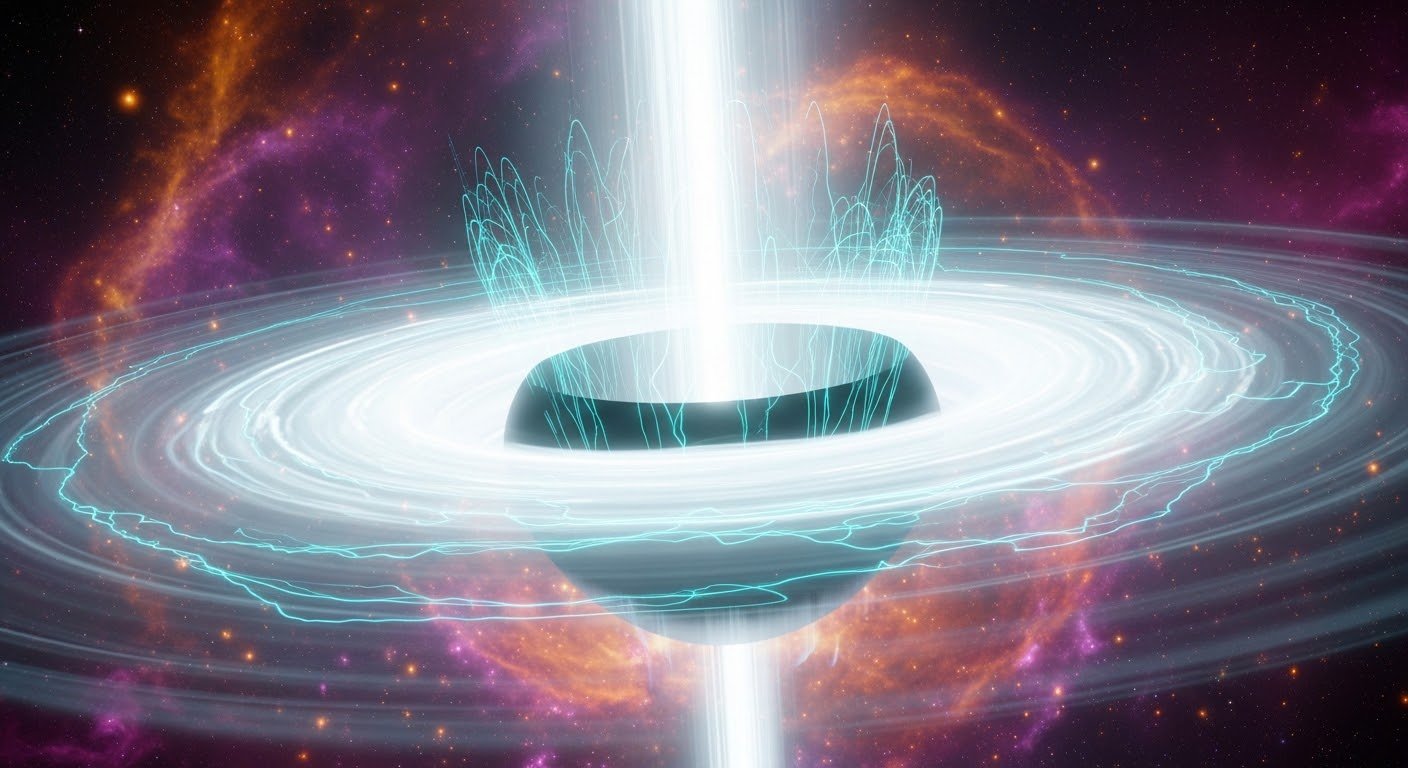
$$r_s \approx 150 \text{ Mpc} \approx 490 \text{ million light-years}$$A ring-shaped structure at a preferred scale resembles what a BAO cross- section would look like in projection. The Big Ring's diameter of approximately 400 megaparsecs is nearly three times the BAO scale. Additionally, BAO signatures are spherical shells; the Big Ring's three- dimensional structure is more coil-like than spherical. The geometry is incompatible regardless of the size discrepancy. BAOs were the first explanation reached. They do not fit.
Cosmic Strings
Cosmic strings are hypothetical one-dimensional topological defects in spacetime, predicted to form during symmetry-breaking phase transitions in the early universe. Their tension is parametrized by $G\mu/c^2$, where $\mu$ is the mass per unit length. Current observational constraints from CMB measurements limit this to:
$$G\mu/c^2 \lesssim 10^{-7}$$A string with even low tension exerts gravitational influence along its full length. Matter in its vicinity is drawn toward the string over cosmic timescales, potentially seeding arc-like or filamentary galaxy arrangements tracing the string's path. No cosmic string has been directly detected. The observational upper bound constrains but does not eliminate the possibility.
Conformal Cyclic Cosmology
Roger Penrose's CCC proposes that the universe undergoes infinite cycles of Big Bang expansion. At the end of each aeon, when all massive particles have decayed or been consumed by black holes that subsequently evaporate, only massless particles remain. In this limit, scale becomes mathematically undefined -- and the end state of one aeon is conformally equivalent to the beginning of the next. Gravitational wave imprints from supermassive black hole mergers in a previous aeon could propagate through the crossover and manifest in the current aeon as ring-like structures in the CMB or in the large-scale galaxy distribution.[9]
Claimed detections of CCC-predicted rings in CMB data have been disputed by independent analyses. The model is not mainstream cosmology. It is not empty either.
What We Actually Know
The absorbers are arranged as the data shows. MgII absorption events in the Boötes field at redshift 0.8 cluster into configurations that, by multiple independent statistical measures, are unlikely to arise from a uniform random distribution. The arc shape is real in the data. The sigma values are real. These facts are not disputed.
What is disputed is what the data represents. Whether the statistical baseline was correctly constructed. Whether the linking parameters applied to identify the structures are appropriate for a sparse absorber catalogue. Whether the same parameters, applied to a universe obeying the cosmological principle, would produce similar configurations. These are methodological questions. They do not resolve by examining the same data more carefully.
Independent confirmation from a different survey using a different method is the next step that would shift the balance. The Euclid space telescope, launched in 2023, will eventually cover the Boötes field with sufficient depth to test the arc's reality through galaxy distributions rather than absorber catalogues. The Dark Energy Spectroscopic Instrument is building MgII catalogues orders of magnitude larger than the SDSS data from which the arc was identified. Both instruments will provide cleaner tests than anything available today.
Until those results arrive: the cosmological principle is under pressure it was not designed to handle. The standard model produces a ceiling of 1.2 billion light-years. The Boötes field at redshift 0.8 appears to contain three structures that ignore it. Whether the universe is telling us something fundamental about its architecture, or whether a detection method is producing patterns that a better-controlled analysis would dissolve -- that question is genuinely open.
The Giant Arc is not a settled discovery. It is not a debunked claim. It is a live scientific problem at the exact intersection of observation, statistical methodology, and foundational cosmological theory -- the intersection where the most consequential questions tend to live, and where clean answers tend to arrive slowly, if at all.
The question has found its correct form. The answer has not arrived yet.
[1] Milne, E.A. (1935). Relativity, Gravitation and World-Structure. Oxford University Press. The cosmological principle as a formal statement originates here, though the underlying Copernican reasoning is centuries older.
[2] Yadav, J.K., Bagla, J.S., Khandai, N. (2010). Fractal dimension as a measure of the scale of homogeneity. Monthly Notices of the Royal Astronomical Society, 405(3), 2009-2015. This paper establishes the 370 Mpc homogeneity scale referenced in the debate.
[3] Lopez, A.M., Clowes, R.G., Williger, G.M. (2022). A Giant Arc on the Sky. Monthly Notices of the Royal Astronomical Society, 516, 1557-1572. The original discovery paper, formally published after the 2021 AAS presentation.
[4] The overdensity value $\delta\rho/\rho \approx 1.3 \pm 0.3$ is modest relative to galaxy cluster overdensities, which can reach hundreds. What makes it significant is the volume over which it is maintained.
[5] Sarkar, S., quoted in: Conover, E. (2021). An arc of galaxies 3 billion light-years long may challenge cosmology. Science News, June 11, 2021.
[6] Sawala, T., Teeriaho, M. (2025). The Giant Arc: Filament or Figment? The Open Journal of Astrophysics, 8. doi:10.33232/001c.145931
[7] Lopez, A.M., Clowes, R.G., Williger, G.M. (2024). A Big Ring on the Sky. arXiv:2402.07591. Presented at the 243rd meeting of the American Astronomical Society, January 2024.
[8] Lopez, A.M., Clowes, R.G. (2026). A Giant Ring on the Sky. arXiv:2604.17534. Presents the third ultra-large structure in the Boötes field at redshift 0.8.
[9] Penrose, R. (2010). Cycles of Time: An Extraordinary New View of the Universe. Alfred A. Knopf. The accessible book-length presentation of CCC, written for non-specialist readers while remaining mathematically serious.
Comments (0)
Leave a Comment