Why Faster-Than-Light Galaxies Break No Rules
There is a question most people ask incorrectly. Not because they are careless, but because the framing was built into how the subject is usually introduced. The question is: how can distant galaxies move faster than light? And the answer, frustratingly, is that they cannot. They do not. What is happening is something else entirely, and the difference between that something else and the thing the question assumes is the whole of modern cosmology in miniature.
Two Kinds of Speed
The word velocity is doing too much work in popular science writing. It gets applied to rockets, to sound waves, to neutrinos in particle beams, and, without much ceremony, to the apparent separation of galaxy clusters across billions of light-years of intergalactic space. Same word. Completely different physical quantities.
The first kind is peculiar velocity: the motion of an object through its local space. This is the velocity Einstein's special relativity governs. It is the velocity measured by a speedometer, registered by a radar gun, subject to the hard upper limit of $c$. No object with mass reaches it. No signal propagates faster than it. The limit is absolute within any local inertial frame.
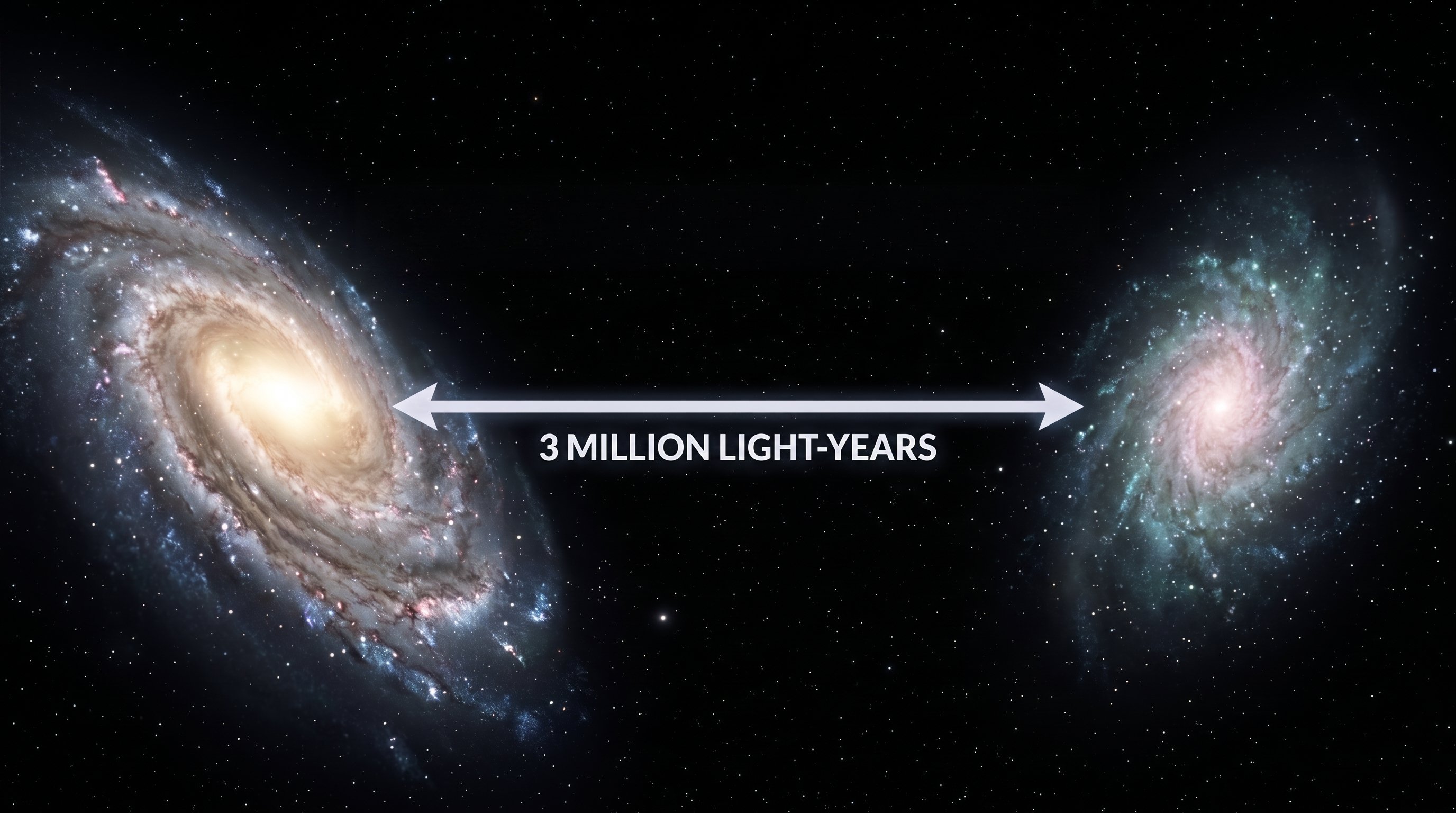
The second kind is recession velocity: the rate at which the proper distance between two comoving objects increases because the space between them is expanding. The objects themselves may be entirely stationary relative to their local surroundings. No thrust, no acceleration, no force applied. The distance still grows, continuously, because the geometry of space is evolving.
Recession velocity is not governed by special relativity. It is not constrained by $c$. This is not a loophole or a convenient exception. It follows directly from the fact that recession velocity and peculiar velocity are measuring categorically different things. Applying Einstein's speed limit to recession velocity is a category error, like asking whether a temperature is heavier than a kilogram.
Space Is Not a Container
The intuition most people carry is of space as a room: fixed, passive, a backdrop against which physics happens. Things move through it. The room itself does not participate. This picture is not wrong for everyday purposes. A building does not notice the speed of light. But at cosmological scales, it fails completely.
General relativity, published in 1915, treats spacetime as a dynamic geometric entity. It curves in the presence of mass and energy. It evolves. The universe described by GR is not a static container with galaxies scattered through it. It is a geometry whose metric, the mathematical object assigning distances between points, changes over time.
In a flat, homogeneous, isotropic universe, that metric is described by the Friedmann-Lemaitre-Robertson-Walker (FLRW) line element:
$$ds^2 = -c^2\,dt^2 + a(t)^2\bigl[dr^2 + r^2\,d\Omega^2\bigr]$$Here $a(t)$ is the scale factor: a dimensionless function of cosmic time that equals 1 today by convention and was much smaller in the past. All proper distances scale with $a(t)$. When $a(t)$ increases, every comoving separation increases with it, not because anything moved through space, but because the geometry that defines distance is evolving.
The expansion of the universe is not an explosion outward into a pre-existing void. It is the evolution of the metric itself. There is no center. There is no edge. Every observer in a homogeneous expanding universe sees the same pattern of recession in every direction.
What Hubble Actually Discovered
In 1929, Edwin Hubble published a proportionality between the distances of galaxies and their apparent recession velocities. The farther the galaxy, the faster it receded. The relationship was linear. He named the proportionality constant $H$. We still call it that.
What Hubble measured was not galaxies in motion through space. It was the Hubble flow: the large-scale recession produced by an expanding metric, visible in the redshifts of spectral lines shifted toward longer wavelengths. In modern notation, Hubble's Law is:
$$v_{\text{rec}} = H_0 \, D$$where $v_{\text{rec}}$ is recession velocity, $H_0$ is the present value of the Hubble parameter (approximately 67 to 73 km/s/Mpc depending on measurement method[1]), and $D$ is the proper distance to the object. This equation has no built-in speed limit. It is a geometric relationship. At distances beyond $D = c/H_0$, approximately 14.3 billion light-years, recession velocity exceeds $c$. This is arithmetic, not anomaly.
It is worth noting that a Belgian priest and physicist named Georges Lemaitre derived the same relationship from Einstein's field equations two years before Hubble published it.[2] He estimated a value for the proportionality constant in 1927. When his paper was translated into English in 1931, that paragraph was quietly omitted. The International Astronomical Union voted in 2018 to rename the law the Hubble-Lemaitre Law.
The Hubble Sphere and Why It Is Not a Horizon
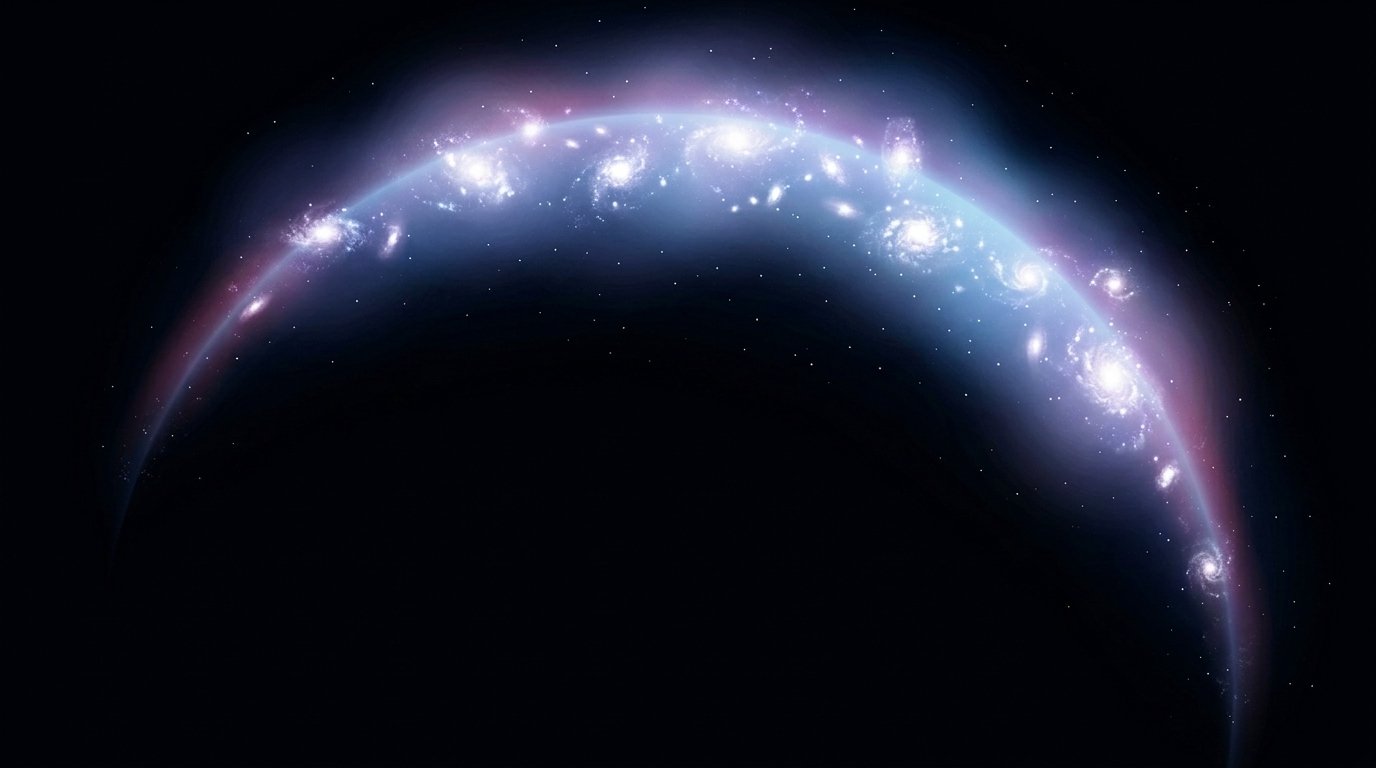
The surface at which recession currently equals $c$ is called the Hubble sphere. Its radius is $c/H(t)$, currently approximately 14.3 billion light-years. Everything beyond it is receding superluminally right now.
Most people assume this is a wall, a barrier beyond which nothing can be observed. It is not. Photons cross the Hubble sphere in both directions. Light from galaxies well beyond it reaches us routinely. The James Webb Space Telescope observes galaxies at redshifts of $z = 10$, $z = 13$, even $z = 16$, all of which were receding superluminally when they emitted the light we now detect.
The mechanism by which this happens depends on the Hubble sphere itself being a moving threshold. As the Hubble parameter $H(t)$ decreases over time, the radius $c/H(t)$ increases. A photon emitted from beyond the Hubble sphere initially has a net velocity away from us: the recession of its location exceeds its propagation speed. But as the Hubble sphere expands outward, it overtakes the photon. Once inside the subluminal region, the photon begins closing the distance and eventually arrives.
The total proper velocity of a photon aimed toward us from a superluminally receding region is:
$$v_{\text{total}} = H(t)\,D - c$$This is positive (away from us) when $H(t)D > c$, and negative (toward us) when $H(t)D < c$. The photon's fate depends on whether the Hubble sphere expands fast enough to cross from the first condition to the second before the photon drifts too far away.
Three Boundaries, Not One
The observable universe has three distinct cosmological boundaries, each defined by a different question. They are routinely collapsed into one in popular accounts, producing a picture of the cosmos that is significantly smaller and more closed than it actually is.
The Hubble Sphere (approximately 14.3 billion light-years): where recession currently equals $c$. Not an observational limit. Not a barrier. A geometric description of today's expansion rate applied to distance. It moves over time.
The Cosmic Event Horizon (approximately 16 billion light-years): the boundary beyond which any light emitted today will never reach us, given that the accelerating expansion will continue indefinitely. Galaxies currently at redshift $z \approx 1.8$ are crossing this boundary permanently. The universe we can communicate with is already finite and shrinking in comoving terms.
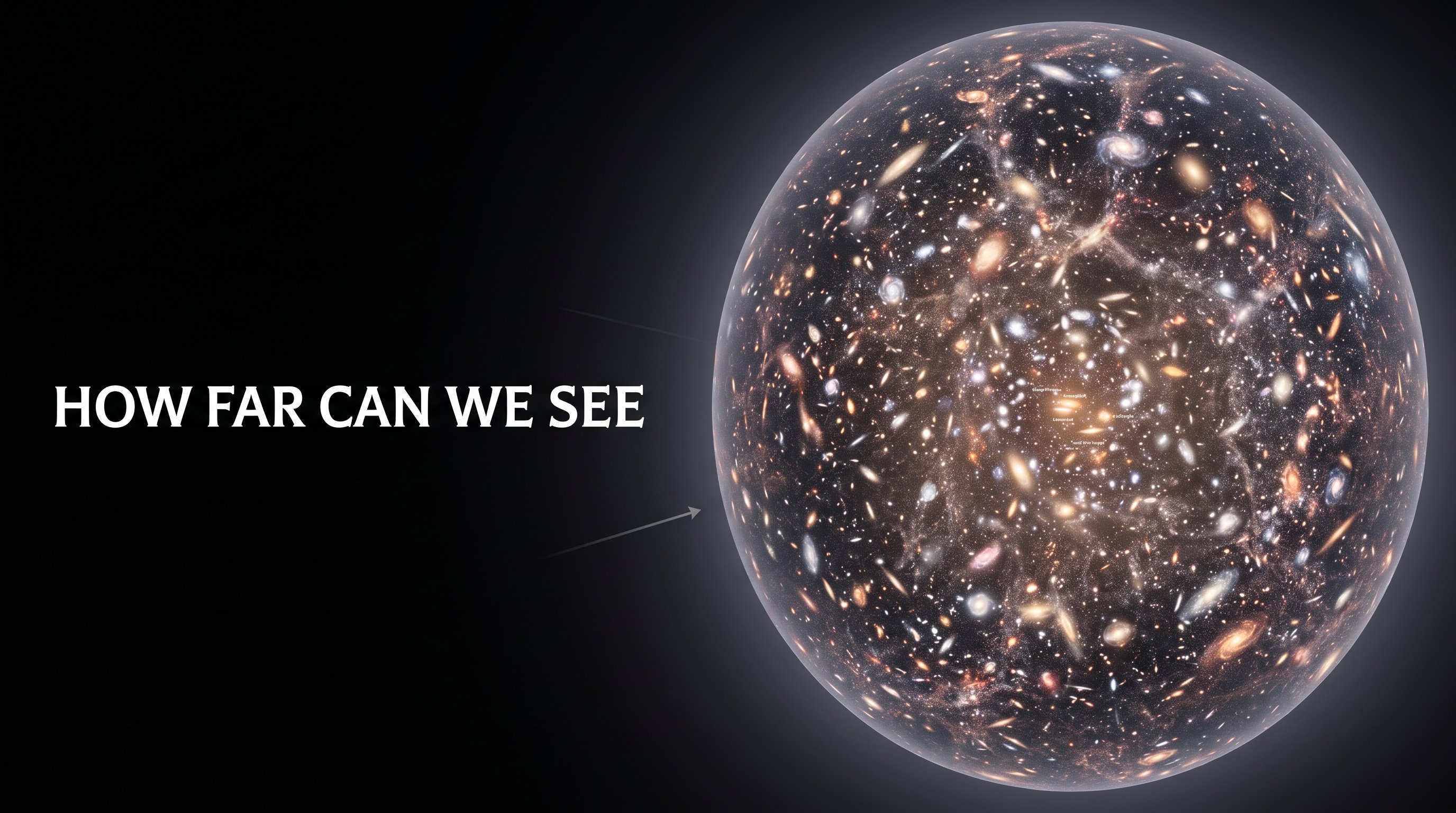
The Particle Horizon (approximately 46.5 billion light-years): the full extent of the observable universe, the farthest point from which light has had time to reach us since the Big Bang. The cosmic microwave background originates at this surface, at the surface of last scattering approximately 380,000 years after the Big Bang.[3]
Three surfaces. Three questions. Three different distances. Conflating them produces a universe with an observable radius of 13.8 billion light-years, which is not only wrong but wrong by a factor of more than three.
Cosmological Redshift Is Not a Doppler Effect
The redshift of distant galaxies is almost universally described as a Doppler effect: galaxies moving away, like a receding ambulance dropping in pitch. The analogy is intuitive. It is also incorrect for cosmological redshift, and the distinction is not merely technical.
The Doppler effect describes a source moving through a medium away from a receiver. The wavelength of emitted light gets stretched by the relative motion. Cosmological redshift is produced by a different mechanism: the physical stretching of a photon's wavelength as it travels through space that is expanding beneath it.
The formula governing cosmological redshift depends only on the ratio of the scale factor at reception to the scale factor at emission:
$$1 + z = \frac{a(t_r)}{a(t_e)}$$This formula contains no velocity term. It does not depend on how fast the source was moving at the moment of emission. A galaxy with zero peculiar velocity, completely stationary in its local frame, emitting light at a known wavelength, would still produce a cosmological redshift if the universe expanded between emission and reception. The redshift is a record of geometric expansion during the photon's journey, not of the source's speed at either endpoint.
At low redshifts, the two effects produce nearly identical numerical results, which is why the confusion persists. At high redshifts, they diverge significantly. Applying the special relativistic Doppler formula to high-$z$ galaxies produces results that are ruled out observationally at 23-sigma confidence.[4]
The Accelerating Universe and Dark Energy
In 1998, two independent teams studying Type Ia supernovae found that distant supernovae were dimmer than expected. Dimmer means farther than expected at a given redshift. Farther than expected means the universe was expanding more slowly in the past than models predicted, implying it is expanding faster now.
The expansion is not decelerating under its own gravity. It is accelerating.
The component driving this acceleration was named dark energy. In the simplest model, it is represented by the cosmological constant $\Lambda$, a uniform energy density associated with empty space itself. Unlike matter and radiation, which dilute as the universe expands, dark energy maintains a constant density: each new cubic meter of expanding space contributes the same energy, so the total grows while the density stays fixed. The Friedmann equation governing the expansion becomes:
$$H^2 = \frac{8\pi G\,\rho}{3} - \frac{kc^2}{a^2} + \frac{\Lambda c^2}{3}$$Dark energy currently comprises approximately 68 percent of the total energy content of the observable universe. It governs the long-term behavior of the event horizon, the permanent separation of galaxy clusters, and the trajectory of everything the universe will eventually lose from our causal reach.
The cosmological constant problem, the question of why the vacuum energy density predicted by quantum field theory is approximately $10^{120}$ times larger than the observed value, remains the most severe unresolved discrepancy in theoretical physics.[5]
The Hubble Tension
Two independent methods of measuring $H_0$ give incompatible answers. The early-universe method, using temperature anisotropies in the cosmic microwave background measured by the Planck satellite, gives:
$$H_0 = 67.4 \pm 0.5 \text{ km/s/Mpc}$$The local distance-ladder method, using Cepheid variable stars calibrated against Type Ia supernovae, gives:
$$H_0 = 73.04 \pm 1.04 \text{ km/s/Mpc}$$The discrepancy exceeds 5-sigma statistical significance. In particle physics, 5-sigma is the threshold for claiming a discovery. Here it is the threshold for acknowledging that something in the standard cosmological model is either wrong or incomplete.
The James Webb Space Telescope observed the same Cepheid populations in 2024 and confirmed the local measurement, ruling out instrumental crowding as the source of the error.[6] The tension is real. Whether it points toward early dark energy, modifications to gravity, or a systematic error that has survived all checks remains open.
Inflation: The Original Superluminal Event
The superluminal recession of today's distant galaxies is, by comparison, almost quiet. The universe has a prior episode of expansion that makes the current Hubble flow look negligible.
Alan Guth proposed in 1980 that a scalar field called the inflaton drove a period of exponential expansion between approximately $10^{-36}$ and $10^{-32}$ seconds after the Big Bang.[7] During this period, the universe expanded by a factor of at least $10^{26}$. Every point in space was receding from every other at rates that dwarf the recession velocities of the most distant galaxies we now observe.
Inflation solved three problems simultaneously. The horizon problem: why the CMB is thermally uniform across regions that, without inflation, could never have been in causal contact. The flatness problem: why the universe is geometrically flat to measurement precision despite flatness being an unstable equilibrium in standard Big Bang cosmology. The monopole problem: why magnetic monopoles predicted by grand unified theories are not observed, their density diluted to near zero by the enormous expansion.
Inflation also stretched quantum fluctuations to macroscopic scales, seeding the density variations that became the large-scale structure of the universe: the filaments, voids, galaxy clusters, and superclusters visible in redshift surveys today. All of it, traced back to quantum noise in the first $10^{-32}$ seconds.
What We Will Lose
Galaxies at redshift $z \approx 1.8$ are crossing the cosmic event horizon right now. The light they emit after crossing will never reach us. Only about 3 percent of the observable universe is physically reachable by a spacecraft traveling at the speed of light. The other 97 percent are already beyond causal reach, even as their ancient light continues to arrive.
In approximately 100 billion years, every galaxy beyond the Local Group will have crossed the event horizon. The cosmic microwave background will have redshifted below any detectable threshold. The large-scale structure of the universe will be unobservable. A physicist in that era, working carefully and in good faith, would conclude the universe is a static island galaxy. They would be completely wrong, and no observation available to them would reveal it.
The universe is not currently at its most typical state. It is at something close to its most information-rich state, the window in which the CMB is still detectable, the expansion history still readable in galaxy redshifts, the large-scale structure still visible in survey data. That window is open. It has been closing, slowly, since the expansion began accelerating approximately 5 billion years ago.
What We Actually Know
Distant galaxies recede faster than light. This has been confirmed observationally, is consistent with general relativity, violates no physical law, and has been the default condition of most of the observable universe for billions of years.
The apparent contradiction dissolves completely once two things are accepted. First, that special relativity governs motion through space, not the expansion of space, and that these are categorically different physical quantities. Second, that the universe is not a static container with galaxies scattered through it, but a dynamic geometry whose metric evolves over time, carrying comoving objects apart without any of them moving through their local space at unusual speeds.
The observable universe extends 46.5 billion light-years, not 13.8 billion. The redshift of distant galaxies is not a Doppler effect but a record of expansion during transit. The Hubble sphere is not a horizon. The event horizon is. They are at different distances, defined by different questions, with different implications for what can be seen, reached, or known.
The question was asked incorrectly. The correct question, what kind of speed is this and what rules govern it, opens into a picture of the universe that is stranger, larger, and more consequential than the original framing allowed.
[1] The Hubble tension: early-universe measurements give $H_0 \approx 67.4$ km/s/Mpc (Planck Collaboration 2020), while local distance-ladder measurements give $H_0 \approx 73.04$ km/s/Mpc (Riess et al., SH0ES 2022). The discrepancy exceeds 5-sigma and remains unresolved.
[2] Lemaitre, G. (1927). Un Univers homogene de masse constante et de rayon croissant rendant compte de la vitesse radiale des nebuleuses extra-galactiques. Annales de la Societe Scientifique de Bruxelles. The numerical estimate was omitted from the 1931 English translation. See Livio, M. (2011). Lost in translation: Mystery of the missing text solved. Nature, 479, 171.
[3] The surface of last scattering is at redshift $z \approx 1100$, when the universe cooled enough for protons and electrons to combine into neutral hydrogen, making space transparent to photons for the first time. Planck Collaboration (2020). Planck 2018 Results: Cosmological Parameters.
[4] Davis, T.M. and Lineweaver, C.H. (2004). Expanding Confusion: Common Misconceptions of Cosmological Horizons and the Superluminal Expansion of the Universe. Publications of the Astronomical Society of Australia, 21, 97-109. The SR Doppler interpretation is ruled out at 23-sigma confidence using supernova data.
[5] Weinberg, S. (1989). The Cosmological Constant Problem. Reviews of Modern Physics, 61, 1. The predicted vacuum energy density from quantum field theory exceeds the observed value by approximately $10^{120}$, making it the largest known discrepancy between theory and observation in physics.
[6] Breuval et al. (2024). Small Magellanic Cloud Cepheids observed with JWST confirm the SH0ES distance ladder. The Astrophysical Journal. JWST data confirmed prior HST Cepheid measurements, ruling out crowding and blending as sources of the Hubble tension.
[7] Guth, A.H. (1981). Inflationary Universe: A Possible Solution to the Horizon and Flatness Problems. Physical Review D, 23, 347. The paper has been cited approximately 13,000 times and remains the foundational reference for inflationary cosmology.
Comments (0)
Leave a Comment