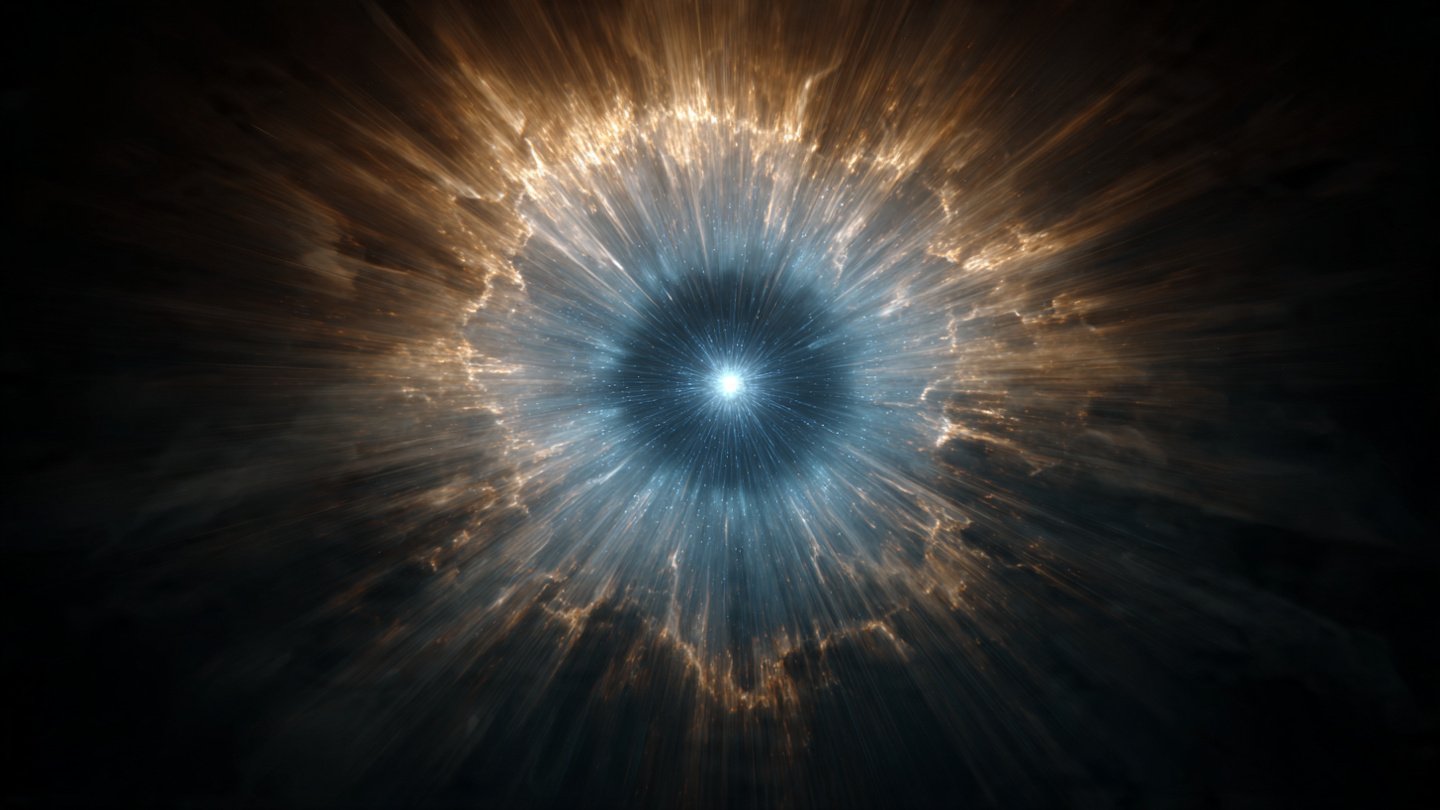
Why a Supernova Is Not Actually an Explosion
Every description of a supernova starts the same way. A massive star, at the end of its life, explodes. The word is so embedded in the literature, in classrooms, in documentary narration, that questioning it feels pedantic. But the word is doing real damage to the understanding of what these events actually are. A supernova does not begin with an outward release of energy. It begins with the fastest, most catastrophic inward collapse a massive object can undergo. The explosion, when it occurs, is a secondary consequence of a mechanism that can fail, frequently does fail, and depends on one of the most weakly interacting particles in the universe to work at all.
The Iron Problem
A massive star spends its life in a careful equilibrium. Gravity pulls inward. The energy released by nuclear fusion pushes outward. For most of a star's life, these forces balance and the star is stable. But this balance depends on fusion releasing energy, and fusion only releases energy when lighter nuclei are combined into heavier ones up to a specific limit.
That limit is iron.
Iron-56 sits at the lowest point of the nuclear binding energy curve. Fusing iron does not release energy. It absorbs it. So when a massive star has processed enough material to build an iron core, the energy source that was holding the core up disappears. The core is now supported not by fusion energy but by electron degeneracy pressure, a quantum mechanical effect arising from the Pauli exclusion principle, which forbids two electrons from occupying the same quantum state.
The core keeps accumulating mass as silicon in the shells above continues burning and depositing iron below. When the iron core reaches approximately 1.4 solar masses, it crosses the Chandrasekhar limit,[1] the maximum mass that electron degeneracy pressure can support. At this point, the collapse is not triggered. It is simply no longer preventable.
The relevant equation for the Chandrasekhar limit in its simplified non-relativistic form is:
$$M_{Ch} \approx \frac{5.87}{\mu_e^2} \, M_\odot$$where $\mu_e$ is the mean molecular weight per electron, approximately 2 for iron-group nuclei. The full relativistic derivation yields approximately 1.4 solar masses for an iron core, which matches observations of neutron star masses and white dwarf stability limits.
The Collapse That Outruns Itself
The infall of the outer core is not a slow process. Once the Chandrasekhar limit is crossed, the inner core collapses on a timescale of roughly 100 milliseconds. The outer core, which cannot receive information about the inner core's collapse faster than the local speed of sound, roughly a few thousand kilometers per second, continues falling inward at velocities approaching one third the speed of light before it finds out the floor is gone.
This is not metaphor. The collapse outruns its own acoustic signals. Different regions of the outer core are falling without coordinating with each other because coordination requires information transfer and there is no time.
Simultaneously, two processes accelerate the collapse. First, photodisintegration: the core is hot enough that photons break iron nuclei apart into free protons and neutrons, absorbing energy and removing support. Each iron nucleus costs roughly 8 MeV to disassemble. Second, electron capture: protons absorb electrons and become neutrons, releasing neutrinos and removing the very particles providing degeneracy pressure. The collapse feeds itself.
The kinetic energy of the infalling material is enormous. For a shell of mass $m$ falling from radius $r$ to the neutron star surface, the kinetic energy acquired is approximately:
$$E_k \approx \frac{G M_{NS} \, m}{R_{NS}}$$where $M_{NS}$ is the neutron star mass and $R_{NS}$ its radius. For typical values, this gives energies of order $10^{53}$ ergs, comparable to the total gravitational binding energy released.
The Nuclear Floor and the Bounce
The inner core does not collapse indefinitely. At a density of approximately $2.3 \times 10^{17}$ kg per cubic meter, atomic nuclei are fully touching. The short-range repulsive component of the strong nuclear force activates. The compressibility of nuclear matter drops sharply. The inner core overshoots equilibrium, compresses past nuclear saturation density, and rebounds.
This bounce generates a shockwave. For a brief moment, this shockwave carries approximately $10^{51}$ ergs of kinetic energy and moves outward at tens of thousands of kilometers per second. It is, for a few milliseconds, the most energetic pressure front in the local galaxy.
Then it stalls.
The shockwave must push through the outer iron core, which is still falling inward. Every iron nucleus it encounters costs energy to photodisintegrate. The energy budget is brutal: photodisintegration of the outer iron core alone costs between $1.5$ and $2.0 \times 10^{51}$ ergs. The shockwave begins with enough energy to power a supernova and spends more than that amount crossing the iron core. It stalls at 100 to 200 kilometers from the center, converting from an outward-moving pressure front into what astrophysicists call a standing accretion shock.
Ninety-Nine Percent Invisible
While the shockwave stalls, the proto-neutron star at the center is cooling. The mechanism by which it cools is not electromagnetic radiation. At these temperatures and densities, the dominant cooling channel is neutrino emission. Thermal neutrino-antineutrino pairs of all three flavors are produced in enormous quantities and stream outward.
The total energy radiated in neutrinos in the first ten seconds after core bounce is approximately $3 \times 10^{53}$ ergs. This is the gravitational binding energy of the neutron star. For comparison, the canonical kinetic energy of a supernova explosion is $10^{51}$ ergs. The neutrino emission exceeds the explosion energy by a factor of roughly 300.
The neutrino luminosity in the first second after collapse temporarily exceeds the combined electromagnetic luminosity of the entire observable universe. The neutrino-matter interaction cross-section for typical supernova neutrino energies is:[2]
$$\sigma \approx \frac{G_F^2 \, E_\nu^2}{\pi \, \hbar^4 c^4} \approx 10^{-44} \, \text{cm}^2 \left(\frac{E_\nu}{10 \, \text{MeV}}\right)^2$$where $G_F$ is the Fermi constant. At this cross-section, a neutrino traveling through lead would require approximately one light-year of material to have a 50 percent probability of interacting. And yet the supernova depends on these particles entirely.
The neutrino-heating mechanism, first proposed by Colgate and White in 1966, describes how roughly one percent of the neutrino luminosity is absorbed in the gain region, a thin shell of material between roughly 70 and 200 kilometers from the center, depositing enough energy to eventually revive the stalled shock.[3] The gain region is where the ratio of the neutrino heating timescale to the advection timescale determines the outcome:
$$\frac{\tau_\text{heat}}{\tau_\text{adv}} < 1 \implies \text{explosion}$$In three-dimensional simulations, convection and the Standing Accretion Shock Instability (SASI) improve the efficiency of neutrino heating by increasing the time material spends in the gain region, tipping this ratio toward explosion. In one-dimensional models, the shock almost never revives.
When Stars Disappear Without Exploding
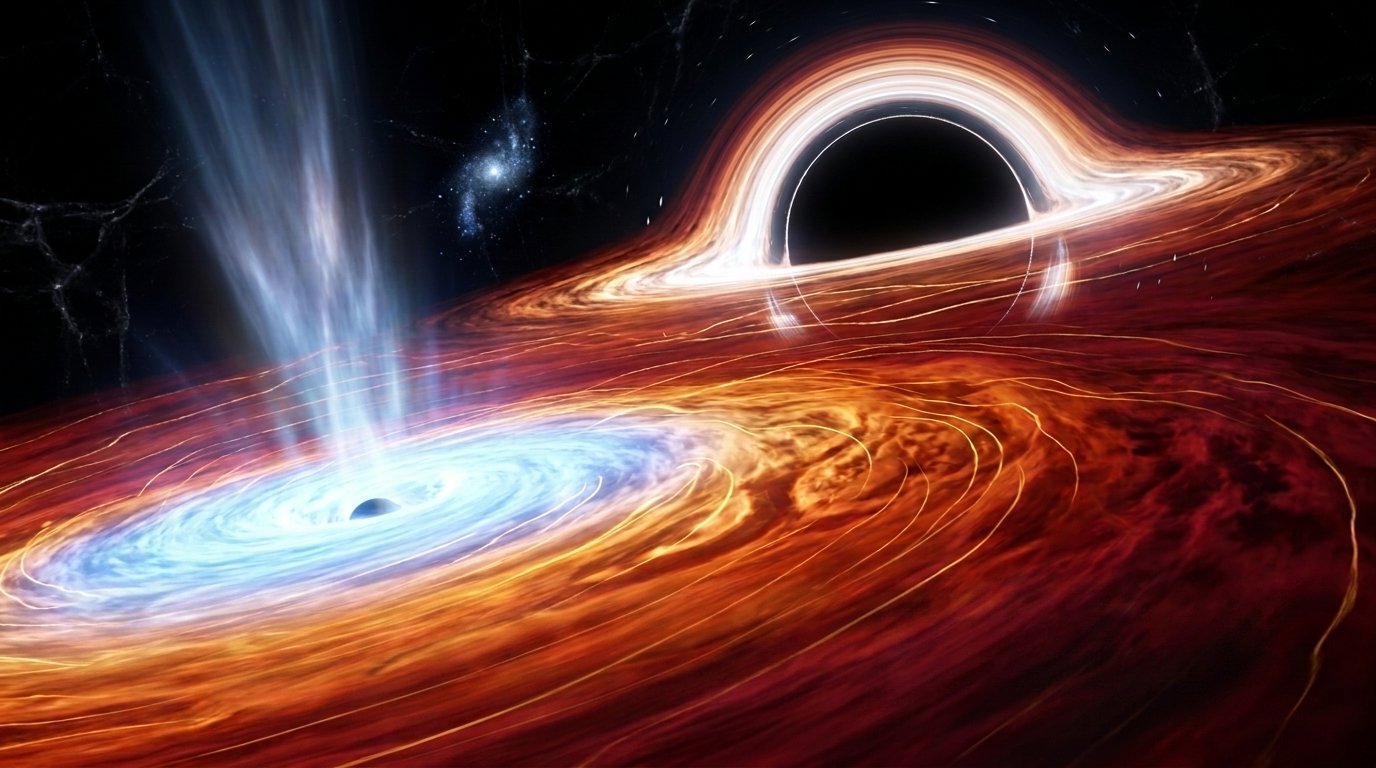
The mechanism can fail. For progenitors above roughly 20 to 25 solar masses, the accretion rate onto the proto-neutron star is high enough that the critical neutrino luminosity for shock revival is never reached. The proto-neutron star may collapse to a black hole before the shock revives. The outer layers fall inward. No optical transient occurs.
The best observational candidate for a failed supernova is N6946-BH1, a red supergiant of approximately 25 solar masses in NGC 6946, the Fireworks Galaxy. In 2009, the star brightened slightly and then faded. By 2015, Hubble Space Telescope imaging confirmed the star had disappeared, replaced by a faint infrared source consistent with a black hole accreting residual material.[4]
Current estimates suggest that between 10 and 50 percent of all core collapses in the universe produce no visible supernova. This wide range reflects genuine uncertainty in the models. The boundary between exploding and non-exploding progenitors is not a clean mass threshold. It depends on rotation, magnetic fields, and the detailed internal structure of the progenitor in ways that are still being mapped by increasingly realistic three-dimensional simulations.
What the Star Leaves Behind
In supernovae that succeed, the shockwave that revives processes the material it passes through. Explosive nucleosynthesis in the oxygen and silicon shells produces iron-group elements and alpha elements in quantities that have shaped the chemical composition of the galaxy. The innermost ejecta are rich in nickel-56, which decays to cobalt-56 with a half-life of 6.1 days and then to stable iron-56 with a half-life of 77.2 days. This decay chain powers the optical luminosity of the supernova for weeks to months after the explosion.
The elements produced and distributed by core-collapse supernovae include most of the oxygen in the universe, the alpha elements from neon through calcium, and a fraction of the iron-group elements. The r-process, which builds elements heavier than iron up to uranium by rapid neutron capture, may also occur in some core-collapse environments, though neutron star mergers are now confirmed as a primary r-process site following the detection of r-process signatures in the kilonova associated with GW170817.
The neutron star or black hole left at the center is not a remnant in any passive sense. A neutron star of 20 kilometers diameter containing 1.4 solar masses of material compressed to nuclear density is its own ongoing physics problem, a laboratory for dense matter equations of state, a potential source of gravitational waves, and in some cases a pulsar whose timing precision rivals atomic clocks.
SN 1987A and the Twenty-Four Particles
On February 23, 1987, three underground neutrino detectors on three different continents recorded a total of 24 to 25 interaction events in a thirteen-second window, several hours before the optical brightening of SN 1987A was observed. Kamiokande II in Japan detected 11 events. IMB in Ohio detected 8. Baksan in Russia detected 5.
From a burst of approximately $10^{58}$ neutrinos, 24 to 25 left detectable marks. The energies of the detected events were consistent with theoretical predictions for the cooling of a proto-neutron star. The total energy implied by the detected fraction, extrapolated to the full isotropic emission, was approximately $3 \times 10^{53}$ ergs, matching the gravitational binding energy of a neutron star.
The three-hour gap between the neutrino detection and the optical brightening is itself a measurement. It encodes the transit time of the shockwave from the core of Sanduleak -69 202 to its surface, providing a direct constraint on the progenitor radius consistent with the blue supergiant classification identified in pre-explosion archival images.
What We Actually Know
The broad outline of core-collapse supernova physics is observationally anchored and theoretically coherent. Massive stars develop iron cores. Iron cores collapse when they exceed the Chandrasekhar limit. The collapse releases approximately $3 \times 10^{53}$ ergs as neutrinos. Some fraction of that energy revives a stalled shockwave via neutrino heating, turbulence, and instabilities in the gain region. The shockwave distributes processed elements into the interstellar medium. The neutrinos from SN 1987A confirmed the energy scale and timescale of this picture.
What remains open is the detailed revival mechanism: which instabilities matter most in which progenitors, where the boundary between successful and failed explosions lies as a function of progenitor properties, and whether core-collapse supernovae contribute significantly to r-process nucleosynthesis or whether neutron star mergers dominate. These questions are being addressed by increasingly high-resolution three-dimensional simulations and by survey programs watching for stellar disappearances in nearby galaxies.
A galactic supernova, when it occurs, will be detected simultaneously in neutrinos by Super-Kamiokande and its successors, in gravitational waves by LIGO and Virgo, and in light by every optical telescope on Earth and in orbit. The multi-messenger observation of a nearby core collapse will provide constraints on all of these open questions simultaneously.
The word explosion is not being retired. It describes the outcome accurately enough for most purposes. What it misses is everything that determines whether the outcome occurs at all: the iron wall, the infall at one third the speed of light, the nuclear floor, the shockwave that stalls and nearly stays stalled, and the particle so weakly interacting that it treats a light-year of lead as nearly empty space, delivering the energy that starts a star coming apart from the inside.
That is what a supernova is. The word explosion describes where it ends up. It says nothing about how it gets there.
[1] Chandrasekhar, S. (1931). The Maximum Mass of Ideal White Dwarfs. Astrophysical Journal, 74, 81. The derivation was initially controversial but is now foundational to stellar physics and has been confirmed by observations of white dwarf masses and Type Ia supernova standardizability.
[2] The weak interaction cross-section scaling with $E_\nu^2$ was established through the theoretical framework of Fermi's theory of beta decay and its subsequent generalization. For supernova neutrino energies of 10 to 20 MeV, the cross-section is approximately $10^{-44}$ to $10^{-43}$ cm squared.
[3] Colgate, S.A. and White, R.H. (1966). The Hydrodynamic Behavior of Supernova Explosions. Astrophysical Journal, 143, 626. The neutrino-heating mechanism was proposed here and has been the central focus of core-collapse supernova theory for nearly six decades.
[4] Adams, S.M. et al. (2017). The Search for Failed Supernovae with the Large Binocular Telescope: Confirmation of a Disappearing Star. Monthly Notices of the Royal Astronomical Society, 469, 1445. N6946-BH1 remains the strongest observational candidate for a failed core-collapse supernova.

Comments (0)
Leave a Comment