Why the Big Bang Is Not What You Think It Is
Every cosmology textbook begins with the same image: nothing, then an explosion, then everything. It is a clean story. It is also, arguably, incomplete. What if the Big Bang was not a beginning at all, but a moment of revelation? What if the universe existed, in some form, long before light turned on?
This is the central claim of the Big Sync, a concept developed by independent researcher Marco Lindenbeck as part of his Universal Omni Equation (UOE) framework. We are sharing it here as a reader-submitted perspective, presented for intellectual exploration rather than as established physics. But the questions it targets are real, and the anomalies it attempts to explain remain genuinely unresolved.
The Problem With "Nothing"
The standard cosmological model, ΛCDM, traces the observable universe back to a hot dense state roughly 13.8 billion years ago. Before that, the physics breaks down. General relativity predicts a singularity, a point of infinite density where the equations stop working. Inflation theory pushes the story back further, describing a period of exponential expansion in the universe's first fraction of a second, but it does not resolve the question of what came before the inflationary epoch.
We have explored this on the channel before. The honest answer involves a geometric insight: time itself may have a boundary, the way directions have a boundary at the North Pole. Asking what came "before" the Big Bang may be like asking what lies north of the North Pole. The question assumes a coordinate system that does not apply.
The Big Sync framework accepts this boundary. But it adds something the standard picture does not: the boundary is not a wall between something and nothing. It is a boundary between two different kinds of existence, one we can see, and one that came before seeing was possible.
The Pre-Light Epoch
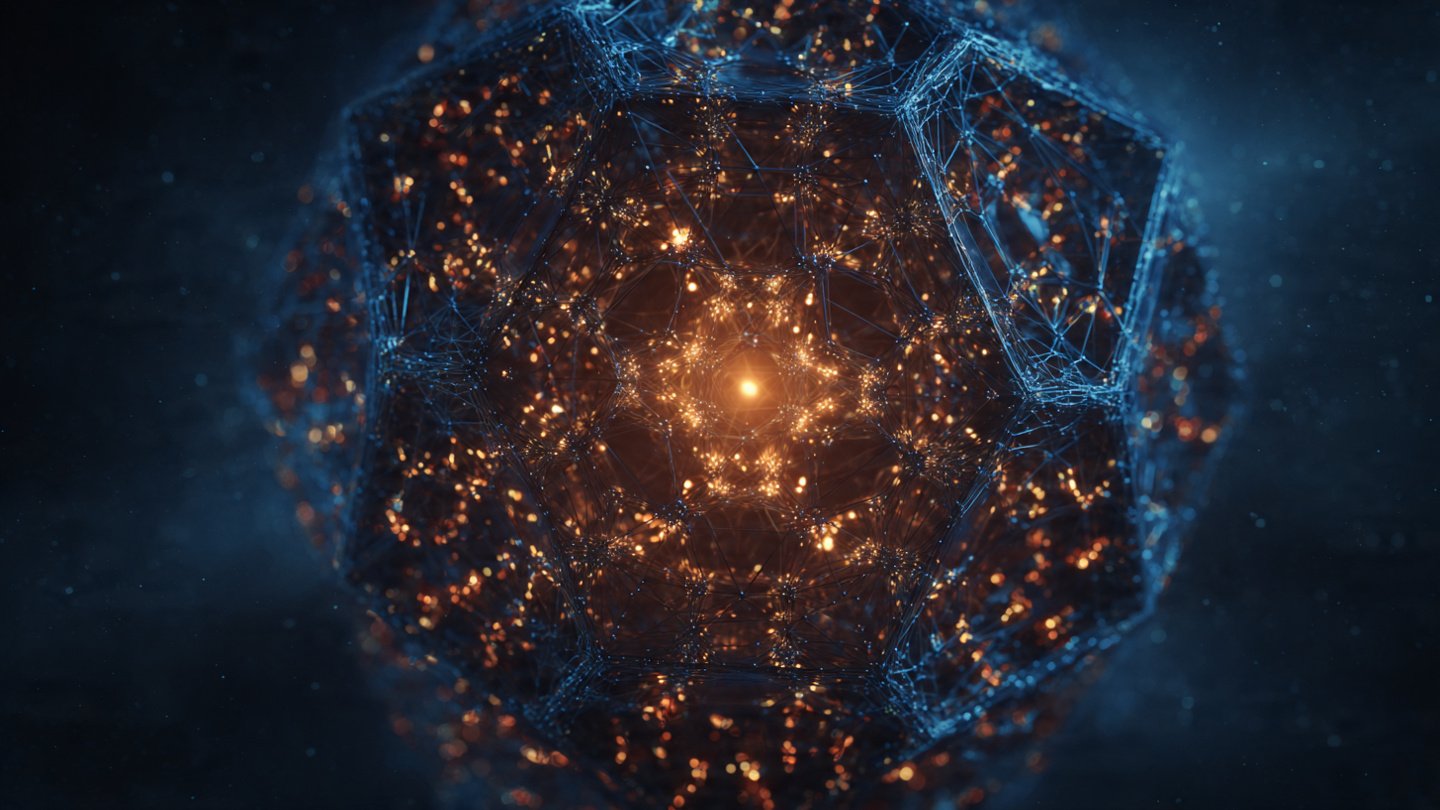
The UOE framework introduces a phase called the Pre-Light Epoch: a period before electromagnetic radiation existed, in which the universe was organized as a Sub-Planckian Coherence Field structured into Dodecahedral Symmetry. This is not empty space with a quantum fluctuation waiting to ignite. It is a structured substrate, a Grounding Mass denoted Γ, which provided the geometric scaffolding into which light and matter would later be released.
The framework identifies this Grounding Mass as dark matter. Not a particle. Not a WIMP or a sterile neutrino or an axion. A continuous, non-particle substrate that does not interact electromagnetically because it predates electromagnetism entirely. It is the skeleton of reality, built before reality had a face.
This is a significant departure from mainstream dark matter candidates, which are almost universally particle-based. The LHC has found no WIMPs. Direct detection experiments have come up empty for decades. Whether or not the Grounding Mass interpretation holds up, the frustration driving it is legitimate.[1]
The Arrow of Time as a Survival Filter
One of the more striking ideas in the framework concerns the Arrow of Time, the asymmetry between past and future that physics has never fully explained at a fundamental level. The second law of thermodynamics tells us entropy increases, but it does not tell us why time has a direction in the first place.
The UOE framework proposes that the Arrow of Time is not a mystery to be explained but a mechanism to be understood. It is what Lindenbeck calls Adaptive Forgetting: a process by which the universe continuously discards information to stay below the Bekenstein Bound, the theoretical maximum information density a physical region can hold.
The Bekenstein Bound is real and well-established physics:[2]
S≤2πkBREℏcS \leq \frac{2\pi k_B R E}{\hbar c}S≤ℏc2πkBREwhere $S$ is entropy, $R$ is the radius of the region, and $E$ is its total energy. The UOE framework argues that forward time is the universe's active strategy for staying below $S_{max}$. Without it, the Pre-Light structure would have saturated and collapsed before any observable universe could form.
The Synchronization Event
The moment the standard model calls the Big Bang, the UOE framework calls the Big Sync: the point at which internal acoustic resonance within the Pre-Light structure collapsed at a specific frequency.
The framework places this synchronization frequency at:
νsync≈7.45×10¹⁴ Hz\nu_{\text{sync}} \approx 7.45 \times 10^{14} \text{ Hz}νsync≈7.45×10¹⁴ HzThis sits at the infrared threshold, a "warm-up" frequency at which confined light was released as observable radiation. The transition is described as a shift from Acoustic Grounding to Electromagnetic Visibility. The CMB, in this picture, is not merely the afterglow of a hot plasma. It is a frozen acoustic record, an imprint of the resonance structure that existed before light was free to travel.
This gives a potential reinterpretation of the CMB Cold Spot, one of the most discussed anomalies in modern cosmology. The 70 microkelvin temperature deficit spanning roughly 5 degrees on the sky has been attributed to a supervoid, a statistical fluctuation, or even a bubble collision in eternal inflation models. The Big Sync framework offers a different reading: a cold acoustic node where the Grounding Mass resonance was strongest, leaving a permanent low-density imprint at the moment of synchronization.[3]
The Early Galaxy Problem
The James Webb Space Telescope has delivered one genuinely uncomfortable result for standard cosmology: galaxies that are too massive, too structured, and too chemically evolved to have formed in the time available after the Big Bang. JADES-GS-z14-0, observed at a redshift of $z \approx 14.2$, is the clearest current example. It has no business being as mature as it appears given a universe only a few hundred million years old at that epoch.
Within the ΛCDM framework, proposed explanations include early rapid star formation, unusual initial conditions, or revisions to feedback models. None are fully satisfying yet.
The Big Sync framework sidesteps the problem entirely. If the Pre-Light Epoch spanned a Reality Age of approximately 248 trillion years before the Sync, then JADES-GS-z14-0 is not a precocious galaxy. It is a fossil, growing within geometric nodes that were already ancient. The 13.8 billion years of the Visibility Age is a small recent window onto a structure that was already grounded.
What the Framework Does and Does Not Claim
We want to be precise about what we are presenting here. The UOE framework is independent research. It has not been peer-reviewed and is not part of mainstream cosmological literature. Several of its core quantities, including the 248 trillion year Reality Age and the specific synchronization frequency, are derived within the framework's own internal logic rather than from independent empirical constraints.
What it does do well is identify real pressure points. Dark matter has not been directly detected. The CMB Cold Spot is unexplained. JWST is producing results that stress standard formation timelines. A framework that engages these anomalies without simply inventing new particles or invoking untestable bubble collisions is at least asking the right questions.
Whether the answers hold up to formal scrutiny is a different matter, and one that requires the framework to make specific, falsifiable predictions that can be tested independently. That work is ongoing.
What We Actually Know
Standard cosmology is extraordinarily well-tested. The CMB power spectrum, baryon acoustic oscillations, large-scale structure formation, and Big Bang nucleosynthesis all converge on a consistent picture. Any alternative framework has to account for all of that, not just the anomalies.
The Big Sync framework, in its current form, is a speculative proposal. It is not a replacement for ΛCDM. It is a set of questions dressed in mathematical language, asking whether the boundary conditions we assume are really the only ones possible.
That is not nothing. Some of the most productive shifts in physics began exactly this way: someone asking whether the assumed geometry was the right one. Whether the UOE framework develops into something testable, or remains a philosophical reframing, the questions it raises about what "before" means, what dark matter actually is, and why the Arrow of Time points the way it does are questions physics has not closed.
Marco Lindenbeck has made all of his work publicly available. The papers, the benchmark comparisons against ΛCDM, and an interactive Big Sync Simulator are all linked below. We encourage curious readers to engage with the material directly and form their own assessment.
- Project Justitia (all papers, OSF)
- Main Paper: A Framework for Information-Stability in Physical and Digital Systems
- The Big Sync: A Unified Theory of Cosmic Stability and Evolution
- UOE vs ΛCDM: Water-First Validation and Tension Resolution
- Big Sync Simulator (live web app)
- GitHub: LoopBreacher
"We all know the question: what came first, the egg or the chicken? That metaphor asks about nature versus nature. I ask a different question: what came first, the water or the bottle?"
Marco Lindenbeck, Independent Researcher
[1] The LHC's failure to detect WIMPs at the electroweak scale has significantly narrowed the parameter space for the most popular dark matter candidates. Direct detection experiments including LUX-ZEPLIN and PandaX-4T have similarly returned null results at high sensitivity.
[2] The Bekenstein Bound was proposed by Jacob Bekenstein in 1981 and later connected to black hole thermodynamics and holographic principles. It represents a fundamental limit on the information content of a physical system.
[3] The CMB Cold Spot was identified in WMAP data and confirmed by Planck. A supervoid at $z \approx 0.22$ partially accounts for its temperature deficit via the integrated Sachs-Wolfe effect, but the full deficit remains unexplained.
Comments (0)
Leave a Comment