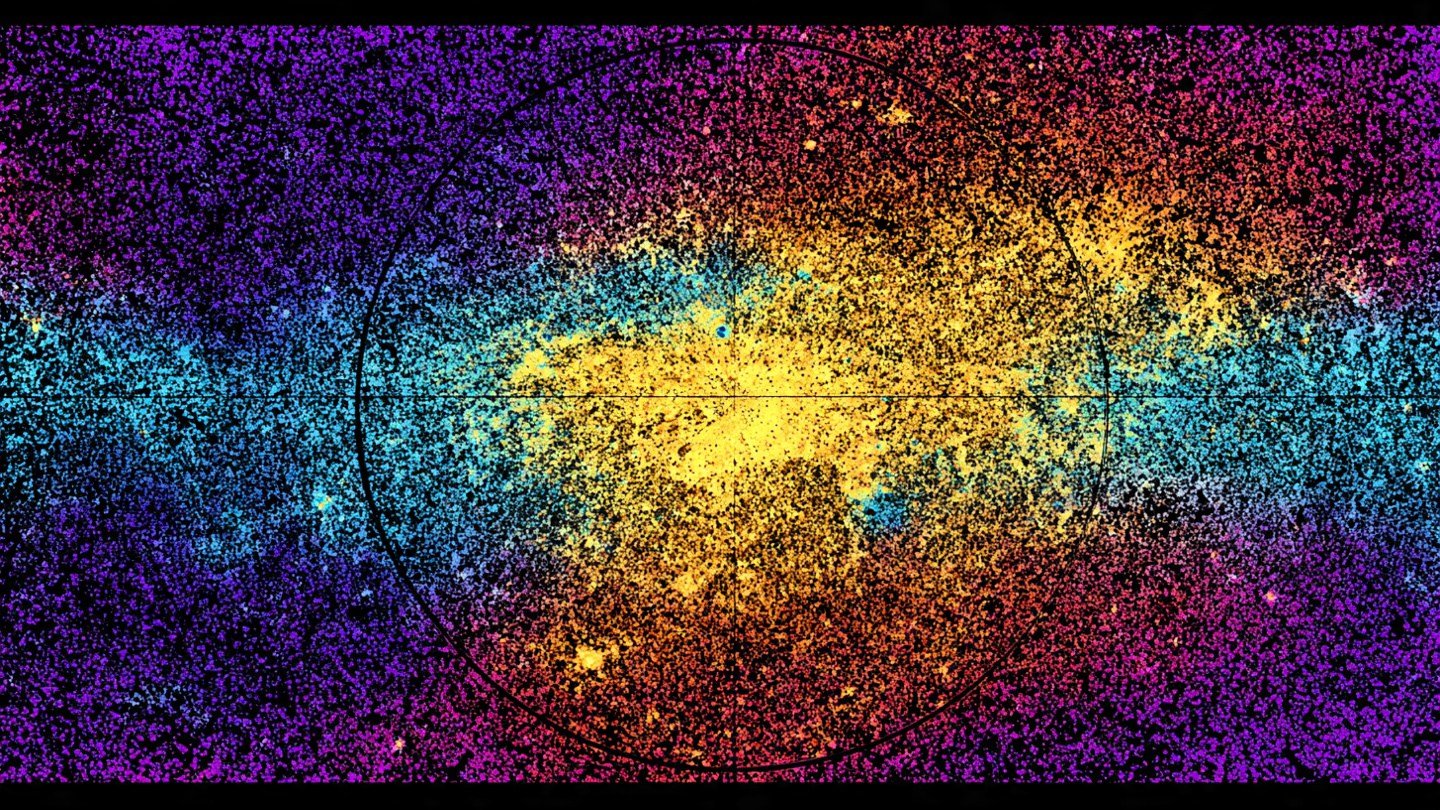
Why the CMB Cold Spot Has No Explanation Yet
There is a region of the sky, in the direction of a dim southern constellation called Eridanus, where the oldest light in the universe is colder than it should be. Not dramatically colder. Not in any way you could perceive directly. Seventy millionths of a degree below the average temperature of the cosmic microwave background. And yet that difference, smaller than anything a standard thermometer could register, has survived two separate satellite missions, decades of independent analysis, spectroscopic surveys of thousands of galaxies, and gravitational lensing maps from one of the most ambitious sky surveys ever conducted. It is still there. It is still unexplained. And the list of things it might be gets stranger the further down it you read.
What the Cosmic Microwave Background Actually Is
To understand why the Cold Spot matters, you have to understand what it sits inside. The cosmic microwave background is the oldest light in the observable universe, released approximately 380,000 years after the Big Bang when the universe cooled enough for electrons and protons to combine into neutral hydrogen atoms for the first time.[1] Before that moment, the universe was a dense, hot plasma so opaque that photons could not travel more than a short distance before colliding with a free electron and scattering. When neutral atoms formed, that opacity vanished. The photons that had been trapped in the plasma streamed outward into suddenly transparent space and have been traveling ever since.
That light, stretched by 13.8 billion years of cosmic expansion from hot visible wavelengths into cool microwaves, now arrives at our detectors from every direction simultaneously. Its average temperature is 2.725 Kelvin, approximately 270 degrees below zero Celsius. The fluctuations across the full sky, the hot and cold patches that encode the density variations of the early universe, are on the order of one part in 100,000. To map them required satellites cooled to within fractions of a degree of absolute zero, orbiting above Earth's atmosphere, sweeping the sky for months.
NASA's WMAP satellite, launched in 2001, produced the first high-resolution full-sky maps of these fluctuations. ESA's Planck satellite, launched in 2009, refined them further with greater sensitivity and wider frequency coverage. Both missions confirmed the same basic picture: a universe whose early density variations match the predictions of the standard cosmological model, Lambda-CDM, with extraordinary precision. Across most of the sky, the agreement between theory and observation is among the most precise in all of science.
Across most of the sky.
The Anomaly That Would Not Dissolve
In the first year of WMAP data, a region in the southern sky registered colder than expected. Centered in the direction of the constellation Eridanus at galactic coordinates $l = 207.8°$, $b = -56.3°$, the Cold Spot spans approximately five degrees on the sky and runs about 70 microkelvins below the CMB average, with its coldest regions reaching 140 microkelvins below average.[2]
Typical CMB fluctuations peak at angular scales of around one degree, the characteristic scale set by acoustic oscillations in the early plasma. Five degrees is five times that. The probability of finding a cold region this large and this cold arising by chance within the standard model has been estimated at between one and two percent, depending on the statistical method applied. That figure shifts slightly with different analysis choices, but remains consistently in the tail of the distribution across every study that has examined it.
The standard response to an anomaly in a single dataset is to wait for independent confirmation. Planck provided it in 2013. Different satellite, different detector technology, different institution, different continent. Same location. Same angular size. Same temperature deficit. The Cold Spot was no longer a single-mission finding. It was a feature of the microwave sky.
The Supervoid and the Integrated Sachs-Wolfe Effect
The most natural conventional explanation involves a large underdense region of the universe, a supervoid, sitting between us and the CMB along the line of sight toward the Cold Spot. In an expanding universe dominated by dark energy, photons traveling through a supervoid experience a net energy loss through a mechanism called the Integrated Sachs-Wolfe effect.[3]
The mechanism works as follows. As a photon enters a void, it climbs a gravitational potential hill, losing energy in the process. In a static universe, it would recover that energy descending the other side. But in an accelerating universe, dark energy stretches the void while the photon is crossing it. The hill the photon descends on exit is shallower than the one it climbed on entry. The photon exits with less energy than it entered with. Expressed mathematically, the temperature change from the late-time ISW effect is:
$$\frac{\Delta T}{T} = \frac{2}{c^3} \int \dot{\Phi} \, d\chi$$where $\dot{\Phi}$ is the time derivative of the gravitational potential along the photon path and $\chi$ is the comoving distance. The integral accumulates the effect over the entire crossing, which for a structure 1.8 billion light-years across can take hundreds of millions of years even at the speed of light.
In 2015, a team led by Dr. Istvan Szapudi at the University of Hawaii identified a supervoid in this direction using combined data from the Pan-STARRS1 optical survey and NASA's WISE infrared satellite. The void spans approximately 1.8 billion light-years and sits roughly 3 billion light-years from Earth, making it one of the largest individual structures ever identified.[4] Its existence aligned spatially with the Cold Spot, and the ISW mechanism provided a physically plausible explanation for at least part of the temperature deficit.
Why the Supervoid Is Not Enough
The problem is the numbers. When researchers model the Eridanus Supervoid using its measured size and density contrast and calculate the expected ISW temperature decrement, the result is approximately negative 10 to 20 microkelvins. The observed deficit is approximately negative 70 microkelvins. The supervoid, by best current estimates, explains somewhere between one-seventh and one-third of the observed signal.
The Dark Energy Survey Year-3 results, published in 2021, confirmed the supervoid's existence at signal-to-noise significance greater than five using gravitational lensing mass maps rather than galaxy counts, providing a genuinely independent line of evidence.[5] The DES data confirmed the spatial correlation between the void and the Cold Spot. It also found that the lensing amplitude from the supervoid was approximately 30 percent lower than expected from comparable structures in standard Lambda-CDM simulations, adding a separate discrepancy to the already existing gap.
A 2017 study from Durham University sharpened the problem further. A team led by Ruari Mackenzie and Professor Tom Shanks used spectroscopic redshifts of approximately 7,000 galaxies across the Cold Spot region, measured with the Anglo-Australian Telescope, to construct a precise three-dimensional map of the galaxy distribution in that direction.[6] Unlike earlier photometric redshift surveys, which estimate distances from galaxy colors with significant uncertainty, spectroscopic measurements directly measure the shift in spectral lines, producing precise distances. The study found no single coherent supervoid of the size and depth required to explain the Cold Spot via the ISW effect. The galaxy distribution showed several smaller underdensities but no unified structure capable of producing the required temperature signal.
Three Explanations That Remain Open
With the conventional explanation insufficient, three categories of possibility remain, each with a different relationship to the standard cosmological model.
Statistical fluctuation. The Cold Spot may be an extreme but permitted draw from the distribution of CMB fluctuations predicted by Lambda-CDM. The one to two percent probability figure means that in a thousand simulated universes, ten to twenty would produce a feature comparable to the Cold Spot by chance. This explanation requires no new physics. It requires accepting that two unlikely things, the Cold Spot and the supervoid, happen to coincide in the same direction for unrelated reasons. The joint probability of that coincidence is considerably lower than either figure alone.
Cosmic texture. A topological defect formed during a phase transition in the very early universe could have imprinted a large cold region on the CMB. Cosmic textures are field configurations that are initially stable but eventually collapse, releasing energy through a rapidly evolving gravitational potential. Cruz et al. argued in 2007 that a texture model can produce a good fit to the observed Cold Spot profile, though it requires specific parameters for the energy scale of the underlying phase transition.[7] This explanation requires early-universe physics not contained in the standard inflationary model but not in direct conflict with established physics either.
Bubble collision. Most models of cosmic inflation predict eternal inflation in which the inflating background spacetime continues expanding indefinitely, with bubble universes nucleating stochastically within it. If our universe is one such bubble, a collision with a neighboring bubble in the early inflationary period would propagate a wave across our universe, potentially imprinting a disk-like temperature anomaly on the CMB. The geometry of such an imprint, roughly circular with a defined boundary, is not inconsistent with the Cold Spot. Critically, this hypothesis makes a specific testable prediction: a bubble collision should produce a distinctive polarization signature in the CMB aligned with the temperature anomaly. Searches in Planck polarization data have not found this signature, though the current sensitivity threshold may be insufficient to detect it if present.[8]
A 2024 Alternative: Local Galaxy Foregrounds
A paper published in Astronomy and Astrophysics in 2024 proposed a different mechanism entirely. The Eridanus super-group, the largest galaxy group complex in the local universe, sits in the direction of the Cold Spot. The study found that the systematic decrease in CMB temperature observed around nearby late-type spiral galaxies, a phenomenon identified in earlier work by Luparello et al. and Hansen et al., could produce a temperature decrement whose shape and intensity substantially overlaps with the Cold Spot when the spiral-rich Eridanus super-group complex is modeled as a foreground contribution.[9] This would represent a local, low-redshift explanation requiring no modifications to the standard model, though it would require the poorly understood galaxy-CMB temperature correlation to be stronger in this region than elsewhere in the sky.
What We Actually Know
The Cold Spot exists. It has been measured to approximately 70 microkelvins below the CMB average across a region spanning five degrees in the direction of the constellation Eridanus. It has been confirmed independently by WMAP and Planck. It is statistically anomalous under standard Lambda-CDM at the one to two percent level, or more conservatively when the supervoid alignment is included in the joint probability.
The Eridanus Supervoid exists at high significance and is spatially correlated with the Cold Spot. The ISW effect provides a real physical mechanism connecting them. That mechanism accounts for at most a fraction of the observed temperature deficit.
The three remaining explanations, statistical fluctuation, topological defect, and bubble collision, are each scientifically defensible. None is confirmed. None is ruled out. The bubble collision hypothesis has the most specific testable prediction and the least observational support. The statistical fluctuation hypothesis requires the least imagination and the most tolerance for coincidence. The texture hypothesis sits between them, requiring new early-universe physics while leaving the rest of cosmology intact.
Future CMB polarization surveys, including the Simons Observatory currently under construction in Chile and the proposed CMB-S4 experiment, will map CMB polarization with significantly greater sensitivity than Planck. If the bubble collision or texture hypotheses are correct, those instruments may find the corroborating signals that current data cannot confirm or deny. If they find nothing, the statistical explanation becomes more defensible by default.
The Cold Spot will be in the southern sky when those results arrive. It will be there whether or not they resolve anything. It has been there for 13.8 billion years. A few more decades of patience seems reasonable.
[1] European Space Agency. "Planck and the Cosmic Microwave Background." ESA Science and Technology.
[2] "CMB Cold Spot." Wikipedia.
[3] Sachs, R.K. and Wolfe, A.M. (1967). "Perturbations of a Cosmological Model and Angular Variations of the Microwave Background." The Astrophysical Journal, 147, 73. See also: "Sachs-Wolfe Effect." Wikipedia.
[4] Szapudi, I. et al. (2015). "Detection of a supervoid aligned with the cold spot of the cosmic microwave background." Monthly Notices of the Royal Astronomical Society, 450(1), 288-294. See also: University of Hawaii Institute for Astronomy press release, 2015.
[5] Kovacs, A. et al. (2022). "DES view of the Eridanus supervoid and the CMB cold spot." Monthly Notices of the Royal Astronomical Society, 510(1), 216-229.
[6] Mackenzie, R., Shanks, T. et al. (2017). "Evidence against a supervoid causing the CMB Cold Spot." Monthly Notices of the Royal Astronomical Society. arXiv:1704.03814. Reported by Royal Astronomical Society via ScienceDaily, April 2017.
[7] Cruz, M. et al. (2007). Cosmic texture hypothesis. Referenced in "CMB Cold Spot." Wikipedia. See also: Marcos-Caballero, A. et al. (2023). "The CMB cold spot under the lens: ruling out a supervoid interpretation." arXiv:2211.16139.
[8] Bubble collision hypothesis and polarization predictions. See: Quanta Magazine, "Physicists Study How Universes Might Bubble Up and Collide" (2021). Physics World, "The enduring enigma of the cosmic cold spot." Scientific American, "Could Cold Spot in the Sky Be a Bruise from a Collision with a Parallel Universe?"
[9] Hansen, F.K. et al. (2024). "The CMB Cold Spot as predicted by foregrounds around nearby galaxies." Astronomy and Astrophysics, 681. Summarized in Astrobites, "New Clues in the CMB Cold (Spot) Case" (2024).
Comments (0)
Leave a Comment