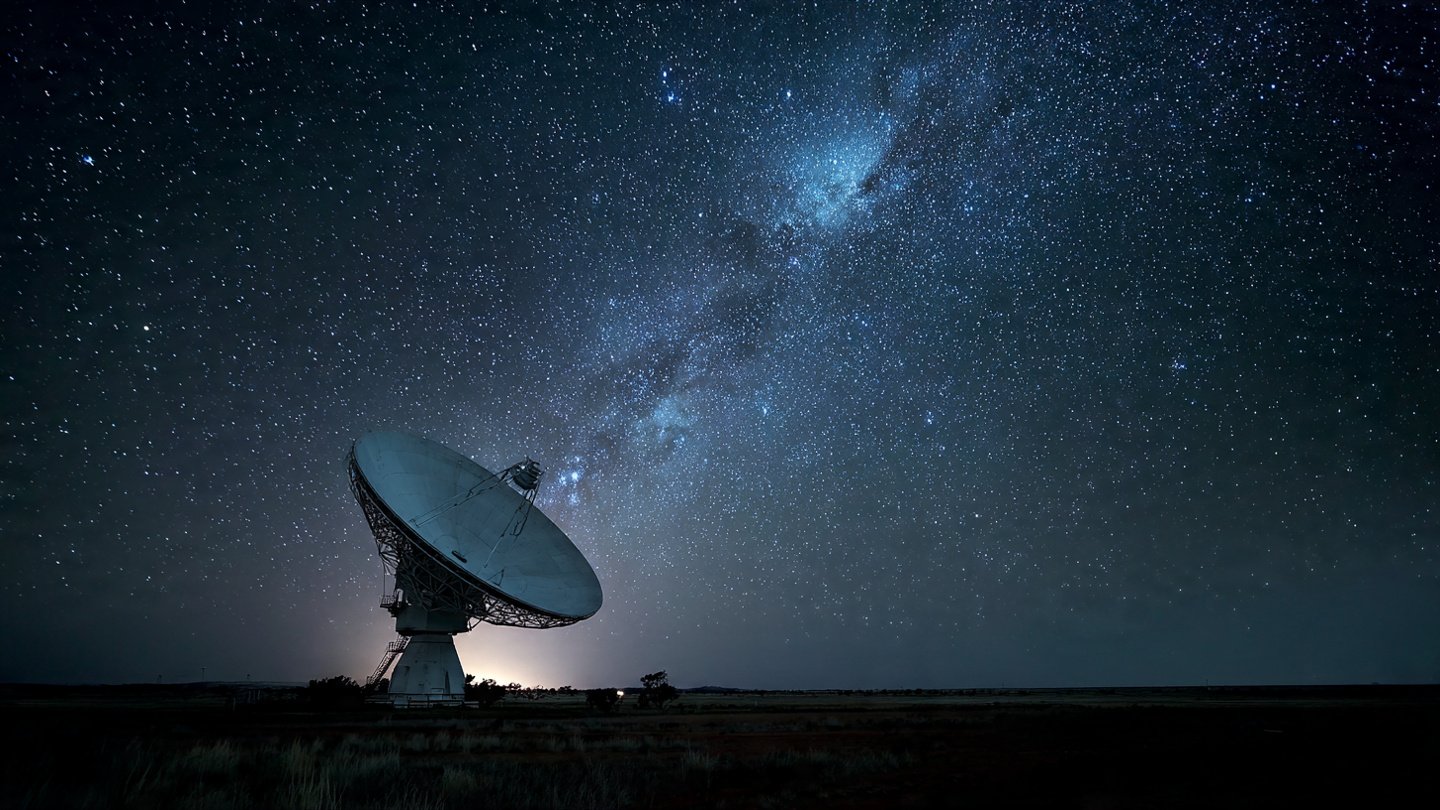
Why the Wow! Signal Has Never Been Explained
Most unexplained things in science get explained eventually. The data improves, the instruments get better, someone checks an archive with a new method and the anomaly dissolves into the ordinary. That is how it usually goes. The Wow! signal has not done that. Detected on August 15, 1977, studied by increasingly powerful instruments for nearly five decades, and still sitting in the record without a confirmed origin, it occupies a position in radio astronomy that almost no other observation shares: genuinely, honestly unresolved. Not because people stopped looking. Because the looking keeps coming back with nothing.
The Night It Arrived
The Big Ear radio telescope at Ohio State University was not a glamorous instrument. It had no moving dish, no dramatic dome. It was a large flat structure on a mowed field in Delaware, Ohio, relying entirely on Earth's rotation to sweep its fixed beam across the sky. Since 1973 it had been running continuously as part of a SETI search, one of the longest-running in history, feeding data to an IBM 1130 computer that printed everything onto continuous-feed paper rolls. Volunteers came in when they could and read through the printouts by hand.
Jerry Ehman was one of those volunteers. He had a PhD in astronomy and a full-time teaching job elsewhere. On August 18th, three days after the signal had been recorded, he was reviewing the printout at his kitchen table when a column of values stopped him. The sequence read: 6EQUJ5. Each character encodes signal intensity on a scale where digits go from 1 to 9 and then continue as letters. U is the twenty-first letter of the alphabet, representing an intensity value of 30. Thirty sigma above background noise. On a frequency where nothing was supposed to be producing a signal that strong.
He circled it in red pen. In the margin beside the circle he wrote one word: Wow!
The exclamation point was not rhetorical. The signal's intensity, its narrowband character, and its frequency placed it squarely within the parameters that SETI researchers had identified as most consistent with a transmission of non-natural origin. The entire sequence lasted exactly 72 seconds, which is precisely how long Big Ear's fixed beam could observe any given point in the sky as the Earth rotated beneath it. The signal rose, peaked, and fell in the shape that a fixed celestial source would produce. It appeared in one of the telescope's two feed horns and not the other.
By the time Ehman found it, the sky had moved on. The source, whatever it was, had already left the beam.
Why the Frequency Matters
The signal arrived at approximately 1420.456 MHz.[1] This is not an arbitrary number. It sits extremely close to the hyperfine transition frequency of neutral hydrogen, which is one of the most physically fundamental frequencies in the universe.
A hydrogen atom in its ground state consists of one proton and one electron. Both particles carry a quantum property called spin. When the electron's spin orientation flips spontaneously from parallel to antiparallel relative to the proton, the atom releases a photon at a precise frequency:
$$\nu_{HI} = 1420.405751768 \text{ MHz}$$This transition, known as the 21-centimeter line, was predicted theoretically in 1944 by Hendrik van de Hulst and first detected observationally in 1951 by Harold Ewen and Edward Purcell at Harvard. Because hydrogen is the most abundant element in the universe, comprising roughly 74 percent of all ordinary matter, this frequency is detectable everywhere in the cosmos. It is, in a meaningful sense, the universe's most common radio voice.
In 1959, Cornell physicists Philip Morrison and Giuseppe Cocconi published a paper in Nature arguing that any technologically advanced civilization attempting interstellar communication would likely choose a frequency near the hydrogen line, precisely because it is a universal constant that any radio-capable civilization would independently discover.[2] The frequency became the foundational tuning target for SETI searches. Big Ear's receiver was built around it.
The signal that arrived on August 15, 1977 was offset from the hydrogen line by approximately 50 kHz, which is consistent with a Doppler shift produced by a source moving toward Earth at roughly 10 kilometers per second. It was confined to a single 10-kilohertz channel out of fifty available channels, making it narrowband in a way that natural broadband sources typically are not. Its intensity of 30 sigma placed it far above anything the background sky should have been producing in that direction.
The Searches That Found Nothing
Ehman searched the same coordinates repeatedly in the months following the detection using Big Ear. John Kraus and Robert Dixon, the observatory's director and staff astronomer, improved the processing software and reobserved the region. The telescope was already pointed at that part of the sky every day as the Earth rotated. The source did not return.
Robert Gray, a data analyst from Chicago who became one of the most persistent independent investigators of the signal, searched with the META array at Oak Ridge Observatory in 1987 and 1989. He searched again with the Very Large Array in New Mexico in 1995 and 1996, an instrument significantly more sensitive than Big Ear. In 1999, he collaborated with Simon Ellingsen to conduct six 14-hour observation sessions at the University of Tasmania's Mount Pleasant Radio Observatory. Every search returned a null result.
In 1995, SETI League executive director H. Paul Shuch used a 12-meter telescope at the National Radio Astronomy Observatory in Green Bank, West Virginia, to observe the signal's coordinates. Nothing. Breakthrough Listen, the most comprehensive SETI program in history, eventually examined the region as part of its ongoing survey. Nothing.
The accumulated null result across nearly five decades of searching is itself a data point. A signal that repeats would have been recoverable with the instruments deployed. The Wow! signal has not repeated in any observation window across multiple decades, multiple countries, and multiple generations of radio telescope technology.
The Comet Hypothesis
In 2016, astronomer Antonio Paris proposed that the signal had been produced by the hydrogen envelope surrounding a passing comet. Comets release water molecules as they approach the Sun, and solar radiation breaks these molecules apart, releasing neutral hydrogen that surrounds the nucleus in a diffuse cloud millions of kilometers across. This cloud emits at the hydrogen line.
Paris identified comet 266P/Christensen as a candidate. The comet, discovered in 2005, had been moving through the region of Sagittarius at the time of the 1977 signal when its orbit was extrapolated backward. Between November 2016 and February 2017, Paris conducted over 200 observations of the comet using a 10-meter radio telescope and detected emission at 1420.25 MHz. Moving the telescope one degree away from the comet caused the signal to disappear. He observed three additional comets and found similar emission patterns.
The hypothesis was contested on several grounds. The Wow! signal's intensity of 30 sigma was substantially higher than the emission detected from 266P/Christensen, though Paris attributed this to mass loss the comet had experienced over decades. More significantly, the signal's bandwidth was far narrower than what cometary hydrogen emission would be expected to produce. Doppler broadening from the velocity distribution of hydrogen atoms across a large diffuse cloud should smear the emission across multiple frequency channels. The Wow! signal occupied a single channel. The signal also appeared in only one of Big Ear's two feed horns, which is inconsistent with a large extended source like a comet's hydrogen envelope passing through the telescope's beam.[3]
The comet hypothesis remains a minority position in the research literature.
The Magnetar Hypothesis
In 2024, Abel Mendez at the Planetary Habitability Laboratory, University of Puerto Rico at Arecibo, along with collaborators at the Harvard-Smithsonian Center for Astrophysics and the University of Antioquia in Colombia, proposed a different astrophysical explanation based on archived data from the Arecibo Observatory.[4]
A magnetar is a neutron star with an extraordinarily intense magnetic field, on the order of $10^{15}$ tesla. To put this in context, the strongest sustained magnetic fields produced in laboratory settings reach approximately $10^{2}$ tesla. A magnetar's field is strong enough to distort the electron orbitals of atoms and alter the properties of the vacuum in its immediate vicinity. Magnetars occasionally release enormous bursts of energy through a mechanism involving stress fractures in their solid neutron star crust. A moderate magnetar flare can release more energy in fractions of a second than the Sun emits over thousands of years.
When a magnetar flare's radiation front reaches a cold cloud of neutral hydrogen drifting in the interstellar medium, the researchers proposed, it can trigger stimulated emission through a process analogous to maser amplification. An incoming photon strikes a hydrogen atom already in its higher-energy spin state, triggering an immediate transition rather than waiting for spontaneous decay. The transition releases a second photon identical to the first in frequency and direction. This cascade can amplify the signal significantly before the excited population of atoms returns to its ground state.
The result would be a brief, intense, narrowband spike at 1420 MHz, transient because the triggering event is over quickly and the cloud returns to its cold baseline. The Mendez team found similar signals in Arecibo data from 2020, produced by cold hydrogen clouds, which they called candidate analogs to the Wow! signal.[5]
The hypothesis accounts for the signal's narrowband character, its intensity, and its non-repetition more cleanly than the comet explanation. It has not been confirmed. Identifying the specific magnetar and hydrogen cloud involved, across decades and in a crowded region of the galaxy, is a substantial unsolved problem.
The Candidate Star
In 2022, independent researcher Alberto Caballero searched the Gaia star catalog for sun-like stars within the Wow! signal's positional error box. He identified one strong candidate: 2MASS 19281982-2640123, a star with temperature, radius, and luminosity closely matching the Sun, located approximately 1,800 light-years from Earth in the direction of Sagittarius.[6]
The light-travel arithmetic has a certain quality to it worth noting. A signal leaving that star and arriving at Earth in 1977 would have departed around 177 AD. The civilization, if any, that might have sent it did so into a universe where no one on Earth had yet conceived of radio waves, let alone built a telescope to receive them.
Breakthrough Listen examined 2MASS 19281982-2640123 using sensitive radio instruments. The star was quiet across all observed frequencies. A single observation window cannot rule out an intermittently transmitting source, but no anomalous emission was detected.
The Broader Silence
The Wow! signal does not exist in isolation. It sits inside a larger problem that physicist Enrico Fermi articulated during a lunch conversation at Los Alamos in 1950, when he asked, apparently in the middle of an unrelated discussion: where is everybody?
The Fermi paradox is not a paradox in the strict logical sense. It is a tension between probability estimates and observational results. The Drake equation, formulated by Frank Drake in 1961, attempts to estimate the number of communicating civilizations in the Milky Way:
$$N = R_* \cdot f_p \cdot n_e \cdot f_l \cdot f_i \cdot f_c \cdot L$$Where $R_*$ is the rate of star formation, $f_p$ the fraction with planets, $n_e$ the number of habitable planets per system, $f_l$ the fraction where life develops, $f_i$ the fraction where intelligence emerges, $f_c$ the fraction that develop detectable technology, and $L$ the length of time such civilizations remain detectable. The biological and sociological terms are almost entirely unconstrained by current data. Depending on assumptions, $N$ can range from tens of thousands to effectively zero.
What is not in dispute is that more than six decades of systematic searching have produced no confirmed signal. The Great Silence, as researchers call it, is real. It constrains what is possible without answering what is true.
Robin Hanson's Great Filter argument, introduced in 1996, proposes that some transition in the sequence from chemistry to interstellar civilization is extremely improbable. If the filter lies in humanity's past, the silence reflects our rarity. If it lies ahead, the silence may reflect a pattern.[7]
What We Actually Know
The Wow! signal was real. It was detected by a functioning instrument on a protected frequency, in the shape that a fixed celestial source would produce, at an intensity 30 times the background noise. Jerry Ehman's annotation was not a claim. It was a notation that something unexpected had appeared in the data.
The signal has never recurred in any of the follow-up searches conducted across nearly five decades, using instruments ranging from the original Big Ear to the Very Large Array to Breakthrough Listen.
Three candidate explanations have been proposed: terrestrial interference (considered unlikely given the protected frequency and the signal's celestial profile), a cometary hydrogen cloud (contested due to bandwidth and intensity problems), and a magnetar-triggered hydrogen maser (physically coherent but unconfirmed and untraceable without identifying the specific source).
No explanation has been confirmed. The signal's origin remains officially undetermined.
Ehman himself, in a 2019 interview, said he was convinced the signal had the potential to be the first detection of extraterrestrial intelligence. Not that it was. That it had the potential to be. That qualifier, after decades of careful thought about a single column of data, is the most honest position the evidence supports.
The coordinates in Sagittarius are still there. The telescopes are still running. The question is still open.
[1] Ehman, J.R. (1998). "The Big Ear Wow! Signal: What We Know and Don't Know About It After 20 Years." Ohio State University Radio Observatory. bigear.org
[2] Morrison, P. and Cocconi, G. (1959). "Searching for Interstellar Communications." Nature, 184, 844-846.
[3] Paris, A.T. (2017). "Hydrogen Line Observations of Cometary Spectra at 1420 MHz." Journal of the Washington Academy of Sciences. planetary-science.org
[4] Mendez, A., Ortiz Ceballos, K., and Zuluaga, J. (2024). "Arecibo Wow! I: An Astrophysical Explanation for the Wow! Signal." arXiv:2408.08513
[5] Mendez, A. et al. (2025). "Arecibo Wow! II: Revised Properties of the Wow! Signal from Archival Ohio SETI Data." arXiv:2508.10657
[6] Caballero, A. (2022). "A Candidate Host Star for the Wow! Signal." International Journal of Astrobiology.
[7] Hanson, R. (1996). "The Great Filter: Are We Almost Past It?" George Mason University.


Comments (0)
Leave a Comment