Why the First Stars Had to Be Monsters
Before the first star ignited, the universe had been dark for somewhere between one hundred and two hundred million years. Not dim. Not faintly lit by distant sources. Completely, uniformly, everywhere dark. The cosmos contained hydrogen, helium, and an almost negligible trace of lithium, and nothing else. No carbon. No oxygen. No dust. No planets. The periodic table had two real entries and a footnote, and that was the entire chemical inheritance available to whatever came next. What came next were the most extreme stars the universe has ever produced, and the reason they had to be extreme was already written into the physics before a single one of them formed.
What the Big Bang Left Behind
Big Bang nucleosynthesis -- the process by which atomic nuclei formed in the first roughly twenty minutes of the universe's existence -- produced a cosmos of approximately 76% hydrogen and 24% helium by mass, with trace amounts of deuterium and lithium-7.[1] The window for building heavier nuclei closed before anything beyond lithium could accumulate in meaningful quantities. The universe was expanding too fast. The temperature dropped below the fusion threshold, and whatever had been made was what there was.
This compositional fact -- two elements and a footnote -- is not a minor technical detail about the early universe. It is the central constraint on everything that followed. The elements that make efficient gas cooling possible in the present-day universe -- carbon, oxygen, silicon, iron in their various ionized and molecular forms -- did not exist. The only cooling agent available to a collapsing primordial gas cloud was molecular hydrogen, and molecular hydrogen is a weak, fragile tool with a hard limit on what it can do.
Understanding why the first stars were so massive begins here. Not with the stars themselves, but with the chemistry they did not have access to.
The Cooling Problem and the Jeans Mass
When a region of gas becomes dense enough that its own gravity begins to matter, there is a competition between two forces: the inward pull of gravity and the outward push of thermal pressure from the hot gas. A star forms only when gravity wins. The threshold mass at which gravity overcomes pressure is called the Jeans mass, and it depends steeply on the temperature of the gas.
The relationship is not linear. The Jeans mass scales roughly as temperature to the power of 3/2:
$$M_J \propto T^{3/2} \cdot \rho^{-1/2}$$where $T$ is the gas temperature and $\rho$ is its density. Double the temperature, and the minimum collapsing mass increases by a factor of roughly 2.8. Lower the temperature significantly, and the Jeans mass drops by orders of magnitude. This temperature dependence is the mechanical link between cooling physics and stellar mass -- and it does not negotiate.
In the present-day Milky Way, star-forming molecular cloud cores reach temperatures around 10 Kelvin through a combination of carbon monoxide emission, fine-structure lines from ionized carbon and oxygen, and dust grain cooling. At 10 Kelvin, the Jeans mass works out to roughly one solar mass -- which is why the Sun's mass is not a coincidence. It is the natural output of present-day thermal conditions applied to gravitational collapse.
Molecular hydrogen, the only coolant available in primordial gas, cools through rotational and vibrational transitions that become inefficient below approximately 200 Kelvin.[2] The quantum mechanical spacing of H$_2$ energy levels sets a floor that the thermal collisions in the gas cannot push past once temperatures fall that low. At 200 Kelvin, the Jeans mass in a typical primordial cloud is not one solar mass.
It is several hundred solar masses.
The factor of twenty between the primordial temperature floor and the modern one, raised to the power of 3/2, gives a Jeans mass roughly 90 times larger in primordial gas than in present-day clouds. The numbers from detailed simulations are consistent with this scaling: characteristic Pop III masses of tens to a few hundred solar masses, compared to the roughly one solar mass typical of modern star formation.
Fragmentation, Accretion, and the Absent Brakes
In a present-day molecular cloud, the collapse does not produce one star. It produces hundreds. The cloud fragments -- breaks into many smaller dense cores -- because efficient metal and dust cooling allows the Jeans mass to fall during the infall. As the temperature drops, sub-regions of the cloud that were previously too small to be gravitationally independent become large enough to collapse on their own. The result is a distributed population of solar-mass objects.
Primordial clouds could not fragment this way. The H$_2$ cooling floor kept the Jeans mass large throughout the collapse, meaning no sub-region became independently self-gravitating before the whole cloud concentrated at the center. The mass that in any modern epoch would have been distributed across dozens of stars poured instead into one or a handful of objects.
The accretion rate -- the speed at which infalling gas added mass to the forming protostar -- made things more extreme still. Accretion rate scales with the cube of the sound speed of the surrounding gas, and sound speed scales with the square root of temperature:
$$\dot{M} \approx \frac{c_s^3}{G}, \quad c_s = \sqrt{\frac{k_B T}{m_H}}$$Gas at 200 Kelvin produced accretion rates 10 to 100 times higher than present-day star-forming regions at 10 Kelvin. And none of the mechanisms that normally slow or interrupt accretion were present: no dust opacity in the infalling envelope, no radiation-driven winds from the forming star (winds require metal absorption lines to function), no competing feedback from neighboring stars in the isolated dark matter minihalo where the collapse was occurring.
A protostar that in a modern cloud would have accumulated one solar mass of material before feedback terminated the infall instead kept growing, for thousands of years, until it had gathered hundreds of solar masses. Not because something unusual happened. Because nothing intervened.
The Physical Portrait of a Population III Star
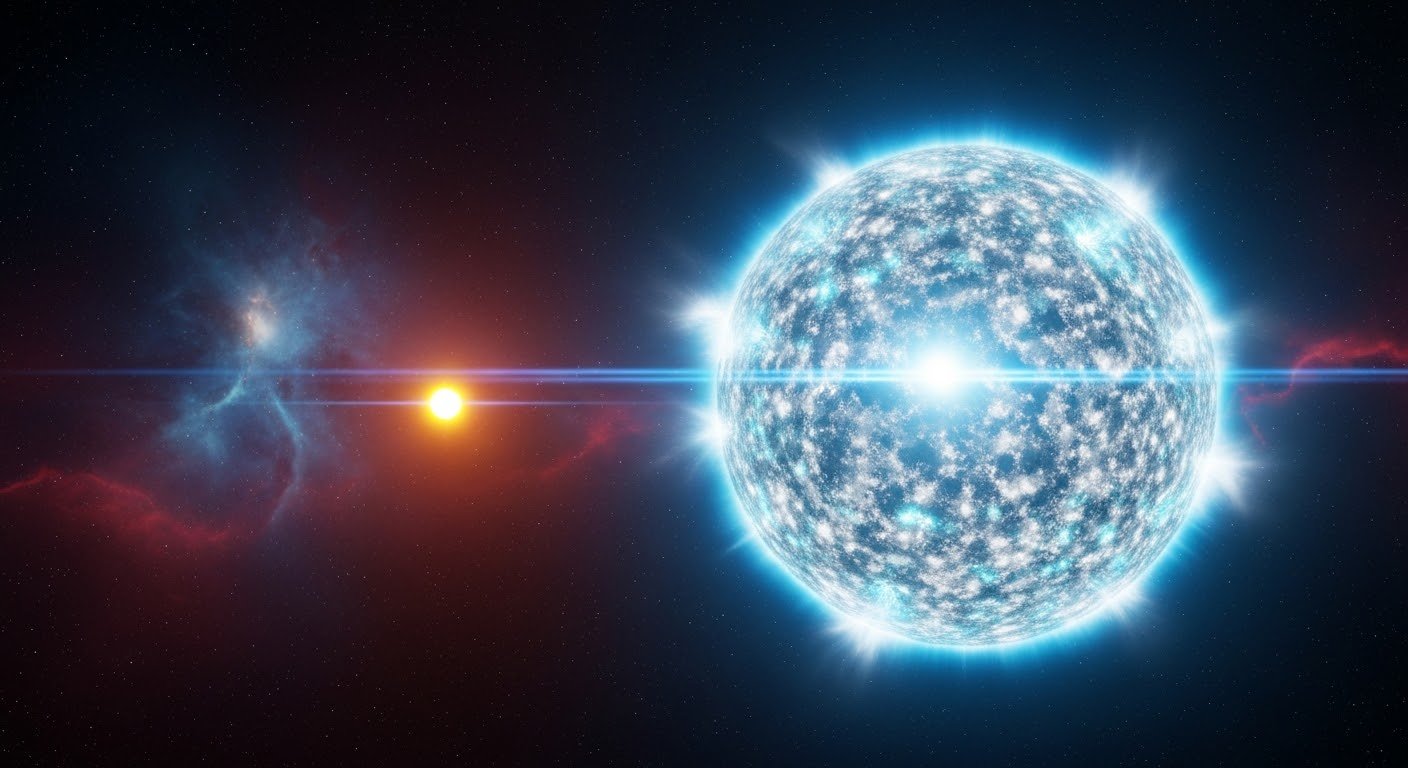
A fully formed Population III star on the main sequence was an object unlike anything that exists in the present-day universe. Carrying between roughly 100 and several hundred solar masses, it had a surface temperature near 100,000 Kelvin -- compared to the Sun's 5,778 Kelvin -- and a luminosity approaching one million times the Sun's output, near the Eddington limit throughout its lifetime.
The Eddington luminosity -- the maximum at which radiation pressure balances gravity for a hydrogen-ionized atmosphere -- is:
$$L_{Edd} = \frac{4\pi G M m_p c}{\sigma_T}$$For a star of 100 solar masses, this works out to approximately $1.3 \times 10^{31}$ watts, or roughly 1.3 million solar luminosities. Population III stars operated at or near this limit, pouring their energy output almost entirely into the ultraviolet -- photon energies sufficient to ionize hydrogen across distances of tens of light-years.
Above roughly 40 solar masses, all Population III stars converged on approximately the same surface temperature regardless of their actual mass.[3] A star of 100 solar masses and one of 500 solar masses would read nearly identically on a thermometer. The luminosity differed dramatically -- the more massive star was far brighter -- but the surface temperature was locked by the opacity properties of metal-free stellar atmospheres.
These stars had no stellar winds. In modern massive stars, radiation pressure on metal absorption lines continuously strips away the outer layers throughout the star's lifetime -- sometimes removing tens of solar masses before death. Population III atmospheres contained no metal lines. The radiation streamed through without gripping anything. Every gram of mass accumulated during formation stayed, intact, until the final moment.
Two Million Years and Three Ways to Die
Stellar main-sequence lifetime scales inversely and steeply with mass. A star of 100 solar masses burns through its hydrogen supply in roughly two to three million years -- independent of exact mass above about 40 solar masses, because the higher luminosity of more massive stars consumes their proportionally larger fuel supply at a rate that cancels most of the advantage. The Sun has a main-sequence lifespan of roughly 10 billion years. Population III stars had approximately 2 million.
When the hydrogen in the core was exhausted, the death pathway depended entirely on the total stellar mass. Three distinct outcomes existed, separated by mass thresholds set by nuclear and quantum physics.
Core-Collapse Supernovae (roughly 10 to 40 solar masses)
Stars in the lower Pop III mass range died in core-collapse supernovae broadly similar to what massive stars experience today. An iron core accumulated, exceeded the Chandrasekhar mass, collapsed in under a second, and the resulting shockwave dispersed the outer layers. A neutron star or small black hole remained. Heavy elements produced during the star's evolution were released into the surrounding gas.
Pair-Instability Supernovae (roughly 140 to 260 solar masses)
Stars in this mass range encountered a death mechanism with no meaningful present-day equivalent. As core temperatures climbed past approximately four billion Kelvin at densities too low for degeneracy pressure, thermal photons began spontaneously producing electron-positron pairs through the process:
$$\gamma + \gamma \rightarrow e^- + e^+$$Each pair production event removed a photon from the radiation field, reducing radiation pressure. The core lost support, began to contract, heated further, and triggered explosive nuclear burning energetic enough to reverse the infall. The explosion completely disrupted the star. No compact remnant formed. Roughly 100 solar masses of oxygen, silicon, sulfur, and calcium -- elements the universe had never contained in free form -- were ejected into the surrounding gas.
Direct Collapse to Black Holes (roughly 40 to 140 and above 260 solar masses)
Stars outside the pair-instability window collapsed directly to black holes without a successful explosion. Those above 260 solar masses were gravitationally bound so strongly that no energy release could unbind the star. The object ceased to exist as a visible source and became a black hole of comparable mass, accreting whatever gas remained in the surrounding minihalo.
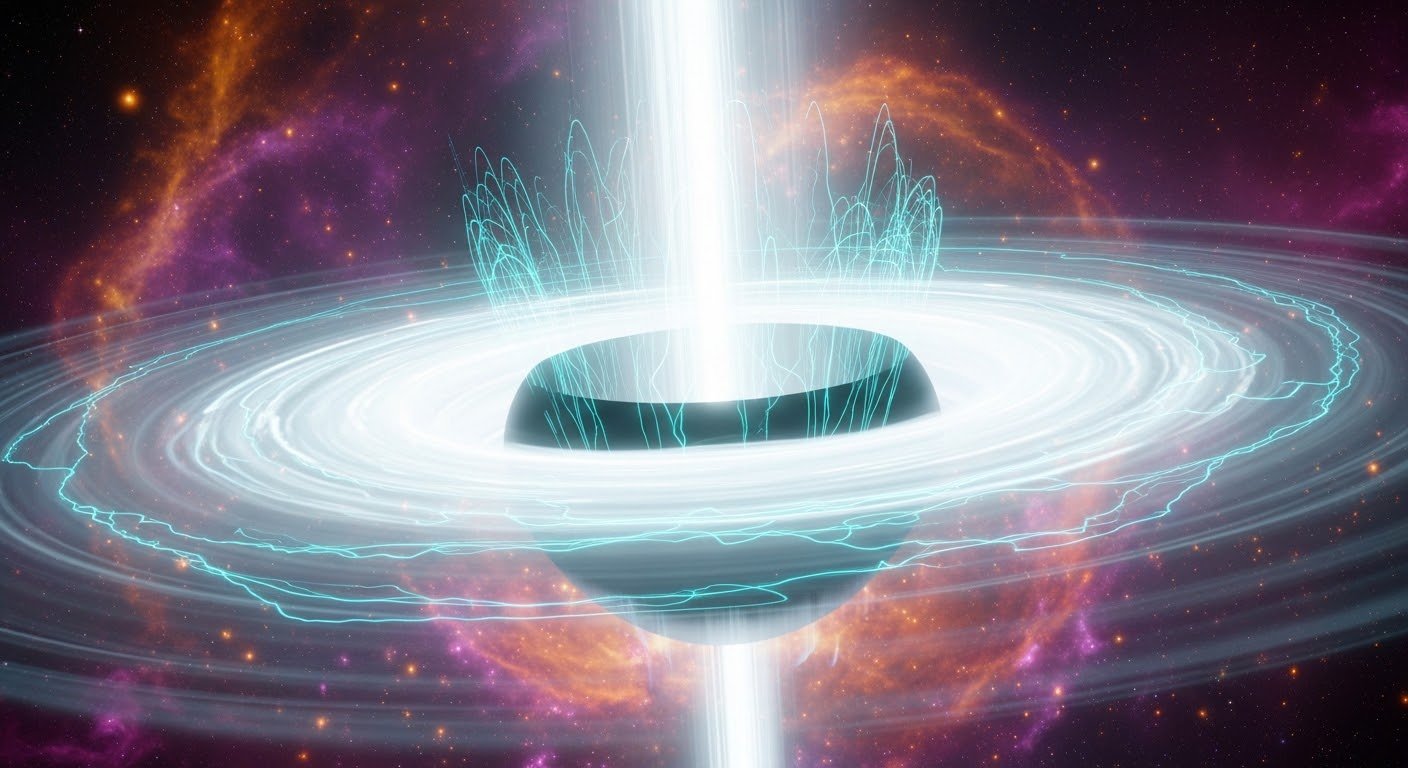
These direct-collapse remnants are the leading candidates for the seeds from which supermassive black holes grew over the subsequent 13 billion years.[4] A seed of several hundred solar masses, given enough time, accretion, and mergers through hierarchical structure formation, can plausibly reach the billion-solar-mass scales observed in quasars less than one billion years after the Big Bang -- a timescale that stellar-mass seeds from modern supernovae cannot comfortably achieve.
The Chemical Transition That Changed Everything
Each pair-instability supernova ejected heavy elements into the surrounding primordial gas. Those elements -- particularly carbon and oxygen -- were not merely chemical additions. They were physical transformers of the gas they entered.
Ionized carbon has a fine-structure emission line at 158 micrometers produced by a transition between closely-spaced ground-state energy levels. The energy spacing is small enough that thermal collisions at temperatures well below 200 Kelvin can excite it, allowing the gas to continue cooling past the H$_2$ floor. Oxygen contributes similar transitions at 63 and 146 micrometers. Together, even in trace abundances, carbon and oxygen open cooling channels that molecular hydrogen cannot provide at low temperatures.
The critical metallicity threshold -- the minimum metal abundance above which this transition cooling becomes efficient enough to change cloud fragmentation -- is approximately:
$$Z_{cr} \approx 10^{-5 \pm 1} \, Z_\odot$$One hundred-thousandth of the Sun's metallicity. A contamination so small it would be difficult to detect without targeted analysis. But above this threshold, collapsing gas clouds can cool past 200 Kelvin toward 10 Kelvin, the Jeans mass drops by orders of magnitude, fragmentation into solar-mass objects becomes possible, and the Population III star-forming mode ends permanently in that volume of gas.
The transition was not reversible. Metals do not leave the gas. Every region of the intergalactic medium that was enriched above the critical metallicity by the first supernovae was permanently altered -- unable to produce Population III stars again, newly capable of producing everything else.
The Fossil Record in Living Stars
Population III stars themselves are gone -- their lifetimes of two to three million years ensured that. But their chemical signatures survive in the surface abundances of the oldest Population II stars in the Milky Way halo, which formed from gas enriched by only one or a handful of Pop III supernovae and have been burning quietly ever since.
The field of stellar archaeology recovers these signatures through high-resolution spectroscopy: splitting the light from ancient metal-poor halo stars into component wavelengths and reading the absorption features produced by each element present in the stellar atmosphere. Stars with iron abundances of $[Fe/H] \leq -5$ -- one hundred-thousandth of the Sun's iron content -- carry chemical compositions that reflect the nucleosynthetic yields of the first stellar generation almost directly.
Carbon-enhanced metal-poor (CEMP) stars, a subclass with carbon-to-iron ratios far exceeding the solar value, are considered the most direct chemical descendants of Population III stars. [5] Their abundance patterns -- elevated carbon, oxygen, and lighter elements relative to iron -- match the predicted yields of certain Pop III supernova models, though the match is not perfect and the exact progenitor mass range remains a subject of active research.
These stars are not at cosmological distances. They are in our own galactic neighborhood, at distances of a few thousand to tens of thousands of light-years, accessible to ground-based spectroscopy. The evidence for the universe's first stellar generation is not only in the distant universe that JWST is now approaching. Some of it is sitting in the Milky Way halo, in stars that have been burning for over 10 billion years while carrying in their atmospheres the chemical record of events that occurred before the galaxy assembled.
What JWST Is Now Looking For
The James Webb Space Telescope has brought the direct spectroscopic detection of Population III signatures within tentative reach for the first time. Its NIRSpec instrument can obtain spectra of objects at redshifts above 6 -- looking back to when the universe was less than one billion years old -- with sensitivity that no previous space telescope approached at infrared wavelengths.
The key signature is HeII emission at 1640 angstroms in the rest frame, produced when doubly ionized helium recombines. Doubly ionizing helium requires photons above 54.4 electron volts -- more than four times the ionization energy of hydrogen -- and the short list of astrophysical sources capable of producing such photons in sufficient numbers is headed by Population III stars with their near-100,000 Kelvin surface temperatures. The presence of HeII emission alongside the absence of metal emission lines is the cleanest available signature of a metal-free stellar population ionizing metal-free surrounding gas.
A faint companion object designated Hebe, detected near the galaxy GN-z11 at redshift 10.6 using NIRSpec, showed HeII emission without associated metal lines in 2024.[6] A separate candidate, LAP1-B at redshift 6.6, was described in 2025 as the first system simultaneously consistent with three independent theoretical predictions for Population III star formation: a low-metallicity host halo in the expected virial temperature range, a top-heavy initial mass function inferred from the ionizing photon budget, and a total stellar mass in massive stars consistent with fragmentation models.
Neither is confirmed. The alternative explanations -- active galactic nuclei, unusual low-metallicity but not metal-free populations -- remain technically consistent with the data. But the gap between candidate and confirmed detection is narrowing, and the instruments capable of closing it are already operating.
What We Actually Know
Population III stars have not been directly observed. Their existence is inferred from theory, from the chemical abundances of the oldest surviving stars, and from the large-scale properties of the universe that their deaths helped produce. The exact shape of their initial mass function remains an open question -- recent simulations incorporating turbulence and magnetic fields suggest a broader mass range than the earliest models predicted, with some objects in the 2 to 70 solar mass range alongside the more massive ones, though even these lower estimates are far above typical present-day stellar masses.
What is well established is the framework: molecular hydrogen cooling sets a temperature floor at 200 Kelvin, the Jeans mass at that temperature is hundreds of solar masses, the accretion rates in primordial gas are dramatically higher than today, and the braking mechanisms that limit protostellar growth in modern environments were absent. The consequence of those conditions -- a top-heavy initial mass function dominated by objects far more massive than anything forming today -- follows straightforwardly from physics that is not in dispute.
The conditions that produced Population III stars will not return. The intergalactic medium is now permeated by metals from over 13 billion years of stellar activity. The ultraviolet background has been present since the epoch of reionization. The temperature floor of the diffuse gas has been permanently raised by photoheating. Every volume of the universe that could have produced pristine primordial collapses has already been touched by at least some enrichment.
The first stars poisoned the environment for their own kind, permanently and completely, on their way out. What they left behind is the rest of the universe: the oxygen in the atmosphere, the silicon in the crust, the iron circulating in blood, the transparency of the cosmos that allows telescopes to see across billions of light-years, the supermassive black holes anchoring every large galaxy. All of it downstream from objects that lived for two million years and have been gone for over 13 billion.
[1] The predicted light element abundances from standard Big Bang nucleosynthesis agree with observations of ancient, barely-enriched gas to within a few percent -- one of the strongest confirmations of the standard cosmological model. The agreement is not exact for lithium-7, which is observed at lower abundances than predicted, a tension known as the cosmological lithium problem that remains unresolved.
[2] The 200 Kelvin floor is not a sharp cutoff but a gradual reduction in cooling efficiency. The H$_2$ rotational transitions that dominate at these temperatures require a minimum collision energy to excite, and as temperatures fall below 200 K, the fraction of collisions energetic enough to trigger them decreases rapidly. HD (hydrogen deuteride) can cool gas somewhat below 200 K under specific conditions, but its abundance is low enough that this channel is limited to particular environments.
[3] The mass-independent surface temperature of Population III stars above roughly 40 solar masses arises because the opacity of metal-free stellar envelopes is dominated by electron scattering rather than bound-free transitions, and electron scattering opacity is essentially independent of temperature at these values. The effective temperature is therefore set by the radiation pressure balance condition rather than by the stellar mass directly.
[4] The direct collapse of Population III stars is one of several proposed seed mechanisms for supermassive black holes. Others include the direct collapse of primordial gas clouds without a stellar phase (producing seeds of $10^4$ to $10^5$ solar masses) and runaway stellar mergers in dense early star clusters. The relative contribution of each channel to the observed supermassive black hole population remains an open question.
[5] Carbon-enhanced metal-poor stars are divided into several subclasses based on whether they also show enhancements in barium (CEMP-s, associated with mass transfer from an AGB companion) or not (CEMP-no, more likely connected to Pop III progenitors). The CEMP-no subclass is the one most directly associated with Population III nucleosynthesis in current models.
[6] The Hebe detection by Maiolino et al. (2024) in Nature Astronomy reported HeII 1640 emission from a companion object approximately 3 kiloparsecs from GN-z11 at z = 10.6. The interpretation as a Population III stellar complex was offered as a plausible explanation; alternative explanations involving AGN activity at very low metallicity were not fully excluded by the available data.
Comments (0)
Leave a Comment