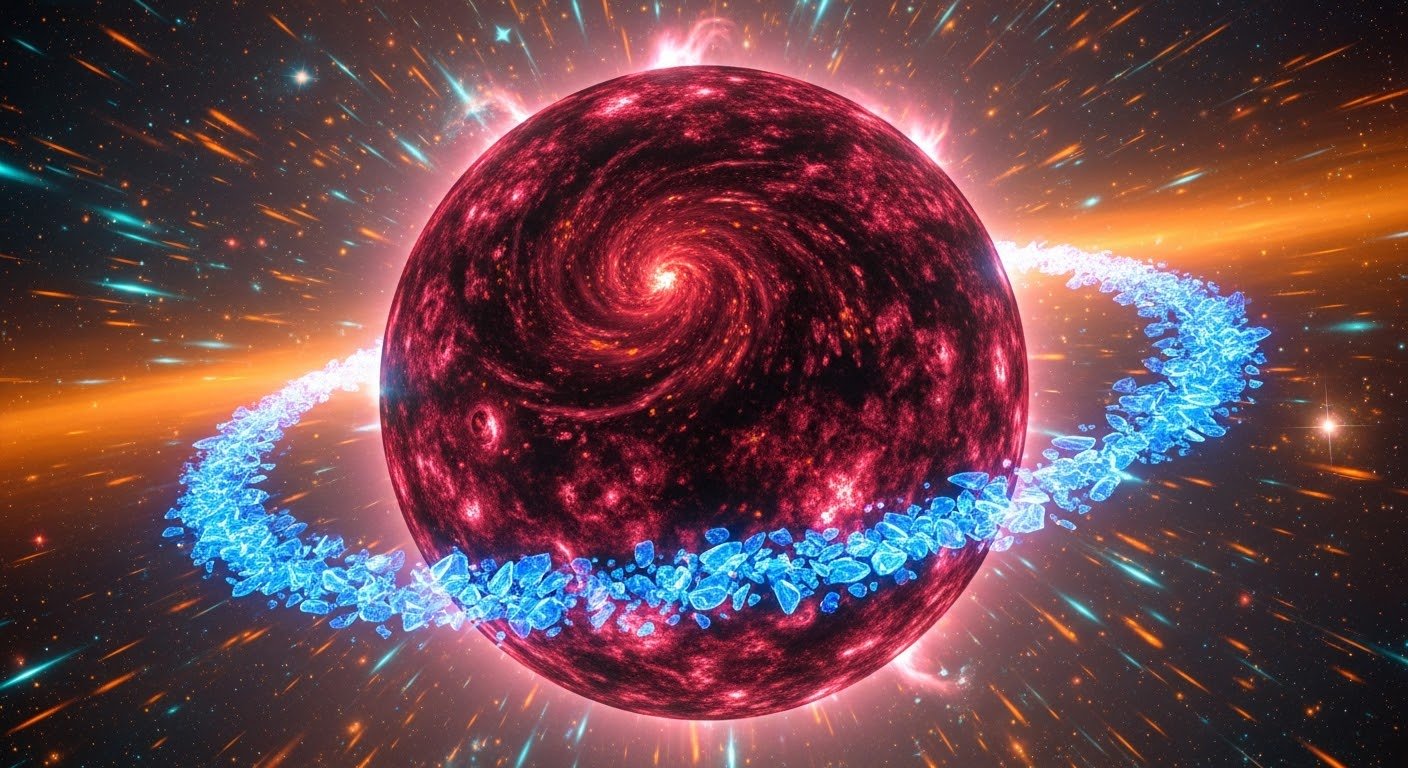
Why Most Stars Never Actually Ignite
There is a version of the night sky that nobody has ever seen with the naked eye. In that version, the darkness between the stars is not empty. It is crowded with objects the size of failed suns, drifting cold and invisible through the same galactic space as every star you have ever named. They formed the same way stars form. They compressed from the same clouds of hydrogen and helium. They went through the same gravitational collapse. And then, at the last possible moment, they stopped.
Astronomers call them brown dwarfs. They are not brown, they are not dwarfs in any intuitive sense, and the name was chosen before a single confirmed example existed. What they are, in physical terms, is this: the most common stellar-mass objects in the galaxy, invisible to every optical telescope ever built, present in numbers that may rival the entire hydrogen-burning star population of the Milky Way.
The first confirmed brown dwarf was discovered in 1995. The theoretical prediction that they should exist was made in 1962. The thirty-three years between those two dates is a useful measure of how difficult it is to find something that produces almost no light.
The Number That Decides Everything
Star formation is, at its core, a mass problem. A cloud of gas and dust collapses under its own gravity, compresses toward a center, and heats as it falls inward. Whether that process produces a star or something else depends almost entirely on how much mass was available when the collapse began.
The threshold is 0.08 solar masses, roughly 80 times the mass of Jupiter. Above that value, the contracting object compresses and heats until the core reaches approximately 10 million Kelvin. At that temperature, hydrogen nuclei collide with enough energy to overcome their mutual electromagnetic repulsion and fuse. The outward pressure from that fusion balances gravity. The object stabilizes. A star is born.
Below 0.08 solar masses, the core temperature plateaus before reaching 10 million Kelvin. Not because something goes wrong. Not because the process is interrupted. Simply because there is not enough gravitational energy available to compress the material to the required density and temperature before a different physical mechanism intervenes and halts the collapse permanently.
That mechanism is electron degeneracy pressure, and it changes everything about what the resulting object is and how it behaves.
The minimum mass for hydrogen fusion, sometimes written as $M_{min}$, sits at approximately:
$$M_{min} \approx 0.08 \, M_{\odot} \approx 80 \, M_{J}$$where $M_{\odot}$ is one solar mass and $M_{J}$ is one Jupiter mass. This value shifts slightly depending on the chemical composition of the collapsing cloud: objects with lower metallicity (Population II stars, formed earlier in cosmic history from purer hydrogen and helium) require slightly more mass to cross the ignition threshold, with $M_{min}$ rising to approximately 0.09 $M_{\odot}$.
Objects that form below this line are brown dwarfs. They share the ingredients of stars. They share the formation process. They simply lack the mass to complete the final step.
What Holds Them Together
In a true star, the internal structure is a negotiation. The outward pressure from nuclear fusion pushes against the inward pull of gravity, and the star maintains this balance for as long as its fuel supply lasts. Remove the fuel and the balance breaks. The star collapses.
A brown dwarf is not a negotiation. It is a settled condition.
During the collapse of a sub-stellar object, as the interior density rises, the electrons inside the object are compressed into a smaller and smaller volume. The Pauli exclusion principle, one of the foundational rules of quantum mechanics, states that no two electrons with the same quantum state can occupy the same location simultaneously. As electrons are forced into a shrinking volume, they exhaust the available low-energy quantum states and are pushed into progressively higher-energy configurations. This generates an outward pressure.
Critically, this pressure, called electron degeneracy pressure, does not depend on temperature. A degenerate electron gas pushes back against compression whether it is hot or cold. Cooling the object does not reduce the pressure. This is fundamentally different from the thermal pressure inside a star, which falls when the temperature falls.
For non-relativistic electrons, the degeneracy pressure scales as:
$$P_{deg} \propto \left(\frac{\rho}{m_p}\right)^{5/3}$$where $\rho$ is the mass density and $m_p$ is the proton mass. The pressure depends only on density, not on temperature. This is why a brown dwarf, once it reaches its final degenerate state, will hold that state indefinitely. The electron degeneracy pressure will continue supporting the object against gravity long after every true star in the universe has exhausted its fuel and collapsed into a remnant.
Brown dwarfs are, in a structural sense, more similar to white dwarf stars than to main-sequence stars. Both are supported by electron degeneracy pressure rather than thermal fusion pressure. The difference is that white dwarfs are the remnants of stars that burned and died, while brown dwarfs never burned at all.
The Brief Exception: Deuterium Fusion
There is one fusion event that brown dwarfs above roughly 13 Jupiter masses do manage. Deuterium, the heavy isotope of hydrogen with one proton and one neutron in its nucleus, fuses at much lower temperatures than ordinary hydrogen, around 1 million Kelvin rather than 10 million. Brown dwarfs reach these temperatures during their early contraction phase.
For a period of tens of millions of years, a young brown dwarf above the deuterium threshold burns this fuel. The reaction temporarily slows the cooling and produces genuine energy output. But deuterium constitutes only approximately 1 in 30,000 hydrogen atoms in any cloud of solar composition. The supply is exhausted quickly. When it runs out, the reaction ends with no replacement process available.
The deuterium-burning mass limit, approximately 13 Jupiter masses or $0.013 \, M_{\odot}$, serves as the working lower boundary of the brown dwarf class. Objects below this limit cannot fuse anything, including deuterium, and are generally classified as planetary-mass objects if free-floating or planets if bound to a star.
More massive brown dwarfs, those above roughly 60 Jupiter masses, can also fuse lithium briefly. But neither reaction provides the sustained energy source that defines stellar burning. The deuterium and lithium are consumed and gone. After that, the object simply cools.
Thirty Years of Searching for Nothing
Shiv Kumar published the theoretical prediction of the hydrogen-burning minimum mass in 1962.[1] Chushiro Hayashi and Takenori Nakano reached consistent conclusions independently around the same time. The mathematical case for the existence of sub-stellar objects was clean and well-grounded.
The search that followed lasted three decades.
Brown dwarfs are nearly invisible in optical wavelengths. They produce no fusion radiation, no ultraviolet output, no bright emission lines. The energy they do radiate comes out primarily in the infrared, as residual heat from formation leaking slowly outward. In the 1960s and through much of the 1970s, infrared astronomy was limited by detector sensitivity and by the thermal glow of Earth's own atmosphere, which radiates in the same wavelengths and can overwhelm faint sources.
Through the 1980s, improved detectors produced a series of candidates. Each was announced carefully, hedged appropriately, and subsequently found to be something else: a very cool low-mass star, a measurement artifact, an object whose classification collapsed under more careful observation. The community absorbed each correction and continued searching.
By 1994 and into 1995, two developments converged. Infrared detector sensitivity had improved substantially. And two separate teams were pointing the right instruments at the right targets.
1995: Two Confirmations at Once
Teide 1 was identified in images from the IAC 80 telescope at Teide Observatory in Tenerife, taken in January 1994 by a team from the Instituto de Astrofisica de Canarias led by Rafael Rebolo. It appeared as a very faint, very red object at the bottom of the Pleiades cluster sequence. Spectral analysis and lithium measurements confirmed it as substellar. The paper was submitted to Nature in May 1995 and published in September. The front page of that issue read: brown dwarfs discovered.
Weeks later, at a conference in Florence, a separate result was announced. Gliese 229B, a companion to the nearby red dwarf Gliese 229 located 19 light-years from Earth, had been imaged with an adaptive optics coronagraph at Palomar Observatory by a team including Shrinivas Kulkarni. Follow-up spectroscopy revealed methane absorption bands in the near-infrared, at 1.6 and 2.2 micrometres.
Methane cannot survive in the atmosphere of any true star at any temperature. Its presence was not a suggestion. It was proof. Gliese 229B was the first confirmed T-dwarf, a new spectral class defined specifically for objects cool enough to have methane-dominated atmospheric chemistry.[2]
Two confirmations. Two different methods. Two teams working independently. The thirty-three-year gap between theoretical prediction and observational confirmation closed within a single year.
The Spectral Life of a Brown Dwarf
The classification system used for brown dwarfs, the M, L, T, Y sequence, looks from a distance like a taxonomy: different categories for different types of object. This framing is misleading. For brown dwarfs, the spectral sequence is not a taxonomy. It is a timeline.
A single brown dwarf, given sufficient time, will pass through every stage of the sequence. There is no equilibrium class, no stable position that it holds for billions of years the way a main-sequence star holds its spectral type. A brown dwarf is always cooling, always moving toward a lower-temperature classification, with no fusion energy to arrest the decline.
L-Dwarfs: 1,300 to 2,400 Kelvin
At L-dwarf temperatures, a brown dwarf's atmosphere contains clouds of liquid iron droplets and silicate mineral dust: enstatite, forsterite, quartz. These condense from the vapor phase as convective currents carry iron-bearing gas upward into cooler atmospheric layers. The clouds organize into latitude bands driven by the brown dwarf's rapid rotation, some completing a full revolution in under two hours. When the condensate particles grow heavy enough, they fall downward, re-evaporate in the warmer layers below, and rise again. It rains iron. Not metaphorically. The same element that forms planetary cores cycles through the atmosphere as a weather system with no terrestrial analogue.
T-Dwarfs: 700 to 1,300 Kelvin
Below roughly 1,300 Kelvin, the iron and silicate clouds sink below the visible photosphere. The atmospheric chemistry reorganizes. Carbon, which at higher temperatures was predominantly bound in carbon monoxide (CO), shifts toward methane ($CH_4$) as the lower-energy equilibrium configuration. The chemical transition follows:
$$CO + 3H_2 \rightarrow CH_4 + H_2O$$The methane absorption features that appeared in Gliese 229B's spectrum in 1995 are the definitive signature of this transition. A T-dwarf's atmosphere shares more chemical character with Saturn's moon Titan and the outer solar system's giant planets than with any stellar atmosphere at any temperature. The object formed like a star. Its sky looks like a cold moon's.
Y-Dwarfs: Below 500 Kelvin
The coldest confirmed class of stellar or sub-stellar object was discovered not through optical surveys but through NASA's Wide-field Infrared Survey Explorer (WISE), which scanned the entire sky in mid-infrared wavelengths and identified objects emitting no visible light at all. The first confirmed Y-dwarfs, announced in 2011, had surface temperatures below 500 Kelvin. Some were below 400 Kelvin. One, WISE 1828+2650, measured below 300 Kelvin by Hubble spectroscopy, near the temperature of a warm afternoon on Earth.
The coldest known brown dwarf, WISE J085510.83-071442.5, discovered in 2013 by Kevin Luhman using archived WISE data, sits at approximately 276 Kelvin and 3 degrees Celsius. It is located 7.4 light-years from Earth, making it the fourth-closest stellar or sub-stellar system to the Sun. It was unknown to astronomy until eleven years ago. It had been drifting through the local stellar neighborhood throughout the entire history of astronomical observation, invisible to every instrument built before infrared space telescopes existed.[3]
The Paradox of Size
A brown dwarf at 80 Jupiter masses, just below the hydrogen-burning limit, has a radius of approximately one Jupiter radius. A brown dwarf at 13 Jupiter masses, near the lower boundary of the class, also has a radius of approximately one Jupiter radius. Across a factor of six in mass, the physical size barely changes.
In true stars, mass and radius are positively correlated. More massive stars are larger. The main sequence, plotted from the smallest red dwarfs to the most massive blue giants, shows a clear upward trend. Adding mass to a star makes it bigger, because the additional gravitational compression is balanced by a hotter and more energetic fusion reaction that expands the star outward.
Brown dwarfs are governed by electron degeneracy pressure, not thermal pressure, and degeneracy pressure responds to density differently. Additional mass increases the gravitational compression, which increases the density of the electron gas, which does increase the degeneracy pressure but not enough to expand the radius. The added mass is accommodated within approximately the same volume, at slightly higher density. At the upper end of the brown dwarf mass range, more mass actually produces a slightly smaller object.
The mass-radius relationship in the degenerate regime, for non-relativistic electrons, follows approximately:
$$R \propto M^{-1/3}$$This inverse relationship means that estimating a brown dwarf's mass from its physical size is nearly impossible without additional information. Two brown dwarfs differing by a factor of four in mass can appear physically identical in radius. Direct mass measurements require dynamical methods: orbital mechanics in binary systems, or radial velocity and astrometric measurements combined with cooling models and age estimates.
The Desert and the Boundary
Why Brown Dwarfs Avoid Close Orbits Around Stars
Radial velocity surveys mapping companion objects around Sun-like stars found something unexpected in the data. Planetary companions, below roughly 13 Jupiter masses, appeared frequently at separations less than 5 AU. Stellar companions, above 80 Jupiter masses, also appeared at these separations. But in the mass range between 13 and 80 Jupiter masses, corresponding exactly to brown dwarfs, the occurrence rate dropped below 1 percent. A pronounced gap sat precisely where brown dwarf companions should have been, if they formed with the same frequency as other companion types.
This gap is called the brown dwarf desert, and it persists across multiple independent surveys. The current explanation points to two distinct formation channels that do not extend efficiently into the brown dwarf mass range at close orbital separations. Core accretion, which builds planets upward from solid cores in protoplanetary discs, has an upper limit around 10 to 15 Jupiter masses beyond which runaway accretion and disc depletion prevent further growth. Direct gravitational fragmentation, which produces stars and some brown dwarfs, tends to generate companions at mass ratios that favor either near-equal pairings or wide separations. Neither channel deposits brown dwarf mass objects into tight orbits around solar-type stars with any regularity.[4]
The desert is not maintained by any exclusion process. It is simply the space where neither formation mechanism reaches.
Where Brown Dwarfs End and Planets Begin
The International Astronomical Union's working definition places the brown dwarf lower boundary at 13 Jupiter masses, set by the deuterium-burning limit. Below this threshold, free-floating objects are classified as planetary-mass. Above it, they are brown dwarfs.
The problem is that formation physics does not observe this boundary. Free-floating objects below 13 Jupiter masses have been found in star-forming regions in numbers and spatial distributions inconsistent with disc formation and ejection. They appear to have formed by gravitational collapse, the same mechanism that produces brown dwarfs, simply at lower masses. If formation mechanism is the physically meaningful distinction between a brown dwarf and a planet, these objects are brown dwarfs, regardless of the mass criterion.
Conversely, objects above 13 Jupiter masses may in some cases have formed in protoplanetary discs and been subsequently ejected through gravitational interactions. An ejected disc-formed object at 20 Jupiter masses, now free-floating, is physically identical to a gravitationally collapsed brown dwarf of the same mass. No observational test distinguishes between these histories for an isolated object.
The boundary at 13 Jupiter masses is administratively functional. It is not physically fundamental.
How Many, and Where
In 2017, a team led by Koraljka Muzic from the University of Lisbon surveyed the dense star-forming cluster RCW 38 using the Very Large Telescope at the European Southern Observatory. Combining this survey with five earlier surveys of different star-forming environments, the team found approximately one brown dwarf for every two stars, consistently across cluster types of varying density and age.[5]
Extrapolating this ratio to the Milky Way produces an estimate of 25 to 100 billion brown dwarfs. The survey did not count objects below 0.03 solar masses, meaning the smallest and faintest brown dwarfs were excluded from the sample. The true population is probably higher than 100 billion. The Milky Way contains 100 to 400 billion hydrogen-burning stars. The brown dwarf population may be comparable in number.
The picture of the galaxy that most people carry, a disk populated by hundreds of billions of stars with dark empty space between them, is a picture of the fraction of matter that happens to emit visible light. The brown dwarfs were always present in that same space, following the same orbital dynamics, distributed through the same galactic structure. They simply did not appear in any survey built to detect stars.
WISE 0855 was the fourth-closest system to the Sun and was unknown until 2013. Given the estimated local brown dwarf density and the detection limits of surveys conducted before infrared space telescopes existed, it is plausible that one or more brown dwarfs closer to Earth than Proxima Centauri remain undetected.
JWST has extended the census further. In late 2024, the telescope identified the first brown dwarf candidates outside the Milky Way, in the star cluster NGC 602 within the Small Magellanic Cloud, 200,000 light-years away. Brown dwarfs found in deep extragalactic survey fields had previously been miscategorized as distant galaxies in broadband photometry, with the misidentification corrected only when NIRSpec spectra revealed their molecular absorption signatures. Objects a few light-years away, catalogued as objects billions of light-years away, until someone looked at the spectra.
The Long Future
The present universe is in what cosmologists call the stelliferous era: the period during which conventional star formation is ongoing and nuclear fusion in stellar interiors accounts for most of the energy generated anywhere.[6] This era will end when the interstellar gas supply available for new star formation is exhausted, in roughly $10^{14}$ years.
What remains afterward is a galaxy that still exists, still contains gravitational structure, and still holds hundreds of billions of objects, none of them burning in the way stars burn. The most massive stars will have long since collapsed into neutron stars or black holes. Sun-like stars will have faded to cooling white dwarfs. The lowest-mass red dwarfs, which burn slowly enough to have outlasted everything else, will finally exhaust their hydrogen and dim to nothing.
The brown dwarfs will still be there.
They have no fuel to exhaust. They have been cooling since formation and will continue cooling on no fixed schedule, simply radiating their residual thermal energy into the surrounding universe until they approach the ambient temperature of the cosmos itself. In a galaxy that has gone dark in the conventional sense, brown dwarfs become the dominant stellar-mass population: cold, degenerate, invisible, present.
On rare occasions in this far-future era, two brown dwarfs will interact gravitationally and eventually merge. If the combined mass exceeds 0.08 solar masses, hydrogen fusion ignites in the merged object. A new star appears in a galaxy that has not seen a star in trillions of years. It burns for perhaps a few billion years before exhausting its hydrogen and collapsing to a white dwarf. A star with no molecular cloud to form from, no nebula to announce its birth, no other burning object in the visible universe. Then gone.
What We Actually Know
Brown dwarfs are not a gap in the stellar population. They are the most common outcome of star formation in the galaxy by number, and they were invisible to astronomy for the first several decades of the modern era simply because the instruments used to survey the sky were built for objects that produce visible light.
The physics governing them is well-established. The hydrogen-burning minimum mass is accurately calculated. Electron degeneracy pressure is understood from first principles and confirmed in white dwarf observations. The L-T-Y spectral sequence is observationally grounded and theoretically consistent. The cooling models, while they carry uncertainties at the coldest temperatures, are anchored by real detections including objects as cold as 276 Kelvin.
What remains genuinely open:
- The exact population density of brown dwarfs in the solar neighborhood, particularly below detection thresholds of current infrared surveys
- The relative contributions of different formation mechanisms across different star-forming environments
- The physical origin of the brown dwarf desert and whether it persists around lower-mass stellar hosts
- The precise location and physical meaning of the boundary between the lowest-mass brown dwarfs and the highest-mass rogue planets
- The atmospheric structure and chemistry of Y-dwarfs at the coldest temperatures, where current models are least tested
The census is being rewritten. JWST is finding brown dwarfs in data collected for entirely different purposes, in fields pointed at the distant universe, in clusters outside the Milky Way. Every improvement in infrared sensitivity adds objects to the count and reveals structure in a population that most of astronomy did not know existed until thirty years ago.
The darkness between the stars has always been inhabited. It is only recently that we have had instruments sensitive enough to notice.
Notes
[1] Kumar, S.S. (1963). "The Structure of Stars of Very Low Mass." Astrophysical Journal, 137, 1121. The paper establishing the theoretical lower mass limit for hydrogen-burning objects and predicting the existence of sub-stellar bodies now known as brown dwarfs.
[2] Nakajima, T. et al. (1995). "Discovery of a Cool Brown Dwarf." Nature, 378, 463. The paper reporting Gliese 229B, whose methane-rich spectrum established the T-dwarf spectral class and provided the first chemically unambiguous confirmation of a sub-stellar companion.
[3] Luhman, K.L. (2014). "Discovery of a ~250 K Brown Dwarf at 2 pc from the Sun." Astrophysical Journal Letters, 786, L18. The discovery paper for WISE J085510.83-071442.5, the coldest known brown dwarf, detected from its mid-infrared thermal emission using archived WISE and Spitzer data.
[4] Grether, D. and Lineweaver, C.H. (2006). "How Dry is the Brown Dwarf Desert? Quantifying the Relative Number of Planets, Brown Dwarfs, and Stellar Companions around Nearby Sun-like Stars." Astrophysical Journal, 640, 1051. A quantitative analysis of the brown dwarf desert using radial velocity survey data, establishing the occurrence rate below 1 percent at separations under 5 AU.
[5] Muzic, K. et al. (2017). "The Low-mass Content of the Massive Young Star Cluster RCW 38." Monthly Notices of the Royal Astronomical Society. The survey paper producing the current best estimate of the Milky Way brown dwarf population at 25 to 100 billion objects.
[6] Adams, F.C. and Laughlin, G. (1997). "A Dying Universe: The Long-Term Fate and Evolution of Astrophysical Objects." Reviews of Modern Physics, 69, 337. The foundational paper introducing the five-era cosmological framework, including the degenerate era in which brown dwarfs become the dominant stellar-mass population of the galaxy.
Comments (0)
Leave a Comment