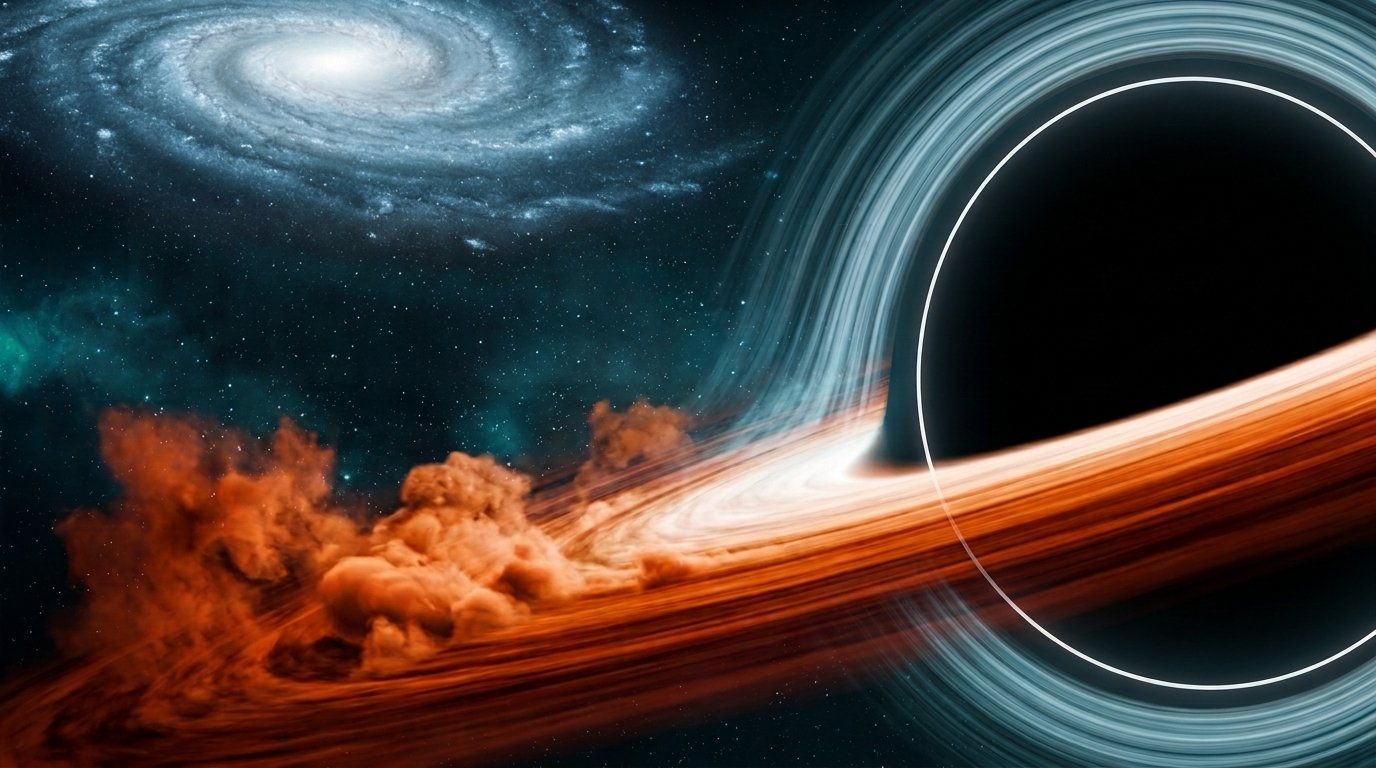
Why Black Holes Never Stay at Galactic Centers
For most of the history of modern astronomy, the supermassive black hole at the center of a galaxy was treated as a fixture. Millions or billions of times the mass of our sun, sitting at the gravitational minimum of the system, anchoring everything else in place. The assumption was never seriously derived from first principles. It accumulated from observation, from intuition, from the reasonable expectation that the most massive object in a system would also be the most still. That assumption is now known to be incomplete. Supermassive black holes can be displaced from their galactic centers, set wandering for billions of years, or in rare cases ejected entirely into intergalactic space. The physics that makes this possible is not exotic. It follows from the same gravitational laws that govern everything from colliding galaxy clusters to a stone thrown upward on Earth.
What a Supermassive Black Hole Actually Is
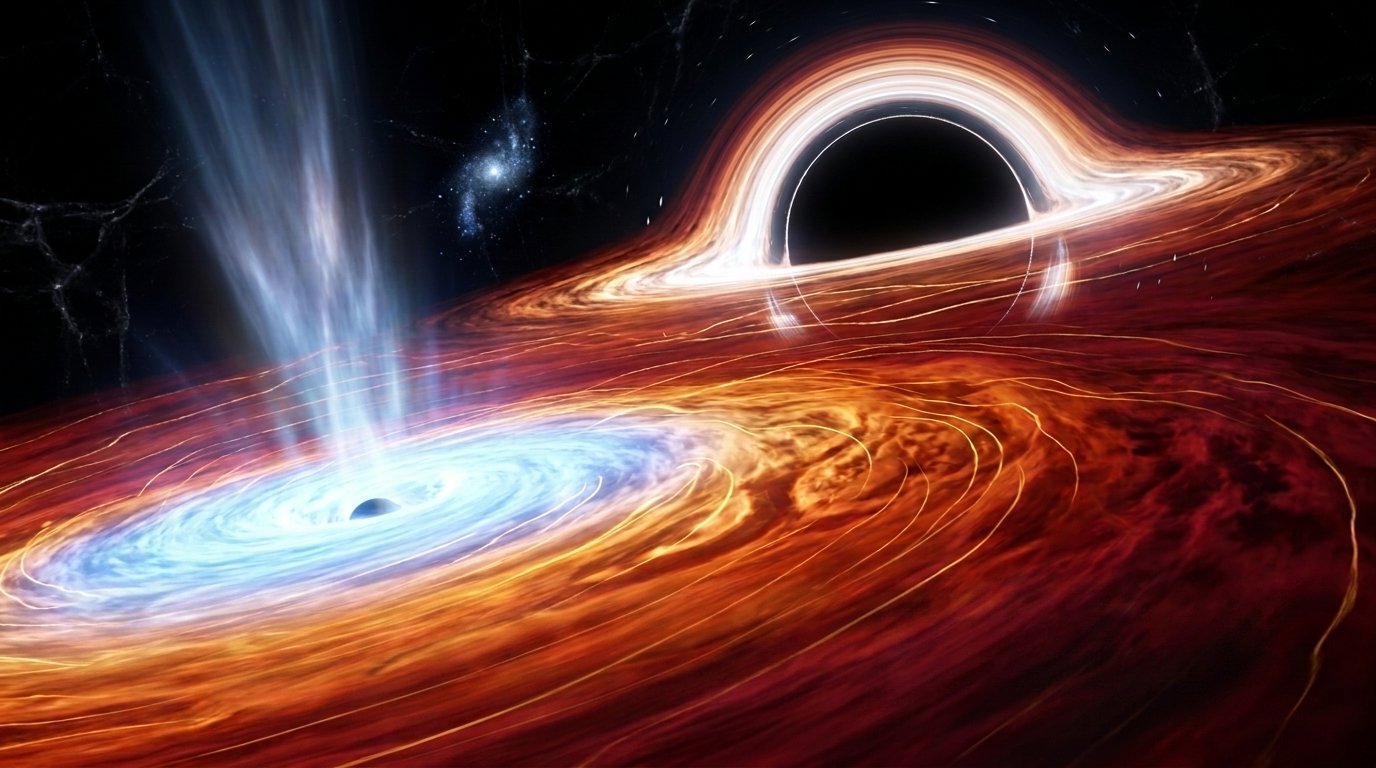
The mass range alone separates supermassive black holes from every other class of black hole. Stellar black holes, formed from collapsing massive stars, weigh between roughly five and ninety solar masses. Supermassive black holes occupy a completely different regime: one million to several tens of billions of solar masses. The black hole at the center of our own galaxy, Sagittarius A*, weighs approximately four million solar masses. The one at the center of the galaxy M87, the first black hole ever directly imaged, weighs approximately 6.5 billion. [1]
The event horizon of M87's black hole is wider than the diameter of our entire solar system out to Neptune. Yet the tidal forces at its boundary are gentle enough that a traveler crossing inward would feel nothing at the moment of passage. The tidal force across a human body at that boundary is smaller than the tidal force the Moon exerts on Earth's oceans. The danger comes only later, as the traveler falls deeper and the gradient grows without bound.
What makes supermassive black holes most relevant to the question of displacement is their relationship to their host galaxies. The mass of the central black hole correlates tightly with the velocity dispersion of stars in the surrounding stellar bulge, a relationship called the M-sigma relation, discovered independently by Ferrarese and Merritt and by Gebhardt et al. in 2000. [2] The relationship implies co-evolution: the black hole and the galaxy shaped each other's growth over billions of years through a feedback mechanism that is still not fully understood. A black hole displaced from its central position breaks the conditions under which that feedback operates.
The M-sigma relation in its standard form is:
$$M_{\bullet} \approx 0.310 \times 10^9 \, M_{\odot} \left(\frac{\sigma_{\star}}{200 \, \text{km/s}}\right)^{4.38}$$where $M_{\bullet}$ is the black hole mass and $\sigma_{\star}$ is the stellar velocity dispersion in the bulge. A wandering black hole that spent significant time off-center during its growth history will contribute scatter to this otherwise tight relation.
The Galaxy as a Gravitational Ecosystem
A galaxy is not a spinning disk of stars with a black hole at the center. It is a layered gravitational system in which every component is in continuous dialogue with every other. Start from the outermost layer: the dark matter halo. Invisible, non-electromagnetic, extending far beyond the optical disk, the halo contains roughly twenty times the combined mass of all the visible stars and provides the gravitational scaffolding within which the baryonic components assemble.
Inside the halo, the stellar disk forms. Inside the disk, the bulge. At the center of the bulge, the black hole. None of these boundaries are sharp. Gas flows inward from the disk and feeds the black hole. The black hole, when actively accreting, drives outflows that push gas back outward. That gas cools, resettles, and eventually triggers new star formation. The dark matter halo holds everything together against the expansion of space. The system is not static. It breathes.
The density profile of the dark matter halo is particularly consequential for the question of black hole displacement. A halo with a steep central density cusp produces strong dynamical friction at small radii, helping infalling objects sink efficiently toward the nucleus. A halo with a shallower core produces weaker friction across a broader region, allowing displaced black holes to remain stranded at large separations. Whether a particular halo has a cusp or a core depends on its merger history, its gas physics, and the feedback history of the central black hole, making the problem deeply self-referential.
How Galaxy Mergers Displace Black Holes
Galaxy mergers are the primary route to black hole displacement. When two galaxies interact gravitationally and eventually coalesce, their central black holes do not simply combine immediately. They are carried inward by a mechanism called dynamical friction, first derived by Subrahmanyan Chandrasekhar in 1943. [3]
As a massive object moves through a background of smaller particles, its gravity draws those particles slightly toward its path, creating an overdense gravitational wake directly behind it. That wake pulls backward on the moving object, transferring kinetic energy into the surrounding medium and decelerating the object over time. The inspiral timescale is given by:
$$t_{df} \approx \frac{1.65}{\ln \Lambda} \cdot \frac{R^2 \sigma}{G M_{BH}}$$where $\ln \Lambda$ is the Coulomb logarithm, $R$ is the orbital radius, $\sigma$ is the velocity dispersion of the surrounding medium, $G$ is the gravitational constant, and $M_{BH}$ is the black hole mass. The timescale scales inversely with black hole mass: heavier objects sink faster, lighter objects sink slower.
In minor mergers, where a large galaxy absorbs a much smaller satellite, the smaller black hole begins its inspiral embedded in the satellite's own dense stellar bulge and dark matter halo. Tidal forces from the larger galaxy progressively strip that surrounding material away during the inspiral. The outer dark matter halo goes first, then the outer stars, then the inner stellar envelope. Eventually the black hole is bare. Its effective mass in the dynamical friction formula drops by orders of magnitude. The inspiral timescale, which had been measured in hundreds of millions of years for the intact satellite, can now stretch to:
$$t_{df} > t_{Hubble} \approx 13.8 \, \text{Gyr}$$A stripped, naked black hole at kiloparsec separations from the galactic center has a sinking timescale longer than the current age of the universe. It does not return. It orbits. Permanently. [4]
The Final Parsec Problem
If the two black holes do reach close separations, a binary forms. The binary hardens its orbit by ejecting surrounding stars through three-body gravitational slingshot interactions. Each ejected star carries orbital energy away from the binary, and the binary tightens. This is real and efficient, until the supply of available stars is exhausted.
The stars on orbits that intersect the binary's gravitational influence radius, what theorists call the loss cone, get depleted faster than they are replenished by scattering from the broader stellar distribution. At a separation of roughly one parsec (3.26 light-years), the binary has ejected most of the available stars and finds itself in a region it has systematically cleared. [5]
At this separation, dynamical friction from the remaining diffuse medium is negligible. Gravitational wave emission, which will eventually drive the final coalescence, scales steeply with separation:
$$\frac{dE}{dt} \propto \frac{1}{r^5}$$At one parsec, the gravitational wave inspiral timescale far exceeds the age of the universe. The binary stalls. This is the final parsec problem, first identified by Begelman, Blandford, and Rees in 1980. [6] The NANOGrav detection of a low-frequency gravitational wave background in 2023 confirms that binaries do eventually merge. Something bridges the stall. The precise mechanism remains an open question, with candidates including non-spherical galaxy geometry, gas dynamics, self-interacting dark matter spikes, and triple black hole interactions.
Gravitational Wave Recoil: The Kick
When two black holes finally merge, the resulting gravitational wave emission carries linear momentum. If the emission is perfectly symmetric, no net momentum is carried in any preferred direction and the remnant does not recoil. Nature never provides perfect symmetry. Mass asymmetry, spin asymmetry, or both ensure that the emission is always lopsided to some degree, and the remnant always receives a kick.
For non-spinning mergers, the maximum recoil from mass asymmetry peaks at the symmetric mass ratio $\eta = m_1 m_2 / (m_1 + m_2)^2 = 0.25$, corresponding to equal masses, and the kick reaches approximately 170 km/s. For spinning mergers, the kick depends on the full three-dimensional spin configuration. In the superkick configuration, where both black holes spin maximally with spins antialigned and lying in the orbital plane, the recoil can reach approximately 5,000 km/s. [7]
The fate of the remnant depends on comparing the kick velocity to the host galaxy's escape velocity:
$$V_{esc} = \sqrt{\frac{2GM}{R}}$$Dwarf galaxies have escape velocities of roughly 10 to 30 km/s. A typical merger kick permanently ejects the remnant. Milky Way-scale galaxies sit at 500 to 600 km/s: a typical kick initiates a billion-year wandering orbit that dynamical friction slowly damps. Giant ellipticals can reach 1,000 km/s or beyond: only extreme spin configurations produce ejection.
Observational Evidence: What Has Actually Been Found
AT2024tvd: The First Off-Nuclear Tidal Disruption Event
On August 25, 2024, the Zwicky Transient Facility flagged a transient that failed the standard pipeline filter for nuclear events. Spectroscopic follow-up classified it as a tidal disruption event, but its position was measurably offset from the center of its host galaxy. Hubble Space Telescope imaging in January 2025 confirmed the offset at 0.8 kiloparsecs (approximately 2,600 light-years) from the host nucleus. Chandra X-ray Observatory observations confirmed the mass of the disrupting black hole at approximately one million solar masses, sitting 2,600 light-years from a 100-million-solar-mass central black hole in the same galaxy. [8]
The most coherent explanation for the offset is a minor merger origin: the nucleus of a satellite galaxy, stripped of its stellar envelope, left stranded with a dynamical friction sinking timescale exceeding the age of the universe. AT2024tvd is the first optically confirmed off-nuclear tidal disruption event.
RBH-1: The Runaway Confirmed by JWST
In 2023, Pieter van Dokkum and collaborators serendipitously discovered a linear feature 62 kiloparsecs long extending from a compact galaxy at redshift $z = 0.964$ in an archival Hubble Space Telescope image. [9] Keck spectroscopy showed the feature contained both shocked gas and actively forming stars, consistent with the wake of a massive supersonic object moving through the circumgalactic medium. JWST NIRSpec follow-up in 2025 to 2026 mapped the velocity structure of the bow shock at the feature's tip and confirmed a supersonic massive perturber at that location. [10] The implied velocity is approximately 1,600 km/s. The implied time since ejection is approximately 39 million years.
The 200,000-light-year ribbon of newly formed stars in the feature's wake will keep burning long after the black hole has moved beyond any detection range. The engine is already gone. The trail it lit remains.
The VLASS Survey and 328 Candidates
The Very Large Array Sky Survey completed nine years of observations in 2026, producing the highest-resolution all-sky radio map in history. Cross-correlation with the Sloan Digital Sky Survey identified 328 offset active galactic nucleus candidates: active black holes sitting measurably away from their host galaxy photometric centers, consistent with wandering supermassive black holes still accreting. [11] Each requires multiwavelength follow-up to confirm, but the list represents the first radio-selected population-level sample.
The Scale of the Hidden Population
The Romulus25 cosmological simulation was built specifically to track black hole orbital evolution without artificially fixing black holes to halo centers. For a sample of Milky Way-mass halos, it predicts an average of:
$$\langle N_{wander} \rangle = 12.2 \pm 8.4 \text{ SMBHs per galaxy (within virial radius)}$$Of these, approximately five reside within the inner ten kiloparsecs of the galactic center. Most are former nuclei of satellite galaxies absorbed in the early universe, stripped and stranded on orbits they have been following for several billion years. [12]
The number scales roughly linearly with halo mass. Galaxy clusters with halos ten thousand times the mass of the Milky Way are predicted to host over 1,600 wandering supermassive black holes apiece. At redshifts above three, the total luminosity of accreting black holes across the universe was dominated not by central active galactic nuclei but by wanderers. The hidden population was, briefly, the dominant one.
What Comes Next: Rubin, LISA, and GRAVITY+
Three instruments define the near-term frontier of detection.
The Vera Rubin Observatory's Legacy Survey of Space and Time began operations in 2025 and is expected to detect hundreds of tidal disruption events per year. Based on the Zwicky Transient Facility's demonstrated off-nuclear detection rate, Rubin is projected to find many dozens of offset tidal disruption events annually, building a statistically significant census of the wandering population from a sample of two confirmed events to hundreds over a decade.
GRAVITY+, operational from 2026 at the Very Large Telescope Interferometer, achieves near-infrared angular resolutions of tens of microarcseconds. This is sufficient to detect parsec-scale astrometric offsets in the nuclei of nearby galaxies without requiring a tidal disruption event to announce the wanderer's presence.
LISA, the Laser Interferometer Space Antenna scheduled for ESA launch in 2035, will detect gravitational waves from individual supermassive black hole mergers in the millihertz band. Every detection will directly measure the masses and spins of the merging black holes, enabling reconstruction of the recoil kick each event produced. LISA observes the moments that create wanderers.
What We Actually Know
The evidence is no longer purely theoretical. AT2024tvd places a million-solar-mass black hole 2,600 light-years off-center in a confirmed detection. RBH-1 places a supersonic massive object at the tip of a 200,000-light-year stellar wake, confirmed by JWST. VLASS has identified 328 radio-selected candidates. NANOGrav has detected the gravitational wave background from the merger population that creates displaced remnants. The simulations, the observations, and the theory are now pointing in the same direction.
The Milky Way, by simulation predictions, hosts approximately ten wandering supermassive black holes right now. They produce no electromagnetic emission. They announce nothing. The nearest one could be a few thousand light-years away, in the same spiral arm as our solar system, and we would have no way of knowing. Gravitational microlensing surveys may eventually catch one. A tidal disruption event from within the Milky Way would be unmistakable. But on the relevant timescales, neither is guaranteed soon.
What is certain is the revision the evidence demands. The supermassive black hole is not a fixed point around which the galaxy organizes itself. It is a massive body, subject to the same gravitational forces that govern everything else, capable of wandering for billions of years and in rare cases leaving entirely. The assumption of centrality accumulated from observation and intuition. The physics never guaranteed it.
The anchor was never fixed. It was just moving slowly enough that we mistook its drift for stillness.
References
[1] Event Horizon Telescope Collaboration (2019). First M87 Event Horizon Telescope Results. Astrophysical Journal Letters, 875.
[2] Ferrarese, L. and Merritt, D. (2000). A Fundamental Relation Between Supermassive Black Holes and Their Host Galaxies. Astrophysical Journal Letters, 539. Gebhardt, K. et al. (2000). A Relationship Between Nuclear Black Hole Mass and Galaxy Velocity Dispersion. Astrophysical Journal Letters, 539.
[3] Chandrasekhar, S. (1943). Dynamical Friction. Astrophysical Journal, 97.
[4] Callegari, S. et al. (2009). Pairing of Supermassive Black Holes in Unequal-Mass Galaxy Mergers. arXiv:0811.0615.
[5] Merritt, D. and Milosavljevic, M. (2005). Massive Black Hole Binary Evolution. Living Reviews in Relativity, 8.
[6] Begelman, M.C., Blandford, R.D., Rees, M.J. (1980). Massive black hole binaries in active galactic nuclei. Nature, 287.
[7] Campanelli, M. et al. (2007). Maximum Gravitational Recoil. Physical Review Letters, 98. Gonzalez, J.A. et al. (2007). Supermassive Recoil Velocities for Binary Black Hole Mergers with Antialigned Spins. arXiv:gr-qc/0702052.
[8] Yao, Y. et al. (2025). AT2024tvd: The First Offset Tidal Disruption Event. Astrophysical Journal Letters.
[9] van Dokkum, P. et al. (2023). A Candidate Runaway Supermassive Black Hole Identified by Shocks and Star Formation in its Wake. Astrophysical Journal Letters, 946.
[10] van Dokkum, P. et al. (2026). JWST Confirmation of a Runaway Supermassive Black Hole via its Supersonic Bow Shock. Astrophysical Journal Letters, 998.
[11] VLA Sky Survey cross-correlation results. NRAO / TechTimes, July 2026.
[12] Tremmel, M. et al. (2018). Wandering Supermassive Black Holes in Milky-Way Mass Halos. Astrophysical Journal Letters, 857:L22.
Comments (0)
Leave a Comment