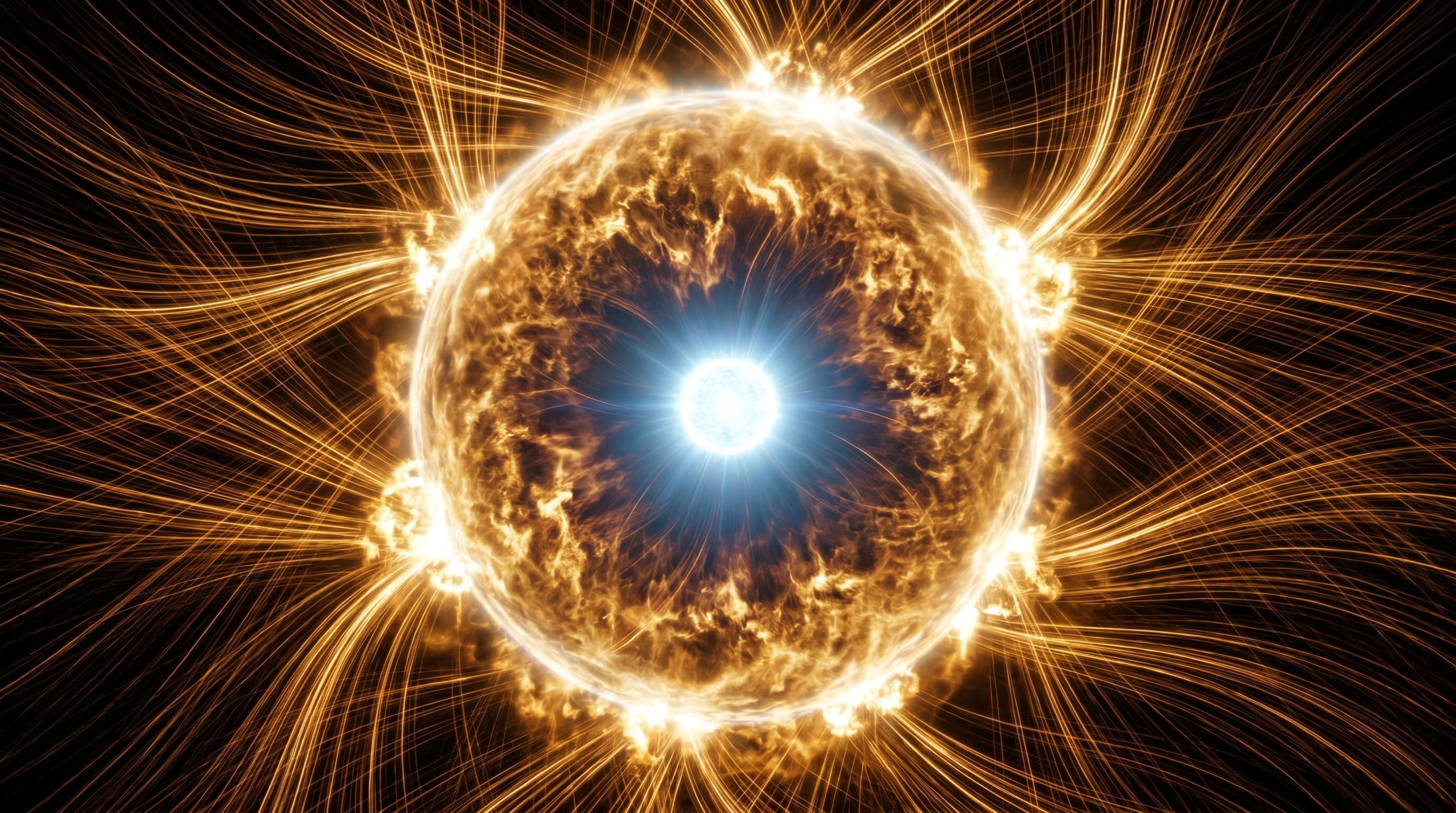
Why Betelgeuse Will Disappear From Our Sky
There is a star in the shoulder of Orion that your eye finds without trying. Reddish, slightly variable, present in the winter sky for as long as human beings have looked up and noticed things. It has been there for every version of civilization that ever existed on this planet. It will not always be there. And the story of why is one of the strangest, most complete stories in all of astrophysics -- beginning with hydrogen, ending with an absence that will be permanent.
The Star Itself
Betelgeuse is a red supergiant located approximately 700 light-years from Earth, sitting at what would be the upper-left shoulder of Orion if you are looking at the constellation from the northern hemisphere. It is currently ranked among the ten brightest stars in the night sky, though its brightness is variable enough that this ranking shifts. It has dropped as low as twentieth and risen as high as seventh within the span of a few years.
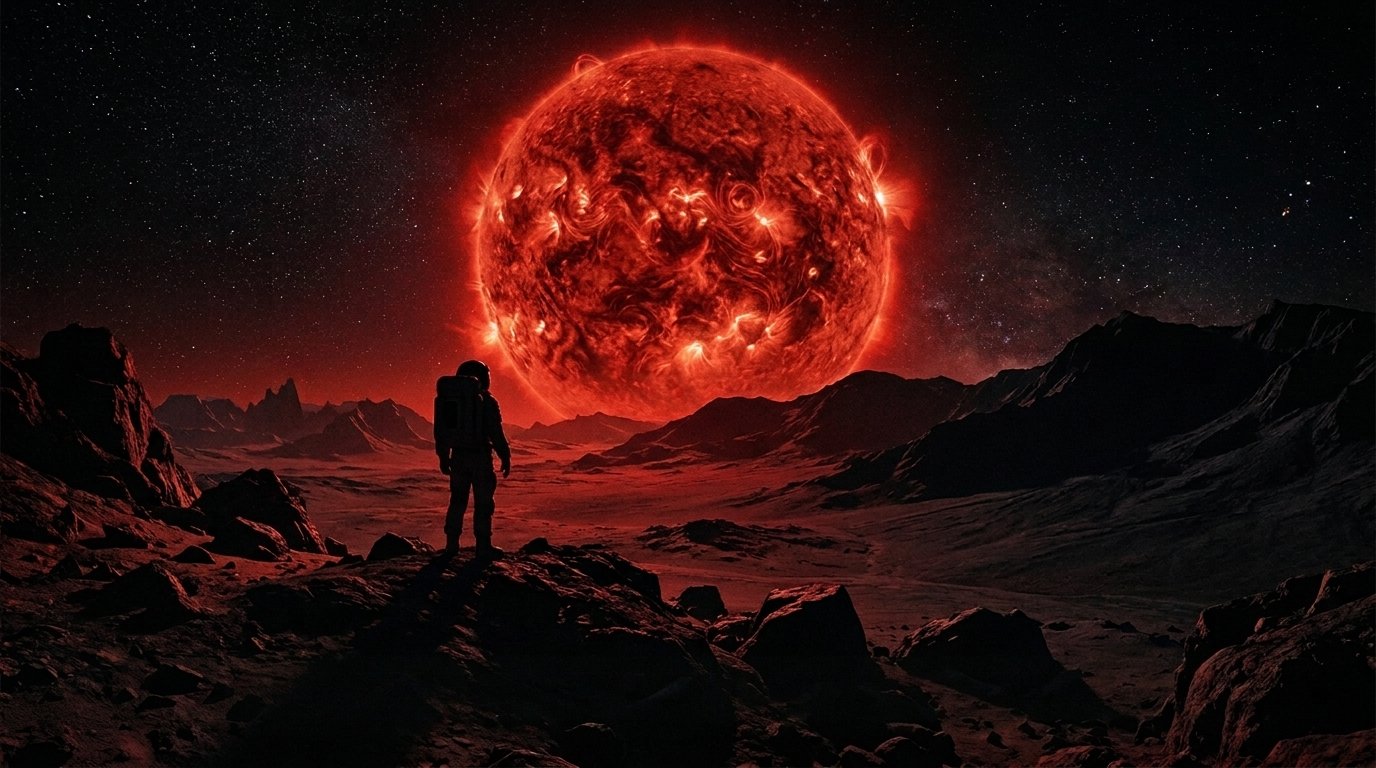
Its size is the first thing that resists casual comprehension. Betelgeuse has a radius roughly 700 times that of the Sun. If placed at the position of our Sun, its surface would extend past the orbit of Jupiter. The inner solar system -- Mercury, Venus, Earth, Mars, and the asteroid belt -- would sit inside this star's outer atmosphere. Not near it. Inside it. [1]
It formed with somewhere between 15 and 20 times the mass of the Sun. That initial mass committed it, from the beginning, to a particular kind of life: hot, luminous, fast, and short by stellar standards. The Sun will burn for approximately 10 billion years on the main sequence. Betelgeuse spent perhaps 8 to 10 million years there before expanding into the red supergiant we observe today. It is, by stellar accounting, old -- even though the number of years sounds young by geological standards.
The surface is not smooth. Direct imaging with instruments like the VLTI/GRAVITY interferometer and ALMA has resolved Betelgeuse's disk into a surface showing enormous convective cells, each one potentially larger than the distance from Earth to the Sun. The star breathes and churns in slow motion, continuously shedding material into the surrounding space through stellar winds at rates millions of times greater than the Sun's wind.
What Is Happening Inside It Right Now
A star generates energy and outward pressure by fusing lighter atomic nuclei into heavier ones. The fundamental relationship is the mass-energy equivalence:
$$E = \Delta m \cdot c^2$$where $\Delta m$ is the mass deficit between inputs and outputs, and $c$ is the speed of light. For hydrogen fusing to helium, approximately 0.7% of the input mass converts to energy. This fraction decreases for each successive fuel. Helium fusing to carbon via the triple-alpha process releases roughly 0.065% of the input mass as energy. Each subsequent stage is less efficient and therefore burns through its fuel faster.
Betelgeuse has long since exhausted hydrogen in its core. It has burned through helium. It is currently in one of the later stages of nuclear burning -- carbon, neon, or oxygen, depending on which model and which observational data you trust. The exact current stage is genuinely uncertain because we cannot see inside the star directly. We infer its internal state from surface behavior, luminosity, spectral data, and evolutionary models calibrated against other well-studied stars.
The later burning stages compress dramatically in duration. Hydrogen burning lasted millions of years. Helium burning: hundreds of thousands. Carbon burning in a massive star lasts on the order of a few hundred years. Neon burning: roughly a year. Oxygen burning: months. Silicon burning: days. One day, at the end of millions of years. [2]
Silicon burning produces iron. And iron is where the sequence terminates.
The Iron Problem
Every fusion reaction that releases energy does so because the product nucleus is at a lower energy state than the inputs -- the binding energy per nucleon increases up to iron in the periodic table. Iron-56 sits at the minimum of this energy landscape. Fusing iron does not release energy. It absorbs it.
The iron core therefore cannot generate outward pressure. As silicon burning deposits iron into the core, the core grows heavier without generating any compensating energy. Gravity, which has been balanced against fusion pressure for the star's entire life, finds itself with a growing advantage.
The core is held up temporarily by electron degeneracy pressure -- a quantum mechanical effect arising from the Pauli exclusion principle, which prevents two electrons from occupying the same quantum state. This pressure has a hard ceiling, known as the Chandrasekhar limit, approximately:
$$M_{Ch} \approx \frac{5.87}{\mu_e^2} \, M_\odot$$where $\mu_e$ is the mean molecular weight per electron (approximately 2 for an iron core), giving roughly 1.4 solar masses. When the iron core accumulates this much mass, electron degeneracy pressure is no longer sufficient, and collapse is unavoidable. [3]
The Collapse
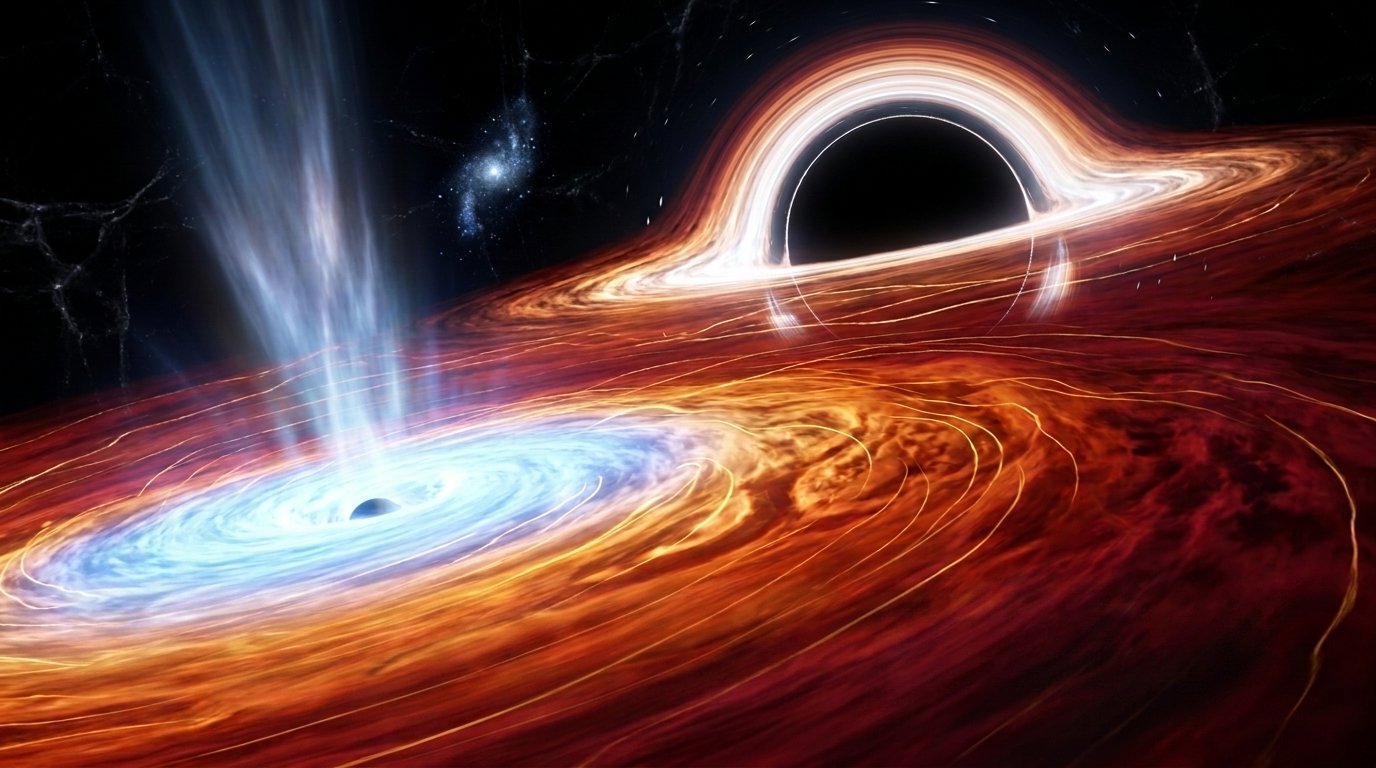
When the iron core exceeds the Chandrasekhar limit, it collapses in under one second. The inner core -- the innermost region of perhaps 20 kilometers in final radius -- falls inward at roughly a quarter of the speed of light. At nuclear density, the infalling material encounters the newly formed proto-neutron star and rebounds, sending a shockwave outward through the still-infalling outer core.
The shockwave initially stalls. It is pushing outward against material moving inward, and it loses energy as the iron it passes through dissociates into free protons and neutrons. For a brief period of perhaps a few hundred milliseconds, the outcome is genuinely uncertain: will the shockwave revive, or will it die and allow the star to collapse entirely into a black hole without a visible explosion?
For stars in Betelgeuse's mass range, current models favor shockwave revival via neutrino heating. The proto-neutron star radiates neutrinos with a luminosity of:
$$L_\nu \approx 3 \times 10^{53} \text{ erg/s}$$This exceeds the Sun's entire electromagnetic energy output across its full 10-billion-year lifetime, compressed into a few seconds. Although neutrinos interact with matter only via the weak nuclear force -- making them nearly transparent to all material -- a small fraction deposits energy in the region behind the stalled shockwave, heating it and driving the explosion forward. [4]
The outer layers of the star -- ten or more solar masses of hydrogen, helium, carbon, oxygen, and everything the star spent millions of years building -- are expelled at velocities exceeding 10,000 kilometers per second. The total kinetic energy released in the explosion is approximately $10^{44}$ joules. The core left behind is a neutron star or, depending on final mass, a black hole roughly 20 kilometers across.
The 2019 Dimming and What It Actually Was
Between October 2019 and February 2020, Betelgeuse faded to approximately 40% of its usual brightness -- the faintest recorded observation in the star's documented history. The event attracted significant public and scientific attention because of the obvious implication: was this a precursor to core collapse?
The answer, established through Hubble Space Telescope ultraviolet observations and ground-based spectroscopic data, was no. A large convective bubble had pushed material from the stellar surface outward. As this material moved away from the star and cooled, it condensed into dust. The dust cloud, large enough in cross-section to dim a star measurably from 700 light-years away, temporarily sat between Betelgeuse and Earth. [5]
The star itself had not changed significantly. The view of it had. By early 2020 Betelgeuse was recovering, and by 2023 it had briefly risen to the seventh brightest star in the sky -- the same star that had fallen out of the top 20 only three years earlier.
The Great Dimming was, if anything, evidence of the star doing what a red supergiant at this stage of its life does: ejecting large quantities of material, continuously, in ways that are visible from across hundreds of light-years. It was not a countdown. It was weather.
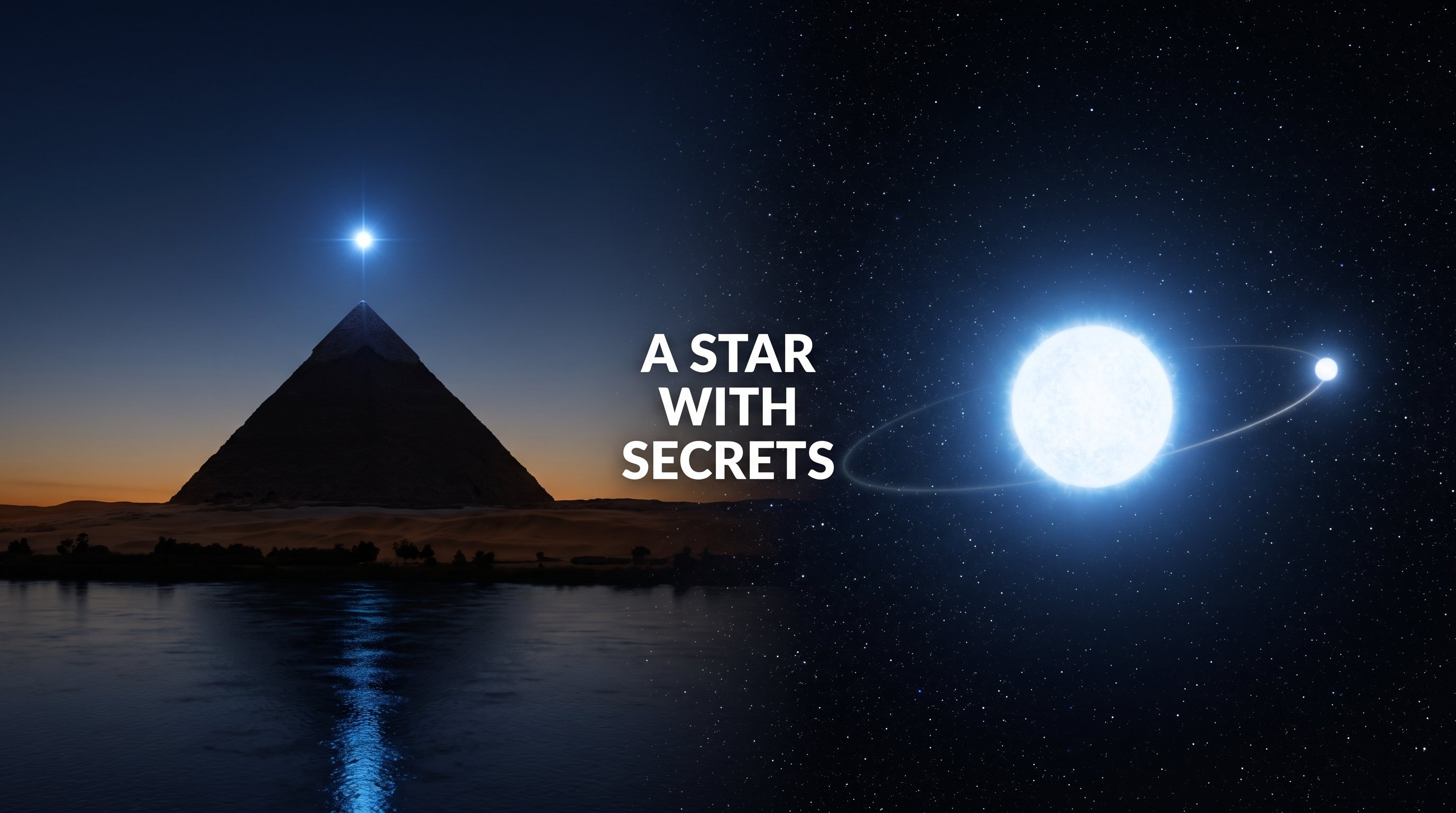
Siwarha: The Star That Changed the Timeline
For decades, observers noticed a roughly 2,100-day cycle in Betelgeuse's brightness variations -- longer than the well-known 400-day pulsation period and not cleanly explained by any single internal model. Some researchers interpreted this long cycle as a potential signature of late-stage core evolution -- which, if correct, would place the supernova within decades or centuries rather than the more traditional estimate of up to 100,000 years.
In July 2025, a team led by astrophysicist Steven Howell published findings in The Astrophysical Journal Letters confirming what had long been suspected: Betelgeuse has a companion star. [6]
The companion, named Siwarha (Arabic for "her bracelet," honoring the Arabic roots of Betelgeuse's own name), is a hot blue-white pre-main-sequence star of approximately 1.5 solar masses. It orbits Betelgeuse every 2,100 days -- exactly the period that had appeared as unexplained variability for decades. Its existence was confirmed via speckle imaging with the 'Alopeke instrument on the Gemini North telescope in Hawaii, using observations from 2020 and 2024.
The discovery reclassified the 2,100-day cycle from an intrinsic stellar pulsation (which would imply late core evolution) to a binary interaction effect. This collapsed the argument for an imminent supernova. Without the long-cycle variability as a diagnostic of core state, the evolutionary timeline reverts to models placing Betelgeuse in an earlier burning phase -- most likely helium burning -- with core collapse probable hundreds of thousands of years from now.
What the Supernova Will Look Like From Earth
When the explosion occurs -- whenever that is -- the sequence of what we will observe from Earth unfolds in stages.
The first signal will not be light. Underground neutrino detectors -- IceCube at the South Pole, Super-Kamiokande in Japan, and others -- will register a sharp burst lasting roughly ten seconds from the direction of Orion. This burst will arrive hours before any optical change in the sky, because neutrinos pass through the star's outer layers in seconds while the light must wait for the shockwave to reach the stellar surface and for the expanding shell to become transparent.
This network -- the SuperNova Early Warning System, or SNEWS -- would trigger automated alerts to observatories worldwide. The sky would still look normal. Betelgeuse would still be where it always is. And then, hours later, the light would arrive.
The brightening would not be instantaneous. It would accumulate over days as the expanding shell of ejecta heats and becomes luminous. Peak brightness, reached perhaps a week or two after the collapse, is estimated at roughly apparent magnitude -12, comparable to the full Moon in raw brightness -- though compressed into a point source rather than a disk. [7]
It would be visible in the daytime sky. It would cast soft shadows at night. The nickel-56 synthesized in the explosion would decay to cobalt-56 (half-life 6.1 days) and then to iron-56 (half-life 77.2 days), releasing energy that keeps the ejecta glowing for months after the peak. During this entire period, no telescope would be required. Anyone who stepped outside and looked at Orion would see it.
Then it would fade. Over months, dropping back through the brightness rankings, growing dimmer than it was before. Eventually dropping below naked-eye visibility. Eventually leaving nothing where it was.
The Danger Question
The threshold at which a supernova poses a meaningful risk to Earth's atmosphere through gamma-ray and high-energy cosmic-ray irradiation is generally estimated at 25 to 50 light-years. At this range, the flux could cause significant ozone depletion with potential consequences for surface life.
Betelgeuse is approximately 700 light-years away. It is not in the danger zone by any current model. The gamma-ray flux at Earth would be below the level of a standard medical imaging procedure. The cosmic rays would arrive spread over thousands of years rather than in a burst, indistinguishable from the background flux Earth already receives. The neutrino pulse will pass through every person on Earth without a single perceptible interaction. [8]
The most violent event in the local stellar neighborhood will arrive at Earth as a bright point of light that a person can look at with their bare eyes and then go back inside. The gap between what it is at the source and what it is from here is 700 light-years wide.
The Permanent Absence
After the supernova fades, the sky over Earth will have a specific and permanent feature: a gap in Orion where Betelgeuse was. The remaining stars of the constellation -- the belt, Rigel, Bellatrix, the feet -- will still be there. The shape will still be recognizable as Orion. But the warm reddish point at the upper left will be gone.
Over decades, a faint expanding nebula may become detectable at that location in amateur telescopes. Over centuries it will grow. Over thousands of years it will spread and cool and eventually merge with the surrounding interstellar medium. At the center of all that expanding gas, a neutron star will be spinning down slowly, cooling toward thermal equilibrium with its surroundings over timescales longer than the current age of the universe.
People born after the supernova will learn a different Orion. It will not feel incomplete to them, because it will be the only version they know. The absence will become the normal.
What We Actually Know
Betelgeuse is a red supergiant approximately 700 light-years from Earth, in the final stages of its stellar life by any reasonable accounting. Its core has exhausted hydrogen and helium, and it is currently burning heavier elements in layered shells surrounding a growing inert center. It will eventually undergo core collapse and produce a Type II supernova.
The 2019 Great Dimming was caused by a dust cloud formed from ejected surface material, not by any change in the stellar interior. The discovery of companion star Siwarha in 2025 revised the supernova timeline from possibly decades to likely hundreds of thousands of years, by demonstrating that the 2,100-day brightness cycle is driven by binary interaction rather than internal core evolution.
When the explosion occurs, it will be visible in the daytime sky, will cast soft shadows at night, will pose no physical danger to Earth, and will leave a permanent gap in Orion. Neutrino detectors will provide hours of warning before the light arrives. The light itself will fade over months. The nebula that forms will expand for millennia before dissipating into the interstellar medium.
The star that has been in every human sky since before any surviving record of sky-watching will, at some point, not be there. The physics that governs this has been understood in outline for decades, and recent observations have refined the timeline considerably. What cannot be refined is the fact of it. Betelgeuse will go. The only genuinely open question is when.
[1] Harper, G. M. et al. (2017). "An Updated 2017 Astrometric Solution for Betelgeuse." The Astronomical Journal, 154(1). Direct imaging and astrometric data establishing distance and angular diameter from which physical radius is derived.
[2] Woosley, S. E., Heger, A., and Weaver, T. A. (2002). "The evolution and explosion of massive stars." Reviews of Modern Physics, 74(4), 1015. Canonical reference for massive star burning timescales.
[3] Chandrasekhar, S. (1931). "The Maximum Mass of Ideal White Dwarfs." The Astrophysical Journal, 74, 81. Original derivation of the mass limit for degenerate stellar cores.
[4] Janka, H.-T. (2012). "Explosion Mechanisms of Core-Collapse Supernovae." Annual Review of Astronomy and Astrophysics, 50, 107. Comprehensive review of neutrino-driven explosion mechanism and shockwave revival.
[5] Montarges, M. et al. (2021). "A dusty veil shading Betelgeuse during its Great Dimming." Nature, 594, 365-368. Peer-reviewed confirmation of the dust explanation for the 2019 dimming event.
[6] Howell, S. B. et al. (2025). "The Probable Direct-Imaging Detection of the Stellar Companion to Betelgeuse." The Astrophysical Journal Letters, July 2025. Confirmation of Siwarha via speckle imaging with Gemini North 'Alopeke instrument.
[7] The distance modulus $m - M = 5 \log_{10}(d / 10\,\text{pc})$ applied at $d \approx 200\,\text{pc}$ with an assumed absolute magnitude of $M \approx -17$ gives apparent magnitude near $-12$. Estimates vary based on ejecta mass and nickel-56 yield, which are model-dependent prior to the actual event.
[8] Gehrels, N. et al. (2003). "Ozone depletion from nearby supernovae." The Astrophysical Journal, 585, 1169. Establishes the 25-50 light-year danger threshold for atmospheric ozone impact from supernova radiation.
Comments (0)
Leave a Comment