Why the Void We Live In Should Not Exist
There is a standard assumption baked into almost every cosmological measurement ever made from this planet. It is so foundational that it rarely gets named. The assumption is that we are not in a special place. That our corner of the universe is, statistically speaking, ordinary. That the galaxy counts, the matter density, the gravitational environment surrounding us represent a fair sample of the cosmos as a whole. Almost every calculation of how fast the universe expands, how old it is, and how its matter is distributed rests quietly on this assumption. It has never been confirmed directly. And there is now substantial evidence that it is wrong.
What the KBC Void Actually Is
In 2013, three astronomers named Ryan Keenan, Amy Barger, and Lennox Cowie published a paper in The Astrophysical Journal that most people outside of cosmology never heard about. They had spent years counting galaxies across multiple large-scale sky surveys, including the Two-Micron All-Sky Survey and the Sloan Digital Sky Survey, and comparing what they found to what standard cosmology predicted they should find.
What they found was a deficit. Within roughly 300 megaparsecs of our position, which is approximately one billion light-years in every direction, galaxy density was measurably, consistently, and significantly lower than the cosmic average. Not by a small margin. By somewhere between 20 and 50 percent, depending on where and how you measured. At greater distances, the counts returned to normal. The universe beyond a certain threshold looked as expected. Inside that threshold, something was missing.
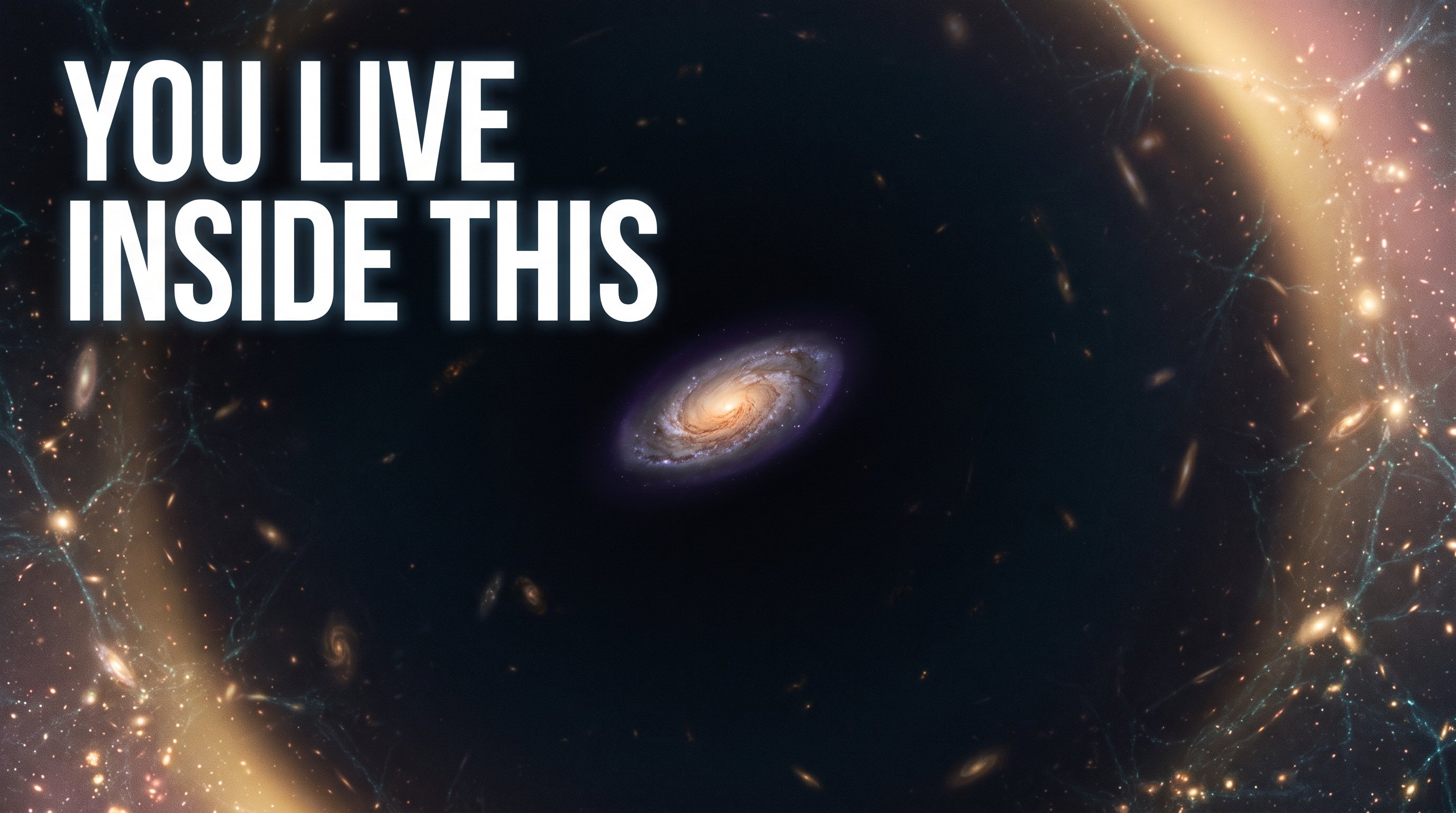
The structure they identified is now called the KBC Void, named from their initials, though it also goes by the Local Hole. It is roughly spherical, approximately two billion light-years in diameter, and it is the largest confirmed void in the known universe. Its boundary is not a hard edge. Galaxy density increases gradually as you move outward, thickening into a shell of denser-than-average cosmic material before the universe resumes its normal distribution. The Milky Way sits near the center of this structure, offset by a few hundred million light-years from the geometric middle, but close enough that the word "center" remains honest. [1]
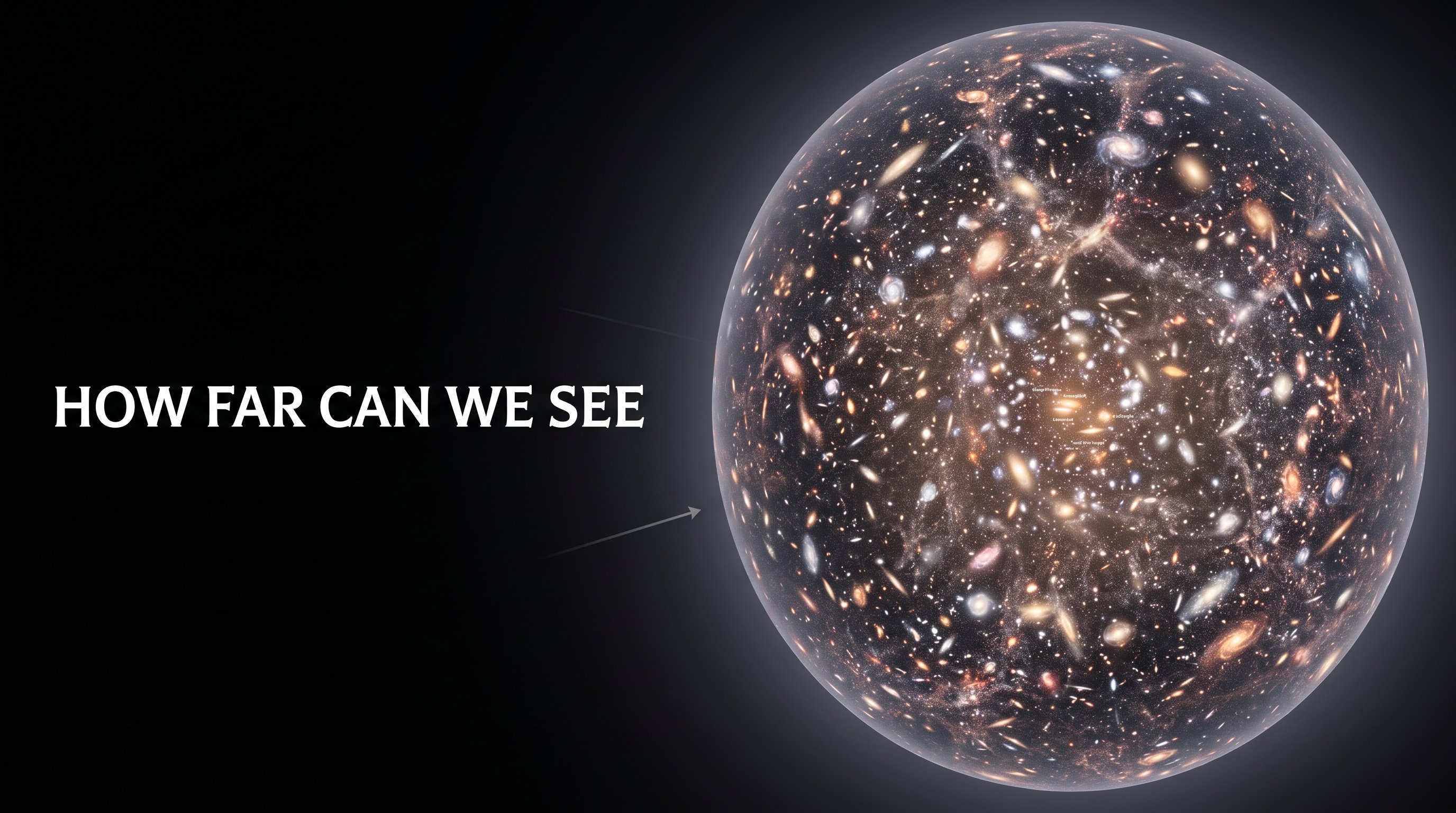
It is worth pausing on the scale before moving forward. Two billion light-years is not a number that yields to intuition. The observable universe is roughly 93 billion light-years across. The KBC Void occupies approximately 2 percent of that diameter. Expressed differently: if the observable universe were the size of Earth, the KBC Void would be roughly the size of France. We live inside France. And France, as it turns out, contains far fewer galaxies than average.
How It Was Confirmed
A single study is not sufficient to establish a structure this consequential, and the field treated it accordingly. In 2017 and 2018, a graduate student named Ben Hoscheit, working with Amy Barger, approached the same question from a completely different direction. Rather than counting galaxies, he used something called the kinematic Sunyaev-Zel'dovich effect.
The kinematic Sunyaev-Zel'dovich effect works as follows. Galaxy clusters in motion through space interact with the cosmic microwave background, the oldest light in the universe, via inverse Compton scattering. As free electrons in a moving cluster collide with CMB photons, they shift those photons' energies in a measurable way that reveals the cluster's velocity relative to the CMB rest frame. This is an entirely different kind of measurement from galaxy counting. Different instruments, different assumptions, different datasets.
Hoscheit found that the density profile Keenan had originally mapped was consistent with the kSZ constraints and with Type Ia supernova data simultaneously. He did not claim proof. The language he used was careful: there were no current observational obstacles to the conclusion. But the effect of his paper was significant. The void had now been examined from two methodologically independent directions and had not disappeared from either of them. [2]
The Statistical Catastrophe
This is where the story shifts from interesting to genuinely unsettling. In 2020, cosmologists Moritz Haslbauer, Indranil Banik, and Pavel Kroupa published a paper in Monthly Notices of the Royal Astronomical Society that framed the KBC Void not as a curiosity but as a potential falsification of the standard cosmological model.
Their method was to take the measured density profile of the void and run it against the Millennium XXL simulation, one of the largest cosmological simulations ever constructed. The Millennium XXL models a synthetic universe built to statistically match the real one under standard physics, Lambda Cold Dark Matter (LCDM). The question they asked was simple: how often does a structure like the KBC Void appear in a universe like this one?
The answer was expressed in sigma. The density contrast of the KBC Void, defined as:
$$\delta = 1 - \frac{\rho}{\rho_0}$$where $\rho$ is the local matter density and $\rho_0$ is the cosmic mean, was measured at approximately 0.46 between 40 and 300 megaparsecs. A value of zero would mean perfectly average. A value of 0.46 means roughly half the expected matter is absent. When Haslbauer and colleagues tested this against the Millennium XXL, the tension with LCDM came back at 6.04 sigma. [3]
Six sigma. In physics, five sigma is conventionally the threshold for a discovery, corresponding to a probability of roughly one in 3.5 million that the result is a statistical fluke. Six sigma pushes past that. Combined with the Hubble tension, which will be addressed in the next section, the combined statistical incompatibility of the void with LCDM in their analysis reached 7.09 sigma. The authors were not claiming the standard model was wrong. They were claiming the data was making it extremely difficult to defend.
Kroupa had been raising a version of this concern since at least 2015, when he described the observed large-scale underdensity in an invited review as something that clashes massively with the predictions of structure formation under LCDM. The 2020 paper put numbers on what had previously been a qualitative concern.
The Hubble Tension Connection
To understand why the void matters beyond its own statistics, you need to understand the Hubble tension. The Hubble constant, $H_0$, measures how fast the universe is expanding per unit of distance. It is one of the most important numbers in cosmology. It has also, for the last decade, been producing two different answers depending on how you measure it.
Local measurements, using Cepheid variable stars and Type Ia supernovae as distance indicators, consistently return values around 72 to 75 km/s/Mpc. Early-universe measurements, derived from the cosmic microwave background and baryon acoustic oscillations, return approximately 67 to 68 km/s/Mpc. The gap between these values has persisted and widened as both methods have improved in precision. It currently exceeds five sigma. The better the measurements get, the worse the disagreement becomes.
The KBC Void offers a gravitational mechanism that could partially explain this. An underdense region does not hold its interior matter as strongly as average space does. The denser walls surrounding the void exert a net gravitational pull outward, causing galaxies inside the void to drift toward the shell. When astronomers measuring the local Hubble constant observe these galaxies, that additional outward drift registers as a slightly elevated recession velocity, inflating the apparent local expansion rate above the true global value. The relationship can be expressed schematically as:
$$H_{0,\text{local}} = H_{0,\text{global}} + \Delta H_{\text{void}}$$where $\Delta H_{\text{void}}$ represents the systematic offset introduced by the void's gravitational environment. Banik has estimated this offset could account for approximately 11 percent of the local H0 value, which is close to the size of the actual discrepancy between the two measurement families. [4]
The Scientists Who Disagree
The KBC Void is not accepted as a resolution to the Hubble tension, and some researchers question whether it presents a serious challenge to LCDM at all. These objections deserve full treatment rather than a footnote.
Martin Sahlén and colleagues have argued that supervoids as large as the KBC Void are not necessarily incompatible with LCDM when the statistical framework is applied carefully, with appropriate attention to how the void's boundaries are defined and what comparison sample is used. Because the void does not have hard edges, the measured density contrast is sensitive to those definitional choices, and adjusting them shifts the sigma number significantly.
In 2019, W. D'Arcy Kenworthy, Dan Scolnic, and Nobel laureate Adam Riess analyzed a sample of 1,295 supernovae and found no evidence for the large outward flows that a KBC-scale void would need to produce to inflate the local Hubble constant meaningfully. Their conclusion was direct: local structure does not measurably impact Hubble constant measurements. [5]
A 2022 paper by David Camarena and colleagues, titled pointedly "A Void in the Hubble Tension? The End of the Line for the Hubble Bubble," found that when the full supernova dataset is used rather than only the nearby redshift range, the void model offers no meaningful advantage over standard LCDM. The void-based explanation works only if you restrict the data to the window where the tension is measured in the first place, which is a form of circular reasoning.
Radek Wojtak raised a methodological concern that cuts closer to the data itself. The galaxy surveys used to identify the KBC Void do not cover the entire sky, and the regions excluded tend to be near the Laniakea Supercluster. Measuring underdensity in regions that systematically look away from a nearby overdensity may produce a biased result. He also questioned whether a region only 40 to 50 percent below average density truly qualifies as a void in any physically meaningful sense. Typical cosmic voids are five times less dense than average. The KBC Void, by that measure, is more accurately described as a large, mild underdensity than a genuine void.
An Alternative Theory of Gravity
Haslbauer, Banik, and Kroupa did not stop at showing the tension with LCDM. They proposed an alternative framework under which the void's existence is not statistically improbable but expected. That framework is Milgromian dynamics, known as MOND, first proposed by physicist Mordehai Milgrom in 1983.
Milgrom's original proposal was motivated by galaxy rotation curves. Stars at the outer edges of galaxies orbit faster than Newtonian gravity predicts given the visible mass of the galaxy. The standard solution is to add invisible dark matter in the right distribution. Milgrom's alternative was to modify the gravitational force law itself at very low accelerations, below a threshold $a_0$ of approximately $1.2 \times 10^{-10}$ m/s$^2$. In this regime, gravity falls off more slowly than the standard inverse square law, holding outlying stars in their observed orbits without any hidden mass. [6]
At cosmological scales, Milgromian dynamics predicts that structure formation happens more aggressively than under standard gravity. Matter clumps faster, voids grow deeper, and the universe develops large-scale structures earlier than LCDM allows. When Haslbauer and colleagues modeled a Milgromian universe supplemented with sterile neutrinos (a theoretically motivated but undetected particle), they found that a void the size and depth of the KBC Void was not a one-in-a-billion anomaly but a natural product of the physics.
The Newest Evidence: Bulk Flows in 2023
In 2023, a team led by Richard Watkins published an analysis using the CosmicFlows-4 catalogue, the most comprehensive compilation of galaxy peculiar velocities assembled to date. Peculiar velocities are galaxy motions above and beyond the general Hubble expansion, driven by local gravitational forces. When you average these across a large volume, the result is called a bulk flow.
Under LCDM, bulk flows should decrease as the volume measured increases, because random gravitational pulls from different directions average out. The CosmicFlows-4 data showed something different. At a scale of 150 to 200 Mpc/h, the bulk flow remained anomalously large. The probability of this occurring in a standard LCDM universe was calculated at approximately 0.003 percent, corresponding to 4.81 sigma tension. [7]
What makes this finding particularly significant is that Haslbauer and Banik had made predictions about bulk flow behavior in a universe containing a KBC-scale void before the CosmicFlows-4 data was published. When the data arrived, those predictions held. Not perfectly, but within the tolerances of a genuine a priori forecast surviving contact with new observations. An independent team led by Whitford examined the same data using a more conservative method and reached essentially the same result.
What We Actually Know
The KBC Void exists. That conclusion is supported by enough independent evidence from enough different methods that dismissing it entirely requires discounting a substantial body of careful observational work. Galaxy counts across multiple surveys, kSZ measurements of cluster motion, and peculiar velocity catalogues all point to the same basic picture: the region of space we inhabit contains significantly less matter than a random patch of universe this size ought to contain.
What remains contested is what that means. Whether the void is large and deep enough to meaningfully inflate local Hubble constant measurements is disputed, with serious published work on both sides. Whether its existence is genuinely incompatible with LCDM depends on methodological choices about measurement and definition that have not reached consensus. Whether it constitutes evidence for a modified theory of gravity is an open research question, not an established conclusion.
Banik, who has spent years building the quantitative case for the void's significance, said in connection with the 2023 bulk flow findings that by now it is pretty clear we are in a significant underdensity. That is the considered opinion of one of the field's most active researchers on this specific question. It is not the consensus of the field as a whole.
The most honest summary is this. Our most fundamental cosmological measurements may be systematically biased by where we happen to live. The instrument is not broken. The data is not wrong. But the place the instrument is standing may not be typical, and if it is not typical, then decades of measurements made from this location carry a systematic uncertainty that has not yet been fully accounted for. That uncertainty does not collapse cosmology. It does not invalidate the standard model. But it sits inside every H0 measurement ever made from Earth, patient and unresolved, waiting for better data to settle it one way or another.
The newest numbers are still coming in. The argument is still running.
[1] Keenan, R.C., Barger, A.J., and Cowie, L.L. (2013). Evidence for a approximately 300 Mpc Scale Under-density in the Local Galaxy Distribution. The Astrophysical Journal, 775, 62.
[2] Hoscheit, B.L., and Barger, A.J. (2018). The KBC Void: Consistency with Supernovae Type Ia and the Kinematic SZ Effect in a LLTB Model. The Astrophysical Journal, 854, 46.
[3] Haslbauer, M., Banik, I., and Kroupa, P. (2020). The KBC Void and Hubble Tension Contradict LCDM on a Gpc Scale. Monthly Notices of the Royal Astronomical Society, 499, 2845.
[4] Banik, I., commentary cited in The Brighter Side of News (2025), referencing Mazurenko, Banik, Kroupa and Haslbauer (2024), MNRAS, 527, 4388.
[5] Kenworthy, W.D., Scolnic, D., and Riess, A.G. (2019). The Local Perspective on the Hubble Tension: Local Structure Does Not Impact Measurement of the Hubble Constant. The Astrophysical Journal, 875, 145.
[6] Milgrom, M. (1983). A Modification of the Newtonian Dynamics as a Possible Alternative to the Hidden Mass Hypothesis. The Astrophysical Journal, 270, 365.
[7] Watkins, R., Allen, T., Bradford, C.J., et al. (2023). Analysing the Large-Scale Bulk Flow Using CosmicFlows-4. Monthly Notices of the Royal Astronomical Society, 524, 1885.
Comments (0)
Leave a Comment