Why the Universe May Not Be Infinite After All
For as long as humans have looked at the night sky, the working assumption has been simple: space continues. In every direction, past every visible star and every distant galaxy, space simply goes on. No wall. No edge. No return. This assumption is so deeply embedded in how cosmology is practiced that most textbooks do not even state it as an assumption. It appears as background. As default. As the thing that does not need saying because everyone already knows it. The problem is that nobody has actually checked.
The Question General Relativity Cannot Answer
Einstein's field equations, the mathematical framework that governs how matter curves spacetime and how spacetime moves matter, are local equations. They describe the relationship between curvature and energy at each point in space. They say nothing about whether the full space those points inhabit is finite or infinite, simply connected or looping back on itself. Two universes, one infinite and one self-looping, can both satisfy the field equations identically. The physics is the same. The topology is invisible to the equations.
This distinction between geometry and topology sits at the heart of the cosmic topology problem. Geometry describes local properties: whether parallel lines converge, whether triangles have angles summing to 180 degrees, whether space curves positively or negatively. Topology describes global connectivity: whether the space is simply connected like an infinite plane, or multiply connected like a torus, where traveling far enough in one direction brings you back to your starting point.
The Planck satellite's 2018 final data release, the most precise measurement of the cosmic microwave background ever produced, returned a curvature parameter $\Omega_K = 0.001 \pm 0.002$. The universe is flat to within 0.4 percent. But flatness is a geometric measurement. It tells us nothing about topology. A flat torus and an infinite flat plane are both perfectly flat at every local point. No curvature measurement can distinguish between them. [1]
The Oldest Light and What It Is Missing
Approximately 380,000 years after the Big Bang, the universe cooled enough for electrons and protons to combine into neutral hydrogen atoms. For the first time, photons could travel freely without scattering off charged particles. The light that was released at that moment is still traveling today, arriving from every direction simultaneously at a temperature of 2.725 degrees above absolute zero. This is the cosmic microwave background, and it is the oldest observable thing in the universe.
The CMB carries a record of acoustic oscillations from the early universe, tiny temperature variations of one part in 100,000 that encode the distribution of matter and energy in the first few hundred thousand years. The angular power spectrum of these variations, written as $C_\ell$ for multipole moment $\ell$, is predicted by the standard cosmological model with remarkable precision at small angular scales.
At the largest angular scales, it is not.
The quadrupole, $C_2$, which represents the broadest temperature variation across the entire sky, is substantially weaker than the standard model predicts. The discrepancy is not marginal. Across COBE, WMAP, and Planck data, the quadrupole has consistently appeared at roughly one fifth to one sixth of its expected strength. The octopole, $C_3$, has its own anomaly: it aligns with the quadrupole in a way that has a probability of roughly one in a hundred under the standard model. [2]
In an infinite universe, fluctuations at all scales should exist freely. There is no upper limit on the size of a wave if space has no size limit. But in a finite, compact universe, fluctuations larger than the characteristic scale of the space cannot form. The room is too small to sustain them. The missing power at large angular scales is exactly what a compact universe would produce: a natural suppression of the lowest modes, not through any exotic mechanism, but simply because the geometry does not provide enough room for those waves to exist.
The Circles That Should Be There
In 1998, Neil Cornish, David Spergel, and Glenn Starkman published a paper titled "Circles in the Sky." The central argument was geometric and direct. If the universe is compact, and if the full space is smaller than our observable horizon, then the sphere of the last scattering surface, the spherical shell from which CMB photons were emitted, will intersect itself through the topology. In a three-torus, where opposite faces of a cube are identified, that intersection produces pairs of circles on opposite parts of the sky. The temperature fluctuation pattern along both circles in each pair should be identical, because both circles are, in fact, the same ring of the early universe seen from two different directions through the loop. [3]
The search for these circles was conducted on WMAP data in 2004 and on Planck data in subsequent years. No statistically significant matching circle pairs were found.
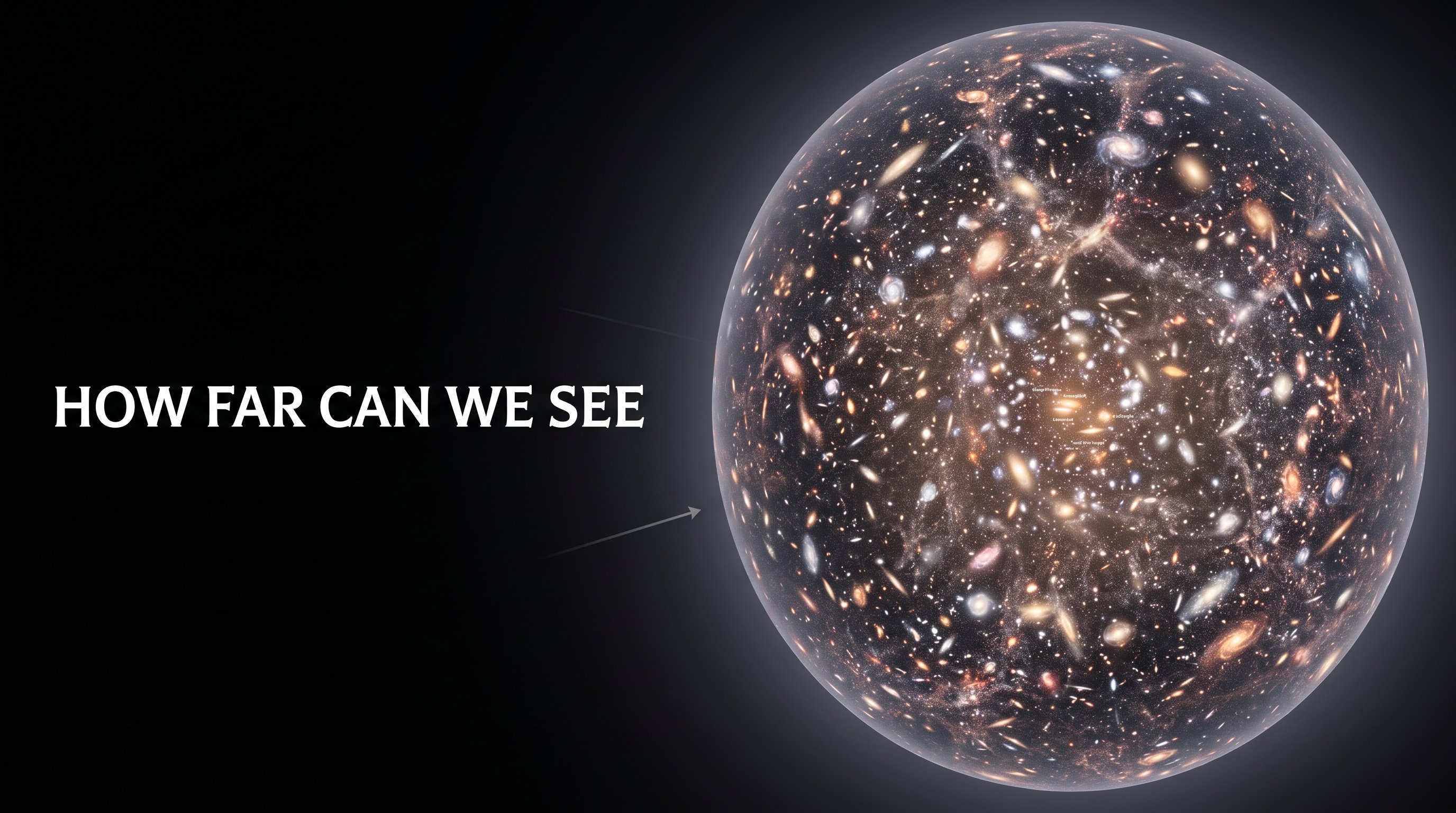
This result is widely misread as evidence against topology. It is not. The circles-in-the-sky method requires the topology to be smaller than the observable horizon. If the characteristic scale of the loop exceeds roughly 46 billion light years, the observable sphere fits inside the fundamental domain without intersecting its identified faces. No circles appear. The topology remains present and real, but outside the reach of this particular search method.
The Twelve-Sided Room
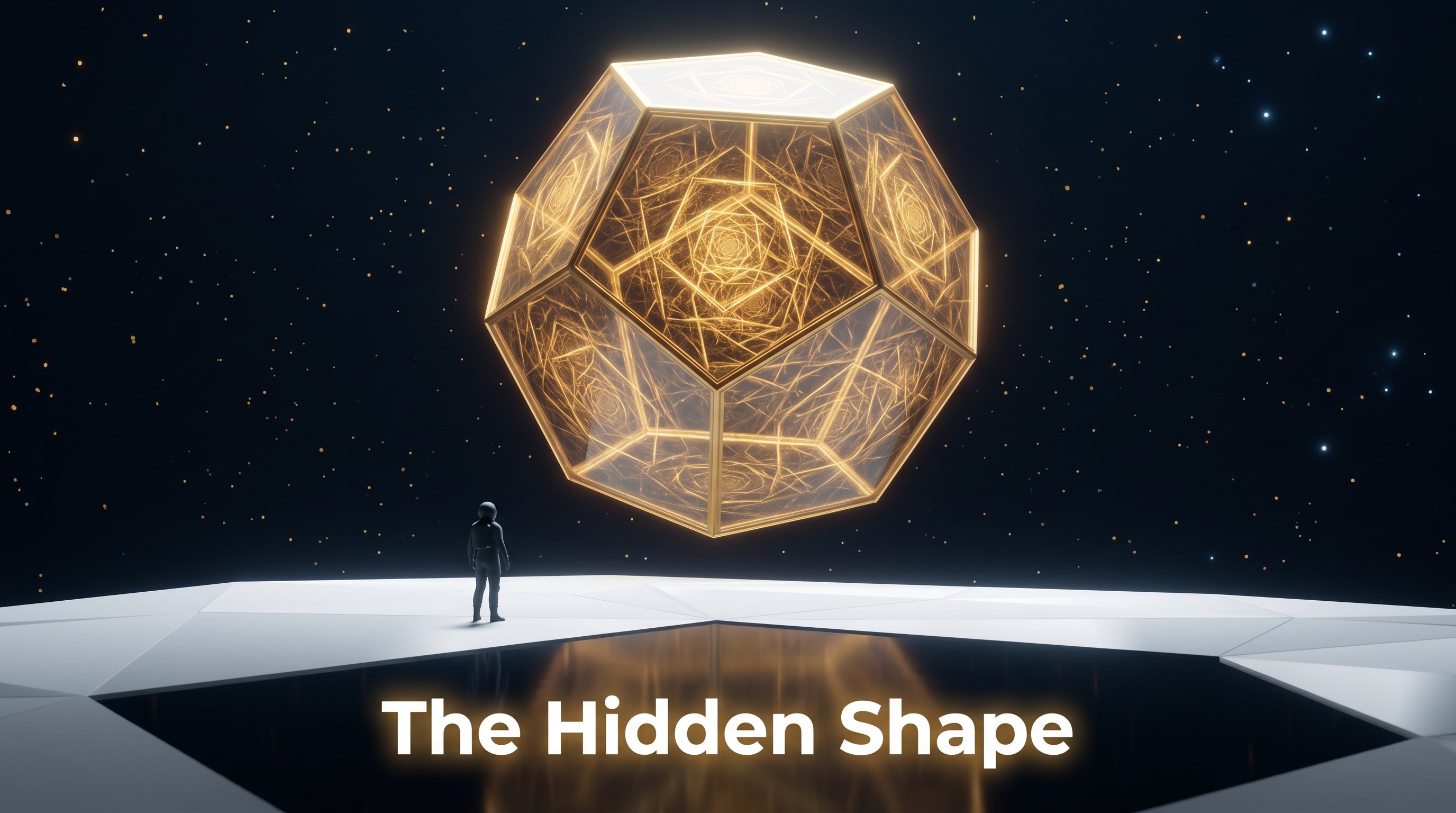
In 2003, Jean-Pierre Luminet and colleagues published a paper in Nature proposing a specific candidate topology for the universe: the Poincare dodecahedral space. The fundamental domain is a dodecahedron, a twelve-faced solid with pentagonal faces, where each face is mathematically identified with its opposite face rotated by 36 degrees. Anything exiting through one pentagonal face immediately reappears through its identified partner. The space is closed, finite, and positively curved. [4]
The Poincare dodecahedral space predicted that the CMB should show the weak large-angle power observed in WMAP. It predicted six pairs of matching circles at an angular radius of approximately 11 degrees. The model fit the data in a way the standard infinite model could not.
The subsequent search for those six pairs found no clean confirmation at the predicted scale in either WMAP or Planck data. The model was not ruled out entirely, but the specific signature it predicted did not appear at the required significance. The Poincare dodecahedral space remains a viable candidate in some parameter configurations, but the clean confirmation the 2003 paper seemed to promise has not arrived.
What the dodecahedral proposal accomplished, regardless of its ultimate fate as a specific model, was to demonstrate that the large-scale CMB anomalies could be explained by topology. The question shifted from whether topology was relevant to which topology, at what scale, and whether the data could ever discriminate between candidates.
Learning to Hear a Different Signal
The COMPACT Collaboration, a group of approximately fifteen scientists from seven countries, formed around the recognition that the circles-in-the-sky approach had explored only a fraction of the available parameter space. Their April 2024 paper in Physical Review Letters stated directly that prior searches for topology have far from exhausted the potentially significant possibilities. [5]
Their approach shifts from searching for a single dramatic signature to computing the full statistical fingerprint of a compact universe. In a topologically compact space, the two-point temperature correlation function $C(\theta)$ is no longer statistically isotropic. It depends not just on the angular separation between two CMB patches but on the direction, because the topology introduces preferred axes and scales. The correlation matrix for a specific manifold can be computed theoretically and compared against the Planck data using Bayesian methods.
For a slab topology, one compact dimension of length $L_z$, the optimal suppression of large-angle correlations occurs when: $$L_z \approx 1.4 \, \chi_{\text{rec}}$$ where $\chi_{\text{rec}}$ is the conformal radius of the last scattering surface. At this scale, the p-value of the observed Planck CMB maps under the compact model is approximately 0.15, compared to $p \lesssim 0.003$ for the standard infinite flat model. This is not a detection. But the improvement is not trivial.
Ghost Images in the Catalog
A compact topology produces another observable consequence that has received less attention: topological lensing. In a multiply connected universe, a single galaxy sends light outward in all directions. Some of that light takes the direct path to an observer. Some takes a longer path through the topology, wrapping around the identified faces of the fundamental domain and arriving from a completely different direction. The two light rays carry images of the same galaxy at different apparent distances, different positions in the sky, and different apparent ages corresponding to the different path lengths.
These repeated images are called ghost images. Karl Schwarzschild raised this possibility in 1900, reasoning purely from geometry with no observational data on extragalactic structure. For plausible compact topology scales, the first ghost images of nearby galaxies would appear at redshifts of approximately $z \approx 2$ or higher. [6]
The Sloan Digital Sky Survey, the 2dF Galaxy Redshift Survey, and the ongoing DESI survey have catalogued millions of galaxies with measured positions, redshifts, and morphologies. None of these catalogs have been systematically searched for topological ghost images at scale. The method requires a prior topological hypothesis to generate a prediction about where to look, what positional offset to expect, and what evolutionary age difference the path length implies. Without a hypothesis, ghost images are indistinguishable from ordinary distinct galaxies.
What Flatness Is Actually Hiding
The flatness measurement from Planck, combined with baryon acoustic oscillation data, is often presented as evidence for an infinite universe. The reasoning is intuitive: if the universe were a sphere or a saddle, we would detect the curvature, and we do not, therefore the universe is flat, and flat means infinite.
Each step in this reasoning is either correct or defensible individually. Together, the conclusion does not follow.
Baryon acoustic oscillations provide an independent geometric constraint. The BAO scale, approximately 150 megaparsecs comoving, serves as a standard ruler. By measuring its angular size at multiple redshifts, cosmologists can constrain the curvature independently of the CMB. The Planck 2018 combined constraint gives $\Omega_K = 0.001 \pm 0.002$. The universe is flat to within a fifth of a percent.
Flat means Euclidean at every local point. It does not mean infinite. The three-torus is a flat, finite, multiply connected space. An infinite Euclidean plane is also flat. No measurement of local curvature can distinguish between a compact flat topology and an infinite flat space, because the distinction is topological, not geometric. The flatness measurement rules out spherical and hyperbolic topologies. It says nothing at all about whether the flat space is simply connected or not.
What We Actually Know
The honest summary of the current state of this question is precise but incomplete.
The universe is flat to within 0.4 percent. This rules out strongly curved topologies. The CMB shows anomalously weak power at the largest angular scales, an unexplained feature that persists across every major dataset. No matching circle pairs have been found in the CMB at the angular scales accessible to the circles-in-the-sky method. This constrains compact topologies to those with characteristic scales larger than the observable horizon. A compact topology at such a scale is consistent with all current data, including the flatness measurement, the BAO constraints, and the CMB power spectrum at all accessible scales.
The universe may be infinite. The standard model assumes it is, and the assumption is consistent with the data. The universe may also be finite and looping, with a characteristic scale somewhat larger than our observable horizon, suppressing the large-angle CMB power we observe, producing ghost images in our galaxy catalogs that we have not yet learned to recognize, and leaving a statistical fingerprint in the correlation structure of the CMB that no analysis has yet been designed to extract cleanly.
The COMPACT Collaboration is currently running those analyses. The Planck data exists. The question is not whether the data is rich enough. It is whether the right mathematical framework has yet been brought to bear on it.
The shape of the universe is a measurable physical property. We have not measured it yet. The possibility that we could, using data that already exists, is one of the more quietly extraordinary situations in contemporary physics.
[1] Planck Collaboration, "Planck 2018 Results VI: Cosmological Parameters," Astronomy and Astrophysics, 2020. The combined constraint with BAO gives $\Omega_K = 0.001 \pm 0.002$.
[2] Copi, C.J. et al., "Large-Angle Anomalies in the CMB," Advances in Astronomy, 2010. The quadrupole anomaly has been confirmed across COBE, WMAP, and Planck datasets independently.
[3] Cornish, N., Spergel, D., Starkman, G., "Circles in the Sky," arXiv:astro-ph/9801212, 1998. The foundational paper establishing the observational search strategy for compact topology.
[4] Luminet, J.-P. et al., "Dodecahedral space topology as an explanation for weak wide-angle temperature correlations in the cosmic microwave background," Nature, 2003.
[5] COMPACT Collaboration (Akrami et al.), "Promise of Future Searches for Cosmic Topology," Physical Review Letters 132, 171501, April 2024.
[6] Luminet, J.-P., Lachièze-Rey, M., "Cosmic Topology," Physics Reports 254, 1995. The comprehensive review of topological lensing and ghost image detection methods.
Comments (0)
Leave a Comment