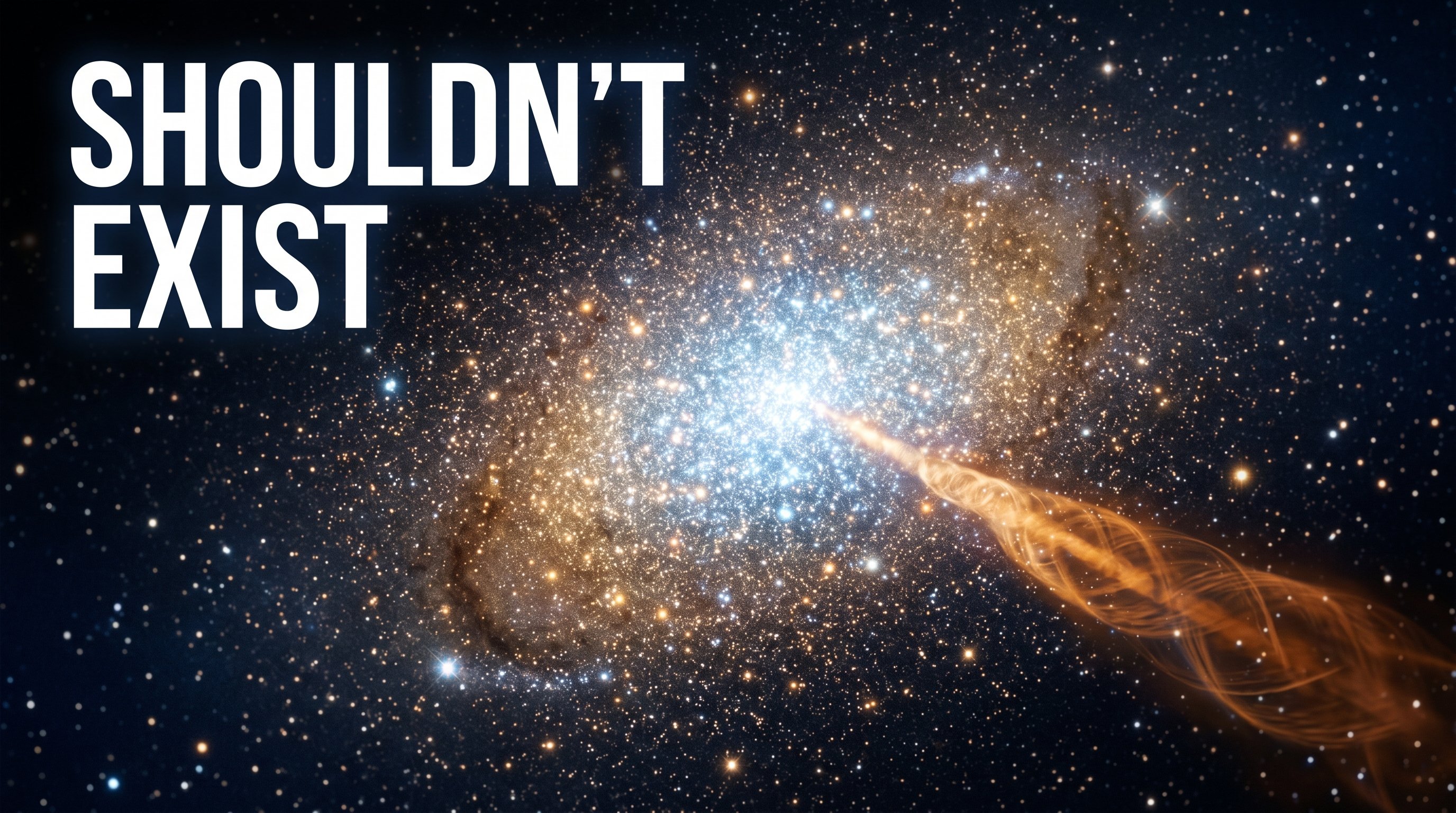
Why the Earliest Galaxies Should Not Exist
There is a rule in cosmology that almost nobody talks about because, until recently, nobody needed to. It goes like this: the universe has a speed limit for building things. Gravity can only pull so fast. Gas can only cool so quickly. Stars can only form at a rate that the underlying physics permits. And galaxies, the largest gravitationally bound structures in existence, take time. Billions of years of it. This was not an assumption. It was a prediction, derived from the best-tested model in all of cosmology, confirmed by decades of observation. Then the James Webb Space Telescope looked further back than any instrument ever had, and found galaxies that had broken the rule entirely.
The Standard Story We Trusted
The prevailing framework for understanding how the universe evolved from a smooth, featureless plasma into the structured cosmos we inhabit today is called Lambda-CDM. The Lambda refers to the cosmological constant, the energy embedded in empty space that is currently driving the universe's accelerating expansion. CDM stands for Cold Dark Matter, the invisible, gravitationally active substance that makes up roughly 27 percent of the universe's total energy content.
At the heart of Lambda-CDM is a process called hierarchical structure formation. The early universe was not perfectly smooth. Tiny quantum fluctuations, stretched to cosmic scales during a period of rapid early expansion called inflation, left faint imprints of unevenness in the distribution of matter. Gravity found those imprints. Over hundreds of millions of years, it amplified them. Small overdensities became denser. Surrounding matter drifted inward. Dark matter, which does not interact with radiation and was therefore free to begin collapsing earlier than ordinary matter, formed the first gravitational wells. Ordinary matter followed, cooling and compressing until the first stars ignited.
The process was hierarchical because of a fundamental constraint: you cannot skip steps. Small structures form first. They merge into medium structures. Medium structures eventually become large ones. A galaxy containing hundreds of billions of stars cannot exist before the gravitational scaffolding, the cooling sequences, the star formation cycles, and the merging processes that produce it have all had time to complete. Lambda-CDM quantifies this constraint through the halo mass function, which specifies how many dark matter halos of a given mass can exist at any given point in cosmic history. A galaxy's stellar mass cannot exceed the baryonic content of its host halo. The ceiling is physical, not arbitrary.
This framework was not built on faith. It predicted the detailed temperature fluctuations of the cosmic microwave background to extraordinary precision. It correctly described the large-scale arrangement of galaxy filaments, walls, and voids across hundreds of millions of light-years. It accounted for the abundance ratios of light elements produced in the first minutes after the Big Bang. Lambda-CDM earned its status as the standard model of cosmology through a long series of predictions made and then verified.
What the Telescope Actually Found
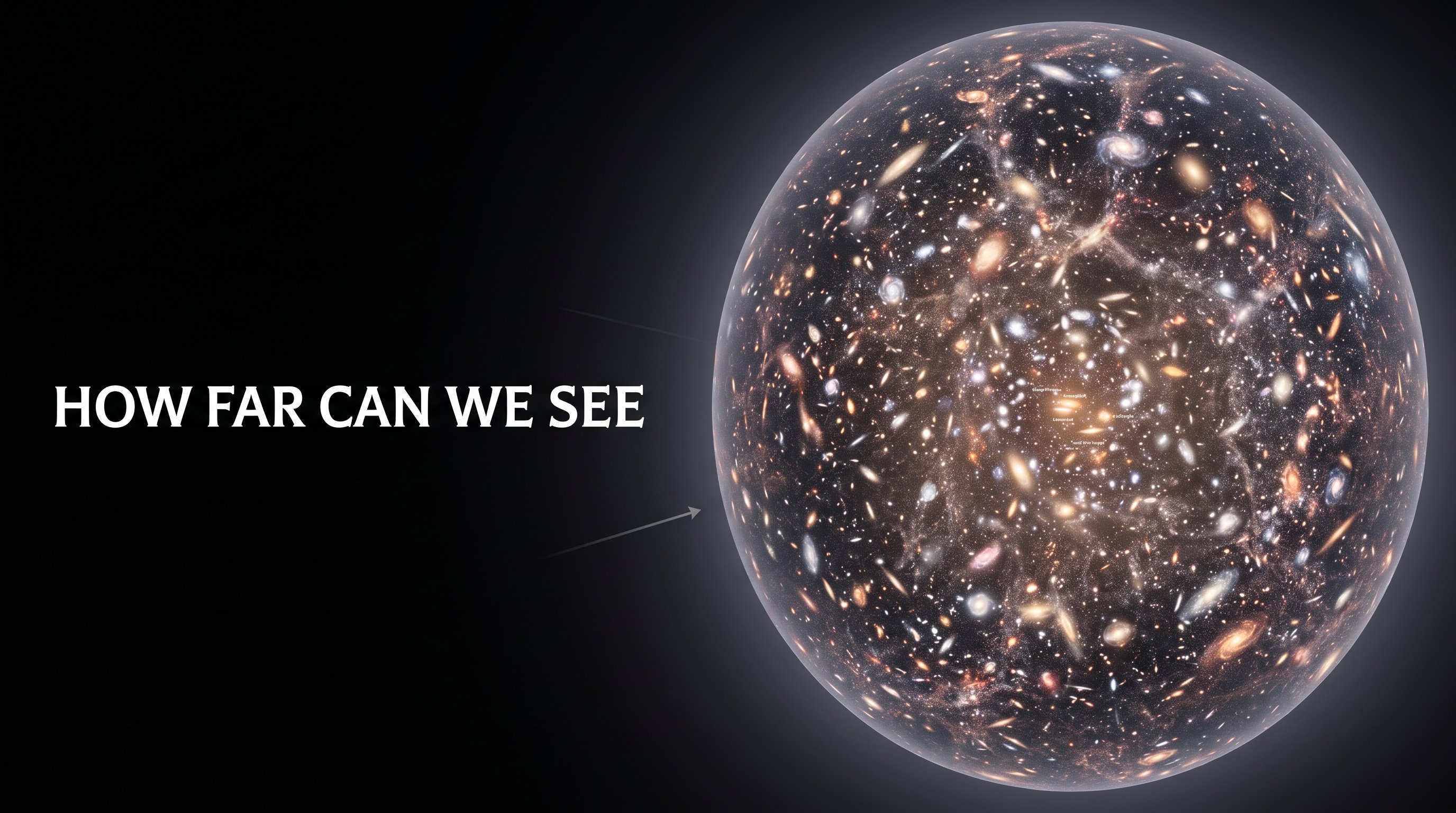
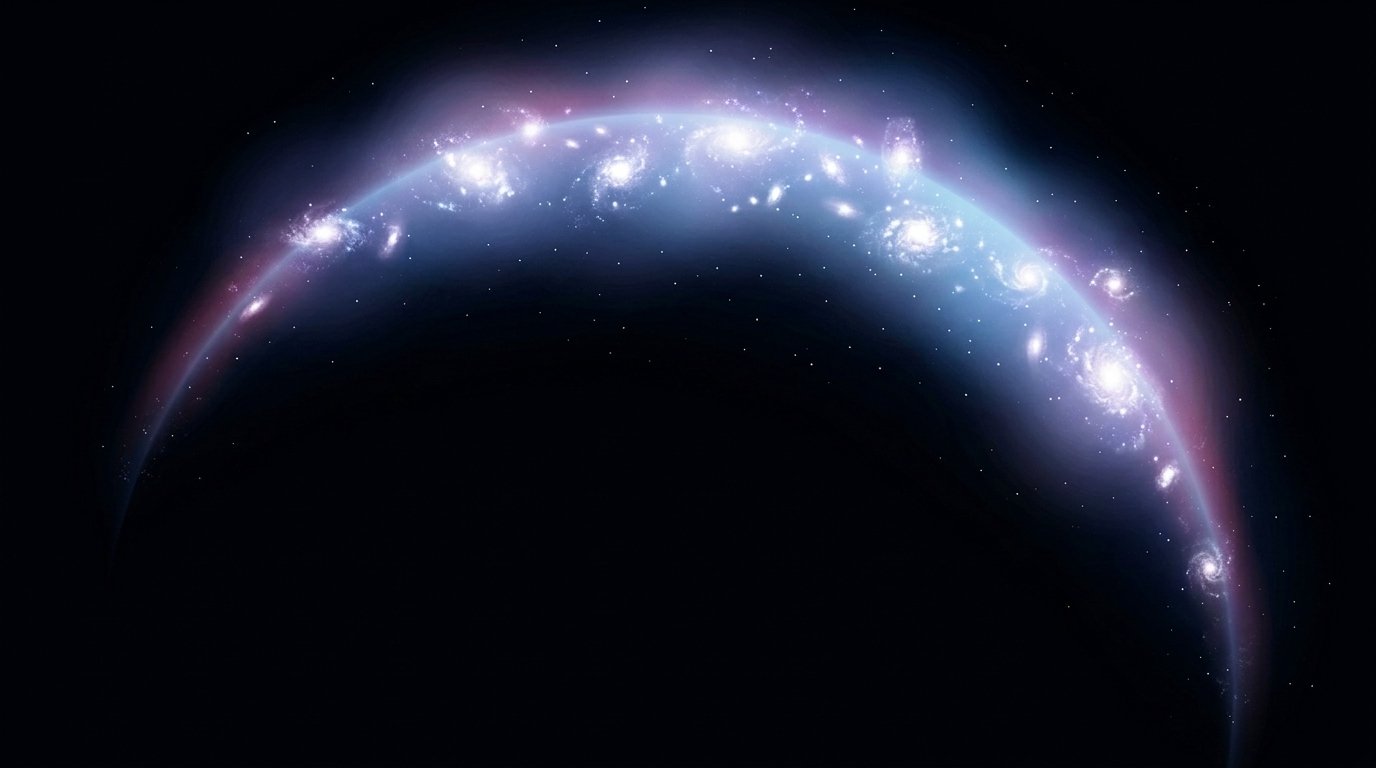
The James Webb Space Telescope launched in December 2021 after years of delays and began returning scientific data in mid-2022. It was designed to observe the universe's earliest galaxies, which emit light primarily in the infrared due to cosmological redshift. As the universe expands, light traveling through it has its wavelengths stretched. A galaxy at redshift 10, seen as it existed roughly 480 million years after the Big Bang, has had its visible light shifted entirely into the infrared range. Hubble could not see it. Webb was built to.
What it saw was not what the models predicted.
Within months of first light, researchers identified galaxies at redshifts above 7, 8, 10, and eventually beyond 12, corresponding to lookback times of over 13 billion years, with stellar masses that challenged the halo mass ceiling Lambda-CDM imposes. These were not small, primitive, slowly assembling proto-galaxies. They were large, dense, and structurally mature, containing hundreds of billions of solar masses worth of stars, at a point in cosmic history when the universe was less than 500 million years old.
The initial reaction from the scientific community was appropriately cautious. Photometric mass estimates, derived from broad-band imaging rather than detailed spectroscopic analysis, are known to carry significant uncertainties. Bright emission lines from ionized gas can inflate apparent brightness and therefore inflate estimated stellar masses. Active galactic nuclei, supermassive black holes feeding at galaxy centers, contribute additional luminosity that has nothing to do with stellar mass. Redshift assignments could be wrong.
Researchers checked. They applied deeper spectroscopic analysis. They used JWST's MIRI instrument to obtain rest-frame near-infrared photometry, which is more reliable for stellar mass estimates at these redshifts. The most extreme initial numbers came down considerably. Some of the most alarming candidates turned out to have AGN contamination or overstated redshifts.
But not all of them.
After corrections, a population of galaxies remained that exceeded the Lambda-CDM ceiling. In some cases, the required baryon-to-stellar-mass conversion efficiency approached values that are physically impossible. The standard model allows for a few percent of available gas to be converted into stars in a given halo, with supernovae and AGN feedback heating and expelling most of the remainder. Some JWST candidates appeared to require efficiencies approaching or theoretically exceeding 100 percent. You cannot convert more matter into stars than you have matter. The tension was real.
The Baryon Efficiency Problem
To understand why this matters, consider the constraint in mathematical terms. The stellar mass of a galaxy is bounded by:
$$M_{\star} \leq f_b \cdot M_{\text{halo}} \cdot \varepsilon$$Where $M_{\star}$ is the stellar mass, $f_b$ is the cosmic baryon fraction (approximately 0.157), $M_{\text{halo}}$ is the dark matter halo mass, and $\varepsilon$ is the star formation efficiency, observationally constrained to be well below 1 in the local and intermediate-redshift universe. For massive early JWST galaxies, inverting this equation and solving for $\varepsilon$ often yields values inconsistent with known stellar feedback physics.
The halo mass function itself provides an additional constraint. In Lambda-CDM, the number density of halos above a given mass at a given redshift is a firm prediction derived from the initial power spectrum of density fluctuations and the growth rate of structure. When researchers compare the observed number density of massive early galaxies from JWST with the predicted number density of halos massive enough to host them, the observed counts exceed the predictions. Not by orders of magnitude, but persistently, across multiple datasets and survey fields.[1]
A useful way to quantify the tension is through the stellar-to-halo mass ratio at high redshift. In the local universe, this ratio peaks at roughly:
$$\frac{M_{\star}}{M_{\text{halo}}} \approx 0.03 \text{ at } M_{\text{halo}} \sim 10^{12} M_{\odot}$$Some JWST galaxy candidates at $z > 7$ appear to require ratios several times higher than this, before even accounting for the fact that their host halos should themselves be less massive at those epochs than halos of the same number density today.
What Dark Matter Might Be Hiding
Lambda-CDM does not fail because dark matter is wrong. It potentially fails, in the early universe, because of our assumptions about how dark matter behaves. Cold dark matter is cold in a specific technical sense: its particles move slowly relative to the speed of light. This sluggishness is what allows it to cluster efficiently at all scales, forming the halo mass function that Lambda-CDM predicts. But cold is not the only option.
Warm dark matter particles move faster. They stream past small overdensities before gravity can trap them, suppressing the formation of low-mass halos. This free streaming introduces a minimum halo mass scale and alters the density profiles of the halos that do form, potentially changing how efficiently gas cools and collapses within them. Whether these changes help or hinder early massive galaxy formation is a question that current simulations have not definitively resolved.
Fuzzy dark matter, also called ultralight axion dark matter, is more radical. Particles with masses around $10^{-22}$ eV have de Broglie wavelengths on the order of kiloparsecs. At these scales, quantum mechanical effects are not microscopic corrections but macroscopic features of the dark matter distribution. Halos cannot form below a minimum mass set by the uncertainty principle. The centers of halos develop quantum pressure rather than classical density cusps. Whether this produces the right kind of early structure to explain the JWST galaxies remains an active area of research.
A third possibility does not change what dark matter is made of but changes when and how the halos formed. If the initial power spectrum of density fluctuations had more power at small scales than the standard inflationary prediction, dark matter halos of significant mass could have assembled earlier than Lambda-CDM predicts. This would provide deeper gravitational wells for gas to fall into at earlier times, potentially accelerating the entire chain of galaxy assembly.
The First Stars Nobody Has Seen
One mechanism that does not require modifying dark matter involves the first generation of stars themselves. Designated Population III, these hypothetical objects formed from gas composed almost entirely of hydrogen and helium, with no heavier elements to aid radiative cooling and gas fragmentation. The absence of metals produced a profoundly different star formation environment. Without the cooling channels that metal and dust provide, collapsing gas clouds fragmented less readily, producing fewer and far more massive stars than any that exist today.
Theoretical models predict Population III stellar masses ranging from tens to possibly over a thousand solar masses. [2] Stars at the upper end of this range were extraordinarily luminous, with surface temperatures above 100,000 Kelvin, and lived for only millions of years before dying in pair-instability supernovae so energetic that they left no remnant whatsoever, dispersing their entire mass as heavy elements into the surrounding gas.
These deaths seeded the second generation of star formation with the chemical complexity needed for more efficient cooling and fragmentation. If the halos hosting these events were massive enough to retain most of their gas against supernova feedback, the second generation could have assembled rapidly from enriched, more efficiently cooling material. A cascade of stellar generations, each faster than the last, could in principle build significant stellar mass within a few hundred million years, faster than the standard model's modest halos and inefficient cooling channels would allow.
No Population III star has been directly detected. The spectroscopic fingerprints of their nucleosynthetic legacy are visible in extremely metal-poor Population II stars in the Milky Way's halo, but individual Population III objects remain below the detection threshold of any current instrument. JWST is searching for their integrated light signatures in the spectra of very early galaxies. Whether it will find them depends on the details of how many formed, how massive they were, and how their light was processed by the surrounding gas.
The Expansion Rate Problem
A related tension in cosmology may not be unconnected to the early galaxy problem. The Hubble constant, $H_0$, describes the current rate at which the universe is expanding. Two independent methods of measuring it give incompatible results.
The CMB-based measurement, derived by fitting Lambda-CDM parameters to the detailed temperature power spectrum of the cosmic microwave background, gives:
$$H_0 = 67.4 \pm 0.5 \text{ km/s/Mpc}$$Local measurements using Cepheid variable stars calibrated against Type Ia supernovae give:
$$H_0 = 73.04 \pm 1.04 \text{ km/s/Mpc}$$The gap between these values, now exceeding five standard deviations of statistical significance, is known as the Hubble tension. One proposed resolution involves early dark energy, a transient energy component active in the pre-recombination universe that would have increased the expansion rate at that epoch, reducing the physical sound horizon and shifting the CMB-derived $H_0$ upward toward the local value.
If early dark energy existed, the early universe was expanding faster than standard Lambda-CDM assumes. This changes the competitive balance between gravitational collapse and cosmic expansion during structure formation, altering predictions for what kinds of galaxies could exist at any given redshift. The relationship between early dark energy and the JWST galaxy tension is not simple or direct, but the two anomalies share a common thread: the early universe may have been operating on parameters that differ from what Lambda-CDM, calibrated primarily on lower-redshift observations, currently encodes.[3]
What the Measurements Might Be Getting Wrong
Science routinely considers whether unexpected results reflect new physics or measurement error. For the JWST early galaxy tension, this question has been taken seriously by the people most invested in the findings being real.
Redshift assignment errors are one candidate. At very high redshifts, photometric redshift estimation relies on identifying the position of the Lyman break, a sharp drop in a galaxy's spectrum caused by neutral hydrogen absorbing photons above a certain energy. If the break is mimicked by dust reddening or unusual spectral energy distributions, a galaxy could be assigned a higher redshift than it actually has, making it appear older and more distant than it is. This would reduce its inferred stellar mass and relax the tension with Lambda-CDM.
Spectroscopic confirmation has addressed this concern for many but not all of the problematic candidates. The galaxies that remain in tension with the standard model after spectroscopic redshift confirmation are a smaller but harder-to-dismiss sample than the full photometric catalog.
AGN contamination remains an issue at the faint end of the sample. An active galactic nucleus can contribute luminosity comparable to or exceeding that of the surrounding stellar population, and disentangling the two in unresolved high-redshift sources is nontrivial. The MIRI corrections that brought early mass estimates down addressed some of this contamination, but not uniformly across all candidates.
What We Actually Know
After several years of JWST operations, several things can be stated with reasonable confidence. First, the most extreme early mass estimates from photometric data have been revised downward substantially after spectroscopic follow-up and MIRI photometry. The tension with Lambda-CDM, while real, is smaller in magnitude than early headlines suggested. Second, a genuine excess of massive early galaxies over Lambda-CDM predictions persists in current datasets after those corrections. It is not a statistical fluke confined to one survey field or one team's analysis. Third, no single proposed explanation has been confirmed. Modified dark matter, Population III star formation cascades, early dark energy, and systematic measurement errors are all live hypotheses being tested simultaneously by multiple research groups.
What is happening in cosmology right now is not a crisis in the sense of collapse. Lambda-CDM remains the best-tested framework in all of physical science for describing the universe at most epochs and scales. What is happening is more precisely described as interrogation at the edges. JWST has opened a window onto a regime, the universe younger than 800 million years, where Lambda-CDM's predictions were extrapolated rather than directly tested. The extrapolation is now being tested. It is not passing all of those tests.
The most honest statement is this: we built a model of the early universe using physics validated at later times, calibrated on observations at accessible distances, and extended by mathematics to regimes we could not observe. Then we built a telescope capable of observing those regimes. The model and the observations do not fully agree. The disagreement is real, persistent, and not yet explained. That is not a failure. That is exactly how science is supposed to work.
The universe built massive galaxies faster than we thought possible. Whatever mechanism made that happen, dark matter behaving differently in the early universe, Population III stars seeding accelerated assembly, expansion rates that have since settled into slower rhythms, it was working before any instrument we have ever built could see it. We are reading the evidence it left behind in light that has been traveling for over 13 billion years to reach a mirror we pointed in the right direction at the right moment in history.
That evidence is incomplete. The picture is still forming. And the next generation of instruments, the Nancy Grace Roman Space Telescope, the Extremely Large Telescope, CMB-Stage 4, and LISA, are being built specifically to fill in the parts we cannot yet see.
[1] Boylan-Kolchin, M. (2023). Stress Testing Lambda-CDM with High-Redshift Galaxy Candidates. Nature Astronomy. arXiv:2208.01611. This paper provides the primary quantitative framework for comparing JWST galaxy number densities against the halo mass function prediction.
[2] Bromm, V. and Larson, R.B. (2004). The First Stars. Annual Review of Astronomy and Astrophysics, 42, 79-118. The foundational review of Population III star formation theory and predicted mass ranges.
[3] Jia-Wei Xu et al. (2024). Early Galaxies and Early Dark Energy: A Unified Solution to the Hubble Tension and Puzzles of Massive Bright Galaxies Revealed by JWST. Monthly Notices of the Royal Astronomical Society, 533(4), 3923. doi:10.1093/mnras/stae1989. This paper explores the connections between early dark energy as a Hubble tension resolution and the JWST galaxy excess simultaneously.
Comments (0)
Leave a Comment