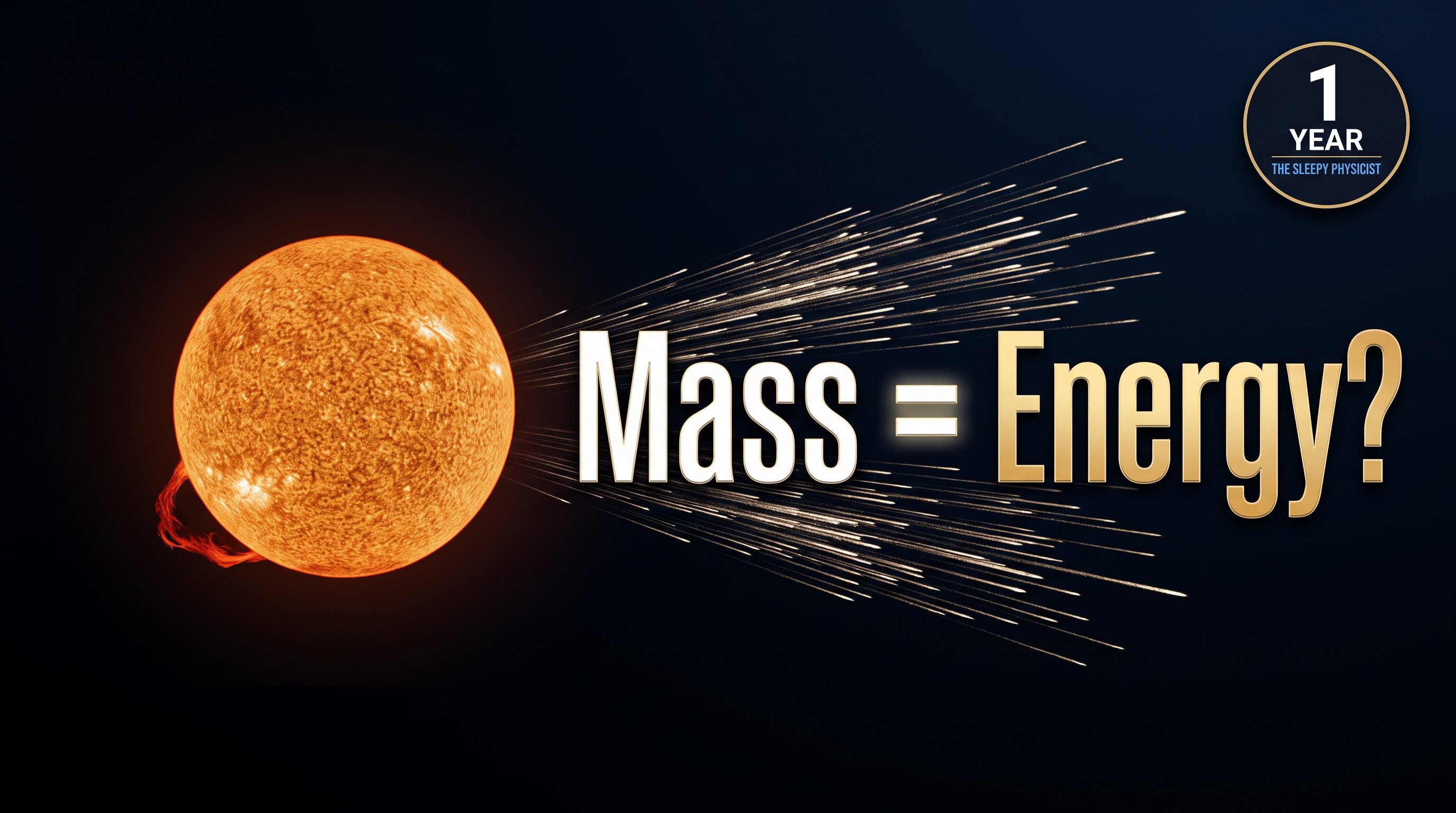
Why Sunlight Has Weight: Mass Equals Energy
There is something sitting in the room with you right now that weighs nothing and yet is draining the nearest star of four million tonnes of its own substance every single second. It passes through your window, your walls, your skin, and it does not slow down. It has been travelling for eight minutes. Before that, it spent somewhere between ten thousand and a hundred and seventy thousand years crawling through plasma so dense that nothing about its journey resembled travel at all.
It is a photon. It has zero rest mass. And it is the mechanism by which the Sun is becoming measurably, calculably lighter right now.
This is not a paradox physics has failed to resolve. It is a paradox that was resolved in 1905 in a three-page paper most people have never read, by someone who never actually wrote the equation now credited to him. The resolution is stranger than the original confusion, and sitting with it properly changes what you thought mass and energy were.
The Equation on the Coffee Mug Is Incomplete
$E = mc^2$ is one of the most recognised strings of symbols in human history. It is not wrong. For a particle at rest, it describes something real and precise: the energy content of a stationary object equals its mass multiplied by the square of the speed of light. That is a genuine and enormous claim about reality, and it is correct.
But it is a special case. The full relativistic energy-momentum relation is:
$$E^2 = (pc)^2 + (mc^2)^2$$Here, $p$ is momentum and $c$ is the speed of light. A particle's total energy has two independent sources: its rest mass, and its momentum. You can have one without the other.
For a particle at rest, momentum is zero. The equation reduces to $E = mc^2$. For a photon, rest mass is zero. The equation reduces to $E = pc$. All of a photon's energy lives in its momentum alone, with nothing underneath it that qualifies as mass in the resting sense. This is why a gamma ray and a radio wave travel at identical speeds but carry vastly different energies: higher frequency means higher momentum, which means more energy, regardless of mass.
The famous equation was always a cropped photograph. The full image has a second term that the coffee mug leaves out, and that second term is where photons live entirely.
What Zero Rest Mass Actually Means
The phrase rest mass contains a hidden assumption: that the particle can, in principle, be brought to rest. For an electron or a proton, this is straightforward. For a photon, it is not. A photon cannot exist at rest. If you could freeze one in place, it would not be a very slow photon. It would simply cease to exist as a photon.
So when physicists assign zero rest mass to a photon, they are applying a measurement to an entity that can never satisfy the conditions for that measurement. Zero rest mass does not mean zero consequence. It means the concept of rest does not apply. The photon is, in a precise sense, only its motion. Stopping it is not slowing it down. It is ending it.
This distinction matters enormously once you start asking whether light responds to gravity. The answer is yes, and the reason is not hidden mass but the fact that gravity, in general relativity, responds to energy and momentum, not only to rest mass. The photon has both. It is not exempt.
What Einstein Actually Wrote in 1905
The fourth of Einstein's 1905 papers was published in Annalen der Physik on the twenty-first of November. It was three pages long. Its title was a question: Does the Inertia of a Body Depend Upon Its Energy Content? The equation $E = mc^2$ does not appear in it. Not once, not in that form.
What appears instead is a sentence, written in German, that translates roughly as: if a body gives off energy $L$ in the form of radiation, its mass diminishes by $L/c^2$.
The thought experiment behind it is simpler than the mathematics. A body at rest emits two pulses of light simultaneously, in opposite directions, equal in energy. The pulses carry equal and opposite momentum, so they cancel. The body does not move. Observed from a reference frame already moving relative to the body, the two pulses are no longer symmetric due to the Doppler effect. Working through the requirement that physical laws hold in both frames, the algebra yields one result: the body's mass has decreased by exactly the amount of energy it radiated, divided by $c^2$. [1]
Einstein's conclusion was careful. He did not say mass converts into energy the way fuel converts into heat, with the fuel depleted and the heat a separate product. He said mass is a measure of energy content. Change the energy, and the mass changes in the same direction by a proportional amount. They are not two things in exchange. They are one physical quantity with two modes of expression.
A Distinction That Still Gets Collapsed
The difference between equivalence and identity is not pedantic. Two currencies can be equivalent at a fixed exchange rate while remaining fundamentally different things. The dollar and the euro are not the same thing. Mass and energy, in Einstein's framework, are. A resting body holds its energy as mass. A radiating body transfers some of that energy outward as photons. The mass decreases not because mass turned into something else, but because the quantity that was expressed as mass is now expressed as radiation.
The Sun does not convert mass into energy. It re-expresses the same conserved quantity in a different form. The light leaving it is not a product of its mass. It is mass, in a different dress.
The Furnace: Three Steps That Cost 0.7 Percent
The solar core operates at approximately 15 million Kelvin and a density of around 150 grams per cubic centimetre.[2] Under these conditions, the dominant fusion pathway is PP-I, the first branch of the proton-proton chain, which converts hydrogen into helium across three steps.
Step One: The Improbable Beginning
Two protons approach each other. The electrostatic repulsion between them, the Coulomb barrier, grows as the inverse square of their separation. At solar core temperatures, the thermal energy of a typical proton is insufficient to classically surmount this barrier.
Quantum mechanics resolves this through tunneling. A particle's position is not definite but described by a probability wave function that penetrates into classically forbidden regions. If the barrier is thin enough, the wave function retains non-zero amplitude on the far side, and the particle has a finite probability of being found there without any classical trajectory through the barrier.[3]
When tunneling occurs and the protons fuse, one must convert to a neutron via the weak nuclear force. This conversion is extraordinarily slow. A single proton in the solar core waits approximately three billion years on average before this event happens to it. The Sun's longevity, and by extension the existence of complex life on Earth, depends directly on how reluctantly the weak force mediates this first step. A faster reaction would produce a faster-burning star with a lifespan measured in millions of years rather than billions.
Steps Two and Three
The deuterium nucleus produced in step one fuses almost immediately with a third proton to form helium-3, releasing a gamma-ray photon. Two helium-3 nuclei then collide to produce helium-4 and two free protons, which return to the plasma.
Net transaction: four hydrogen nuclei enter, one helium-4 nucleus exits. The helium-4 nucleus is lighter than the four protons that formed it. The deficit is approximately 0.7 percent of the original hydrogen mass.
$$\Delta m = m_{4H} - m_{He-4} \approx 0.007 \times m_{4H}$$Applied to the Sun's luminosity of $3.846 \times 10^{26}$ watts, this mass deficit implies:
$$\dot{m} = \frac{L}{c^2} = \frac{3.846 \times 10^{26}}{(3 \times 10^8)^2} \approx 4.27 \times 10^9 \text{ kg/s}$$4.27 billion kilograms. Every second. That 0.7 percent deficit, accumulated across the full 600 million tonnes of hydrogen fused per second, is the source of every joule of solar energy that has ever reached this planet.
The 170,000-Year Detour
A gamma-ray photon born in the solar core travels at $c$. The solar radius is approximately $7 \times 10^8$ metres. The naive transit time is:
$$t = \frac{r}{c} = \frac{7 \times 10^8}{3 \times 10^8} \approx 2.3 \text{ seconds}$$The actual time is between 10,000 and 170,000 years.
The solar interior is plasma at a density that makes the mean free path of a photon, the average distance before absorption, somewhere between a fraction of a millimetre and a few centimetres. After each absorption, the photon is re-emitted in a completely random direction. This is the random walk. No strategy, no memory, no net progress guaranteed by any individual step.
The mathematics of an isotropic random walk shows that net displacement $R$ from a starting point after $N$ steps of length $d$ is:
$$R \approx d\sqrt{N}$$Net displacement grows as the square root of steps taken, not linearly. To diffuse a distance of $7 \times 10^{10}$ cm in steps of 1 cm requires not $7 \times 10^{10}$ steps but $(7 \times 10^{10})^2 = 4.9 \times 10^{21}$ steps. At the speed of light between steps, this translates to tens of thousands to hundreds of thousands of years, consistent with detailed numerical models of the solar radiative zone.[4]
The photon that eventually escapes is not the photon that started. With each absorption and re-emission, energy shifts slightly. The original gamma ray carrying around $10^6$ eV is absorbed, re-emitted at slightly lower energy, absorbed again, again, again, until it emerges from the photosphere carrying roughly 1 to 3 eV. Visible light. Precisely the range the human eye is most sensitive to, because organisms tuned to the peak emission of a 5,800-Kelvin star had a selection advantage over hundreds of millions of years of evolution.
Once free of the photosphere, that same energy crosses 150 million kilometres of vacuum in eight minutes and nineteen seconds. No absorption. No re-emission. No resistance. The interior journey and the exterior crossing are not two phases of the same process in any experiential sense. They belong to entirely different categories of time.
Three Experiments That Proved Light Pays a Physical Toll
The 1919 Solar Eclipse
General relativity predicts that light passing close to a massive object follows the curvature of spacetime rather than a Euclidean straight line. The predicted deflection for starlight grazing the Sun's limb is:
$$\theta = \frac{4GM_\odot}{c^2 r} \approx 1.75 \text{ arcseconds}$$This is exactly twice the value produced by treating light as a Newtonian particle with mass. The factor of two arises because general relativity accounts for curvature in both the spatial and temporal components of spacetime, while Newtonian gravity acting on a massless particle accounts only for the spatial component.
On May 29, 1919, Arthur Eddington at Principe and Andrew Crommelin at Sobral photographed stars near the Sun during a total solar eclipse. The stars appeared displaced from their known catalogue positions. The measured deflection was approximately 1.75 arcseconds.[5]
Light bends under gravity. A thing that bends under gravity participates in gravity. Photons are not exempt from the gravitational accounting of the universe.
The Harvard Tower
In 1960, Robert Pound and Glen Rebka Jr. measured gravitational redshift over a 22.5-metre vertical path in the Jefferson Physical Laboratory at Harvard. Using iron-57 gamma rays and the Mossbauer effect to achieve the required frequency resolution, they detected a fractional frequency shift of:
$$\frac{\Delta f}{f} = \frac{gh}{c^2} \approx 2.46 \times 10^{-15}$$A photon climbing a gravitational field loses energy. Its speed cannot decrease, so the energy loss manifests as a decrease in frequency. The photon reddens. This is the gravitational toll on light: not slower, but diminished. The same principle applies to photons leaving the Sun, which arrive at Earth carrying slightly less energy than they had at the photosphere.[6]
Solar Sails
Maxwell's 1865 electromagnetic theory implied that light carries momentum proportional to its energy divided by $c$. The momentum of a photon is:
$$p = \frac{E}{c} = \frac{hf}{c}$$Pyotr Lebedev confirmed radiation pressure experimentally in 1899. In 2010, JAXA's IKAROS spacecraft deployed a 14-metre sail of 7.5-micron polyimide film and demonstrated measurable propulsion from solar photons. LightSail-2 (2019) raised its orbital altitude by adjusting sail angle to modulate radiation pressure. The force per unit area on a perfectly absorbing surface at Earth's distance from the Sun is approximately 9 micronewtons per square metre, scaling with the inverse square of distance.
Light pushes things. Kepler observed this in comet tails in 1619 and had no framework to explain it. Today it is an engineering parameter in spacecraft mission design.
The Cleanest Proof: Pair Annihilation
If one demonstration were to be selected as the most direct and unambiguous confirmation that mass and energy are the same quantity, pair annihilation provides it.
An electron and a positron, each carrying a rest-mass energy of exactly 0.511 MeV, meet at low relative velocity. Both cease to exist as matter. Two gamma-ray photons of exactly 0.511 MeV each emerge, travelling in opposite directions to conserve momentum. The conservation law for the two-photon case requires:
$$2m_e c^2 = 2E_\gamma \implies E_\gamma = m_e c^2 = 0.511 \text{ MeV}$$Not approximately. Exactly. The rest-mass energy of one electron, expressed without loss, without inefficiency, without remainder, as the energy of one photon. This happens in hospital PET scanners routinely, in cosmic ray showers above the atmosphere, and in the solar core wherever positrons from the proton-proton chain meet surrounding electrons.[7]
The boundary between matter and energy is not crossed in annihilation. The electron's mass was its energy. The photons are that same energy. The before and after are identical quantities in different expressions.
What We Actually Know
The Sun has lost less than 0.03 percent of its original mass over 4.6 billion years of continuous fusion. That fraction, compounded at 4.3 million tonnes per second, is the sum total of every joule of solar energy that has ever reached this solar system. Every ocean current, every storm, every photosynthetic reaction in every leaf that has ever grown on this planet. All powered by a star that is barely lighter than it was when it formed.
The Sun has approximately five billion years of core hydrogen remaining. The process is finite. The mass available for conversion is finite. When it is exhausted, the core will contract, the outer layers will expand, and the Sun will become something very different from what it is now.
But the physics that governs all of this was never about conversion between two different things. It was always about one thing, expressing itself differently under different conditions. Mass is what energy looks like when it is not moving. Light is what energy looks like when it cannot stop.
The photon has no rest mass because it cannot rest. The Sun loses mass because the energy is leaving. These two facts are not in tension. They are the same fact, said twice.
Every photon that passes through your window was once part of the star. Not produced by the star, not derived from the star. Part of it. The warmth on your skin is hydrogen, not transformed into something else, but re-expressed as something it always was, at a different moment in the same continuous process.
[1] Einstein, A. (1905). "Ist die Tragheit eines Korpers von seinem Energieinhalt abhangig?" Annalen der Physik, 18, 639-641. English translation available at Fourmilab.ch. The paper does not contain the formula E = mc^2 in that form; the relation appears as a sentence describing a change in mass proportional to a change in energy.
[2] Solar core conditions from the Standard Solar Model: Bahcall, J.N., Serenelli, A.M., and Basu, S. (2006). The Astrophysical Journal Supplement Series, 165(1), 400-431.
[3] Griffiths, D. (2004). Introduction to Quantum Mechanics. Pearson Prentice Hall. Chapter 8 covers WKB approximation and tunneling. The probability of tunneling decreases exponentially with barrier thickness and the square root of barrier height minus particle energy.
[4] The range of 10,000 to 170,000 years reflects genuine uncertainty in photon diffusion models due to varying assumptions about mean free path at different solar radii. See: Mitalas, R. and Sills, K.R. (1992). The Astrophysical Journal, 401, 759-760.
[5] Dyson, F.W., Eddington, A.S., and Davidson, C. (1920). "A Determination of the Deflection of Light by the Sun's Gravitational Field." Philosophical Transactions of the Royal Society A, 220, 291-333. Radio interferometry measurements in the 1970s and the ESA Hipparcos satellite in the 1990s later confirmed the deflection to one part in a thousand.
[6] Pound, R.V. and Rebka, G.A. (1960). "Apparent Weight of Photons." Physical Review Letters, 4(7), 337-341. The result was refined to 1 percent accuracy by Pound and Snider in 1964.
[7] The 0.511 MeV figure is the rest-mass energy of the electron: $m_e c^2 = 0.51099895$ MeV, known to eight significant figures. PET scanners exploit the back-to-back 0.511 MeV photon pairs to triangulate annihilation sites to millimetre precision inside the patient.
Comments (0)
Leave a Comment