Why the Dark Between Galaxies Is Not Empty
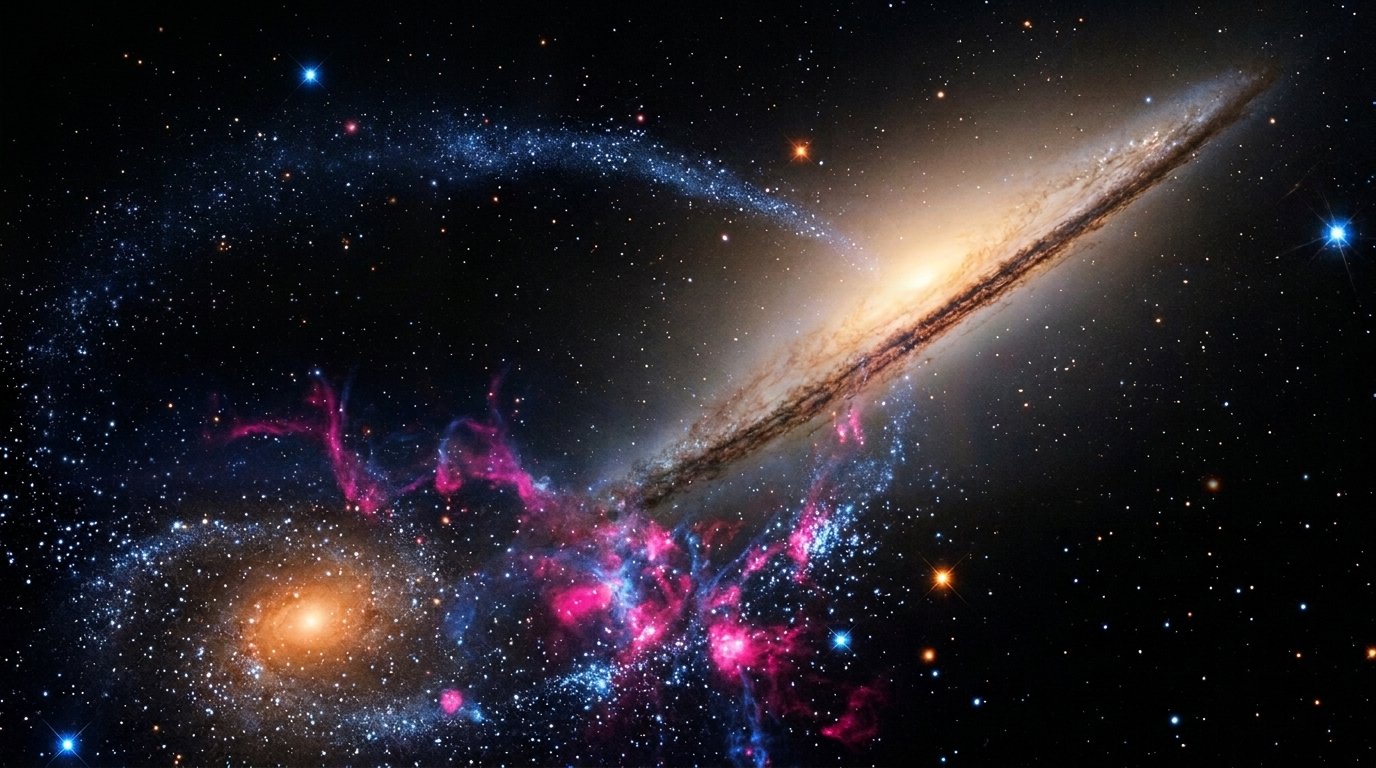
Four billion light-years away, a cluster of galaxies is in the middle of a collision that has been unfolding for longer than the Earth has existed. Between its galaxies, in space that instinct says should be empty, trillions of stars drift on paths so long that a single orbit takes a billion years to complete. They belong to no galaxy. They answer only to the gravity of the whole structure around them. Their light is so faint that it took until the 1990s to confirm it was real, and so scientifically rich that it is now one of the most important signals in the search for dark matter.
This is the story of intracluster light: what it is, how it forms, and what it reveals about the invisible majority of the universe's mass.
The Cluster That Started It All
Abell 370 sits at a redshift of $z = 0.375$, roughly 4 billion light-years from Earth.[1] Its total mass sits somewhere between one and two times $10^{15}$ solar masses, making it one of the most massive gravitationally bound objects known. The bulk of that mass is dark matter, inferred from how aggressively the cluster bends the light of background galaxies rather than from anything it emits directly.
The cluster is not a settled, relaxed system. Its mass distribution is bimodal, elongated along a north-south axis, dominated by two brightest cluster galaxies sitting roughly 190 kiloparsecs apart. The X-ray gas between them is elongated and offset from the gravitational mass peaks. The lensing maps contain a dark matter concentration between the two central galaxies with no detectable stellar counterpart. Abell 370 is, in plain terms, two sub-clusters in the process of merging, and that merger is still underway.
The cluster was selected as one of six targets for NASA's Hubble Frontier Fields program for a reason: complex, disturbed systems reveal things that calm systems conceal.[2] What Abell 370 has been concealing, and what the Frontier Fields data began to expose, is a population of displaced stars whose existence rewrites what the space between galaxies means.
The Dragon Arc and the First Gravitational Lens
In 1987, Guilaine Soucail and colleagues at the Toulouse Observatory published an image of Abell 370 containing a long, curved smear of blue-white light in the cluster core. It was not a galaxy seen edge-on. It was too curved to be a jet and too bright to be an artifact. It was the first gravitational arc ever discovered, and it became known as the Dragon.[3]
General relativity predicts that mass curves spacetime and that light follows this curvature. The Einstein radius, the angular size of the lensed ring produced when a source, lens, and observer are in alignment, is given by:
$$\theta_E = \sqrt{\frac{4GM}{c^2} \cdot \frac{D_{ls}}{D_l D_s}}$$where $M$ is the lens mass, $D_l$ is the distance to the lens, $D_s$ is the distance to the source, and $D_{ls}$ is the distance between them. For a cluster at Abell 370's mass and distance, the Einstein radius reaches tens of arcseconds, large enough to produce the Dragon arc's extraordinary length.[4]
The Dragon is not one image of one galaxy. It is five separate images of the same background galaxy at $z = 0.725$, folded by the cluster's gravitational field into a single continuous luminous curve. In 2024, JWST resolved 44 individual stars inside it, red supergiants magnified thousands of times, each one a star in a galaxy 6.5 billion light-years away seen as it existed when the universe was roughly half its current age.[5]
What Actually Fills the Space Between Galaxies
The space between galaxies in a cluster is not empty. Three things fill it, and understanding each one is necessary to understand the third.
First, the intracluster medium: hot plasma, mostly ionized hydrogen and helium, heated to between $10^7$ and $10^8$ kelvin. It emits X-rays. It contains more ordinary matter than all the cluster's galaxies combined, despite a particle density so low it would count as a vacuum by laboratory standards. In Abell 370, the X-ray gas is elongated along the merger axis and offset from the dark matter peaks, a signature of the ongoing collision.
Second, dark matter. Its gravitational influence extends throughout the cluster volume, the dominant structural component that holds the whole system together. It produces no detectable radiation. Its presence is inferred from lensing maps and cluster dynamics.
Third, and hardest to see: stars. Individual stars, unbound from any galaxy, orbiting the cluster's combined gravitational potential on paths spanning hundreds of thousands of light-years. Their integrated emission is called intracluster light, and its surface brightness sits at roughly 26 to 26.5 magnitudes per square arcsecond at its detectable extent, more than 100,000 times fainter per unit area than the darkest night sky on Earth.
This is not a rounding error in the cluster's stellar census. At 10 to 25 percent of the cluster's total stellar mass, the ICL is equivalent in total stellar content to four to six completely dissolved Milky Way-sized galaxies.[6]
Fritz Zwicky and Forty Years of Doubt
In 1951, Fritz Zwicky reported diffuse light between the galaxies of the Coma cluster, detected by direct photography on glass plates. Nobody followed up seriously for a long time. Zwicky's reputation for overclaiming made other astronomers cautious, and the signal itself was genuinely at the limit of what photographic plates could resolve.
The sky is the problem. It glows, faintly and continuously, from airglow, scattered starlight, zodiacal light, and the unresolved emission of millions of faint background galaxies. Trying to detect the ICL from the ground means measuring a signal that sits below this background. A flat-fielding error of half a percent, a calibration imprecision smaller than most observers would flag, produces a residual that completely swamps the ICL signal.[7]
It was not until CCD detectors replaced photographic plates in the 1980s and 1990s that reliable measurements became possible. CCDs respond linearly to incoming light and have well-characterized noise properties that photographic plates could not match. Bernstein and colleagues produced the first robust quantitative measurement of the Coma cluster's ICL in 1995.
Zwicky died in 1974. He had been right about something that the instruments of his lifetime could not confirm.
How Tidal Forces Take Stars From Galaxies
When a galaxy orbits inside a cluster, the cluster's gravity does not pull on every part of it equally. The side closer to the cluster center experiences a stronger pull than the side farther away. This differential force tends to stretch the galaxy along the radial direction. The tidal radius, the distance from the galaxy's center at which the cluster's tidal acceleration equals the galaxy's own surface gravity, defines the boundary between stars the galaxy holds and stars it cannot keep.
The tidal radius is not fixed. At pericenter, the galaxy's closest approach to the cluster center, tidal forces are strongest and the tidal radius shrinks. Stars that were inside the galaxy's gravitational grip on the previous orbit may find themselves outside it. They do not accelerate sharply away. They drift, over millions of years, onto orbits that belong to the cluster rather than to the galaxy they formed in.
The process is cumulative and irreversible. Each pericentric passage strips a little more. In Abell 370, where the ongoing major merger produces tidal forces from two cluster cores rather than one, the stripping reaches deeper into infalling galaxies than it would in a relaxed system. The merger is not just a dynamical event. It is an accelerant for ICL production.
Tidal stripping is the dominant mechanism, but not the only one. Violent relaxation during mergers between galaxies and the brightest cluster galaxy ejects a fraction of stars into the intracluster space rapidly. Dwarf satellites, with their shallow potential wells, can be completely dissolved, their entire stellar population dispersed along the orbital path, nothing remaining. Infalling galaxy groups arrive pre-processed, carrying intragroup light they built before the cluster captured them.[8]
Color as a Fossil Record
A star's color encodes its temperature, which encodes its mass, which encodes the chemical conditions of its birth environment. Metallicity, the abundance of elements heavier than hydrogen and helium, records how many generations of stellar evolution enriched the gas the star formed from. High-metallicity stars formed in environments that had processed many stellar generations. Low-metallicity stars formed earlier or in shallower potential wells where enrichment was limited or lost to galactic winds.
In the ICL, this produces a radial color gradient. The inner ICL is redder and more metal-rich, stripped from the interiors of infalling galaxies where enrichment is highest. The outer ICL is bluer and more metal-poor, stripped from galaxy peripheries or from disrupted dwarf satellites. The gradient is not random. It is a map of the stripping geometry, written in the integrated color of the displaced stellar population.
In Abell 370, the Frontier Fields photometry shows an excess of emission in the intermediate optical filter F606W relative to the bluer and redder filters.[9] This points to a higher fraction of A-type and F-type stars in the ICL than a relaxed cluster would contain. These are younger, lower-metallicity populations, consistent with stars stripped from recently infalling, still-star-forming galaxies captured by the growing cluster during the current merger episode. Two stellar populations, two histories, overlapping spatially but distinguishable in the photometric color data.
The ICL as a Dark Matter Tracer
Dark matter cannot be seen. It does not emit, absorb, or scatter electromagnetic radiation of any kind. Its presence in a cluster is inferred from the gravitational effects it produces on lensed background galaxies and on the velocities of cluster members. Lensing maps provide the most direct constraint on its distribution, but strong lensing constrains only the cluster core, and the projection inherent to any lensing observation introduces ambiguities in complex merging systems.
In 2019, Montes and Trujillo compared the two-dimensional ICL distribution in six Hubble Frontier Fields clusters to the dark matter distributions derived from lensing models, using the Modified Hausdorff Distance as a quantitative similarity metric.[10] The result was an agreement of approximately 25 kiloparsecs between ICL contours and mass contours, less than the diameter of the Milky Way, in the context of structures spanning several megaparsecs. The X-ray gas showed larger offsets from the dark matter peaks than the ICL did.
The physical reason connects to dynamics. Both intracluster stars and dark matter particles are collisionless: they respond to the large-scale gravitational potential of the cluster and do not interact electromagnetically. When two clusters merge, the hot gas shocks, slows, and is offset from the mass. The stars and the dark matter pass through the event on their independent orbits, their distributions shaped by the same potential rather than by hydrodynamic forces.
The correspondence is real but not one-to-one. Intracluster stars are more centrally concentrated than dark matter because they are deposited near pericenter, deep in the potential well, on orbits that are more radially anisotropic than the dark matter distribution. The radial density profiles of the two components differ systematically. Using the ICL as a morphological tracer of dark matter shape and orientation is well-supported by data and simulations. Using it as a precision radial mass measurement requires calibrating for this concentration bias, and that calibration is ongoing work.
What Abell 370 Specifically Shows
Abell 370's mass model contains a feature that has persisted across more than a decade of improved analysis: a dark matter concentration between the two BCGs with no detectable stellar counterpart. Multiple independent lensing analyses using different methodologies and different datasets have found it. Its origin is not settled. It may be a real displaced dark matter concentration produced by the merger geometry. It may be a limitation of parametric modeling in a system too complex for the standard approach to handle cleanly. The honest answer is that it is not yet understood.[11]
The ICL in Abell 370 wraps around both BCGs rather than concentrating around a single center, reflecting the bimodal structure of the merger. The two sub-clusters have each been stripping their own infalling galaxies, building their own local ICL contributions, and the merger has not yet combined those contributions into a single centrally concentrated distribution. The ICL map carries the morphology of the collision.
The Frontier Fields ICL fraction measurements for Abell 370 range from approximately 7 to 25 percent depending on filter and aperture, consistently at or above the higher end of what relaxed clusters of comparable mass show. The ICL mass fraction within 300 kiloparsecs sits at approximately 12 to 15 percent of the cluster's total stellar mass.[12]
The New Generation of Instruments
JWST extended the radial reach of ICL measurements to approximately 400 kiloparsecs for intermediate-redshift clusters, twice the extent Hubble could reliably achieve. Its infrared sensitivity breaks the age-metallicity degeneracy that limits optical-only stellar population analysis, enabling age and metallicity to be constrained more independently. In 2026, a study of XLSSC 122 at $z = 1.98$ reported ICL detection with JWST, showing that intracluster stellar assembly was already significant when the universe was less than 4 billion years old.
Euclid's Early Release Observations of the Perseus cluster detected approximately 1.5 trillion orphan stars and mapped the ICL to 600 kiloparsecs, roughly one-third of the cluster's virial radius, in four photometric bands. The BCG and ICL together account for approximately 38 to 40 percent of Perseus's total stellar luminosity within the central 500 kiloparsecs.[13] The full Euclid survey will provide homogeneous ICL measurements for thousands of clusters, transforming the field from individual case studies to statistical science.
The Vera C. Rubin Observatory's Legacy Survey of Space and Time will reach surface brightness depths of approximately 30 magnitudes per square arcsecond across the entire southern sky over ten years, in six photometric bands. The outer ICL, beyond 400 kiloparsecs, which sits at the detection limit in all current data, will become measurable at population scale for the first time.
What We Actually Know
The space between galaxies in a cluster is not empty. It contains the integrated wreckage of billions of years of gravitational violence: stars stripped from infalling galaxies orbit by orbit, stars ejected during BCG mergers, dwarf galaxies completely dissolved, intragroup stellar populations absorbed when whole galaxy groups fell in. Their combined light is faint, diffuse, and scientifically rich.
In Abell 370, this population constitutes roughly 12 to 15 percent of the cluster's total stellar mass within 300 kiloparsecs, distributed in two concentrations reflecting the two BCGs of an ongoing major merger, with a color structure that encodes multiple episodes of stripping at different epochs. It traces the cluster's dark matter distribution more faithfully than the hot X-ray gas, and its shape encodes the orientation and ellipticity of the dark matter halo.
What is not yet settled: the physical origin of the anomalous dark matter clump between the two BCGs, the precise calibration of the ICL as a radial mass measurement tool, the degree to which the ICL's concentration bias can be modeled precisely enough for precision cosmological applications, and how the ICL fraction and stellar population properties evolve across the full range of cluster masses and merger states that Euclid and Rubin will eventually sample.
The displaced stars between the galaxies of Abell 370 are not a curiosity. They are a record. Every stellar population, every color gradient, every radial age structure encodes something about a specific episode in the cluster's assembly history. Reading that record, with instruments now capable of detecting light more than 100,000 times fainter than the night sky across thousands of clusters simultaneously, is the work the next decade of ICL science is built around.
[1] Richard, J. et al. (2010). Abell 370 revisited: refurbished Hubble imaging of the first strong lensing cluster. Monthly Notices of the Royal Astronomical Society, 402(1), L44-L48.
[2] Lotz, J. M. et al. (2017). The Frontier Fields: Survey Design. The Astrophysical Journal, 837(97).
[3] Soucail, G. et al. (1987). A blue ring-like structure in the center of the A 370 cluster of galaxies. Astronomy and Astrophysics, 172, L14.
[4] Paczynski, B. (1987). Giant luminous arcs discovered in two clusters of galaxies. Nature, 325(6105), 572-573.
[5] Sun, F. et al. (2024). JWST discovery of 40+ microlensed stars in the Dragon arc behind Abell 370. arXiv preprint.
[6] Montes, M. and Trujillo, I. (2014). Intracluster light at the frontier: Abell 2744. The Astrophysical Journal, 794(2), 137.
[7] Bernstein, G. M. et al. (1995). The Surface Brightness of the Coma Cluster. The Astronomical Journal, 110(3), 1507.
[8] Contini, E. (2021). A Theoretical Perspective on Intracluster Light. Galaxies, 9(3), 60.
[9] Jimenez-Teja, Y. et al. (2022). Intracluster light on Frontier Fields clusters Abell 370 and Abell S1063. Monthly Notices of the Royal Astronomical Society, 512(2), 1916-1930.
[10] Montes, M. and Trujillo, I. (2019). Intracluster light: a luminous tracer for dark matter in clusters of galaxies. Monthly Notices of the Royal Astronomical Society, 482(2), 2838-2851.
[11] Limousin, M. et al. (2025). Mass and light in galaxy clusters: The case of Abell 370. Astronomy and Astrophysics.
[12] Morishita, T. et al. (2017). Characterizing Intracluster Light in the Hubble Frontier Fields. The Astrophysical Journal, 846(2), 139.
[13] Kluge, M. et al. (2025). Euclid: Early Release Observations: The intracluster light and intracluster globular clusters of the Perseus cluster. Astronomy and Astrophysics, 697, A13.
Comments (0)
Leave a Comment