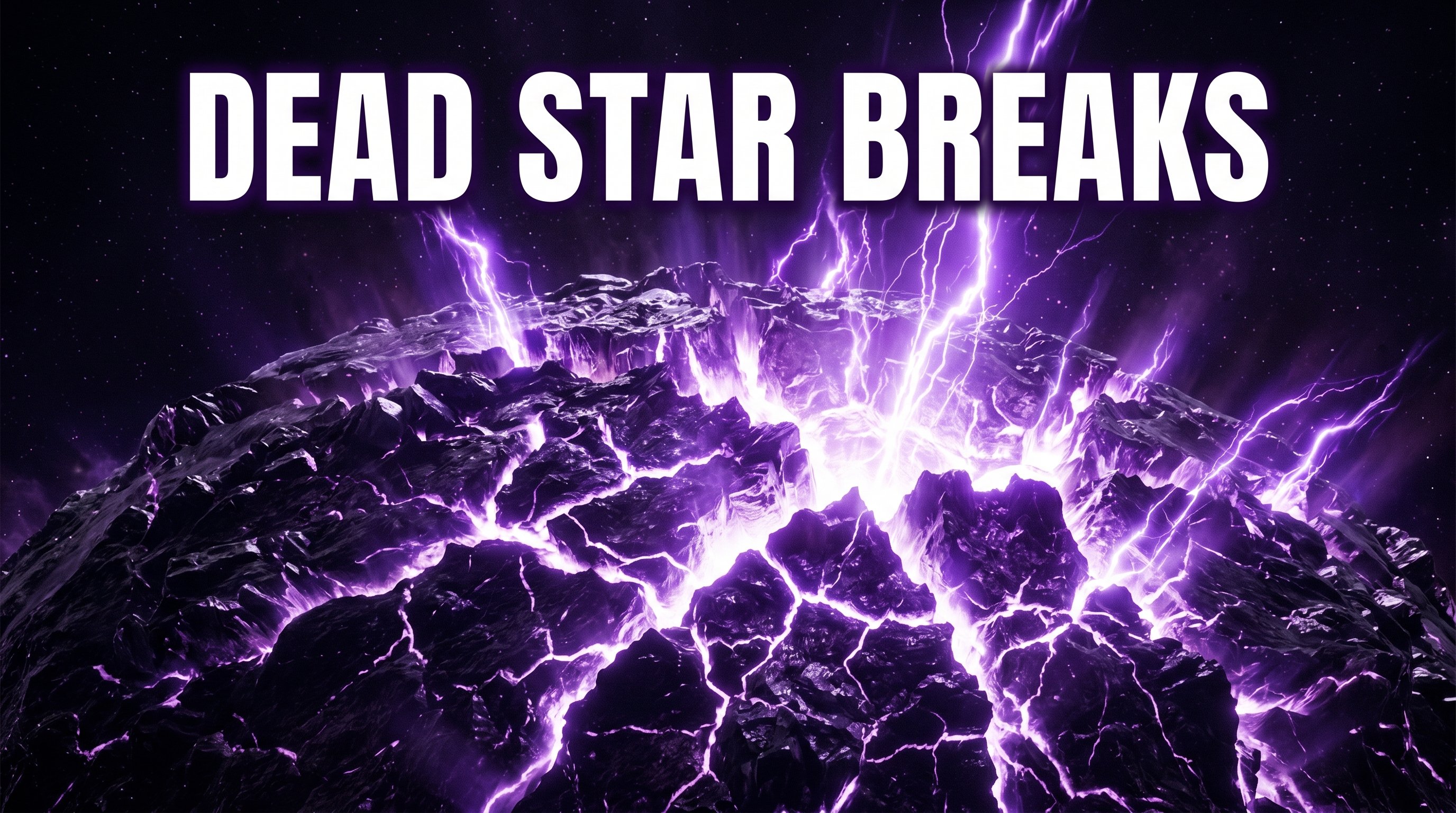
Why Pulsar Starquakes Are the Most Violent Events
There is a dead star roughly twenty kilometers across sitting on the far side of the Milky Way, and at some unknown moment in the future, a crack will form in its surface. The crack will be approximately one millimeter deep. In the fraction of a second that follows, it will release more energy than our Sun has radiated across the last hundred thousand years. No explosion. No fuel consumed. Just a millimeter of movement in the strongest solid material the universe has ever produced, and the cosmos shudders.
These events are called pulsar starquakes, and they are the most violent geological events in the observable universe. Not because the objects are large. Because the matter they are made of is so incomprehensibly dense that the word geological barely reaches what is actually happening.
What a Neutron Star Actually Is
When a massive star exhausts its nuclear fuel, the core collapses. In seconds, a sphere roughly the size of the Sun compresses into an object twenty kilometers across. All the angular momentum that belonged to the original enormous slow sphere now belongs to a tiny dense one, and the spin rate explodes. Newly born neutron stars rotate hundreds of times per second. The fastest known pulsar, PSR J1748-2446ad, completes 716 rotations every second, its equatorial surface moving at approximately 24 percent of the speed of light.[1]
The density of the resulting object is not intuitive. A teaspoon of neutron star material weighs approximately four billion tons. The gravitational acceleration at the surface is roughly two hundred billion times that of Earth. Light itself loses energy climbing away from the object, redshifting measurably as it escapes the gravitational well. These are not approximations or order-of-magnitude estimates. They are the values that emerge from the Tolman-Oppenheimer-Volkoff equation, which describes the structure of a neutron star in general relativity:
$$\frac{dP}{dr} = -\frac{(\rho + P/c^2)(m + 4\pi r^3 P/c^2) \cdot G}{r^2 (1 - 2Gm/rc^2)}$$Solving this equation with a realistic equation of state for dense matter produces a mass-radius relation that observations of two-solar-mass pulsars have recently begun to constrain. What it tells us, in plain terms, is that the object is real, it is stable, and it is extraordinary in a way that requires no embellishment.
The Crust That Will Eventually Break
The outer kilometer of a neutron star is a solid. Not solid in the way rock is solid, not solid in the way steel is solid, but solid in the sense that it has a crystal structure, a shear modulus, and a breaking strain. The material is primarily a body-centered cubic lattice of iron-like nuclei, fully ionized, embedded in a sea of degenerate electrons. Its shear modulus is approximately $\mu \approx 10^{30}$ dyne/cm2, and its breaking strain is roughly 0.1, meaning it can absorb ten percent deformation before failure.[2]
To put those numbers in context: the shear modulus of structural steel is approximately $8 \times 10^{11}$ dyne/cm2. The neutron star crust is about ten billion times more rigid. Its breaking strain of 0.1 compares to roughly 0.0001 for steel. This material does not exist anywhere else. No laboratory on Earth has produced it or can produce it.
Deeper in the crust, nuclear clusters lose their spherical identity under increasing pressure. They elongate into rods, merge into sheets, develop holes, and invert into tunnels. Physicists named these structures after pasta because no other vocabulary existed: spaghetti, lasagna, bucatini. These nuclear pasta phases are predicted to be even harder to deform than the iron lattice above them, forming the deepest and most structurally exotic layer of the solid shell.
Threaded through the inner crust is a neutron superfluid. At temperatures of roughly $10^8$ Kelvin, free neutrons in the inner crust form Cooper pairs and enter a collective quantum state in which viscosity vanishes entirely. This superfluid coexists with the rigid lattice, flowing through its gaps without friction, carrying angular momentum through quantized vortex lines rather than classical rotation.
How Stress Builds Over Thousands of Years
A neutron star is born spinning fast and slows gradually as electromagnetic radiation bleeds rotational energy away. This deceleration is clean from the outside: the pulsar's timing record shows a smooth, predictable spin-down, losing perhaps a few microseconds per year. From the inside, nothing is clean.
As the spin rate decreases, the equilibrium shape of the star changes. A more slowly rotating object has less centrifugal force pushing outward at the equator, so the equilibrium shape is slightly more spherical, slightly less oblate. The star's shape should follow its speed. The crust does not follow it.
The crust formed rigid. It crystallized at the spin rate of a young, fast pulsar, and its lattice locked in that oblate geometry. Now, thousands of years later, the physics is applying a persistent load in the direction of a less oblate shape, and the crust is absorbing that load in its bonds and lattice angles, distributing the stress through its structure rather than yielding to it. The elastic energy stored in a stressed crust before fracture is:
$$E_{\text{elastic}} = \frac{1}{2} \mu V (\text{strain})^2$$For a major starquake, this yields energies in the range of $10^{41}$ to $10^{44}$ ergs, consistent with observed magnetar giant flares.[3] Simultaneously, the superfluid interior is accumulating its own tension. Its vortex lines are pinned to nuclear clusters in the inner crust. As the crust slows, the superfluid cannot spin down with it. A rotational lag grows between them, the superfluid carrying excess angular momentum that has no way out, the Magnus force on the pinned vortices increasing with every passing year.
The Moment of Failure
There is no warning. The crust has been absorbing stress for centuries, and then in a duration shorter than any human perception, it gives. The crystalline structure fails at the point of maximum stress concentration. A section slips.
The displacement is approximately one millimeter. Possibly less.
On a neutron star, a millimeter of crustal displacement involves the movement of matter so dense that the gravitational potential energy released by that shift alone, before the elastic strain energy is even considered, exceeds what our Sun will radiate across one hundred thousand years. The Sun's luminosity is $L_{\odot} \approx 3.8 \times 10^{33}$ erg/s. One hundred thousand years in seconds is approximately $3.15 \times 10^{12}$ seconds. The energy product is roughly $1.2 \times 10^{46}$ ergs. A starquake releases this in a fraction of a second.
The temperature at the fracture site spikes immediately, vaporizing hundreds of trillions of metric tons of surface matter. The magnetic field, which is embedded in the crust and moves with it, convulses. Field lines that were in one configuration are forced into another, and the magnetic energy difference between those two configurations is released as gamma rays, electrons, and positrons born directly from the electromagnetic energy itself. In a magnetar, whose field exceeds $10^{15}$ gauss, this magnetic component of the energy release dominates everything else.
The Star Rings Like a Bell
After the fracture, the neutron star does not go still. The shear waves from the slip propagate through the crust and set the whole object vibrating at resonant frequencies that depend on its interior structure. These quasi-periodic oscillations (QPOs) are recorded in the oscillating brightness of the burst's tail, with frequencies ranging from roughly 18 Hz to over 1 kHz.
The relationship between QPO frequency and interior structure follows approximately:
$$f_t \approx \frac{v_s}{2 \, \delta r}$$where $v_s$ is the shear wave speed in the crust (of order $10^9$ to $10^{10}$ cm/s) and $\delta r$ is the crust thickness. The lowest observed QPO frequencies are consistent with torsional oscillation modes in a crust with properties predicted by nuclear theory. Higher frequencies correspond to Alfven modes driven by the magnetic field and harmonics of the fundamental mode.[4]
QPOs are one of the few direct windows into the interior of a neutron star. The object is ringing, and the ring encodes its composition.
December 27, 2004
The light left before humans had agriculture. A magnetar called SGR 1806-20, located approximately 50,000 light-years away on the far side of the Milky Way, fractured its crust roughly 42,000 years before the first human city was built. The gamma rays departed at the speed of light and crossed the galaxy.
On December 27, 2004, they arrived.
More than a dozen spacecraft recorded the burst simultaneously: the Rossi X-ray Timing Explorer, NASA's Swift satellite (which had launched weeks earlier and was immediately saturated), INTEGRAL, Mars Odyssey, Cassini, Ulysses, and MESSENGER. In the first 200 milliseconds, the energy released was equivalent to what our Sun radiates in 250,000 years. The burst was roughly 100 times more energetic than any previously observed soft gamma repeater flare.[5]
The effects on Earth were physical and measurable. The night-side ionosphere was ionized to a daytime state. Radio communications were disrupted. Satellite navigation signals were briefly lost. Earth's magnetic field was compressed, and some analyses indicate a small permanent shift. Fishermen in the Arctic saw an unexpected aurora. The equivalent earthquake magnitude would be approximately 32 on the Richter scale, roughly 32 sextillion times more powerful than the largest earthquake ever recorded on Earth.
SGR 1806-20 is located 50,000 light-years away. A comparable event within ten light-years would destroy Earth's ozone layer. The closest known magnetar is approximately 13,000 light-years away.
The Glitch in the Timing Record
When the crust shifts inward, even fractionally, the star's moment of inertia decreases. Conservation of angular momentum requires the rotation rate to increase:
$$\frac{\Delta\omega}{\omega} = -\frac{\Delta I}{I}$$This spin-up is called a glitch. For the Vela pulsar, one of the most reliably glitching pulsars known, the fractional spin-up is of order $10^{-6}$, occurring roughly every few years. The spin-up portion of the 2016 Vela glitch was resolved to under 12.6 seconds, placing a strong constraint on the localized mechanical nature of the trigger event.[6]
The word "glitch" is a genuinely poor choice of terminology for what is actually occurring. It is approximately equivalent to calling the eruption of a supervolcano a hiccup. The word entered astrophysics in the late 1960s when the first timing anomalies were documented, borrowed from colloquial usage, and has stayed because scientific terminology rarely escapes once established.
After the glitch, the pulsar relaxes back toward its previous spin-down trend over weeks to months, as the superfluid interior recouples to the crust. The post-glitch state is not identical to the pre-glitch state. The crust geometry has changed. The magnetic poles have shifted fractionally. The spin-down rate is slightly different. The object that exists after the quake is not the same object that existed before it.
The Farthest Consequence: Fast Radio Bursts
When a magnetar crust fractures and the magnetic field rearranges, the resulting magnetospheric disturbance may produce not only gamma rays and X-rays but millisecond bursts of coherent radio emission detectable at cosmological distances. These are fast radio bursts: signals lasting under a few milliseconds, carrying energies equivalent to days or weeks of solar output, arriving from sources hundreds of millions to billions of light-years away.
The first FRB was found in 2007, in archival data from the Parkes telescope in Australia, in observations originally made in 2001. The signal had been recorded for six years before anyone recognized what it was.
In April 2020, the Galactic magnetar SGR J1935+2154 produced a radio burst detected simultaneously by the CHIME telescope in Canada and the STARE2 detector in California. The burst was approximately three orders of magnitude brighter than any previously known magnetar radio burst and consistent with what an extragalactic FRB would look like from nearby. The magnetar-FRB connection, long hypothesized, gained its strongest direct support.[7]
If this connection holds broadly, cracks in the crusts of dead stars billions of light-years away have been arriving at Earth for as long as radio telescopes have been operating. Many of those signals were discarded as interference, or simply missed. The sky has been broadcasting them continuously.
What We Actually Know
The starquake model for pulsar glitches was proposed in 1969 by Ruderman and has been refined continuously since. The current consensus is a hybrid: the starquake may trigger the event, but the angular momentum transfer from the superfluid vortex reservoir does most of the energetic work. The precise division between the two mechanisms, and the conditions that determine which dominates in a given pulsar, remain active areas of research.
The interior of a neutron star below the inner crust is genuinely unknown. At densities exceeding nuclear saturation, the behavior of matter has no experimental confirmation. Hyperons, quark matter, color-flavor locked phases, and other exotic states are theoretically plausible but observationally unconstrained. The shockwave from a starquake propagates into this unknown material and couples to whatever it finds there. The post-glitch relaxation timescale carries information about that coupling, and therefore about the deep interior, but decoding that information requires models that are not yet good enough.
What is known: the crust is the strongest solid in the universe and it fractures. The energy released is real, measured, and documented. The 2004 event physically touched Earth from fifty thousand light-years away. Radio telescopes are running right now, tracking pulsar timing to nanosecond precision, waiting for the next deviation in a trend line that will announce another structural event in an object we can never visit.
The crust is accumulating stress tonight. Somewhere in the galaxy, the lattice is holding. And then at some moment, with no announcement, it will give. The pulse will arrive early. A researcher will notice the data point sitting fractionally above the line.
And the star will have told us, quietly, that something broke.
[1] Hessels, J. W. T. et al. (2006). A Radio Pulsar Spinning at 716 Hz. Science, 311(5769), 1901-1904. PSR J1748-2446ad was discovered November 2004 and confirmed January 2005; its equatorial velocity is approximately 0.24c.
[2] Horowitz, C. J. and Kadau, K. (2009). Breaking Strain of Neutron Star Crust and Gravitational Waves. Physical Review Letters, 102, 191102. Molecular dynamics simulations establishing the breaking strain at approximately 0.1 and the shear modulus at around 10^30 dyne/cm^2.
[3] Baym, G. and Pines, D. (1971). Neutron Starquakes and Pulsar Speedup. Annals of Physics, 66, 816. The foundational quantitative treatment of starquake energetics and geometry, still cited in modern literature.
[4] Watts, A. L. (2012). Magnetar Oscillations. Annual Review of Astronomy and Astrophysics, 50, 609-640. Comprehensive review of QPO frequencies, mode identification, and constraints on neutron star interior structure.
[5] Palmer, D. M. et al. (2005). A Giant Gamma-Ray Flare from SGR 1806-20. Nature, 434, 1107-1109. Primary observational paper on the December 27, 2004 event with energy estimates and Earth atmosphere effects.
[6] Ashton, G. et al. (2019). Rotational evolution of the Vela pulsar during the 2016 glitch. Nature Astronomy, 3, 1143-1148. Time-resolved analysis of the 2016 Vela glitch placing the spin-up duration at under 12.6 seconds.
[7] CHIME/FRB Collaboration and STARE2 Team (2020). A Bright Millisecond Radio Burst from a Galactic Magnetar. Nature, 587, 54-58. Detection paper establishing the direct observational link between magnetars and fast radio bursts.
Comments (1)
Leave a Comment
This is a beautiful website! I sincerely hope that it becomes a success. I have learned so much about the universe and what it’s made of, including the stardust that made me! I wish everyone on the staff much prosperity and success.❤️