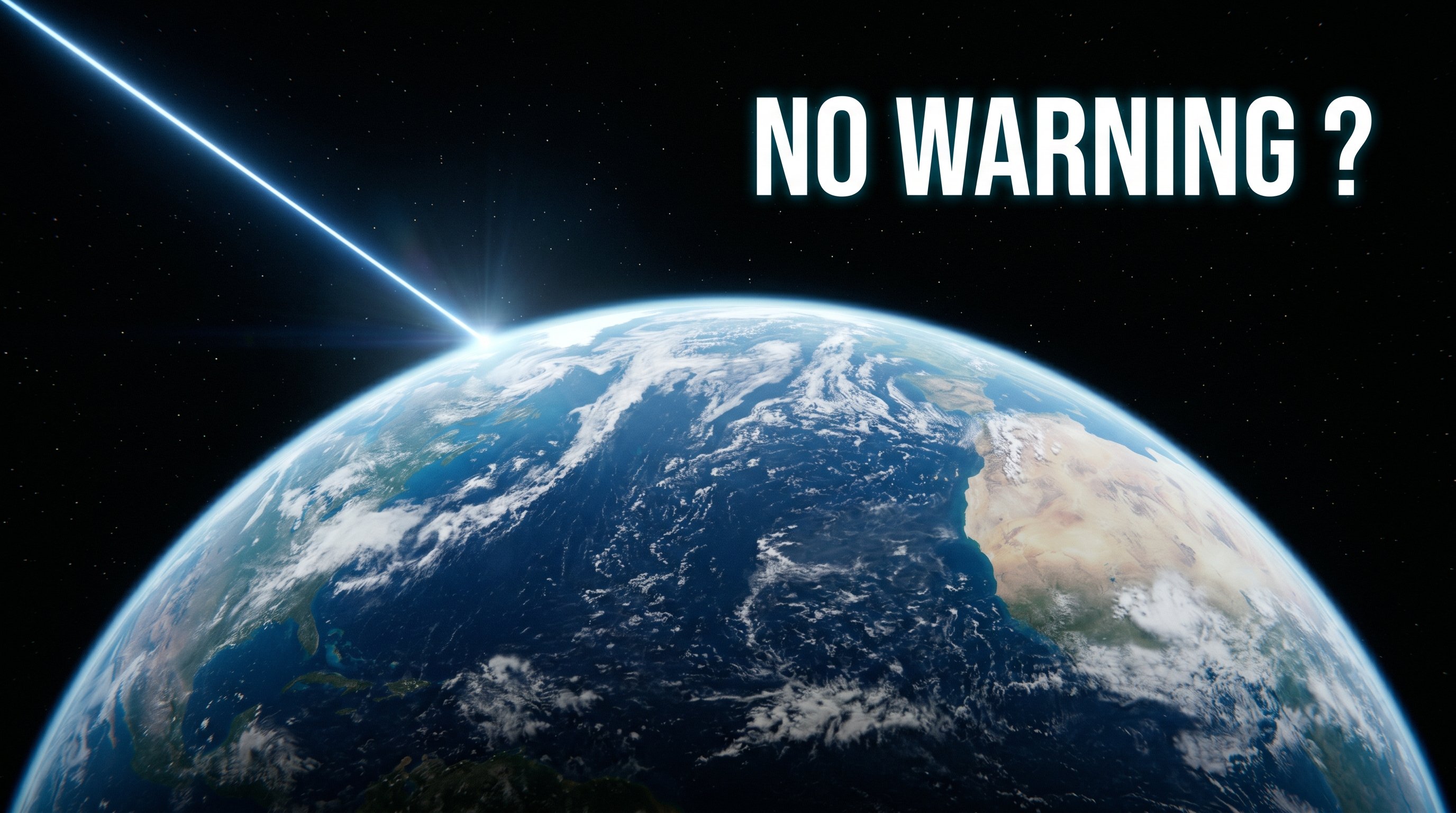
Why a Gamma-Ray Burst Gives No Warning
There is a category of threat that no early warning system, no monitoring network, and no future technology can address. Not because we have not built the right instruments yet. Because the physics of the universe structurally forbids a forerunner signal. The threat and the information that the threat exists travel at the same speed. They are, in every meaningful sense, the same event. That category has a name: gamma-ray bursts. And the more carefully you look at what they are and what they do, the more clearly you see that our intuitions about danger, warning, and survival simply do not apply to them.
What a Gamma-Ray Burst Actually Is
A gamma-ray burst (GRB) is a transient pulse of gamma radiation originating from cosmological distances, lasting anywhere from a few milliseconds to several minutes. They are divided into two broad classes based on duration. Long-duration GRBs, lasting more than two seconds, are associated with the core collapse of massive stars, specifically those with at least eight to twenty times the mass of the Sun. Short-duration GRBs, lasting under two seconds, are produced by the merger of two compact objects, most commonly neutron stars.
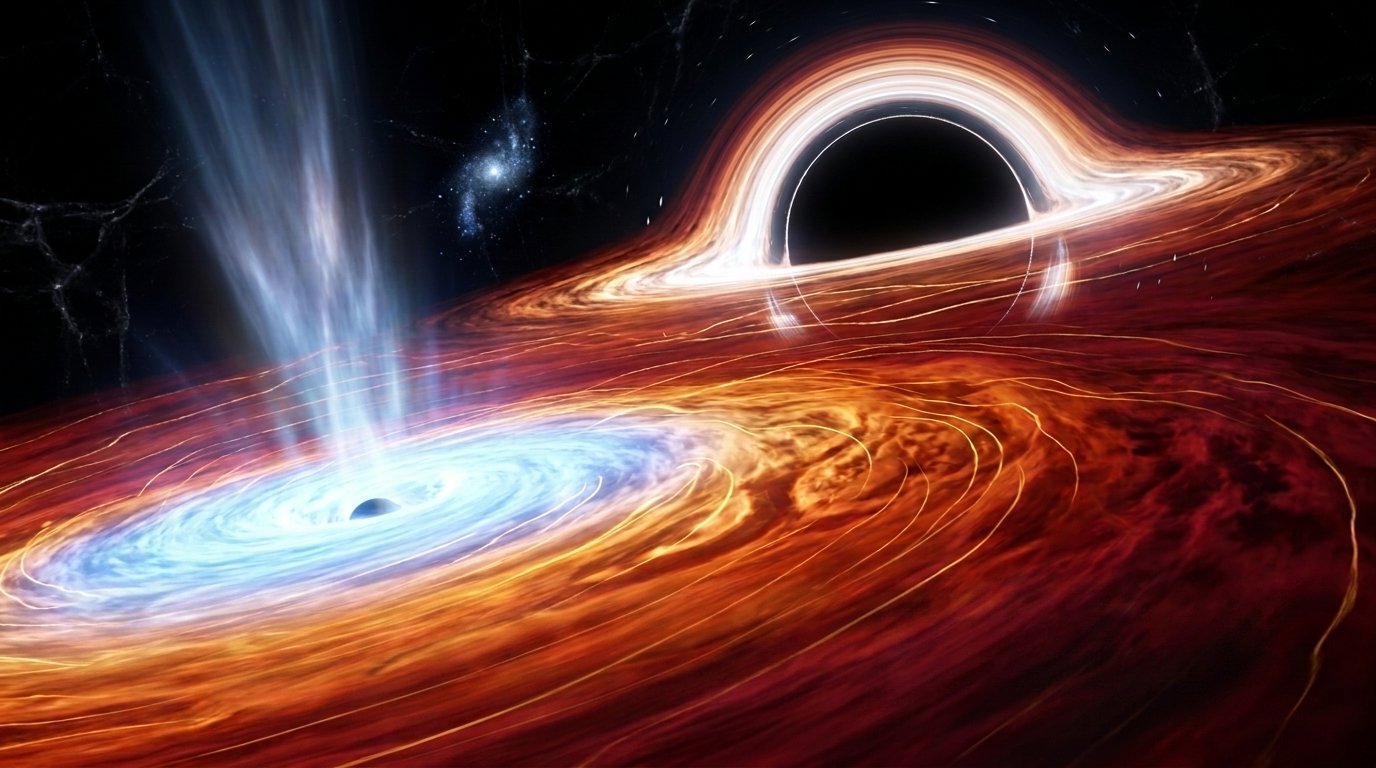
In both cases, a new black hole forms at the center of the event. Material falling toward that black hole under certain conditions of spin and magnetic field geometry does not distribute itself symmetrically. It forms an accretion disk, and from the poles of that disk, two narrow jets of plasma are launched outward at velocities within a fraction of one percent of the speed of light. These jets punch through whatever stellar material surrounds the collapse site and, when they break free, interact with the surrounding gas and dust in a way that produces gamma rays. What we detect across billions of light-years is the light from that interaction.
The energy involved is genuinely difficult to hold in the mind. A single long-duration GRB can release between $10^{51}$ and $10^{55}$ ergs of energy. For comparison, the Sun's total lifetime energy output is approximately $10^{51}$ ergs. The most energetic bursts release, in a matter of seconds, what our star will emit across ten billion years of continuous fusion.
They were discovered entirely by accident. Military satellites launched by the United States in the late 1960s to monitor Soviet compliance with the Partial Nuclear Test Ban Treaty detected gamma-ray flashes that were not coming from the ground. They were coming from everywhere at once, randomly distributed across the sky, with no pattern consistent with any known military or natural source on Earth. The data was classified for years. When it was finally published in 1973, the astrophysics community had no explanation for what these objects were. The most powerful events in the observable universe had been found by people looking for illegal nuclear weapons tests.[1]
The Physics of No Warning
Most threats arrive with something before them. A tsunami has a withdrawal of water from the shore. An earthquake has, sometimes, foreshocks. A volcanic eruption has weeks of ground deformation and gas emission detectable by instruments before the main event. Even an asteroid on a collision course with Earth is, in principle, detectable years or decades in advance because it is a physical object moving through space at sub-light velocity and reflecting sunlight the whole time.
A gamma-ray burst is different in kind, not degree. The burst is electromagnetic radiation. It travels at the speed of light. The information that the burst is coming also travels at the speed of light because all information is bounded by that speed. There is no gap between the warning and the event because they are physically identical: both are the same photons, arriving at the same moment, indistinguishable from each other.
This is not an engineering limitation. It is not a problem that more sensitive telescopes or faster computers will eventually solve. It is written into the causal structure of spacetime itself. Special relativity establishes that no information can travel faster than light in a vacuum. The speed of light is not a speed limit the way a highway speed limit is a speed limit. It is the geometry of cause and effect. Events cannot be known before the light carrying news of them arrives. And for a GRB, that light is the event.
Some bursts show brief X-ray precursor flickers in the seconds before the main gamma-ray emission, possibly associated with the jet forming and stalling before it breaks free of the stellar envelope. These precursors are inconsistent across the GRB population. Most bursts show no precursors at all. And in the cases where precursors exist, the time window they open is measured in seconds, not hours or days. No process requiring deliberate human response operates meaningfully on a seconds-level warning for a planetary-scale event.
There is also the deeper problem of the trigger itself. A Wolf-Rayet star, the type of massive evolved star most likely to produce a long-duration GRB, is indistinguishable from any other hot luminous point of light at 8,000 light-years. The variables that determine whether its core collapse produces a jet, specifically the rotational velocity of the iron core and the magnetic field configuration at the moment of pressure failure, are not accessible to any instrument we can build or operate from here. The countdown, if there is one, runs in silence inside a stellar interior we cannot read.
What Happens to a Planet in the Beam
The primary mechanism of harm from a nearby GRB is not what most people imagine. The planet does not explode. The surface is not directly vaporized by gamma rays. The atmosphere absorbs the gamma-ray photons high in the stratosphere. The damage is chemical, and it is slow.
When gamma-ray photons collide with nitrogen molecules in the stratosphere, they trigger a cascade of reactions that produce nitric oxide and nitrogen dioxide in quantities far beyond anything the atmosphere generates through ordinary processes. These nitrogen oxides catalytically destroy ozone through the following cycle:
$$NO + O_3 \rightarrow NO_2 + O_2$$ $$NO_2 + O \rightarrow NO + O_2$$ $$\text{Net: } O_3 + O \rightarrow 2\,O_2$$The nitrogen oxides are regenerated in the cycle, meaning a relatively small initial production can destroy a disproportionately large quantity of ozone over time. Atmospheric modeling conducted by researchers at NASA Goddard Space Flight Center and the University of Kansas estimates that a ten-second burst delivering 100 kilojoules per square meter to Earth would produce a globally averaged ozone depletion of 35 percent, with some latitudes losing more than half their ozone column.[2]
Significant depletion, defined as at least ten percent below baseline, persists for up to seven years after the burst itself lasted only seconds. During that window, elevated ultraviolet-B radiation reaches the surface continuously. UV-B damages DNA through formation of cyclobutane pyrimidine dimers, particularly thymine-thymine bonds that the cell's repair machinery cannot keep pace with under sustained elevated exposure. Marine phytoplankton, which are acutely UV-B sensitive and responsible for roughly half of Earth's oxygen production, would be affected first. The cascade from there moves upward through every food web connected to the ocean.
The asymmetry between cause and consequence is one of the more unsettling features of this threat. The burst lasts seconds. The aftermath persists for years. The sky returns to normal immediately. The damage does not.
The Rock That Remembers: The Ordovician Extinction
Approximately 443 million years ago, roughly 85 percent of marine species disappeared in what is classified as the second-largest mass extinction in the fossil record. The event is called the Late Ordovician mass extinction, and its cause has been debated for decades. Most researchers accept a glaciation event and associated sea level drop as contributing factors. The evidence for glaciation is real and well-documented in the sedimentology.
But there are signals in the fossil record that glaciation alone does not explain cleanly. Species losses in the Ordovician show a geographic asymmetry: communities living in shallow, sunlit, low-latitude tropical seas were hit harder than communities living in deeper water at higher latitudes. This is precisely the pattern that elevated UV-B radiation from ozone depletion would produce. Deep water attenuates UV. Surface water does not. The organisms most exposed to the sky died at higher rates than those sheltered beneath it.
Carbon isotope ratios in Ordovician black shales and the distribution of organic molecules associated with UV-stressed organisms show a disruption to primary productivity, specifically to the phytoplankton and algal communities at the base of the marine food web, in the period immediately preceding peak extinction. Not after the main die-off. Before it. Which is consistent with a surface-level atmospheric event initiating a cascade that then propagated upward through the food web over subsequent months and years.
A 2004 paper by Adrian Melott and colleagues at the University of Kansas modeled what a GRB at approximately 6,000 light-years distance would have done to the Late Ordovician atmosphere and compared the predicted biological consequences to the fossil record. The match was not perfect. It never is across 440 million years of geological processing. But it was close enough to generate a literature that remains active, with subsequent researchers refining, arguing with, and building upon the original hypothesis.[3]
The honest position is that we do not know whether a GRB caused or contributed to the Ordovician extinction. What we can say is that the pattern of that extinction, its latitudinal gradient, its surface-layer bias, its primary productivity disruption preceding peak die-off, is consistent with the predicted consequences of a nearby gamma-ray burst in a way that a purely glaciological explanation has difficulty accounting for fully.
The BOAT: A Demonstration at Safe Distance
On October 9, 2022, at 13:16:59 UTC, the Fermi Gamma-ray Burst Monitor registered a burst and then, essentially, stopped registering it. The detectors saturated. They hit the ceiling of what they were built to measure and stayed there. The event was subsequently designated GRB 221009A. The community had a different name for it within hours: the BOAT. The Brightest Of All Time.
Its total isotropic-equivalent energy was approximately $10^{55}$ ergs, the highest ever measured. It was located at redshift $z = 0.151$, corresponding to a distance of roughly 2.4 billion light-years. Light that left its origin before complex animal life existed on Earth arrived at our detectors and blinded them. The reconstruction of its true brightness took months of work by teams across multiple continents, using partial data from instruments at the edges of the Fermi detector array and from other spacecraft including Konus-Wind and the LHAASO Observatory in Sichuan, China.[4]
The LHAASO collaboration detected more than 140 photons from GRB 221009A with energies exceeding 3 teraelectronvolts. This was the first time a GRB had been observed at very-high-energy gamma rays. The burst was so luminous it measurably ionized Earth's upper atmosphere, an effect typically associated with solar flares, from a source 2.4 billion light-years away. Statistical analysis of the known GRB rate distribution suggests an event this bright occurs approximately once every 10,000 years, making it likely the most luminous burst in Earth's sky since the beginning of human civilization.
GRB 221009A was not a threat to life on Earth. The distance made certain of that. The same inverse-square dilution that renders the catalog's daily entries harmless rendered this one harmless too. But it was a demonstration, at safe distance, of what the top of the GRB energy distribution looks like and what our instruments do when they encounter it. The star that produced it is gone. The galaxy that housed it has continued evolving for 2.4 billion years since. We have only the light it sent ahead of itself.
Where We Are in the Galaxy Might Be Why We Exist
The Milky Way galaxy is approximately 100,000 light-years in diameter. Earth orbits the galactic center at a distance of roughly 8 kiloparsecs, about 26,000 light-years out, in the relatively quiet outer region of one of the spiral arms. This position is not cosmically significant in any obvious way. But it may be biologically significant in a very specific way.
Research by Tsvi Piran and Raul Jimenez, published in 2014 in Physical Review Letters, calculated GRB lethality probability as a function of distance from the galactic center. Within roughly 4 kiloparsecs of the center, the probability that a planet in the habitable zone of a Sun-like star has experienced at least one lethal GRB in the last billion years exceeds 95 percent. The inner galaxy is not hostile in the way a desert is hostile. It is hostile in the way a statistical distribution is hostile: quietly, impersonally, over time.[5]
At Earth's current radius, the picture is different. The Milky Way at 8 kiloparsecs is metal-rich enough that long-duration GRBs are suppressed relative to metal-poor environments, because the massive stars at our galactic radius tend to lose too much angular momentum through stellar winds before they collapse to form the rapidly spinning cores that produce jets. The present-day GRB rate at Earth's location is estimated to be low enough that most stars at this radius have survived the last billion years without a lethal hit.
Extending this analysis to the universe as a whole, Piran and Jimenez concluded that GRBs likely prevent complex life from developing in approximately 90 percent of all galaxies. Not because those galaxies are actively dangerous at every moment, but because their star formation rates, metallicity distributions, and GRB rates combine to interrupt biological complexity before it can accumulate sufficient time to become anything recognizable. The universe produces the conditions for life and then, in most places, disrupts them before those conditions can be sustained.
This has implications for the Fermi Paradox, the old and genuinely unanswered question of why the universe appears quiet despite containing an estimated two trillion galaxies and an inconceivable number of potentially habitable planets. Neocatastrophism is the name for the hypothesis that GRBs have acted as a galactic regulation mechanism across cosmic history, repeatedly resetting complex life before it can reach the developmental threshold required for interstellar communication or travel. We may be living in one of the rare pockets, at the right galactic radius, in the right epoch of cosmic history, where the quiet has lasted long enough.
WR 104 and the Question of Proximity
Wolf-Rayet 104 is a binary star system approximately 8,000 light-years away in the constellation Sagittarius. It consists of a Wolf-Rayet star and an OB companion orbiting each other with a period of roughly eight months, their colliding stellar winds producing a rotating spiral of hydrocarbon dust visible in infrared as a symmetric pinwheel pattern roughly 100 astronomical units across.
The pinwheel faces Earth nearly directly. When this was first characterized carefully by astronomer Peter Tuthill and colleagues, it raised an uncomfortable geometric implication: if the dust spiral is face-on, the rotation axis of the binary system is pointing toward us. And if the Wolf-Rayet component collapses and produces a GRB, the jet would be directed along that rotation axis, toward Earth.
For years, the best constraint on the orbital inclination came from the dust spiral geometry alone, which placed the pole angle at somewhere between 0 and 16 degrees relative to our line of sight. A typical GRB jet has an opening half-angle of roughly 10 to 15 degrees. These ranges overlapped uncomfortably.
In 2024, Grant Hill at the Keck Observatory used radial velocity measurements across multiple orbital periods, obtained with three separate instruments, to determine the true orbital inclination of the system directly. The result placed the orbital axis at 30 to 40 degrees from our line of sight, well outside the probable beam cone for a typical long-duration GRB. The threat assessment from WR 104 was substantially revised downward.[6]
WR 104 is also subject to further uncertainty: Wolf-Rayet stars in metal-rich environments like the Milky Way may lose too much rotational angular momentum through stellar winds to produce a GRB at all when they collapse. Most supernovae from massive stars do not form jets. The conditions required for jet formation are specific and not guaranteed. WR 104 is the candidate that received careful attention because its geometry was striking. It is not the only massive star within several kiloparsecs. It is simply the one we have studied most carefully.
What We Actually Know
Gamma-ray bursts are real. They are the most energetic transient events in the observable universe. They occur at a rate of roughly one detectable event per day across the cosmos, with essentially all of them at distances too great to threaten Earth. The catalog is now thousands of entries long. Each entry represents an event that would have been catastrophic within its local galactic neighborhood.
The mechanisms by which a nearby GRB would damage Earth's biosphere are well-modeled and physically understood. Ozone depletion through nitrogen oxide production is the primary pathway. The damage is not instantaneous. It unfolds over years through elevated UV-B exposure following a burst that lasted seconds. DNA damage, marine ecosystem disruption, and long-term reduction in primary productivity would be the consequence, not an explosion.
The probability that at least one lethal GRB has struck Earth in the last 500 million years is, by the most careful analyses, better than 50 percent. The Late Ordovician mass extinction remains a plausible candidate for such an event, with fossil evidence that fits the predicted consequences of GRB-induced ozone depletion in ways that glaciation alone has difficulty fully explaining.
The inability to detect a GRB before it arrives is not a temporary technological limitation. It is a consequence of the fact that the burst travels at the speed of light and carries its own announcement with it. This places gamma-ray bursts in a unique category among existential risks: fully real, potentially catastrophic, physically unmonitorable in advance, and entirely outside the reach of any early warning architecture we could conceivably build.
What the numbers also show is that Earth's location in the Milky Way, its galactic radius, the metal richness of its neighborhood, and the current epoch of cosmic history have collectively provided the statistical quiet required for 500 million years of uninterrupted biological complexity. That quiet is not guaranteed. It has not always held. The rock at the Ordovician boundary suggests it may have failed at least once. But it has held long enough for the question to be asked, which is, given what the inner galaxy looks like, something worth noticing.
[1] Klebesadel, R.W., Strong, I.B. and Olson, R.A. (1973). "Observations of Gamma-Ray Bursts of Cosmic Origin." Astrophysical Journal Letters, 182, L85. The original declassified paper reporting Vela satellite detections of GRBs from 1969 to 1972.
[2] Thomas, B.C., Jackman, C.H., Melott, A.L. et al. (2005). "Terrestrial Ozone Depletion Due to a Milky Way Gamma-Ray Burst." Astrophysical Journal Letters, 622, L153. NASA Goddard Space Flight Center and University of Kansas two-dimensional atmospheric modeling study.
[3] Melott, A.L., Lieberman, B.S., Laird, C.M. et al. (2004). "Did a Gamma-Ray Burst Initiate the Late Ordovician Mass Extinction?" International Journal of Astrobiology, 3(1), 55-61.
[4] Burns, E. et al. (2023). "GRB 221009A: The BOAT." Astrophysical Journal Letters, 946, L31. Louisiana State University analysis of Fermi-GBM and Konus-Wind data establishing the once-per-10,000-year frequency estimate.
[5] Piran, T. and Jimenez, R. (2014). "Possible Role of Gamma Ray Bursts on Life Extinction in the Universe." Physical Review Letters, 113, 231102. Hebrew University and University College London. The primary quantitative source for galactic habitability statistics and the 90 percent of galaxies figure.
[6] Hill, G.M. (2024). "Is WR 104 a Face-On Colliding-Wind Binary?" Monthly Notices of the Royal Astronomical Society. Keck Observatory radial velocity characterization of the WR 104 system, determining orbital inclination of 30 to 40 degrees from line of sight.

Comments (0)
Leave a Comment