Did We Just Find a Crack in Spacetime?
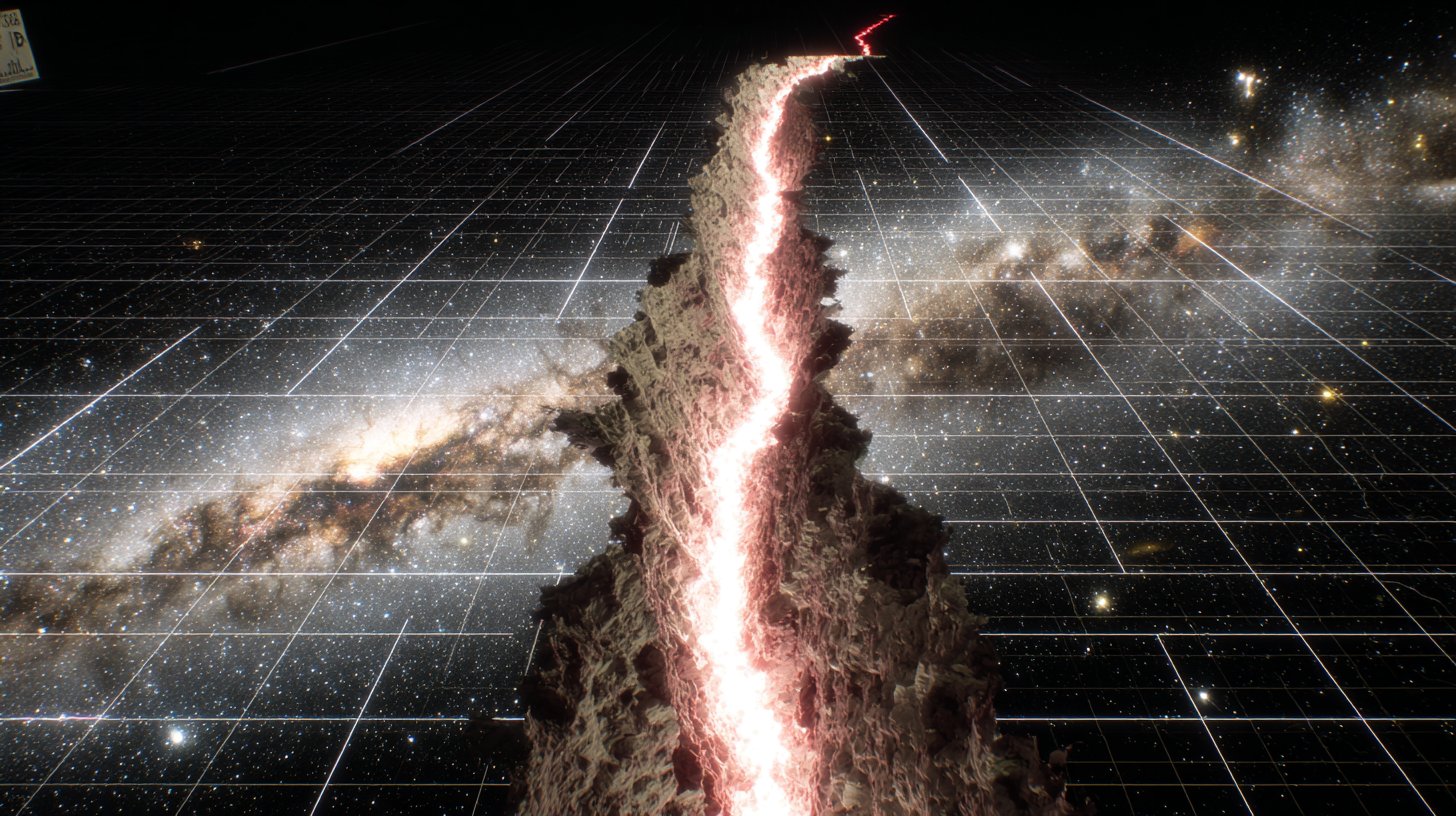
Something happened in the first second of the universe that no instrument has ever directly observed. The universe was cooling -- rapidly, unevenly, in regions too far apart to communicate with each other -- and as it cooled, it went through changes of state. Not gently. In the way water freezes: locally, independently, from many centers at once, each region settling into a new arrangement without knowing what the neighboring regions were doing. And where those regions finally met, the geometry of space itself may have cracked. Not broken. Just seamed. One-dimensional boundaries, thread-thin and impossibly dense, potentially stretching across billions of light-years right now, threading silently through the space between galaxies, through the space between the atoms of the room you are sitting in. They are called cosmic strings. We have never confirmed one. But the search has never been more serious.
What a Phase Transition Actually Does
Most people have a rough picture of a phase transition: ice melts, water boils, steam condenses. The substance changes its arrangement. But what changes in a phase transition is not just the physical configuration of molecules -- it is the symmetry of the system. Ice has a lower symmetry than water: the crystal lattice picks out specific directions in space, whereas liquid water looks the same from every direction. When water freezes, a symmetry is broken. The system chooses an arrangement, and in doing so, gives up the indifference to direction that the liquid phase had.
In the very early universe, the fundamental forces were not distinct. At energies above approximately $$10^{16} \text{ GeV}$$ the strong nuclear force, the weak force, and electromagnetism are expected to behave as a single unified force. As the universe expanded and cooled below this energy threshold, that unified symmetry broke. The forces separated out. The fields governing them reorganized into the lower-energy, lower-symmetry configurations we observe today.
This is the cosmological phase transition. And it did not happen all at once. The universe at that moment was expanding so rapidly that most regions were causally disconnected -- separated by distances growing faster than light could cross them. Each region underwent the transition independently, settling into its own local version of the new phase. And the new phase, like ice crystals forming in a lake, does not have a unique orientation. Different regions could -- and likely did -- arrive at different, locally valid orientations of the broken symmetry field.
When those regions eventually met, their field orientations were incompatible. The field could not smoothly interpolate from one orientation to the other. So it did what a frozen lake does at the boundary between two independently grown ice sheets: it left a seam.
What a Cosmic String Is (and Is Not)
A cosmic string is not a string in the ordinary sense. It has no material substance. It is not made of atoms or particles. It is a topological defect in a quantum field: a one-dimensional region of space where the field is locked into a higher-energy configuration that it cannot escape, because the topology of the field's value space makes relaxation mathematically impossible.
The stability is not mechanical. It is topological. Consider a rubber band with a twist in it, joined at the ends into a loop. No matter how you deform that loop -- stretch it, compress it, move it through space -- you cannot remove the twist without cutting the band. The twist is topologically locked in. Cosmic strings work the same way. The field configuration at the string cannot be smoothed out into the surrounding vacuum by any continuous deformation. It persists because the mathematics forbids the alternative.
What makes strings physically remarkable is the combination of their size and their mass. A cosmic string has a width near the Planck length: $$\ell_P = \sqrt{\frac{\hbar G}{c^3}} \approx 1.6 \times 10^{-35} \text{ m}$$ This is not merely small. It is the scale at which our current theories of spacetime break down entirely. No instrument can resolve this width. No measurement can directly access it. The string is, in a precise sense, below the floor of observable geometry.
And yet a single kilometer of such a string would carry a mass of approximately $$M \approx \mu \cdot L \approx 10^{22} \text{ kg per km}$$ where $\mu$ is the string tension (mass per unit length), set by the energy scale $\eta$ of the phase transition via $\mu \sim \eta^2 / c^2$. For a grand unified theory scale string, this makes one kilometer of thread roughly ten million times the mass of the Earth. Not because it is made of anything heavy. Because the energy density of the locked-in field configuration, compressed into a width smaller than any measurement can reach, is that large.
There is an important clarification about the name. Cosmic strings are not the strings of string theory.[1] String theory strings are fundamental 1D objects at the Planck scale that constitute all particles. Cosmic strings are macroscopic defects in quantum fields and can form in theories with no connection to string theory whatsoever. The possible overlap -- that string theory's fundamental strings might be stretched to cosmic scales -- is a separate speculative idea sometimes called cosmic superstrings, and it is not the mainstream prediction discussed here.
How the Universe Remembers
A fossil is not the original organism. It is a mineral replacement: the original biological material substituted, slowly, by stone, preserving the shape without preserving the substance. What we hold in a museum case is not the bone. It is the geometry of where the bone was.
Cosmic strings are different from fossils in one specific and important way. They are not replacements for something that was there. They are the original thing -- the original high-energy field configuration -- preserved in place. The transition completed everywhere except along the string. The string carries the field value from before the transition, still present, still running on the old rules, 13.8 billion years later.
The persistence is guaranteed by topology, not by strength. Unlike a fossil, which could theoretically be destroyed by sufficient heat or pressure, a cosmic string cannot be smoothed away by external conditions. It can only disappear if it intersects another string, exchanges partners, and the resulting loop radiates its energy away as gravitational waves. This happens. But it happens on cosmological timescales, and the string network, through continuous loop production, maintains a roughly stable statistical configuration regardless of initial conditions -- a property called the scaling regime.[2]
Why You Cannot See It Directly
If a cosmic string passed through the room you are currently in, nothing would register. Not your senses. Not any instrument installed in the building. The string would pass through the walls, through the air, through the atoms of your body -- not because it is weakly interacting in the way that neutrinos are weakly interacting, but because it is a feature of the space itself rather than a thing occupying the space. It does not couple to the electromagnetic force. It emits no light. It ionizes nothing. It heats nothing.
It does, however, have gravity. But the gravitational effect of a straight cosmic string is not what you might expect. It does not attract surrounding matter in the conventional Newtonian sense. Instead, it creates a deficit angle in the space around it: a conical geometry in which the angles around the string's axis add up to slightly less than 360 degrees. The deficit angle is: $$\delta\phi = \frac{8\pi G \mu}{c^2}$$ For a GUT-scale string with $G\mu/c^2 \sim 10^{-6}$, this gives a deficit of a few arcseconds -- small but, in principle, measurable.
The observable consequence of this deficit angle is gravitational lensing. Light passing on either side of a cosmic string is deflected toward the string's axis, and the two deflected beams arrive at an observer as two separate images of the same background object. Not distorted into arcs or rings like conventional gravitational lensing. Just: two. Two identical images, same brightness, same shape, same spectral signature, separated by the deficit angle, with no third central image and no magnification.
This is a unique signature. No other known gravitational lens produces it. And it has never been confirmed in any survey data. The most promising candidate -- a galaxy pair designated CSL-1, announced in 2003 -- was resolved by Hubble Space Telescope imaging in 2006 as a conventional merging galaxy pair, not a string lens. [3] The search continues in JWST survey data, but no detection has been claimed.
The Gravitational Wave Strategy
When the direct search through the cosmic microwave background failed -- not for lack of effort, but because the foreground contamination from galactic and extragalactic microwave sources is irreducibly larger than the string signal at viable tensions[4] -- attention shifted to gravitational waves.
Cosmic strings produce gravitational waves through two mechanisms. First: oscillating strings and string segments radiate continuously as they move, emitting gravitational radiation with each curve and kink in their geometry. Second, and more importantly for detection: closed loops. When two segments of a long string cross and reconnect, they can produce a closed loop -- a ring of string, no longer attached to the network, oscillating under its own tension and radiating gravitational waves until it has emitted all of its energy and ceases to exist.
The lifetime of a loop with initial length $L$ is: $$t_{\text{lifetime}} = \frac{L}{\Gamma G \mu / c^3}$$ where $\Gamma \approx 50$ is a numerical constant from loop dynamics. Smaller loops decay faster. As a loop decays, its oscillation frequency increases and its gravitational wave emission intensifies before the final disappearance.
The sum of all these loops -- at all scales, at all stages of their decay, distributed throughout the observable universe from the time of string formation to the present -- produces a stochastic gravitational wave background. A constant hum, present at all frequencies within a specific range, coming from every direction simultaneously, with a spectral shape determined by the string tension $\mu$ and the distribution of loop sizes.
The LIGO-Virgo-KAGRA collaboration's fourth gravitational wave transient catalog, released in March 2026, more than doubled the total number of confirmed detections to over 200 events. Each confirmed astrophysical source -- each black hole merger, each neutron star collision -- contributes to the modeled foreground that must be subtracted before a cosmological string signal can be identified. Better catalog means better foreground model means cleaner residuals. The search for the string background is proceeding in those residuals, in every observing run, with improving sensitivity.
The Warwick Framework: A Unified Language
For decades, the theoretical landscape of quantum gravity offered competing predictions for tiny distortions in the structure of spacetime itself -- not from cosmic strings, but from the granular or fluctuating character of the spacetime geometry at the Planck scale. Loop quantum gravity, causal set theory, and other frameworks each predicted different types of spacetime fluctuations, described in different mathematical languages, with different predicted observational signatures. Experimentalists searching for these effects had no shared framework for reporting or comparing results.
In April 2026, researchers at the University of Warwick published a paper in Nature Communications introducing the first unified classification of spacetime fluctuations.[5] The framework organizes all predicted spacetime fluctuations into three categories based on their correlation structure in space and time. Each category produces a distinct signature in laser interferometer data. Each maps onto predictions from a specific class of quantum gravity theories.
The paper also resolved a long-standing debate about whether large-scale interferometers like LIGO benefit from their arm cavity length when searching for spacetime fluctuations. The answer: yes, but only for certain fluctuation types. For others, the advantage belongs to small broadband tabletop interferometers like QUEST (Cardiff University) and GQuEST (Caltech), whose wider frequency range allows them to capture the spectral shape information needed to distinguish between fluctuation categories.
What the Warwick framework provides is not a detection. It is something arguably more valuable at this stage: a coordinate system. A common language in which constraints from different instruments at different frequencies can be combined, compared, and accumulated. The search for spacetime structure has, for the first time, a shared vocabulary.
What We Actually Know
The honest summary of the current state is this: cosmic strings have not been detected. No gravitational lensing double image has been confirmed. No stochastic gravitational wave background attributable to strings has been separated from the astrophysical noise. The cosmic microwave background search has been ruled out as a viable strategy at detectable string tensions.
What exists is a set of constraints. Current LIGO and pulsar timing array data require: $$\frac{G\mu}{c^2} \lesssim 10^{-7}$$ This eliminates high-tension strings but leaves a wide viable parameter space. LISA, operating in the millihertz band, will probe tensions several orders of magnitude below this. Next generation pulsar timing arrays -- the Square Kilometre Array and its pathfinders -- will constrain the nanohertz background to levels where strings at even lower tensions would be visible if present.
The physics predicting cosmic strings is not marginal. It emerges from the same theoretical framework -- quantum field theory and the Standard Model of particle physics -- that has produced extraordinarily accurate predictions across every domain it has been tested. The Kibble mechanism for defect formation during phase transitions has been directly confirmed in laboratory condensed matter experiments using superfluid helium and Bose-Einstein condensates.[6] The mechanism works. Whether it operated at cosmological energy scales, producing macroscopic defects that persist today, remains unknown.
A detection would tell us the energy scale of the unifying transition, constrain theories of grand unification, and open a direct observational window on physics at $10^{16}$ GeV -- energies no particle accelerator will ever reach. A confident non-detection would constrain the same parameter space from the other direction, ruling out string formation at any accessible tension and telling us something important about the specific way the early universe's symmetries broke.
Both outcomes are answers. The universe is keeping one of them. The instruments are moving toward it, each observing run tightening the constraints, each engineering upgrade lowering the noise floor, each new tabletop interferometer widening the frequency window. The search is not stalled. It is not failed. It is, with more tools and a better shared language than at any previous point, continuing.
The lake has cracked or it has not. We are learning, very slowly, to hear the difference.
[1] The possible overlap between cosmic strings and string theory strings -- in which fundamental strings from superstring theory are stretched to cosmological scales during inflation, producing "cosmic superstrings" -- is discussed in Copeland and Kibble (2010), Proceedings of the Royal Society A, 466, 623. These would have distinctive properties including lower reconnection probabilities than field-theoretic strings.
[2] The scaling regime of cosmic string networks is established numerically in Hindmarsh et al. (2019), Physical Review D, 99, 083522, and analytically in earlier work by Kibble (1985) and Bennett and Bouchet (1989). The network reaches a universal configuration in which the mean string separation grows proportionally to the Hubble radius, independent of initial conditions.
[3] The CSL-1 candidate was first reported in Sazhin et al. (2003), Monthly Notices of the Royal Astronomical Society, 343, 353. The Hubble Space Telescope follow-up that resolved it as a merging galaxy pair is reported in Sazhin et al. (2006), Monthly Notices of the Royal Astronomical Society Letters, 376, L20.
[4] The impossibility of CMB-based cosmic string detection at viable tensions is demonstrated in Ciuca and Hernandez (2019). The authors showed that even a perfect neural network trained on simulated string CMB maps cannot extract string signatures from realistic maps with foreground contamination, because the information is irreversibly destroyed before analysis.
[5] Balamurugan, S. et al. (2026). A Unified Framework for Detecting Spacetime Fluctuations. Nature Communications, published April 2026. The paper classifies spacetime fluctuations into three categories based on their spatiotemporal correlation structure and identifies the measurable interferometer signatures corresponding to each.
[6] Laboratory confirmation of the Kibble-Zurek mechanism in superfluid helium-3 is reported in Ruutu et al. (1996), Nature, 382, 334. The experiment confirmed that vortex defect densities following rapid cooling through the superfluid transition matched the Kibble-Zurek prediction based on the cooling rate and the causal horizon at the transition.
Comments (0)
Leave a Comment