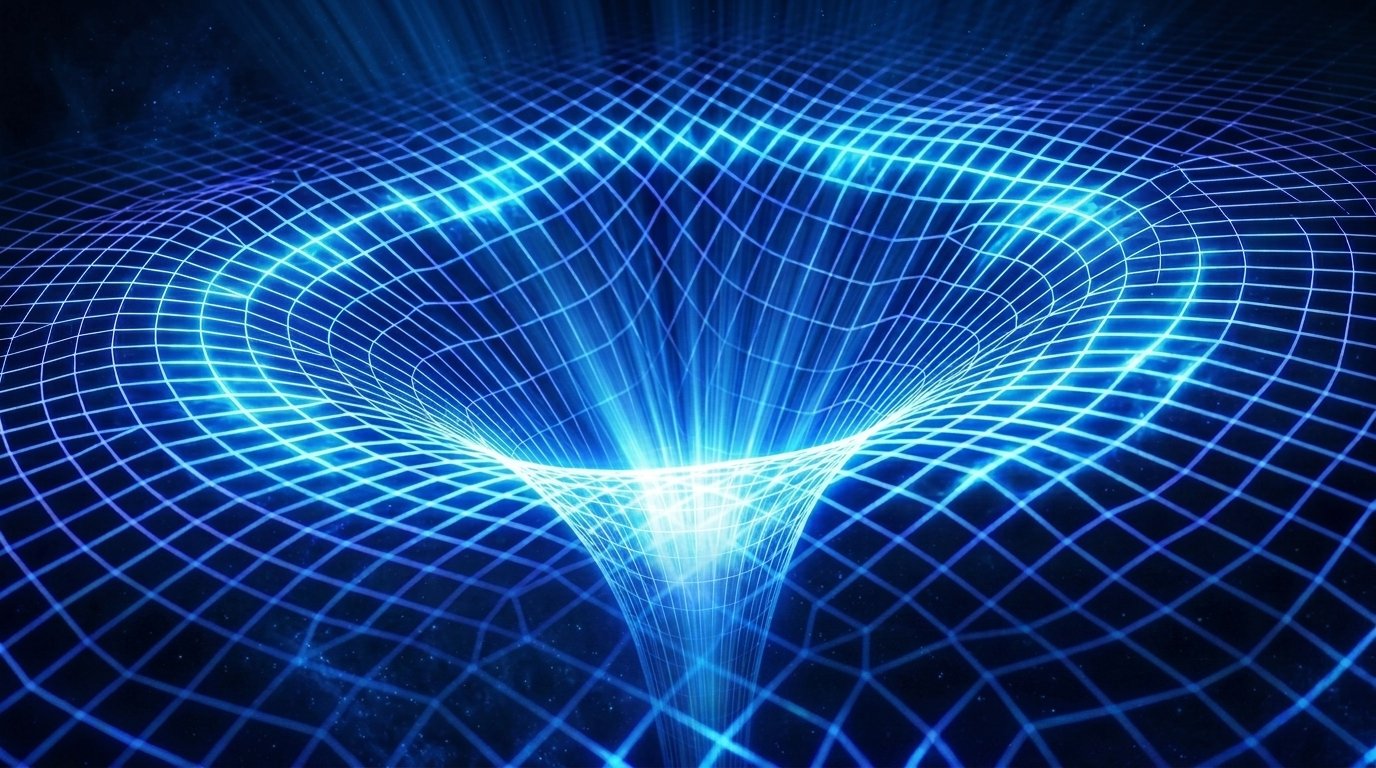
Where Space and Time Actually Meet
Newton had two hundred years of experimental confirmation on his side. Space was a fixed container, time was a universal clock, and every measurement any observer could make would agree with every other. It was not a guess. It was the most thoroughly tested framework in the history of science. Then a pair of physicists floated an interferometer on liquid mercury in Cleveland, Ohio, and found nothing where something was supposed to be. That nothing cracked the foundation. What replaced it turned out to be stranger, more precise, and more deeply embedded in ordinary technology than almost anyone anticipated.
Newton's Stage: The Universe That Made Perfect Sense
Isaac Newton encoded his picture of reality in the Principia Mathematica in 1687. Space, in this picture, exists as an infinite, unchanging container independent of anything inside it. Time flows uniformly everywhere, at the same rate, for every observer simultaneously. Neither space nor time is affected by matter, motion, or energy. They are the backdrop. Physics happens on them, not to them.
The framework worked. Planets moved exactly where the equations predicted. Tides arrived on schedule. Projectiles followed their arcs with mathematical precision. For two hundred years, every experiment confirmed the model without detectable deviation. The inverse-square law of gravitation described interactions across planetary distances with extraordinary accuracy. The picture of an orderly, rule-governed universe resting on fixed spatial and temporal coordinates felt not just useful but obviously true.
What made Newton's assumptions so durable was their internal consistency. If space is absolute, every observer shares the same geometric facts about the universe. If time is absolute, every observer accumulates the same duration between the same events. Measurements are universal. Reality has a single description. These are attractive properties for a physical theory, and abandoning them required something more than philosophical dissatisfaction. It required a specific experimental result that the framework genuinely could not accommodate.
That result arrived in 1887.
The Experiment That Found Nothing
Nineteenth-century physics had established that light travels as a wave. Waves require a medium. Sound needs air. Water waves need water. Light, propagating through the vacuum of space, must need something. Physicists called it the luminiferous aether: an invisible, weightless, perfectly elastic substance filling all of space, the medium through which electromagnetic waves propagated.
The aether also offered something philosophically useful. It provided a candidate for absolute space, a physically real background against which true motion could in principle be measured. Newton's absolute space was no longer merely a mathematical abstraction. It had a substance.
Albert Michelson and Edward Morley built an instrument in Cleveland designed to detect Earth's motion through the aether by measuring the difference in the speed of light travelling in different directions. The logic was clean: if light propagates through a stationary aether at a fixed speed, then Earth moving through that aether should produce a measurable difference between light travelling along Earth's direction of motion and light travelling perpendicular to it. The instrument was sensitive enough to detect the expected shift many times over. It floated on liquid mercury to eliminate vibration from the floor.
The result was a perfect null. No difference. Not a small difference. No difference at all, repeated across multiple orientations and multiple seasons as Earth moved to different positions in its orbit. Light arrived at the same speed regardless of direction, regardless of Earth's motion.
Various explanations were proposed. Hendrik Lorentz and George FitzGerald independently suggested that objects physically contract in the direction of motion through the aether, coincidentally masking the expected shift. The mathematics worked. But it had the feeling of a picture rehung to hide a crack in the wall rather than a repair of the wall itself.
Einstein's Two Postulates: Everything Else Is Consequence
In 1905, Albert Einstein published "On the Electrodynamics of Moving Bodies," a paper that resolved the aether problem not by patching it but by identifying and discarding the assumption that generated it. The paper rests on two postulates stated near its beginning. Everything that follows is derived from them.
The first postulate: the laws of physics are identical in all inertial frames of reference. No experiment conducted inside a smoothly moving system can reveal absolute motion. This was not entirely new. Galileo had said something similar for mechanics. What Einstein did was extend it to all physics, including electromagnetism and the propagation of light.
The second postulate: the speed of light in a vacuum is the same for all observers, regardless of their motion or the motion of the source.
The second postulate is the radical one. Its implications follow with uncomfortable precision. If light travels at the same speed for every inertial observer, then two observers moving at different velocities relative to each other cannot both make consistent measurements of space and time as Newton defined them. The speed of light cannot change. Therefore the measurements of distance and duration must change between observers. Space and time cannot both be absolute if the speed of light is invariant.
The speed of light -- commonly written as $c = 299{,}792{,}458$ metres per second -- is not primarily a property of light. It is a structural constant of spacetime itself: the maximum speed at which any causal influence can propagate. Light travels at $c$ because photons are massless. If they had any mass, they would travel slower.
The Lorentz factor, which governs how strongly time dilation and length contraction occur at a given velocity $v$, is:
$$\gamma = \frac{1}{\sqrt{1 - \frac{v^2}{c^2}}}$$At everyday speeds, $\gamma$ is indistinguishably close to 1. At $v = 0.994c$, $\gamma \approx 9.1$. At $v = 0.997c$, $\gamma \approx 12.2$. As $v$ approaches $c$, $\gamma$ approaches infinity. No finite energy can push a massive object to light speed because the energy required grows without bound.
Minkowski's Geometry: The Shape Underneath the Physics
Einstein's 1905 paper produced correct results through physical reasoning. It took his former mathematics teacher to show what was geometrically happening underneath those results.
Hermann Minkowski gave a lecture in Cologne in September 1908 in which he announced that space by itself and time by itself were doomed to fade into mere shadows, and that only a union of the two would preserve an independent reality.[1] Then he demonstrated the mathematics.
What Minkowski had identified was that special relativity describes a genuine four-dimensional geometric structure: three spatial dimensions combined with a temporal dimension into a single continuum. This is not time bolted onto space as an afterthought. It is a unified four-dimensional manifold in which every event requires four coordinates to specify its location.
The key mathematical object is the spacetime interval. For two events separated by time $\Delta t$ and spatial distances $\Delta x$, $\Delta y$, $\Delta z$, the interval is:
$$s^2 = c^2 \Delta t^2 - \Delta x^2 - \Delta y^2 - \Delta z^2$$Two inertial observers moving at different velocities will disagree on $\Delta t$ and on the spatial separations individually. But every observer, regardless of velocity, will calculate the same value of $s^2$. The interval is invariant. It is the four-dimensional analogue of the Pythagorean distance formula: a quantity that survives the change of reference frame because it is a property of the geometry itself, not of any particular observer's measurement.
Minkowski also introduced the light cone: the geometric surface that divides every event in spacetime into its causal past (the set of events that could have influenced it), its causal future (the set of events it can influence), and the spacelike "elsewhere" that no signal at or below light speed can connect to. Events inside the light cone are timelike-related: a clock can travel between them. Events on its surface are lightlike-related: only light connects them. Events outside are causally disconnected. Causality is not a law imposed on spacetime. It is the structure of the light cones, everywhere, at all times.
Einstein initially dismissed Minkowski's four-dimensional formulation as superfluous mathematical decoration. Within a few years he had reversed this completely and credited Minkowski's framework as essential to the development of general relativity. Minkowski died of appendicitis in January 1909, five months after his Cologne lecture, at forty-four years old.
Time Dilation: The Effect That Is Not an Illusion
A moving clock runs slow relative to a stationary clock. This is time dilation. It is not a perceptual effect, not a consequence of signal travel time, not a measurement artefact. It is a physical difference in the accumulation of proper time along different worldlines through spacetime.
The time measured by a moving clock, $t_{\text{moving}}$, relates to the time measured by a stationary clock, $t_{\text{stationary}}$, by:
$$t_{\text{moving}} = \frac{t_{\text{stationary}}}{\gamma}$$The most concrete demonstration involves cosmic-ray muons. These particles are created about fifteen kilometres above sea level when cosmic rays collide with atmospheric nuclei. A muon's rest half-life is approximately $2.2 \times 10^{-6}$ seconds. At $v = 0.994c$, a muon covers roughly 660 metres per microsecond. In 2.2 microseconds, it travels approximately 1.4 kilometres. The atmosphere is fifteen kilometres deep. Classical physics predicts the overwhelming majority of muons should decay long before reaching the ground.
Muons are the dominant component of cosmic radiation at sea level. They arrive in abundance, passing through approximately one per square centimetre of surface area per minute. The reason is time dilation: at $0.994c$, the Lorentz factor is approximately 9.1, stretching the muon's effective lifetime in the ground frame to roughly 20 microseconds. Rossi and Hall confirmed this relationship in 1941.[2] A CERN storage ring experiment in 1966 pushed muons to $0.997c$ and measured a twelve-fold lifetime extension, matching the relativistic prediction to within experimental error.
When two clocks separate and reunite after one has moved at speed, they show genuinely different elapsed times. The difference is permanent. There is no correction to apply. Both clocks were accurate throughout. They were simply accurate about different quantities of elapsed proper time.
Gravity Is Geometry: The 1915 Extension
Special relativity handled constant-velocity motion. Gravity and acceleration were outside its scope. Between 1905 and 1915, Einstein worked to extend the framework, and the extension required reconceiving gravity entirely.
The foundational insight he later called the happiest thought of his life: gravity and uniform acceleration are locally indistinguishable. A person sealed in a box on Earth's surface and a person sealed in a box accelerating upward through empty space at $9.8 \, \text{ms}^{-2}$ cannot tell their situations apart through any experiment conducted inside the box. This is the equivalence principle.
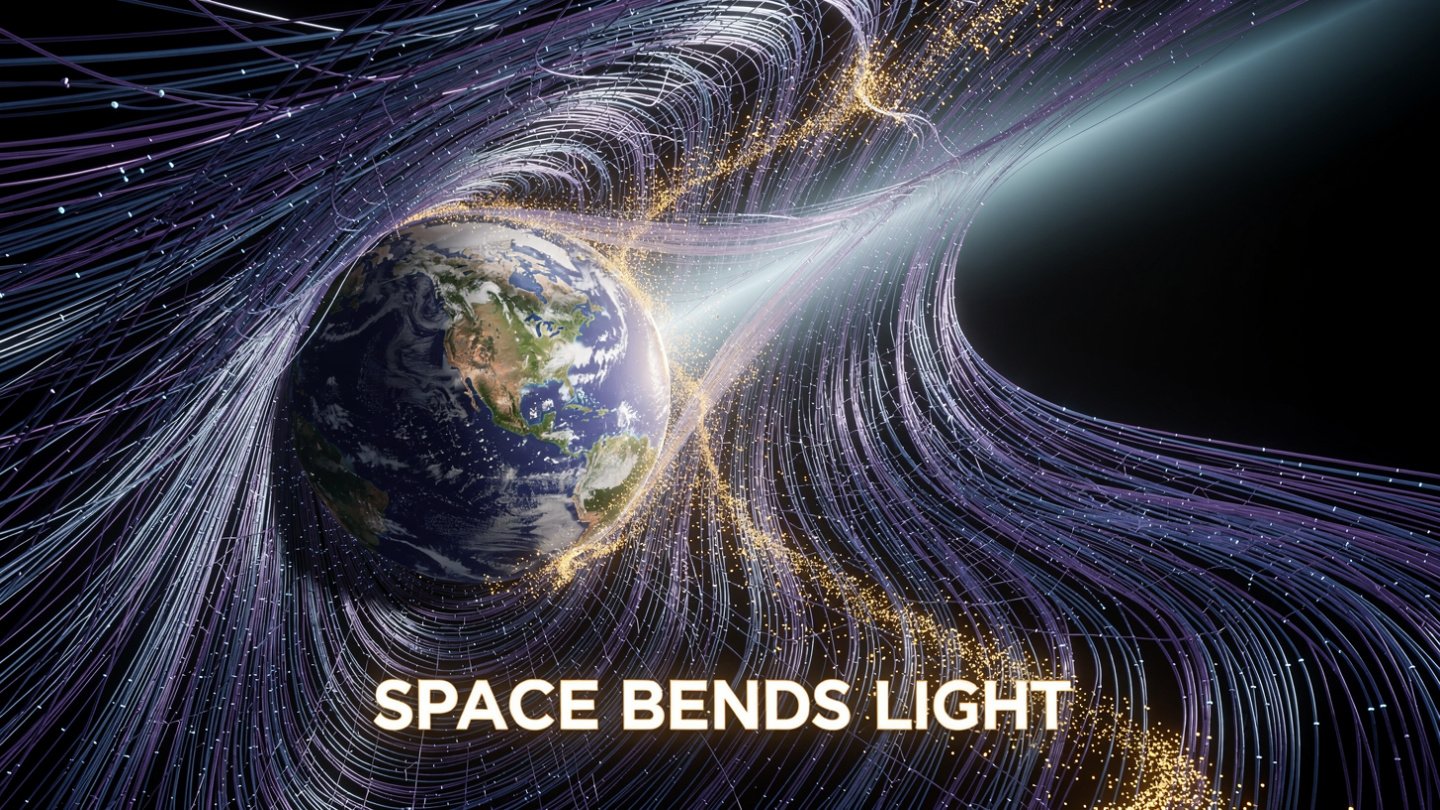
The logical chain it opens is short and difficult to escape. Light bends in an accelerating frame -- the box moves while the light crosses it, so the beam arrives lower than where it entered. The equivalence principle says gravity and acceleration are the same. Therefore light must bend under gravity. But light travels at a fixed speed along the geometry of space. Therefore the geometry of space near a mass must be curved.
General relativity encodes the relationship between spacetime geometry and mass-energy in the Einstein field equations:
$$G_{\mu\nu} = \frac{8\pi G}{c^4} T_{\mu\nu}$$$G_{\mu\nu}$ is the Einstein tensor, encoding the curvature of spacetime at each point. $T_{\mu\nu}$ is the stress-energy tensor, encoding the distribution of mass and energy. The equation is not one equation but ten coupled nonlinear partial differential equations. The left side describes the geometry. The right side describes the matter. Matter tells spacetime how to curve. Curved spacetime tells matter how to move.
What we call gravitational attraction is objects following geodesics: the straightest available paths through a curved geometry. Falling is not being pulled. It is coasting along the natural path through spacetime that mass has shaped. The floor is not holding you up against gravity. It is preventing you from following your geodesic. Astronauts in orbit feel weightless not because gravity is absent but because they are following their geodesic freely.
GPS: Spacetime Physics as Load-Bearing Infrastructure
GPS satellites orbit at approximately 20,200 kilometres altitude at roughly 14,000 kilometres per hour. Their onboard atomic clocks experience two competing relativistic effects simultaneously. Velocity-based time dilation from special relativity causes the satellite clocks to run slow by approximately 7.2 microseconds per day relative to ground clocks. Gravitational time dilation from general relativity -- weaker gravity at altitude means less spacetime curvature means faster clock -- causes them to run fast by approximately 45.9 microseconds per day.
The net effect is a clock gain of roughly 38.4 microseconds per day. One microsecond of timing error translates to approximately 300 metres of positional error. Uncorrected, GPS positions would drift by roughly 11 kilometres per day.
The correction is built into the satellite hardware before launch. The onboard clocks are tuned to tick at a slightly different rate on the ground so that once in orbit, under the combined influence of both effects, they match ground reference clocks. Relativistic physics is not background context for GPS engineering. It is a load-bearing component of the system. Without it, the system does not function.
The Event Horizon: Where the Geometry Closes
A black hole's event horizon is the surface at which the escape velocity equals the speed of light. It is not a physical membrane. It is a boundary in spacetime geometry defined entirely by local curvature: the Schwarzschild radius, given by:
$$r_s = \frac{2GM}{c^2}$$where $M$ is the mass of the object, $G$ is Newton's gravitational constant, and $c$ is the speed of light. For an object the mass of the Sun, $r_s \approx 3$ kilometres. For Earth, approximately 9 millimetres.
From outside the horizon, a falling clock appears to slow as gravitational time dilation becomes more severe with proximity. At the horizon, the dilation factor formally reaches infinity: the clock appears frozen, redshifting toward invisibility but never quite arriving. From the falling clock's own frame, nothing marks the crossing. The fall continues. But something has changed in the causal structure.
Inside the event horizon, the radial coordinate -- the direction pointing toward the singularity -- becomes timelike. Outside, you can choose to move toward or away from the centre. Inside, that direction behaves like time: it has a single direction, it cannot be reversed, and you move through it whether you choose to or not. The singularity is not a place ahead in space. It is a moment ahead in time. Every future-directed path in spacetime leads there. There is no alternative direction to navigate toward.[3]
Gravitational Waves: Feeling Spacetime Move
On September 14, 2015, the twin LIGO interferometers in Livingston, Louisiana and Hanford, Washington registered a signal lasting less than one second. The source was the merger of two black holes -- approximately 29 and 36 solar masses -- 1.3 billion light-years away. Three solar masses of energy were radiated as gravitational waves in the final fraction of a second of the inspiral.
Gravitational waves are not vibrations moving through space. They are oscillations of the spacetime metric itself: the quantity that determines what distances and durations mean at every point. As a gravitational wave passes, space stretches in one direction and compresses in the perpendicular direction, then reverses. The strain $h$ measured by LIGO for GW150914 was approximately $10^{-21}$: a fractional change in the 4-kilometre arm length of roughly $4 \times 10^{-18}$ metres, less than one-thousandth the diameter of a proton.
Before September 14, 2015, spacetime as a dynamic, deformable physical entity was very well-supported theory. After that morning, it was something that had physically displaced a mirror. The abstraction had become mechanical.
The Block Universe: All Moments Equally Real
If time is a genuine dimension with the same ontological standing as the three spatial dimensions, then all points along the time axis are as real as all points in space. New York exists whether or not you are standing in it. If time has the same status, then last Tuesday exists -- not as a happening, but as a fixed coordinate in a real four-dimensional structure.
This is the block universe, or eternalism. Past, present, and future exist equally as coordinates in the four-dimensional block. The experience of time flowing is a feature of conscious experience along a worldline, not a feature of the physics. The "now" that any observer experiences is real but local: a property of a particular worldline, not of the universe.
The alternative view -- presentism, the idea that only the present moment is real -- conflicts directly with the frame-dependence of simultaneity. Two observers in relative motion have different sets of events they would call "now." If only the present is real, and two observers have incompatible presents, reality becomes observer-dependent in a way the physics cannot accommodate. Presentism wants a universal now. Relativity does not provide one.
The Quantum Frontier: Where the Picture Breaks
General relativity and quantum mechanics are the two most precisely confirmed theories in the history of physics. Between them, they describe everything that has ever been measured. They are fundamentally incompatible.
General relativity requires spacetime to be smooth, continuous, and deterministic. Quantum mechanics fills the vacuum with irreducible fluctuations at every scale. Apply quantum uncertainty to the spacetime metric itself and the smooth geometry general relativity needs dissolves at small enough scales. John Wheeler described the result in 1955 as spacetime foam: at the Planck length of approximately $1.62 \times 10^{-35}$ metres, the geometry should be a churning, topologically complex structure of transient fluctuations.[4]
Loop quantum gravity proposes that spacetime is discrete at the Planck scale: area and volume come in minimum quanta, and smooth spacetime emerges as a large-scale approximation of a fundamentally granular structure. The minimum quantum of area is on the order of the Planck area, approximately $2.6 \times 10^{-70} \, \text{m}^2$.
The AdS/CFT correspondence, conjectured by Juan Maldacena in 1997, suggests something more radical: that a theory of gravity in a higher-dimensional spacetime is fully equivalent to a quantum field theory with no gravity on its lower-dimensional boundary. If correct, spacetime geometry is not fundamental. It emerges from the entanglement structure of boundary quantum states the way temperature emerges from molecular motion -- real at the scale where it appears, absent as a fundamental concept at the level underneath.
What We Actually Know
The union of space and time has been confirmed by every relevant experiment since 1905. Time dilation is measured in particle accelerators, atomic clocks on aircraft, and GPS satellite corrections applied daily by engineering teams who treat it as infrastructure rather than philosophy. Gravitational waves from black hole mergers have been detected dozens of times. Light bending around mass is a routine observational tool used to map dark matter. The geometry of spacetime is as empirically grounded as any fact in physics.
What remains open is the question of what spacetime actually is at the deepest level. Whether it is fundamental or emergent. Whether it is smooth or discrete. Whether the block universe is physically real or a mathematical feature of a particular formalism. Whether the incompatibility between general relativity and quantum mechanics signals a missing theory or a missing concept -- something that will require abandoning a current assumption as thoroughly as special relativity required abandoning absolute simultaneity.
Minkowski said in 1908 that space by itself and time by itself were doomed to fade into shadows. He was right. What he could not have known was that the union he described would itself turn out to be a question rather than a final answer -- a deeper layer rather than the bottom.
The geometry is real. Whether it is fundamental is still being worked out.
[1] Minkowski delivered this line in his lecture "Raum und Zeit" (Space and Time) at the 80th Assembly of German Natural Scientists and Physicians, Cologne, September 21, 1908. Einstein initially described the four-dimensional reformulation as "superfluous erudition" before reversing his position entirely by 1912.
[2] Rossi, B. and Hall, D.B. (1941). "Variation of the Rate of Ionization of Cosmic Rays with Altitude and the Anomalous Absorption of the Hard Component." Physical Review, 59(3), 223. The first systematic measurement correlating muon energy with atmospheric penetration depth, confirming the time dilation prediction.
[3] This coordinate exchange -- the radial direction becoming timelike inside the event horizon -- appears explicitly in the Schwarzschild interior solution. When $r < r_s$, the sign of the metric component associated with the $r$ coordinate flips, making it timelike. The singularity at $r = 0$ is spacelike: a moment in time rather than a point in space.
[4] Wheeler, J.A. (1955). "Geons." Physical Review, 97(2), 511. The paper in which Wheeler first described the concept of spacetime foam as a consequence of applying quantum uncertainty to the gravitational field at Planck scales.
Comments (0)
Leave a Comment