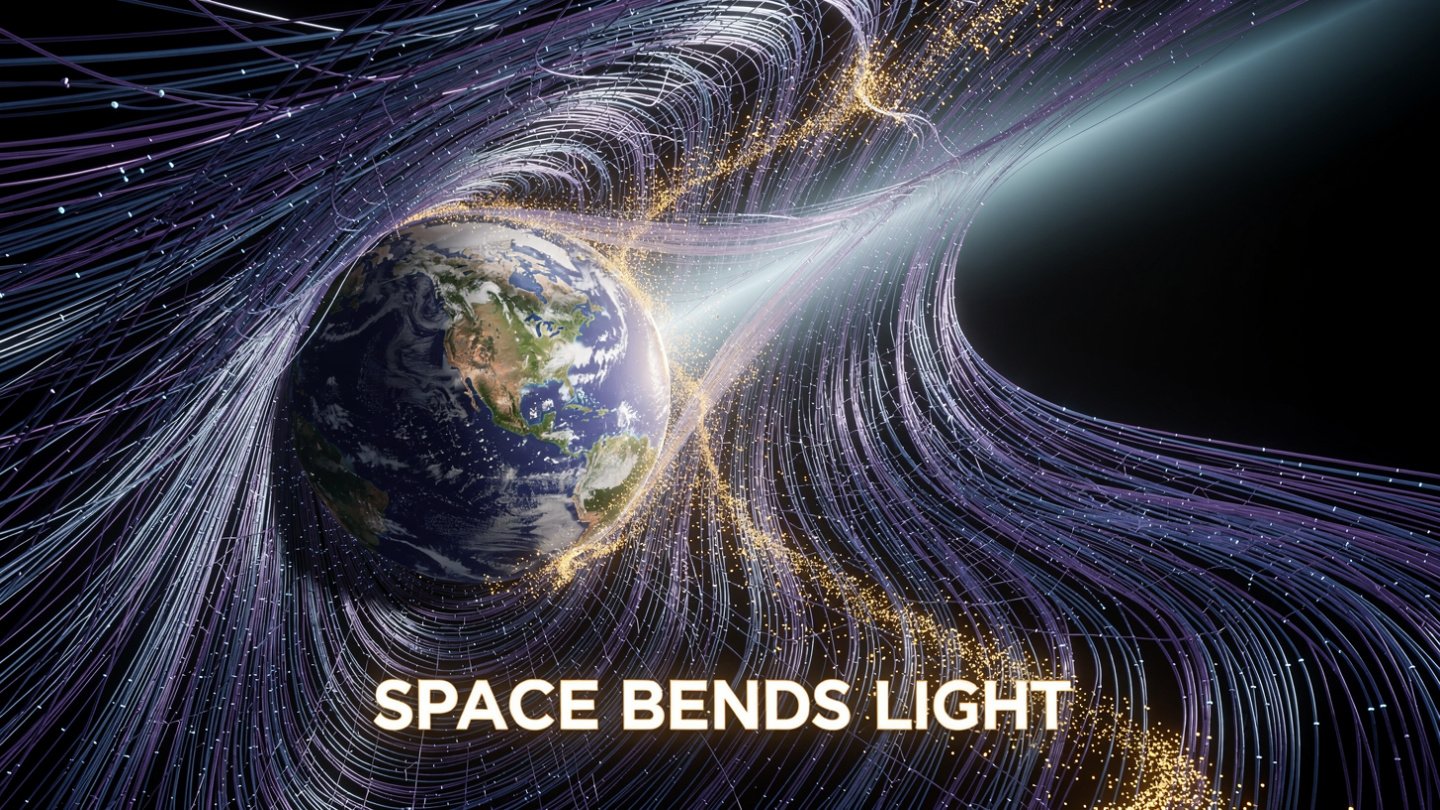
Why Gravity Bends Light That Has No Mass
There is a rule most people absorbed so early it stopped feeling like a rule. Gravity pulls on things with mass. The heavier the object, the stronger the pull. This is the version that arrives without ceremony, settles into the mind like furniture, and stays there. It is also, in a precise and consequential way, incomplete. Light carries no rest mass whatsoever. Under the Newtonian picture, gravity should have nothing to grab. And yet every major telescope ever pointed at a massive object has watched light bend around it. Not slightly. Not ambiguously. By a specific, calculable, repeatedly confirmed amount that depends on the mass doing the bending and the distance of closest approach. The rule was missing something. What it was missing turns out to be the shape of space itself.
What Newton Actually Said
Isaac Newton did not claim that gravity ignores light. The question of whether light could be gravitationally deflected appears in the first query of his Opticks, published in 1704, where he raised it carefully and did not calculate it. That calculation came a century later.
In 1801, a German mathematician named Johann Georg von Soldner worked through the problem using Newtonian mechanics. He treated light as a stream of tiny corpuscles with some effective mass, applied the gravitational force law, and computed the deflection of a light ray passing close to the sun. His result was 0.84 arcseconds.[1] The paper was published, noted by almost nobody, and filed.
Newton's gravitational force law states:
$$F = \frac{G m_1 m_2}{r^2}$$The problem is immediate. If light has no mass, then $m_1 = 0$, and $F = 0$. Soldner's approach required treating photons as though they had a tiny but nonzero effective mass, a convenient fiction that produced a real number. That number was wrong by a factor of exactly two. Not because Soldner made an error. Because the framework he was working inside was one layer short of the full picture.
The missing layer was not a correction to the force law. It was the recognition that space itself is not a fixed, neutral stage on which forces perform. Space participates. Near a massive object, the geometry of space changes. And that geometric change contributes an equal and independent amount to the bending of light, on top of the time-based effect that Newtonian reasoning could partially capture.
Soldner got half the answer correctly. He could not have known that half was missing.
The Thought That Took Eight Years to Finish
In 1907, Albert Einstein was working at a patent office in Bern when a thought arrived that he later described as the happiest of his life. It concerned a person in free fall. A person dropping freely, with nothing to interrupt the fall, would feel no weight. Not reduced weight. No weight at all. From inside the fall, gravity would be undetectable.
This observation, held carefully and turned over, became the equivalence principle: the effects of gravity are locally indistinguishable from the effects of acceleration. A person in a sealed room cannot determine, by any experiment available to them, whether they are stationary in a gravitational field or accelerating through empty space at the same rate.
The equivalence principle implies something immediate about light. If acceleration bends a light beam inside a sealed room (because the room moves while the photon crosses it), then gravity must also bend light. Einstein published this argument in 1911 and produced a predicted deflection of 0.83 arcseconds for light grazing the sun. Almost exactly Soldner's number, arrived at by completely different reasoning.
He was, again, half right.
The equivalence principle captures what gravity does to time. Clocks run slower in stronger gravitational fields, and this time distortion bends light. But spacetime is not just time. It is space and time unified, and space itself also curves near a massive object. The spatial curvature contributes an equal, independent amount to the deflection. The full theory, which Einstein completed in November 1915, accounts for both.
The correct deflection angle for a light ray passing a mass $M$ at closest approach distance $b$ is:
$$\theta = \frac{4GM}{c^2 b}$$For light grazing the sun, this gives 1.75 arcseconds. Exactly twice Soldner's value. The factor of two is not a rounding adjustment. It is the spatial curvature of spacetime, the layer that neither Newton nor the incomplete equivalence principle argument could reach.
What a Geodesic Actually Means
General relativity does not describe gravity as a force. There is no pull, no tether, no reaching between objects. What mass does is curve the geometry of the four-dimensional spacetime through which everything moves. What objects do, in response, is follow the straightest available path through that curved geometry.
That straightest available path has a name: a geodesic. On a flat surface, a geodesic is a straight line. On a curved surface, a geodesic is still the straightest possible path, but it curves when expressed in coordinates that assume flatness. A great circle on a globe is a geodesic. It bends, in the flat-map sense, because the surface it lies on bends.
Photons follow what are called null geodesics, defined by the condition that the spacetime interval $ds$ along their path equals zero:
$$ds^2 = g_{\mu\nu} \, dx^\mu \, dx^\nu = 0$$This zero-interval condition is what it means, mathematically, to travel at the speed of light. It defines the light cone and determines the specific shape of every photon path through every geometry. In flat spacetime, null geodesics are straight lines. In the curved spacetime of the Schwarzschild solution, the geometry around a single spherical mass, null geodesics bend near the mass by exactly the amount the field equations predict.
The photon is not being deflected. Nothing is reaching out to curve its path. The geometry of where it is has changed, and it is following the straightest available path through that changed geometry. The bending is not a response to a force. It is fidelity to a curved road.
The Island, the Eclipse, and the Plates
A prediction, however well-derived, is not a fact until it has been tested against the world. The test required a total solar eclipse, because only during totality could stars near the sun's edge be photographed against a dark sky, their apparent positions compared to reference photographs taken months earlier when the sun was not nearby. Any displacement in apparent position would be the signature of gravitational lensing.
In February 1919, two expeditions set out. Arthur Eddington and his team traveled to the island of Principe, off the west coast of Africa. A second team, led by Andrew Crommelin, traveled to Sobral, Brazil. Both locations fell within the path of totality on May 29, 1919.
Principe had clouds. Not total overcast, but enough to compromise most of the plates. A small number of usable images survived. From those, Eddington extracted stellar position measurements and compared them to the reference plates. The displacement was close to Einstein's prediction.[2]
The Sobral data was somewhat cleaner. The combined result, announced at a joint meeting of the Royal Society and the Royal Astronomical Society on November 6, 1919, supported the full general relativistic prediction over the Newtonian half-value.
The 1919 data was not perfectly clean by modern standards. There were error bars, systematic uncertainties, and legitimate questions about whether the result unambiguously distinguished Einstein's prediction from Newton's. Those questions were fair. The definitive confirmation came later, from radio interferometry in the 1970s and from the Hipparcos satellite in the 1990s, which confirmed Einstein's prediction to within one part in a thousand from stars nowhere near the sun's edge.
The number 1.75 arcseconds stopped being a prediction in stages. It became a fact slowly, through accumulated confirmation, the way all the best facts do.
Rings That Should Not Exist
If a massive object sits precisely on the line connecting a background light source to an observer, the spacetime curvature bends the source's light symmetrically in every direction. Light curves around the top, the bottom, the left, the right, all by the same geometry. At the observer, it arrives from all directions simultaneously, not as a point but as a circle. A thin luminous ring surrounding the lensing object, formed entirely from light that originated behind it.
Einstein calculated this effect in 1936 and then wrote, in the same paper, that it would never be observed. He was thinking of stellar-mass lenses, where the ring diameter would be microarcseconds, far below any detection threshold. He was not thinking about galaxy clusters.
The angular radius of an Einstein ring is given by:
$$\theta_E = \sqrt{\frac{4GM}{c^2} \cdot \frac{D_{ls}}{D_l D_s}}$$where $D_l$ is the distance to the lens, $D_s$ is the distance to the source, and $D_{ls}$ is the distance between them. For galaxy cluster masses of $10^{14}$ to $10^{15}$ solar masses, the Einstein radius reaches tens of arcseconds. Easily visible. The first confirmed ring was discovered in 1988, in radio observations with the Very Large Array, 52 years after Einstein called the effect unobservable.
The James Webb Space Telescope's COSMOS-Web survey, observing 42,660 galaxies for 255 hours, identified more than 400 candidate Einstein rings.[3] Some of them contain light from galaxies that existed when the universe was less than one billion years old. That light, without the intervening gravitational lens, would be undetectable from Earth. The lens redirected it toward us. The rings are, among other things, windows into a period of the universe that is otherwise closed.
What the Invisible Weighs
Gravitational lensing does not ask what kind of mass produces the curvature. Luminous matter, non-luminous matter, any distribution of mass-energy described by the stress-energy tensor on the right side of Einstein's field equations bends spacetime. Spacetime bends light. The light carries a record of the bending. The bending reveals the mass.
All of it. Not just the part that glows.
When astronomers calculate the mass of a galaxy cluster from its lensing geometry and compare it to the mass inferred from the visible stars and gas, the numbers do not match. The lensing mass exceeds the luminous mass by factors of five to ten. The difference is dark matter: matter that interacts gravitationally but produces no detectable electromagnetic radiation. Its identity is unknown. Its presence is unambiguous.
The Bullet Cluster makes this concrete. Two galaxy clusters have passed through each other. The hot intergalactic gas, the ordinary baryonic matter, was slowed by the collision and piled up between the two subclusters. The dark matter halos passed through each other essentially unimpeded, because dark matter does not interact electromagnetically. Gravitational lensing maps of the Bullet Cluster show mass concentrated where the dark matter ended up after the collision, not where the gas is. The mass is not where the light is.[4]
Massless photons, bending through curved spacetime, are currently the most sensitive instrument available for mapping the invisible majority of the universe's mass.
The Edge the Theory Knows About
General relativity has passed every experimental test applied to it for over a century. The precession of Mercury's orbit, gravitational time dilation, gravitational waves detected by LIGO in 2015, the shadow of M87's black hole imaged by the Event Horizon Telescope in 2019. Each prediction confirmed, each measurement consistent with the field equations.
The theory also contains a signal that it knows where its own limits are. At the center of a black hole, the equations produce a singularity: infinite density, infinite curvature, a point where the numbers exceed any physically meaningful measurement. The singularity is not a prediction about what exists. It is a flag indicating that the theory is being applied outside the domain where it is valid.
The domain where general relativity breaks down is the Planck scale, at approximately $1.6 \times 10^{-35}$ meters. At that scale, quantum effects and gravitational effects become simultaneously important, and neither framework alone, nor both applied together, produces a consistent description. Quantum field theory requires a fixed background spacetime. General relativity makes spacetime itself dynamic. The combination is not straightforward and has not been achieved despite nearly a century of serious effort.
String theory and loop quantum gravity are the leading candidates for a unified description. Neither has produced a confirmed empirical prediction. Both remain active areas of research without experimental resolution.
The photon that bends around a galaxy cluster is a quantum object following a classical path through a spacetime that no current theory fully describes at its deepest level. The classical description works. The quantum nature of the photon and the classical geometry of the spacetime it traverses coexist without conflict in this regime, because the scales involved do not require both simultaneously. Push to the extremes, and the coexistence ends.
What We Actually Know
Gravity bends light because gravity is not what the familiar rule said it was. It is not a force reaching between masses. It is the curvature of the four-dimensional geometry of spacetime, produced by the distribution of mass and energy, described by Einstein's field equations, confirmed by every instrument sensitive enough to check.
Light follows that curvature not because it is being pulled, but because the curvature defines what straight means in the geometry light is moving through. A photon near the sun follows the straightest available path through a curved spacetime and arrives at a detector displaced by 1.75 arcseconds from where it would have arrived if the sun were not there. That displacement is the whole story, compressed into a single measurable number.
The Newtonian picture was right about the direction and partially right about the magnitude. It captured the time-distortion component of spacetime curvature and missed the spatial component entirely, because it had no concept of spatial curvature to miss. The full geometry gives both contributions, which happen to be equal, which is why the correct answer is exactly twice the Newtonian one.
The rings that Einstein called unobservable now appear in the hundreds in a single telescope survey. They reveal dark matter, magnify the early universe, and carry precise information about the geometry of spacetime across billions of light-years. The bending of massless light is not a footnote to gravitational theory. It is one of the primary instruments through which the structure of the universe is being read.
The rule from the beginning, the furniture-rule, was not wrong in the places it was used. It was wrong in the places nobody thought to look, which is, characteristically, where the interesting physics turned out to be.
[1] Soldner, J.G. von (1804). "On the deflection of a light ray from its straight motion by the attraction of a celestial body." Berliner Astronomisches Jahrbuch. His result of approximately 0.84 arcseconds is almost exactly half of the general relativistic value, derived correctly from Newtonian assumptions.
[2] Dyson, F.W., Eddington, A.S., Davidson, C. (1920). "A determination of the deflection of light by the sun's gravitational field, from observations made at the total eclipse of May 29, 1919." Philosophical Transactions of the Royal Society A, 220, 291-333. The primary publication of the expedition results.
[3] COSMOS-Web Lens Survey (COWLS II), arXiv 2503.08782. The survey visually inspected over 42,660 galaxies and identified 17 spectacular strong lensing systems in addition to hundreds of candidates across the full field.
[4] Clowe, D. et al. (2006). "A direct empirical proof of the existence of dark matter." The Astrophysical Journal Letters, 648, L109. The Bullet Cluster paper providing the clearest direct evidence that the lensing mass and the luminous mass are spatially separated.
Comments (0)
Leave a Comment