Why the Universe May Repeat Itself Forever
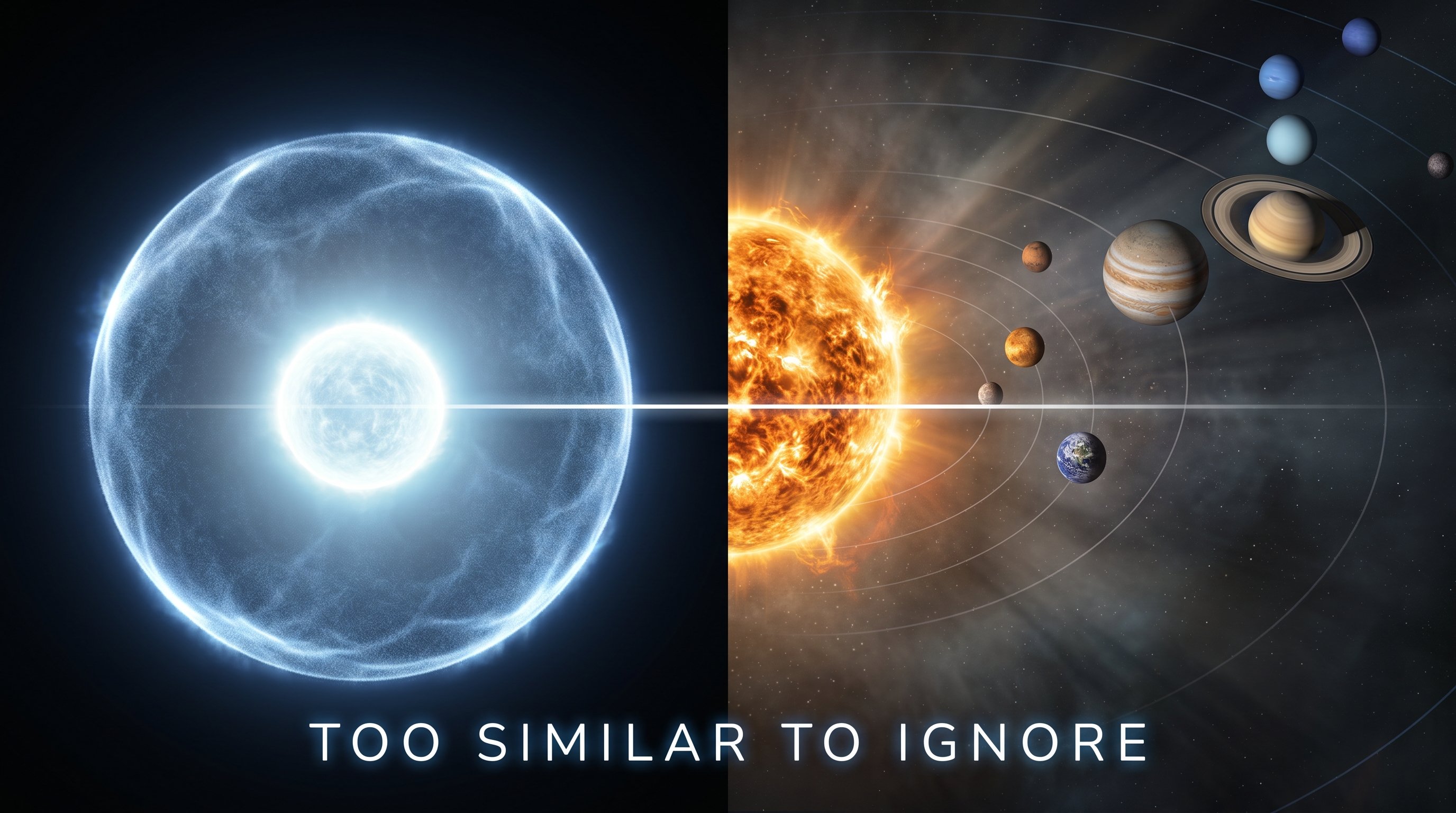
Press your palm flat against a table. Feel the resistance of it. Whatever the table is made of, it pushes back with a consistency that feels absolute. Like there is genuinely something there. There is not. Not in the way it feels. The atom your hand is pressing against is almost entirely empty space, with a nucleus so small relative to the whole that if you scaled the atom to the size of a football stadium, the nucleus would be a marble at the centre. Everything solid you have ever touched is held together not by matter touching matter, but by the electromagnetic repulsion between electron clouds that never actually meet. And when you zoom out from that atom to a solar system, and then to a galaxy, and then to the full observable universe, the same structural logic keeps reappearing: a dense centre, orbiting bodies at enormous relative distances, and a vast proportion of nothing holding the pattern together. This is either the most elaborate coincidence in the history of science, or it is a clue.
What a Fractal Is, Precisely
The word fractal entered the scientific vocabulary in 1975 when Benoit Mandelbrot coined it from the Latin fractus, meaning broken or irregular. It describes a structure that exhibits self-similarity across scales: the same statistical properties hold whether you are looking at the whole or at any part of it. A fractal is not just something that looks similar at different zoom levels. It is something whose measurable properties, specifically how its content scales with the size of the region you measure, follow a consistent mathematical rule across many orders of magnitude.
The formal measure is the fractal dimension D. For an ordinary three-dimensional homogeneous distribution, the number of objects $N$ within a sphere of radius $r$ scales as:
$$N(r) \propto r^3$$For a fractal distribution, the exponent is less than 3:
$$N(r) \propto r^D \quad \text{where } D < 3$$A dimension of 2 means objects are concentrated on surfaces and filaments rather than filling volume uniformly. A dimension of 1 means they concentrate along lines. When Luciano Pietronero analysed galaxy catalogues in 1987, he found $D \approx 2$ across the available survey range.[1] Galaxies were not filling space uniformly. They were clustering on surfaces and threads in a way that had a measurable, scale-invariant structure. The debate that followed was not about whether the fractal structure existed. It was about how far it extended.
Fractals appear throughout nature without anyone designing them in. The branching of the human lung follows the same ratio from the trachea down to structures too small to see without a microscope. River deltas and lightning strikes leave the same tree-shaped trace. The surface of a cauliflower repeats the same bulb shape at three or four nested scales. These are not metaphors for a fractal universe. They are examples of what happens when a simple rule, applied repeatedly under consistent conditions, generates structure at every scale it is given access to.
The Atom and the Solar System
Ernest Rutherford's 1911 gold-foil experiment is one of the more disorienting results in the history of physics. Firing alpha particles at a thin sheet of gold, his team expected minor deflections consistent with a diffuse, evenly distributed atomic structure. Most particles passed straight through. But some bounced back at angles greater than ninety degrees, as if they had struck something solid inside what was supposed to be a cloud of charge. The conclusion was unavoidable: almost all the mass of an atom sits in a tiny, dense nucleus at the centre, surrounded by an enormous relative emptiness.
The proportions are specific enough to be worth stating precisely. A proton has a radius of approximately $1 \text{ fm}$ ($1 \times 10^{-15}$ m). The electron orbits at the Bohr radius, approximately $5.29 \times 10^{-11}$ m. The ratio of orbital radius to nuclear radius is:
$$\frac{a_0}{r_p} \approx \frac{5.29 \times 10^{-11}}{1 \times 10^{-15}} = 52{,}900$$Scale that up. If the proton were one centimetre across, the electron would be orbiting roughly 500 metres away. The atom, in that model, would be nearly a kilometre in diameter, with nothing in between.
The Sun has a radius of approximately $6.96 \times 10^8$ m. Earth orbits at roughly $1.50 \times 10^{11}$ m. The ratio:
$$\frac{r_\text{Earth orbit}}{R_\odot} \approx \frac{1.50 \times 10^{11}}{6.96 \times 10^8} \approx 215$$The ratios are not identical. The solar system is not a scaled copy of a hydrogen atom. But the structural logic is the same: mass concentrated at the centre, an orbiting body at a distance that makes the total system mostly empty, a different force holding the relationship together at each scale. This is the observation that motivates the fractal universe hypothesis, and it is worth being precise about what it does and does not prove. It proves a structural parallel. It does not prove a causal connection. Those are different claims, and conflating them is where most popular coverage of this topic goes wrong.
The Cosmic Web and Its Fractal Signature
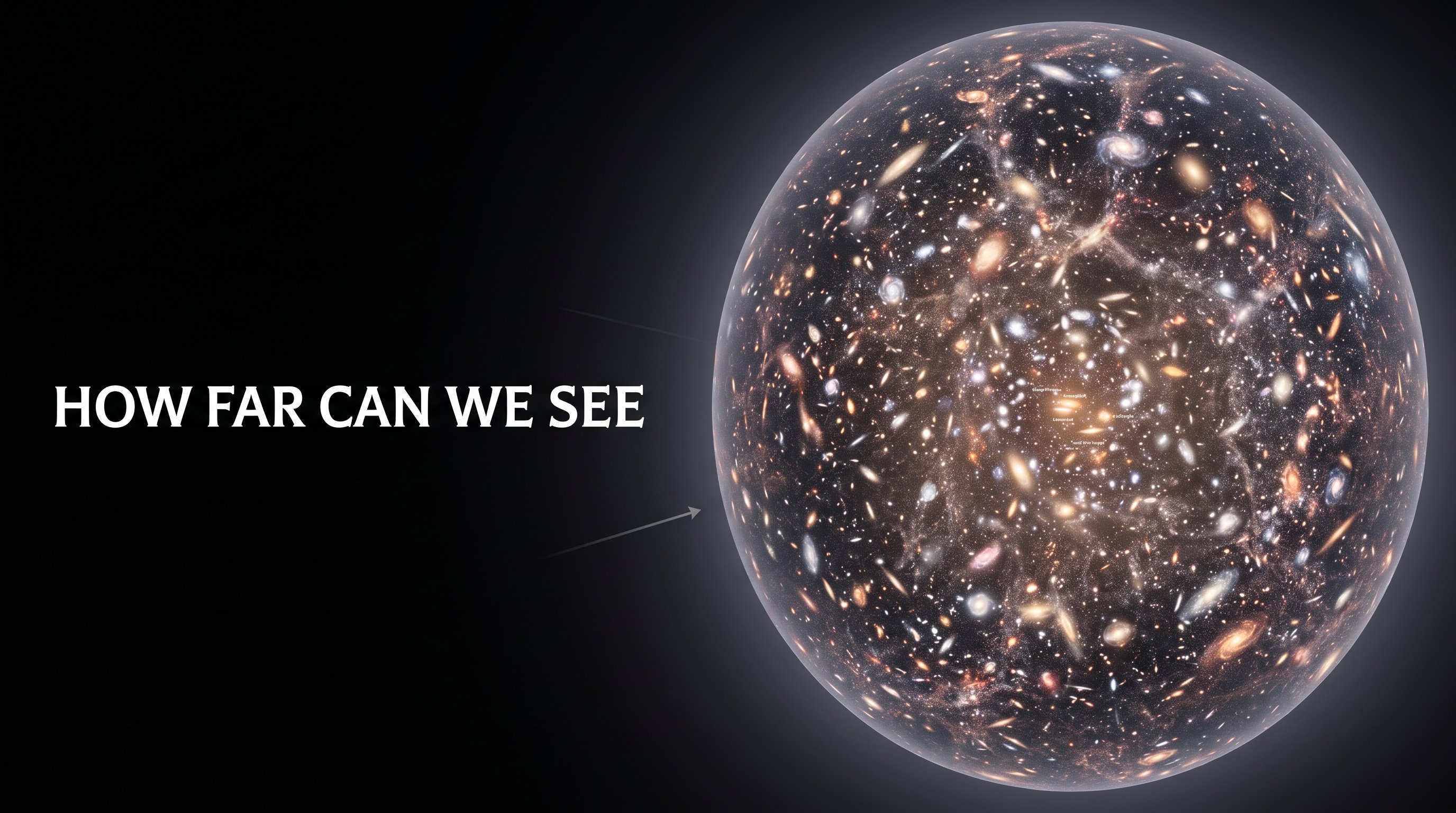
The large-scale structure of the universe is not random scatter. Mapped in three dimensions through redshift surveys, matter arranges itself into a network of filaments, sheets, and nodes surrounding enormous empty voids. Galaxy clusters sit at nodes where multiple filaments intersect. Filaments stretch across tens to hundreds of millions of light-years. Voids occupy most of the universe by volume, some spanning hundreds of millions of light-years of near-emptiness. The whole structure is called the cosmic web, and it was not predicted in detail before it was observed.[2]
The fractal signature in this structure is measurable. Pietronero's 1987 result found $D \approx 2$ across the survey range available at the time. The Sloan Digital Sky Survey, analysed by Yadav et al. in 2005, confirmed fractal behaviour below approximately $70\ h^{-1}$ Mpc and a transition toward homogeneity above that range.[3] The WiggleZ Dark Energy Survey confirmed both sides in 2012: fractal structure at small scales, smooth distribution at large scales, with a crossover consistent with Lambda-CDM predictions.[4]
The scale at which structure gives way to uniformity is called the End of Greatness, occurring at roughly 100 Mpc, or approximately 300 million light-years. Above this scale, the universe becomes statistically homogeneous. The mechanism enforcing this ceiling is dark energy: the accelerated expansion of space prevents gravity from organising matter into coherent structures at larger scales. The ceiling is real, physical, and explained.
What the ceiling does not explain is the direction downward. Dark energy caps structure formation upward. It says nothing about whether the same self-similar logic continues through scales smaller than the cosmic web, through the physics of individual galaxies, through stellar formation, through atomic structure, through whatever sits at the Planck length. The surveys answer what they answer. Below their range, different physics operates, and the question of whether the structural habit persists is one those surveys were not built to address.
Dark Matter Halos: A Fractal Nobody Designed
In 1996 and 1997, Julio Navarro, Carlos Frenk, and Simon White published the results of dark matter simulations that would become among the most cited papers in cosmology. Running simulations of collisionless dark matter particles collapsing under gravity across a wide range of conditions, they found that the density profile of the resulting halos was universal. Regardless of halo mass, regardless of cosmological model, regardless of formation history, the same mathematical curve described every halo:
$$\rho(r) = \frac{\rho_s}{\left(\frac{r}{r_s}\right)\left(1 + \frac{r}{r_s}\right)^2}$$Density falls as $1/r$ near the centre and as $1/r^3$ at large radii. A halo the mass of a dwarf galaxy and a halo the mass of a galaxy cluster follow the same curve, scaled.[5] This is scale invariance: the same physical relationship holding across six or more orders of magnitude in mass.
As simulation resolution increased, sub-halos appeared inside the larger halos, each following the same NFW profile scaled down. Inside the sub-halos, smaller concentrations still, following the same profile again. A nested hierarchy of dark matter structures, all obeying the same density law at every level, down to the resolution limit of whatever computer was running the simulation. Nobody put this in. It emerged from gravity operating the same way at every scale. The nesting runs up against the resolution floor of current computing with no physical indication it would stop if the resolution were higher.
Three Researchers Who Refused to Look Away
The fractal universe has always been a minority position. What makes it unusual is the quality of the researchers who have occupied it and the consistency of their results across decades of scrutiny.
Pietronero published his galaxy distribution data in 1987 and spent years defending it against a field that argued better surveys would reveal the homogeneity he was not finding. Better surveys arrived. The fractal structure at intermediate scales held.
Mandelbrot proposed what he called the Conditional Cosmological Principle: the universe is not homogeneous but is statistically self-similar. Every galaxy sees the same fractal clustering pattern around it, with no preferred centre, preserving the spirit of the cosmological principle while allowing genuine large-scale inhomogeneity. The mainstream did not adopt it. It has not disappeared either.
Robert Oldershaw has been developing Discrete Scale Relativity since 1976, arguing for exact self-similarity between the atomic, stellar, and galactic scales of nature. In his framework, the proton maps to the Sun. Stars map to galaxies. The scaling factor between adjacent levels is approximately $5.2 \times 10^{17}$. He has generated over twenty specific, testable predictions. A pulsar-white dwarf binary system with a total mass of 2.182 solar masses matched a DSR prediction of 2.175 solar masses to within observational uncertainty.[6] This is not proof. It is consistently not-disproof, across decades of attempted falsification, which is its own kind of result.
What Happens at the Very Bottom of Reality
Causal Dynamical Triangulation (CDT) is an approach to quantum gravity developed by Renate Loll, Jan Ambjorn, and Jerzy Jurkiewicz. It constructs spacetime from tiny four-dimensional building blocks assembled under a strict causal constraint and uses quantum mechanical path integrals to determine how they combine. At large scales, CDT produces four-dimensional spacetime consistent with general relativity. At small scales, near the Planck length, it finds something different.
The spectral dimension $D_s$ of the simulated spacetime, defined as:
$$D_s = -2\frac{d \ln P(\sigma)}{d \ln \sigma}$$where $P(\sigma)$ is the return probability of a diffusion process at time $\sigma$, drops from approximately 4 at large scales to approximately 2 near the Planck scale.[7] A best-fit curve describing the transition:
$$D_s(\sigma) = 4.02 - \frac{119}{54 + \sigma}$$This scale-dependent dimensionality is a fractal behaviour. Spacetime at the Planck scale is not a smooth four-dimensional manifold. It is something rougher, something whose effective dimensionality depends on how finely you probe it. This result has since been independently reproduced in asymptotic safety quantum gravity and loop quantum gravity, suggesting it may be a robust feature of any consistent quantum theory of gravity rather than an artefact of one computational approach.[8]
The fractal appears at the bottom of reality as far as current theory can reach. It also appears at the top, in the large-scale structure of the cosmic web. The smooth, classical, four-dimensional universe we inhabit is the intermediate regime, the scale between two fractal limits.
The Hercules-Corona Borealis Great Wall
The cosmological principle implies that no coherent cosmic structure should exceed approximately 1.2 billion light-years. The reasoning is straightforward: the universe is 13.8 billion years old, and gravity operating in a homogeneous universe simply cannot organise matter into anything larger than that in the available time.
In 2013, a Hungarian research team identified a concentration of gamma-ray bursts spanning roughly 10 billion light-years in the direction of the constellations Hercules and Corona Borealis. A 2025 reanalysis extended the estimated size to approximately 15 billion light-years.[9] If accurate, the Hercules-Corona Borealis Great Wall is eight to twelve times larger than the theoretical maximum for any coherent structure in a homogeneous universe.
The authors have been careful. The structure may be a projection effect, several smaller concentrations aligned along the line of sight. The gamma-ray burst sample sizes are small by cosmological standards. The statistical methods carry uncertainties that more direct galaxy mapping would not. These are legitimate caveats.
The structure has been revised upward, not downward, with better data. Something is there. What it means for the cosmological principle, and for the fractal hypothesis that predicts structures larger than Lambda-CDM allows, is genuinely unresolved.
The Universe and the Brain
In 2020, astrophysicist Franco Vazza and neurosurgeon Alberto Feletti published a quantitative comparison of the cosmic web and the human cerebellum in Frontiers in Physics. Using spectral density analysis, the same technique cosmologists apply to galaxy distributions, they compared the two networks across their respective spatial scales.[10]
The distribution of fluctuations in the cerebellar neuronal network, measured across scales from 1 micrometre to 0.1 millimetres, follows the same progression as the distribution of matter in the cosmic web across scales from 5 million to 500 million light-years. Clustering coefficients and degree centrality metrics fell in comparable ranges for both systems. The scale difference between the two networks is approximately 27 orders of magnitude.
The physical processes producing the two structures are completely different. The authors were explicit about this. Structural similarity does not imply causal connection, shared mechanism, or deeper meaning. What it shows is that diverse physical processes can produce networks with similar levels of complexity and self-organisation.
Inflation's Fractal Multiverse
Cosmic inflation is the leading explanation for the flatness, uniformity, and quantum-seeded structure of the observable universe. The evidence supporting some version of inflation is substantial: the near-perfect uniformity of the cosmic microwave background, the flatness of spatial curvature, and the specific pattern of CMB fluctuations that match inflationary predictions to high precision.
In 1986, Andrei Linde showed that in chaotic inflation, quantum fluctuations continuously push regions of the inflating field back up its potential energy curve, preventing inflation from ending globally. Regions where inflation ends become pocket universes. The inflating bulk surrounding them never exhausts itself, continuing to produce new pockets indefinitely. The structure this generates is a self-reproducing fractal tree: pocket universes embedded in an inflating bulk that produces more pocket universes, each containing regions where the same process may repeat.[11]
Our observable universe is, in this model, one reheated pocket among an infinite ensemble. Not special in position, not special in size, not special in physical laws. One node in a branching structure without a highest level or a lowest one.
The Holographic Boundary
The holographic principle, proposed by Gerard 't Hooft in 1993 and developed by Leonard Susskind, states that the information content of any three-dimensional volume of space is fully encoded on its two-dimensional boundary surface. The maximum information density is one bit per Planck area, approximately $1.4 \times 10^{69}$ bits per square metre.
Juan Maldacena's 1997 AdS/CFT correspondence made this mathematically precise.[12] A theory of gravity in five-dimensional Anti-de Sitter space is exactly equivalent to a four-dimensional conformal field theory on its boundary. The two theories compute the same physical quantities because they describe the same physical reality from different perspectives. By 2015, Maldacena's paper had over 10,000 citations.
The Bekenstein-Hawking entropy formula, which initiated this line of thinking, connects black hole entropy to horizon area:
$$S_{BH} = \frac{A}{4G\hbar/c^3}$$where $A$ is the area of the event horizon, $G$ is the gravitational constant, $\hbar$ is the reduced Planck constant, and $c$ is the speed of light. Entropy scales with surface area, not volume. Information is stored on the boundary.
If the three-dimensional depth of space is emergent from a two-dimensional encoding, the question of what encodes that boundary is a genuine one. And if the answer is itself a surface, another level of nesting appears. The holographic principle does not predict an infinite fractal of nested realities. It does not preclude one. It establishes that the relationship between a volume and its boundary is not the simple one we assumed.
What We Actually Know
The fractal universe, in its strongest form, is not the consensus position. That is worth stating plainly. The cosmological principle, supported by CMB uniformity, galaxy survey homogeneity at large scales, and the predictive success of Lambda-CDM, is the foundation of standard cosmology for good reasons.
What the data does support, clearly and without serious dispute:
- The galaxy distribution exhibits fractal-like behaviour with $D \approx 2$ at scales below approximately 300 million light-years, confirmed by SDSS, WiggleZ, and subsequent surveys.
- Dark matter halos nest inside larger dark matter halos, each following the same universal NFW density profile, in a self-similar hierarchy that emerged from simulations without being designed into them.
- Causal Dynamical Triangulation, asymptotic safety quantum gravity, and loop quantum gravity independently find that the spectral dimension of spacetime drops from 4 to approximately 2 near the Planck scale.
- The Hercules-Corona Borealis Great Wall, if confirmed as a coherent structure, is 8 to 12 times larger than the cosmological principle allows.
- The cosmic web and the human cerebellum share quantitatively similar spectral density distributions and network topology metrics across a scale difference of 27 orders of magnitude.
What cannot be determined with current instruments: whether the pattern continues below the scale of atomic physics, whether there is a cosmos inside a proton, whether the fractal extends above the observable universe, and whether the nested structures found at large and small scales are connected by anything other than the coincidence of gravity producing similar patterns under similar conditions.
The pattern arrives uninvited, repeatedly, across unconnected datasets, through unconnected methods, from researchers who were not looking for it. That does not make the fractal universe hypothesis correct. It makes the pattern worth taking seriously, and the question worth keeping open.
No instrument can look inside a proton and find a cosmos. The energy required to probe the relevant scales exceeds anything achievable, possibly by any technology. Some questions live permanently at the edge of what is knowable. This one does. The edge is not a wall. It is where the known stops and something continues past it that has not yet been reached.
[1] Pietronero, L. (1987). The fractal structure of the universe. Physica A, 144(2-3), 257-284.
[2] de Lapparent, V., Geller, M.J., and Huchra, J.P. (1986). A slice of the universe. Astrophysical Journal Letters, 302, L1-L5. First observational evidence of the cosmic web structure.
[3] Yadav, J., Bharadwaj, S., Pandey, B., and Seshadri, T.R. (2005). Testing homogeneity on large scales in the SDSS Data Release One. Monthly Notices of the Royal Astronomical Society, 364(2), 601-606.
[4] Blake, C. et al. (2011). The WiggleZ Dark Energy Survey. Monthly Notices of the Royal Astronomical Society, 418(3).
[5] Navarro, J.F., Frenk, C.S., and White, S.D.M. (1996). The structure of cold dark matter halos. Astrophysical Journal, 462, 563-575.
[6] Oldershaw, R.L. (2007). Discrete Scale Relativity. arXiv:physics/0701132.
[7] Ambjorn, J., Jurkiewicz, J., and Loll, R. (2005). Reconstructing the Universe. Physical Review D, 72(6), 064014.
[8] Carlip, S. (2017). Dimension and dimensional reduction in quantum gravity. arXiv:1705.05417.
[9] Horvath, I., Hakkila, J., and Bagoly, Z. (2015). New data support the existence of the Hercules-Corona Borealis Great Wall. Astronomy and Astrophysics, 584, A48.
[10] Vazza, F. and Feletti, A. (2020). The quantitative comparison between the neuronal network and the cosmic web. Frontiers in Physics, 8, 525731.
[11] Linde, A.D. (1986). Eternally existing self-reproducing chaotic inflationary universe. Physics Letters B, 175(4), 395-400.
[12] Maldacena, J. (1997). The large N limit of superconformal field theories and supergravity. International Journal of Theoretical Physics, 38(4), 1113-1133.
Comments (0)
Leave a Comment