Why Energy Cannot Be Destroyed
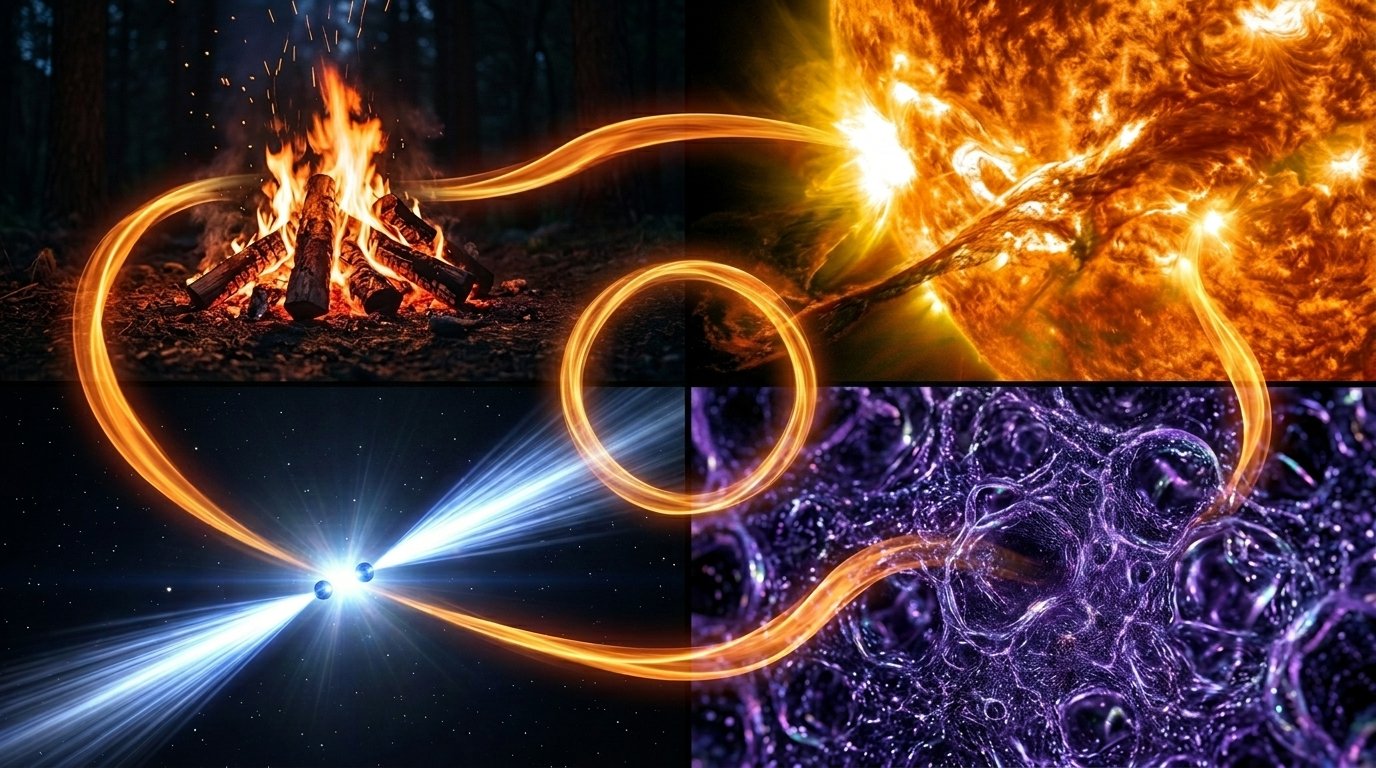
Every day, you watch energy disappear. The phone dies. The fire goes cold. The food runs out. And because this happens so constantly, so reliably, it stops feeling like something worth questioning. Energy runs out. That is just what it does. Except it does not. Not even slightly. What looks like disappearance is always transformation so complete that the original form is unrecognisable, but the total, measured across every form simultaneously, never changes by a single joule. The conservation of energy is not a guideline or a working assumption. It is the most precisely tested claim in the history of experimental science, confirmed without a single exception across two centuries of increasingly sensitive measurement. Understanding why it is true, not just that it is true, leads somewhere unexpected: to a mathematician in Gottingen in 1918, to the nature of time itself, and to the edge of what physics can currently say.
The Wrong Idea That Had to Die First
Before conservation of energy could be built, a different and surprisingly elegant theory had to be dismantled. For most of the 18th century, the dominant framework for understanding heat was the caloric theory: the idea that heat was a real, physical substance, a weightless self-repelling fluid called caloric that flowed from hotter bodies into cooler ones.[1]
This was not fringe thinking. Antoine Lavoisier, who identified oxygen and constructed the foundations of modern chemistry, listed caloric in his table of chemical elements alongside hydrogen and nitrogen. He formalised the theory between 1768 and 1787. The framework had genuine explanatory power: it accounted for thermal equilibrium, it explained why heat conducted through materials at different rates, and it made testable predictions. Wrong theories are often productive for exactly this reason, which is why they take so long to die.
The crack appeared in 1798, in the Royal Arsenal in Munich. Benjamin Thompson, Count Rumford, was overseeing the boring of cannon barrels when he noticed that the friction generated heat apparently without limit. No caloric was being depleted. The metal lost no mass. He designed a direct test: a cannon barrel submerged in a box of water, rotated against a deliberately blunted boring tool driven by two horses. After two and a half hours, the water boiled. No fuel. No fire. No chemical reaction. Just friction, applied continuously, producing heat with no apparent ceiling.
A substance should run out. Caloric did not run out. Rumford wrote it down in flat, careful sentences and left the implication visible without forcing it. The theory could not absorb the result. It tried, for a few more decades, through qualifications and edge-case adjustments, before finally collapsing under the weight of what came next.
Two Men Who Built the Law From Different Directions
James Joule was home-schooled, trained as a brewer, and constitutionally incapable of accepting imprecise measurement. Throughout the 1840s he ran variations of the same experiment: a paddle wheel inside a container of water, connected by a string to a falling weight. The weight descended, the paddle turned, the water warmed. The temperature rise was tiny, the kind of change a less patient experimenter would attribute to ambient variation and move on. Joule measured it anyway, refined the apparatus, and ran it again. And again.
What he established was the mechanical equivalent of heat: 4.2 joules of mechanical work raises one kilogram of water by one degree Celsius. Not approximately. The exchange rate between motion and heat was fixed and exact. His result, confirmed and refined by subsequent repetition, gave physics the unit that now bears his name.
Julius von Mayer arrived at the same conclusion from a cargo ship in the Java Sea in 1840. As ship's physician, he drew blood from Dutch sailors in the tropics and found the venous blood distinctly redder than in European patients. He reasoned that less oxygen had been consumed because the warm climate reduced the body's need to produce internal heat. Tracing that logic outward, he concluded that the body's heat and the sun's heat must be interchangeable expressions of one quantity, and that all forms of energy, heat, motion, light, must therefore be the same thing appearing in different forms.[2]
A physician on a cargo ship, reasoning from the colour of blood, had outlined the conservation of energy before most physicists had framed the question. His paper was rejected by two journals. He kept writing anyway.
Hermann von Helmholtz unified both lines of evidence in 1847, showing that the conservation principle was not specific to heat or to mechanics but applied across every branch of physics simultaneously. Before Helmholtz, there were several observations that rhymed with each other. After him, there was one law with several consequences.
What the Law Actually Says
The first law of thermodynamics is often summarised as "energy cannot be created or destroyed." That summary is accurate but collapses several important distinctions. The formal statement is more careful:
$$\Delta U = Q - W$$The change in internal energy of a system equals the heat added to the system minus the work done by the system on its surroundings. For a truly isolated system, where no heat enters and no work is done across the boundary, both terms are zero:
$$\Delta U = 0$$The internal energy does not change. Not approximately. Not on average. Exactly. The law applies precisely to isolated systems, meaning systems where no energy or matter crosses the boundary. The universe as a whole is the only entity that fully meets this definition without qualification.
Energy appears in nine distinguishable forms: kinetic, gravitational potential, elastic, chemical, thermal, electrical, electromagnetic, nuclear, and mass-energy. Each is a different expression of the same underlying conserved quantity. A stone falling from a cliff converts gravitational potential energy to kinetic energy. A burning log converts chemical energy to thermal and electromagnetic energy. A positron meeting an electron converts the rest-mass energy of both particles to two gamma-ray photons. In every case, the total across all forms is unchanged.
What the law absolutely forbids is a system producing energy that was not already there. Six centuries of attempts to build perpetual motion machines, machines that would generate more energy than they consumed or extract all the heat from a single reservoir as useful work, have failed without exception. By the 19th century, the French Academy of Sciences formally stopped reviewing such proposals. Not from intellectual closure, but from the accumulated weight of a pattern consistent enough to have earned the status of a law.
The Deepest Explanation: Symmetry and Time
Observing that energy is conserved is one thing. Explaining why it must be is another, and the explanation took until 1918. It came from Emmy Noether, a mathematician working in Gottingen who had been invited by David Hilbert to resolve an apparent energy violation in Einstein's general relativity. Rather than solving the specific problem, she solved the general one.
Noether's theorem states that every continuous symmetry of a physical system corresponds to a conserved quantity.[3] The relevant symmetry for energy conservation is time-translation symmetry: the fact that the laws of physics are the same today as they were yesterday and will be tomorrow. If the action $S$ of a system is invariant under the transformation $t \to t + \varepsilon$, then the total energy is conserved:
$$\frac{dE}{dt} = 0$$This is not an observed pattern elevated to law. It is a mathematical consequence of a prior structural fact about time. Conservation of energy and time-translation symmetry are the same statement expressed in different languages. You cannot have one without the other.
The implication runs in both directions. In the expanding universe, the background geometry of spacetime changes over time. The rules governing a physical process one billion years ago operated in a measurably different spacetime than the rules today. Time-translation symmetry, at cosmological scales, is broken by the expansion itself. By Noether's own theorem, this means energy is not strictly conserved at those scales. The law does not fail; its precondition is absent. The theorem predicts both where conservation holds and where it does not, from the same mathematics.
Mass Is Energy at Rest
Einstein's 1905 result is most often encountered as a statement about nuclear weapons. It is better understood as a statement about what matter is.
$$E = mc^2$$Every object at rest contains energy proportional to its mass, scaled by the speed of light squared. The speed of light is approximately $3 \times 10^8$ metres per second, so $c^2$ is approximately $9 \times 10^{16}$ metres squared per second squared. One kilogram of any substance contains roughly $9 \times 10^{16}$ joules of rest energy, approximately 25 million megawatt-hours.[4]
The distinction between matter and energy is not a fundamental physical boundary. It is a category that makes sense at human scales and dissolves under the right conditions. The Sun converts approximately 600 million metric tonnes of hydrogen into helium every second. Of that, roughly 4 million metric tonnes, just 0.7% of the reacting mass, is converted to pure energy via the mass-energy relation. That fraction, applied at stellar scale, produces a luminosity of approximately $3.8 \times 10^{26}$ watts. The conservation law holds through all of it: the total mass-energy before each fusion reaction equals the total mass-energy after, exactly.
Pair annihilation makes the same point more directly. An electron and a positron, meeting under ordinary conditions in ordinary tissue inside a hospital's PET scanner, both vanish. In their place: two gamma-ray photons, each carrying exactly 0.511 MeV, travelling in precisely opposite directions.[5] The photon energies equal the rest-mass energy of both particles combined. The conservation is exact. The matter-energy boundary, treated as absolute in everyday experience, simply was not there.
Quality, Not Quantity: The Second Law
The first law fixes the quantity of energy. The second law governs something else: the quality, the degree to which the energy present in a system is available to do useful work.
Entropy, $S$, measures the number of microscopic configurations that produce a given macroscopic state. Systems evolve toward states that can be achieved in more ways, because those states are statistically overwhelmingly more probable. In any irreversible process, entropy increases:
$$dS \geq \frac{dQ}{T}$$The inequality holds for irreversible processes; equality holds only for idealised reversible ones. For an isolated system where no heat enters, $dQ = 0$, giving $dS \geq 0$: entropy never decreases.
When a log burns, every joule is accounted for by the first law. The chemical energy becomes thermal energy in the air and ash and rising gases. Nothing is lost. But the energy that was tightly organised in molecular bonds, a form from which useful work could be extracted, is now dispersed as the barely perceptible warmth of a slightly warmer room. Gathering it back into a useful concentration would cost more work than the fire produced. The quantity is unchanged. The availability is gone.
Rudolf Clausius stated the endpoint in 1865: the entropy of the universe tends toward a maximum. The implication drawn by Kelvin and Helmholtz independently was the heat death: a future in which all useful energy gradients have been erased, all temperatures equalised, all processes stopped. The total energy of the universe at that state will be exactly what it is now. Every joule, conserved in full, present everywhere at uniform density, incapable of driving any process. The conservation law holds through the end of everything. It does not prevent that end.
The Floor That Cannot Be Reached
Classical physics predicted that cooling a substance far enough would bring its particles to complete rest. Quantum mechanics disagrees, and the disagreement is not subtle.
The Heisenberg uncertainty principle states that the position $x$ and momentum $p$ of a particle cannot simultaneously have precise, definite values:
$$\Delta x \cdot \Delta p \geq \frac{\hbar}{2}$$A particle at rest at a specific location would have $\Delta p = 0$ and a defined position, simultaneously. This is forbidden. Every quantum system therefore has a minimum energy state above zero, the zero-point energy, that cannot be removed by any physical process. For the quantum harmonic oscillator, the ground state energy is:
$$E_0 = \frac{1}{2}\hbar\omega$$This is not a residue of imperfect cooling technique. It is a structural feature of quantum mechanics. The vacuum of quantum field theory consists of an infinite collection of such oscillators, one for each field mode, each contributing zero-point energy to the vacuum energy density. The vacuum is not empty. It seethes with irreducible activity that cannot be switched off.
The reality of vacuum energy is not purely theoretical. Two uncharged metal plates placed extremely close together in a near-perfect vacuum attract each other. The mechanism: the plates restrict which vacuum fluctuation modes can exist between them while the exterior has no such restriction. The resulting pressure imbalance, the Casimir effect, predicted by Hendrik Casimir in 1948 and confirmed experimentally, is now an engineering consideration in nanoscale devices.[6] Casimir forces cause components to stick together in microelectromechanical systems at separations below one micrometre. The vacuum is doing this. The conservation law holds through it. The zero-point energy cannot be extracted precisely because it is the floor.
Liquid helium makes the same point visibly. Under normal atmospheric pressure, helium remains liquid at absolute zero. Its atoms carry enough zero-point energy that the interatomic attractions cannot lock them into a solid lattice. To solidify helium, pressure must be applied, approximately 25 atmospheres, forcing the atoms close enough that attractions overcome quantum motion. Temperature alone will never do it. The conservation law's floor is holding the liquid open.
Where the Law Goes Quiet
The CMB photons released at recombination, 380,000 years after the Big Bang, when the universe cooled enough for electrons to settle into orbits and light to travel freely for the first time, carry today approximately 0.1% of the energy they had at emission. The expansion of space stretched their wavelengths by a factor of roughly 1,100, shifting them from the visible and near-infrared into the microwave range. The other 99.9% has no accounting entry. It did not transfer to another form. It did not go anywhere definable. It is simply gone, in the specific and uncomfortable sense that no conservation equation closes over it.[7]
The explanation is contained in Noether's theorem, which gave the conservation law and now provides the exception. The expanding universe breaks time-translation symmetry: the physics governing any process today operates in a different spacetime geometry than the physics governing the same process a billion years ago. By the theorem's own logic, where the symmetry is absent, the conserved quantity does not exist. Energy is not conserved at cosmological scales not because the law fails but because the law's precondition, the sameness of the rules across time, is not satisfied.
Dark energy introduces a further difficulty. The density of dark energy per unit volume appears to remain approximately constant as the universe expands. More volume at the same density means more total dark energy in any growing region, apparently from no source. The two main frameworks, the cosmological constant and dynamical dark energy, both describe what dark energy does without explaining where it comes from. The cosmological constant problem compounds this: quantum field theory predicts a vacuum energy density approximately $10^{120}$ times larger than the observed dark energy density. This discrepancy is the largest in the history of physics and remains completely unresolved.
Black Holes and the Separate Problem
Black holes appear to destroy everything that falls into them. The energy question is actually resolved. The information question is not, and they are worth keeping separate.
Stephen Hawking demonstrated in 1974 that black holes emit radiation through quantum effects at the event horizon. Virtual particle pairs created near the horizon can be separated, one falling inward and one escaping outward as real radiation. The black hole loses mass to this process and over timescales many orders of magnitude beyond the current age of the universe, eventually evaporates completely. The total energy radiated over the black hole's lifetime equals its mass-energy. Conservation holds. The accounting closes.[8]
What is not resolved is whether the information encoded in the infalling matter, the specific quantum states of every particle that crossed the horizon, is preserved in the Hawking radiation or destroyed. Hawking's original calculation produced purely thermal radiation, random and featureless, carrying no record of what produced it. If the black hole evaporates completely, the information appears gone. This would violate unitarity, a foundational requirement of quantum mechanics, and the violation would cascade into inconsistencies across the rest of the framework. Current theoretical work leans toward information being preserved through subtle correlations in the radiation that Hawking's original calculation missed. The mechanism remains unknown. Energy conservation is settled. Information conservation is the open wound.
What We Actually Know
Every experiment ever conducted in a locally testable physical system has confirmed the conservation of energy without a single exception. Rumford's cannon established it qualitatively. Joule's paddle wheel quantified it to one percent. Nuclear reactors use the mass-deficit calculation as direct engineering. Particle accelerators at CERN confirm it at collision energies of several trillion electron volts, to better than one part in ten thousand per event. Atomic energy levels are consistent with conservation to better than one part in $10^{15}$. Quantum electrodynamics, built on the same symmetry foundation, produces predictions confirmed to one part in $10^{12}$.[9]
A law tested at fifteen decimal places, across every physical domain from subatomic to stellar, without a confirmed exception in two centuries, occupies a different epistemic position than most scientific claims. It is not proven in the mathematical sense. But a violation would not be an anomaly to be explained. It would require the reconstruction of everything built on top of it, which includes all of modern physics.
The reason the law holds locally is now understood at a level below observation. Time-translation symmetry produces energy conservation through Noether's theorem. The symmetry holds in every locally testable region of spacetime. The conservation holds with it. Where the symmetry is absent, at cosmological scales in an expanding universe, the conservation is absent too, and the theorem predicts this correctly without requiring amendment.
Energy is not conserved because physicists decided it was probably true and built a framework around the assumption. It is conserved because of what time is like. Because the rules governing a stone dropped today are the same rules that will govern a stone dropped tomorrow. And because that sameness, traced through mathematics that Emmy Noether worked out in 1918 while technically lecturing under someone else's name, produces a conserved quantity as a necessary consequence.
The fire that went out tonight did not lose its energy. The warmth that left the room is in the walls, and the night air beyond them, and the ground beneath the building, dispersed to the point of imperceptibility but present, accounted for, exactly where the law says it must be. It will keep moving. It always will. The universe has been rearranging the same quantity since before the first atom formed, and it has not lost a single joule of it yet.
[1] Lavoisier listed caloric as a chemical element in his Traite Elementaire de Chimie (1789), formalising a theory he had been developing since 1768.
[2] Mayer submitted his initial paper to Annalen der Physik in 1841; it was rejected. A revised version appeared in Annalen der Chemie und Pharmacie in 1842.
[3] Noether, E. Invariante Variationsprobleme. Nachrichten der Akademie der Wissenschaften in Gottingen, 1918. English translation by Tavel, M.A., Transport Theory and Statistical Physics, 1(3), 1971.
[4] Einstein, A. Ist die Tragheit eines Korpers von seinem Energieinhalt abhangig? Annalen der Physik, 18, 1905. The mass-energy relation was presented as a consequence of the special relativity paper published earlier the same year.
[5] The 0.511 MeV figure is the rest-mass energy of the electron, traceable to the CODATA internationally recommended value for electron mass: $m_e = 9.1094 \times 10^{-31}$ kg. NIST Physical Measurement Laboratory.
[6] Casimir, H.B.G. On the attraction between two perfectly conducting plates. Proceedings of the Koninklijke Nederlandse Akademie van Wetenschappen, 51, 1948. Experimental confirmation to high precision: Lamoreaux, S.K., Physical Review Letters, 78(1), 1997.
[7] The CMB temperature today is 2.725 K, corresponding to a redshift of approximately $z = 1100$ relative to the recombination epoch temperature of approximately 3000 K. Planck Collaboration, Astronomy and Astrophysics, 641, 2020.
[8] Hawking, S.W. Particle creation by black holes. Communications in Mathematical Physics, 43(3), 1975.
[9] The electron magnetic moment anomaly $g-2$ has been measured to agree with quantum electrodynamics predictions to approximately 1 part in $10^{12}$. Hanneke, D., Fogwell, S., Gabrielse, G. Physical Review Letters, 100, 2008.
Comments (0)
Leave a Comment